No bread flour? No problem! Learn how to bake artisan sourdough bread using all purpose flour and active sourdough starter. This easy-to-follow recipe features step-by-step photos, helpful tips, and a simple baking schedule to help you create delicious, naturally leavened loaves at home. It’s light crisp and airy!
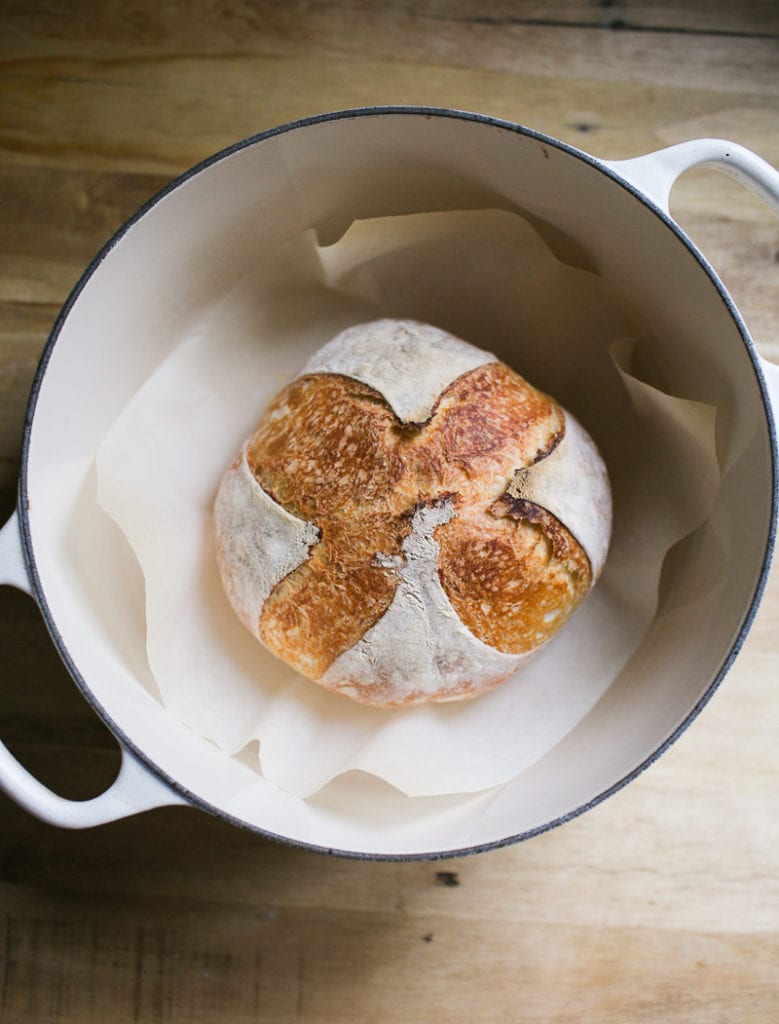
Bakers all over the world choose bread flour to create exceptional sourdough bread at home. It’s prized for its high protein and gluten content, which helps to create a lofty-high rise. But what if you don’t have any bread flour? Can you make light, airy artisan sourdough with all purpose flour instead?
In this post, you’ll find a clear, step-by-step guide to mastering sourdough with all purpose (or plain) flour with a few key adjustments. You’ll gain the tools and confidence you need to bake delicious bread every time.
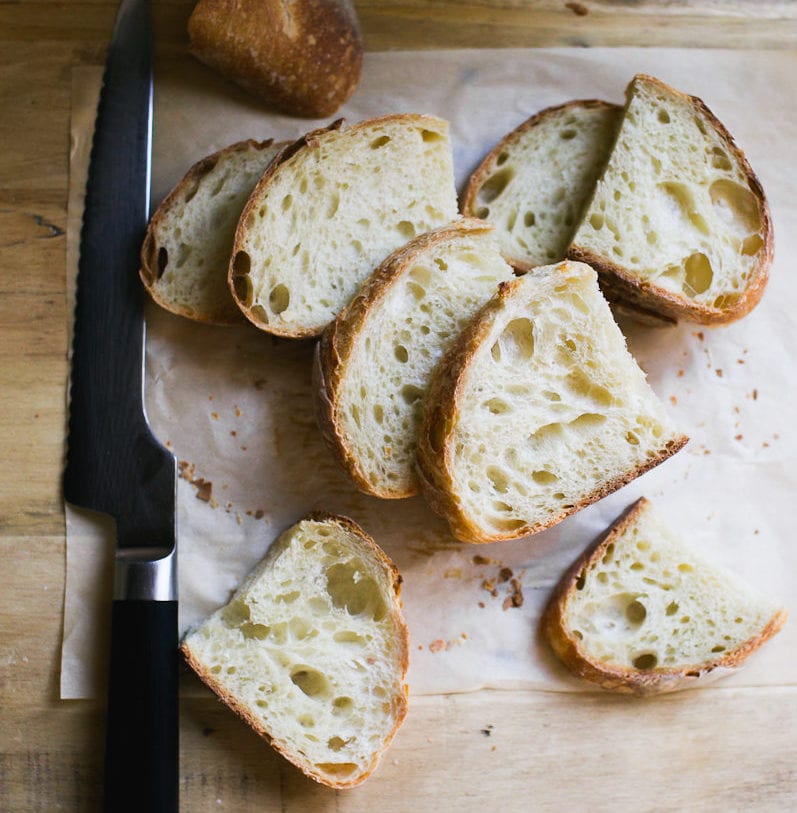
All-Purpose Flour vs. Bread Flour: Key Differences
It all boils down to protein content. Bread flour has a higher protein content than all purpose flour, which affects gluten development and the bread’s rise.
I typically use King Arthur flour for bread baking. Their bread flour contains 12.7% protein, and their all purpose flour contains 11.7%. This recipe was formulated to work with King Arthur and Trader Joe’s all purpose flours, which are comparable. (learn more about choosing flour in this post).
Tip: Protein content varies between brands, so stick to one brand first to understand how it behaves. It will be your reference point for future adjustments as you continue to bake.
How to Use All Purpose Flour in Bread Baking
Swapping all-purpose flour for bread flour is not always an even exchange. Because all-purpose flour absorbs less water, you’ll need to reduce the total water in your dough to avoid stickiness. Too much water makes the dough hard to handle, which can cause flat, dense, or gummy bread- you don’t want that.
Ok, So Reduce the Water by How Much?
I typically suggest reducing the water by 15-30g to start. The range depends on the specific sourdough recipe, the amount of sourdough starter, and the flour brand you use.
You’ll have to play around with the texture of the dough, adjusting the flour/water as needed until it “feels right,” which can be frustrating if you lack experience. But stick with it: success requires practice, patience and persistence. For now, let’s focus on visual and tactile cues to guide you through the process.
How to Make Artisan Sourdough Bread with All Purpose Flour {Step-By-Step Recipe}
Step 1: Mix the Dough
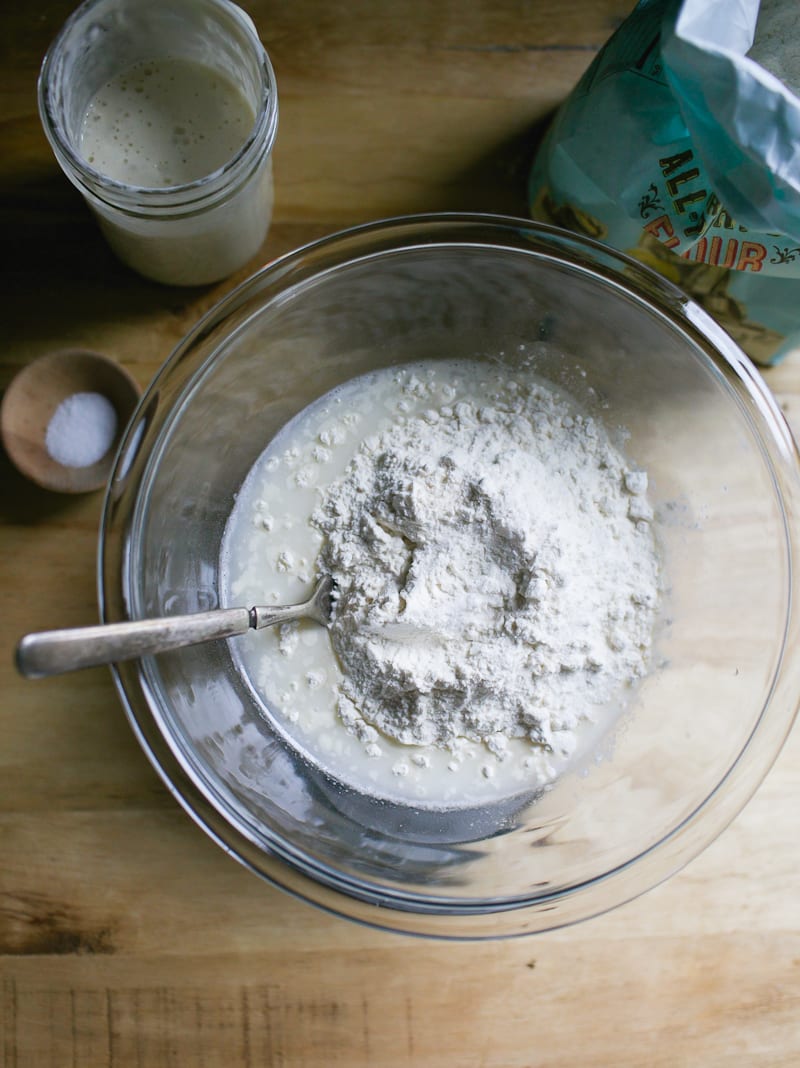
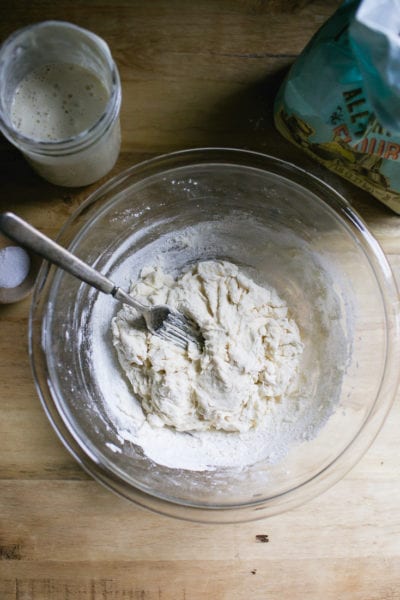
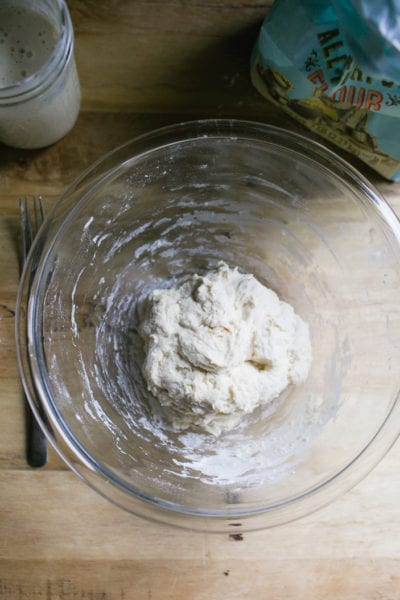
- In a large bowl, whisk your bubbly starter and water together. Add the flour and salt, then mix with a fork until combined. When the dough becomes too stiff to mix with a fork, switch to your hands and knead gently until a rough, shaggy dough forms. This texture is what you’re looking for: slightly sticky but holding together (see images above). Now, cover the bowl with a damp towel or plastic wrap and let rest at room temperature for 30 minutes.
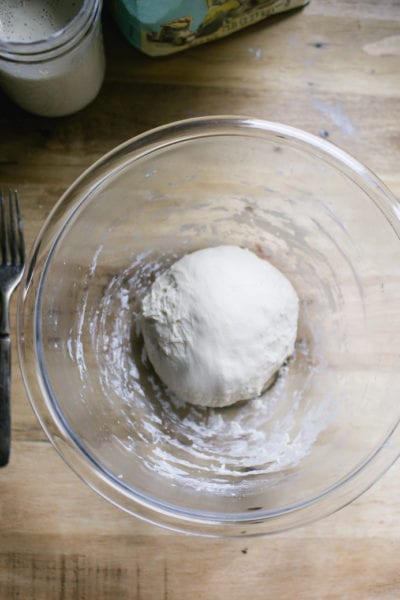
- After the dough has rested, work it into a ball. The surface will appear mostly smooth with a few tears. This is your last chance to adjust the dough’s texture before the bulk rise, so pay attention to how it feels. The dough should be soft and stretchy- not wet, overly sticky, or soupy.
A Few Notes: This recipe makes a small sourdough loaf, ideal for 2–4 people. Smaller loaves are easier to handle, especially if you’re new to sourdough baking. Instructions for a larger loaf are at the end of this post. For best results, you’ll want a digital kitchen scale to measure ingredients accurately, and a Dutch oven (or similar lidded oven-safe pot) for baking. You can find these tools in my shop.
Ste 2: Bulk Rise
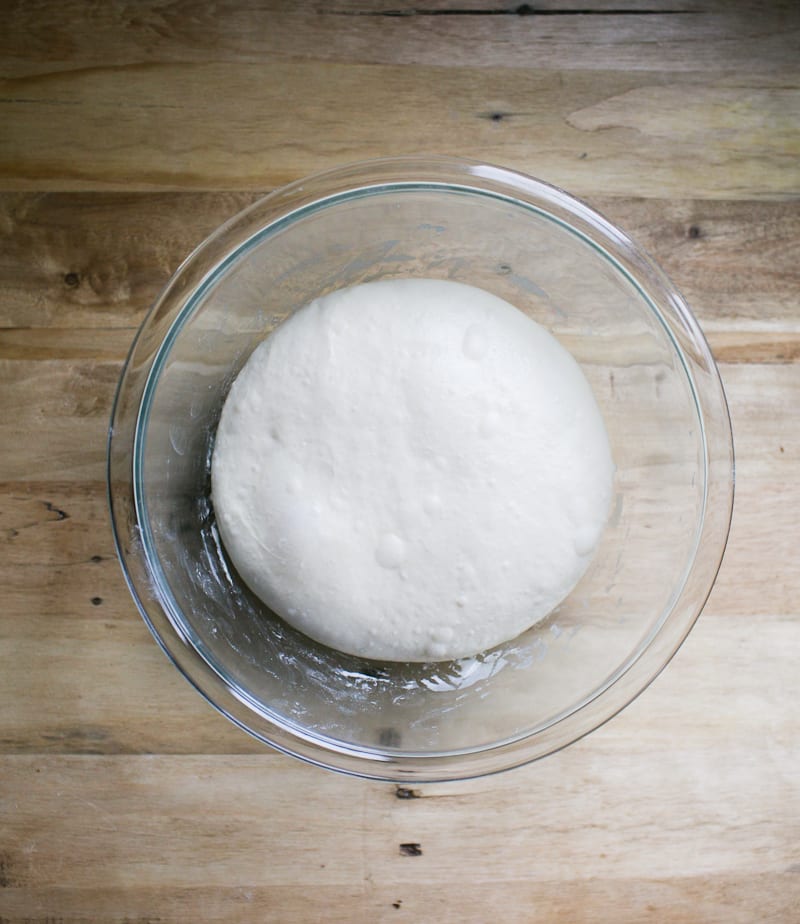
Cover the bowl and let rise overnight, about 10-12 hrs. at room temperature (68 F). The dough is ready when it has doubled in size and looks light and airy. If you’re using a standard 8-inch mixing bowl, the dough should rise to about halfway or two-thirds up the sides, which is perfect for this small loaf.
Optional: Stretch and Fold
This step, done during the bulk rise, helps to strengthen the gluten, improve structure, and give your loaf more height. Watch the video below for additional guidance. Or read the full tutorial: How to Stretch and Fold Sourdough, step-by-step.
About 30 minutes into the rise, perform your first stretch and fold:
- Gently grab one side of the dough, stretch it upward, then fold it over toward the center.
- Rotate the bowl a quarter turn and repeat.
- Continue until you’ve completed four folds (one full set).
- Repeat once more, 30 to 60 minutes later.
Step 3: Shape The Dough
- Line a small bowl with a cotton or linen cloth. Sprinkle generously with flour. Now, you’ll shape the dough twice: first to preshape it, then to build strength and structure.
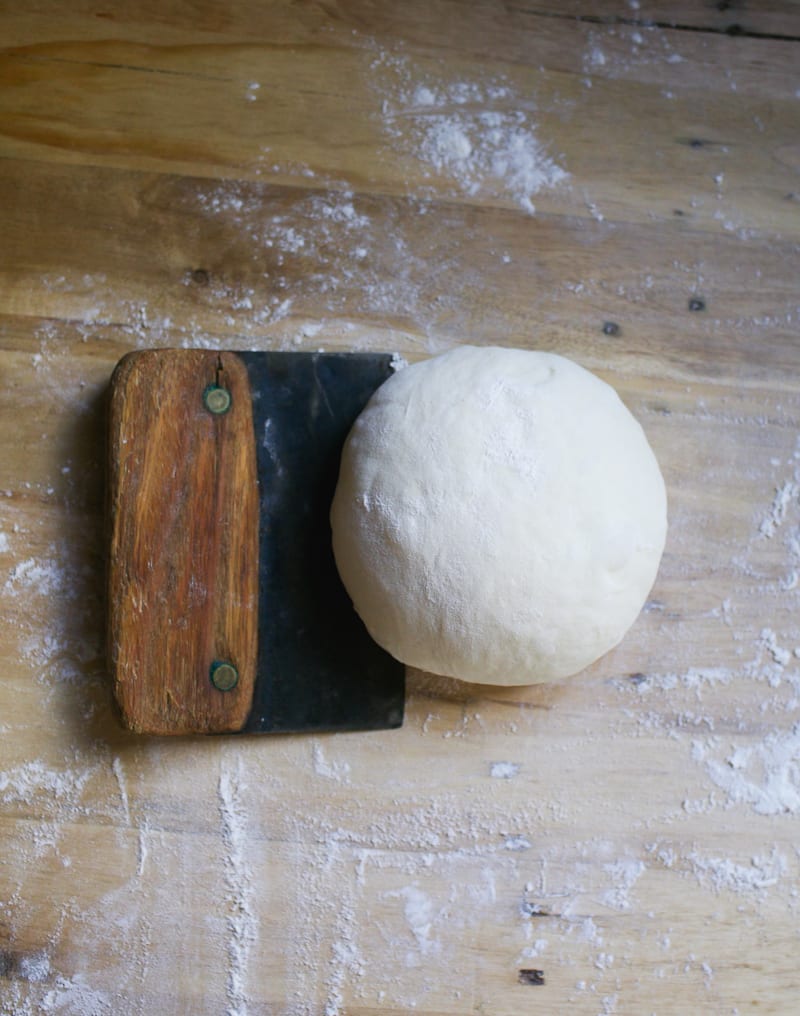
- Preshape: Remove the dough onto a floured surface. Gently fold the top edge of the dough toward the center. Turn it slightly and repeat, working in a circle until the dough forms a round. Use a bench knife to flip the dough over (smooth side up), then cover and let rest for 20–30 minutes.
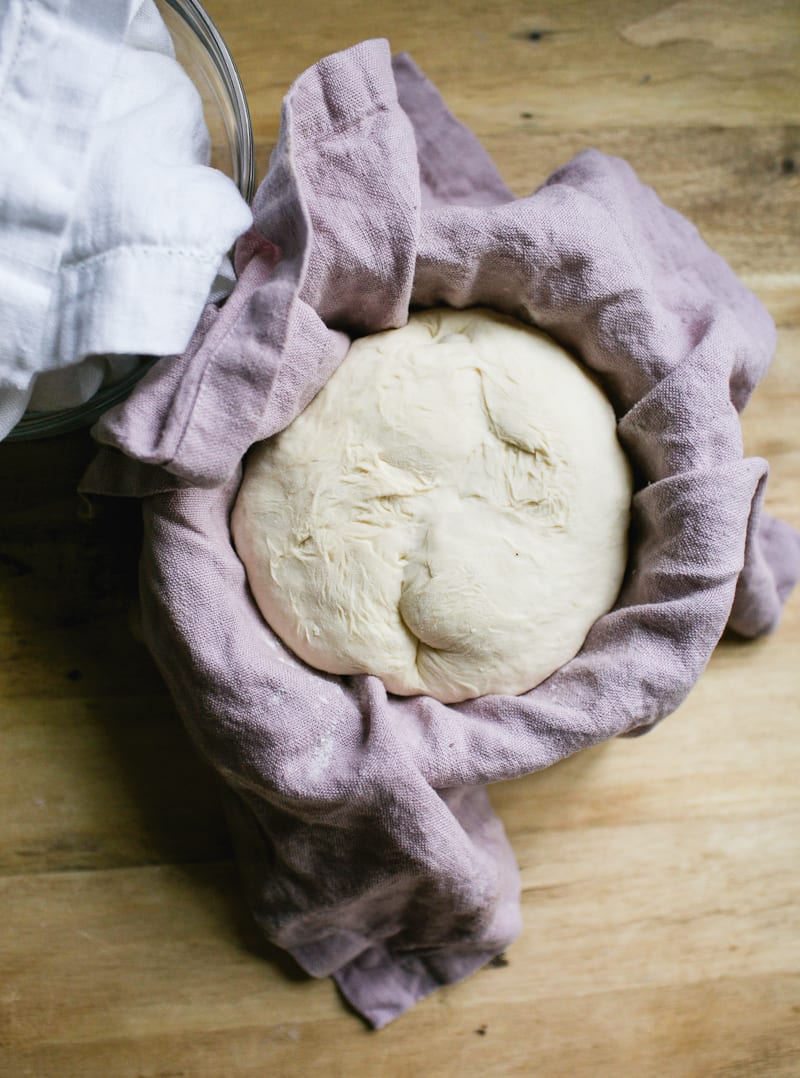
- Final Shape: After resting, flip the dough again so the smooth side is facing down. Repeat the folding process to form a tight round. Then flip it back over. With floured hands, gently pull the dough toward you in a circular motion to tighten the shape. Place the dough into the lined bowl, seam side up. Cover the dough with the cloth overhang.
Step 4: Second Rise
Let the dough rest at room temperature for 30 minutes to 1 hour. It’s ready when it looks plump and slightly puffed—it won’t double in size during this stage. While the dough is rising, preheat your oven to 450°F.
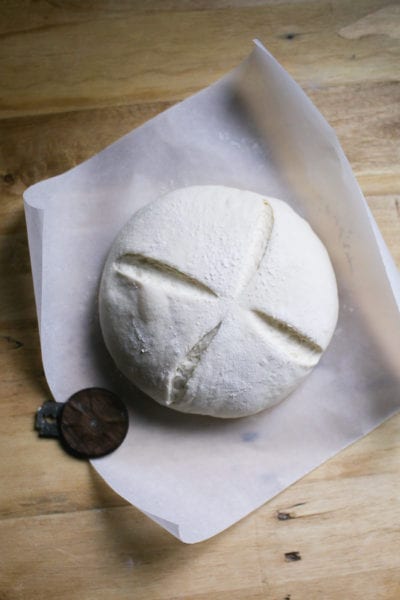
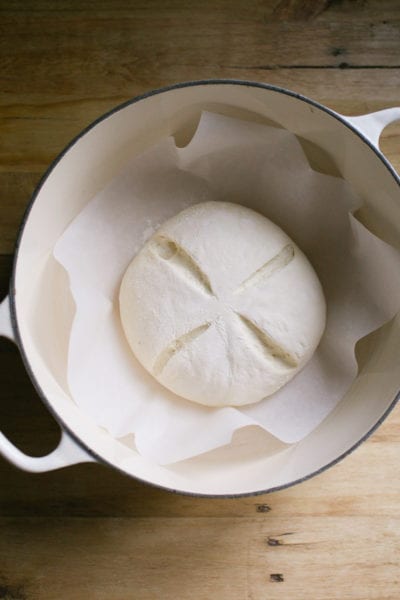
Step 5: Score The Dough
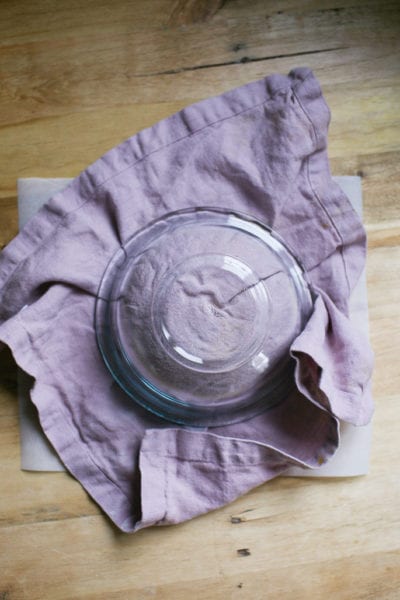
- Invert the bowl of dough onto a sheet of parchment paper. Remove the bowl and cloth.
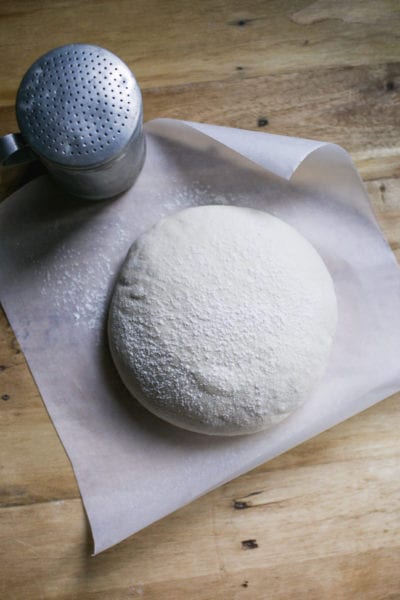
- Sprinkle the dough with flour and smooth the surface with your hands.
- Using a bread lame or a small serrated knife (I used my UFO lame), make four, quick, shallow cuts at 12, 3, 6 and 9 o’clock, turning the parchment paper as you go. Use the tip of the blade as a guide.
- Lift the dough (still on the parchment) and carefully place it into your Dutch oven. Cover with the lid.
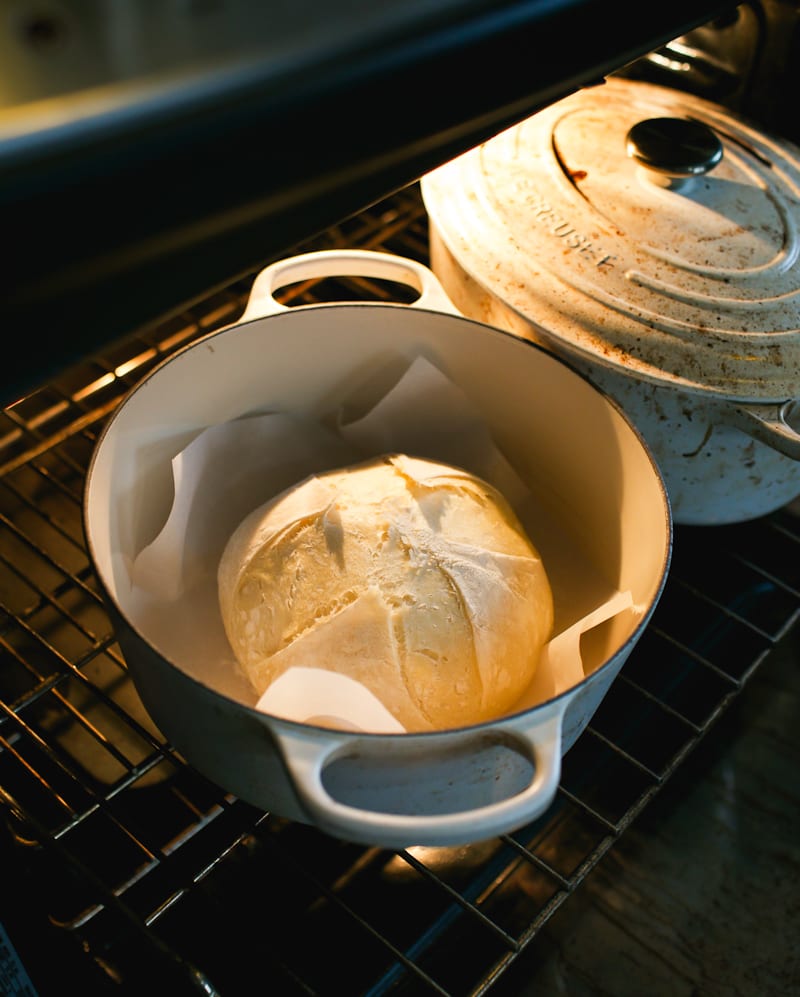
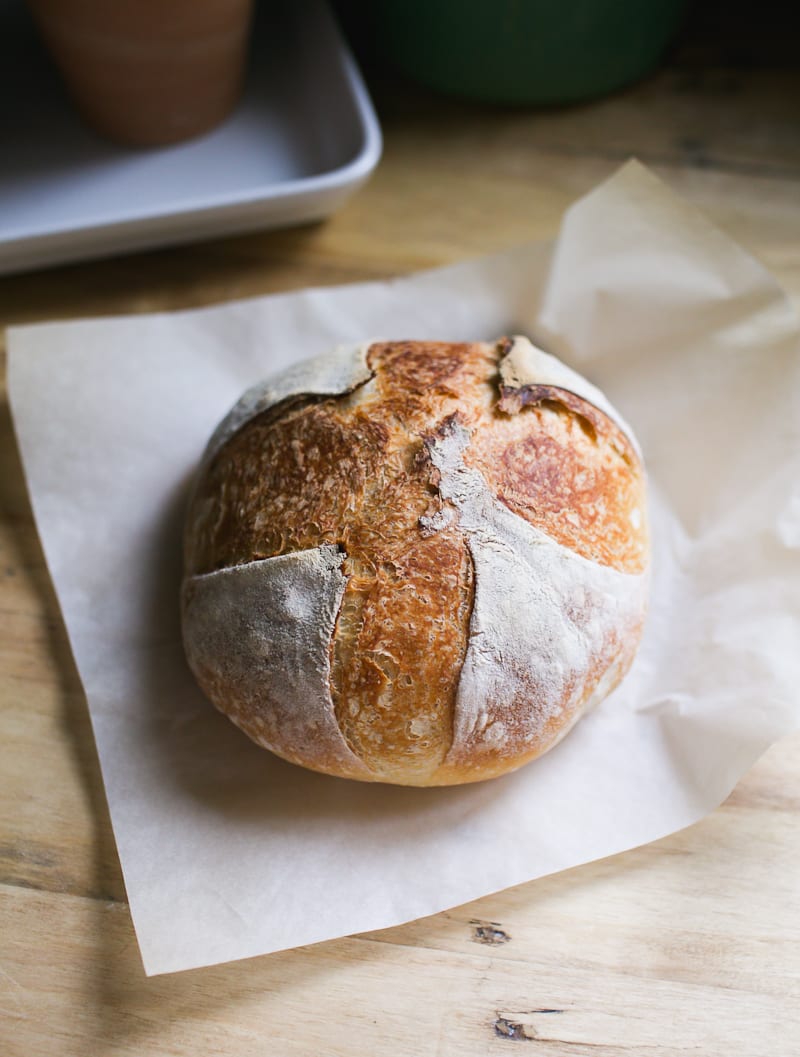
Step 6: Bake The Bread
Place the Dutch oven into the preheated oven, center rack. Reduce the temperature to 425 F. Bake covered for 20 minutes. Then, remove the lid and continue baking for 30–35 minutes, or until the crust is deep golden brown. Cool on a wire rack for 1 hour before slicing.
Sourdough Bread Baking Schedule
Here’s a flexible overnight schedule that works well in most home kitchens (around 68°F). If your kitchen runs warmer, simply start a bit later to prevent over proofing the dough.
The Night Before
7:00 PM – Mix the dough and let rest (30 min)
8:00 PM – First stretch and fold (optional)
9:00 PM – Second stretch and fold (optional)
Cover the bowl and let the dough rise at room temperature (10–12 hours)
The Following Morning
7:00 AM – Check the dough (it should be doubled in size)
7:05 AM – Preshape
7:30 AM – Final shape
7:35 AM – Begin second rise + preheat oven
8:05 AM – Bake
By signing up, you agree to receive emails from The Clever Carrot. Unsubscribe at any time.
Artisan Sourdough Bread Recipe with All Purpose Flour
- Cook Time: 50 minutes
- Total Time: 50 minutes
- Yield: 1 small loaf (2–4 ppl) 1x
- Category: Sourdough Bread
- Method: Oven-Baked
- Cuisine: American
- Diet: Vegetarian
Description
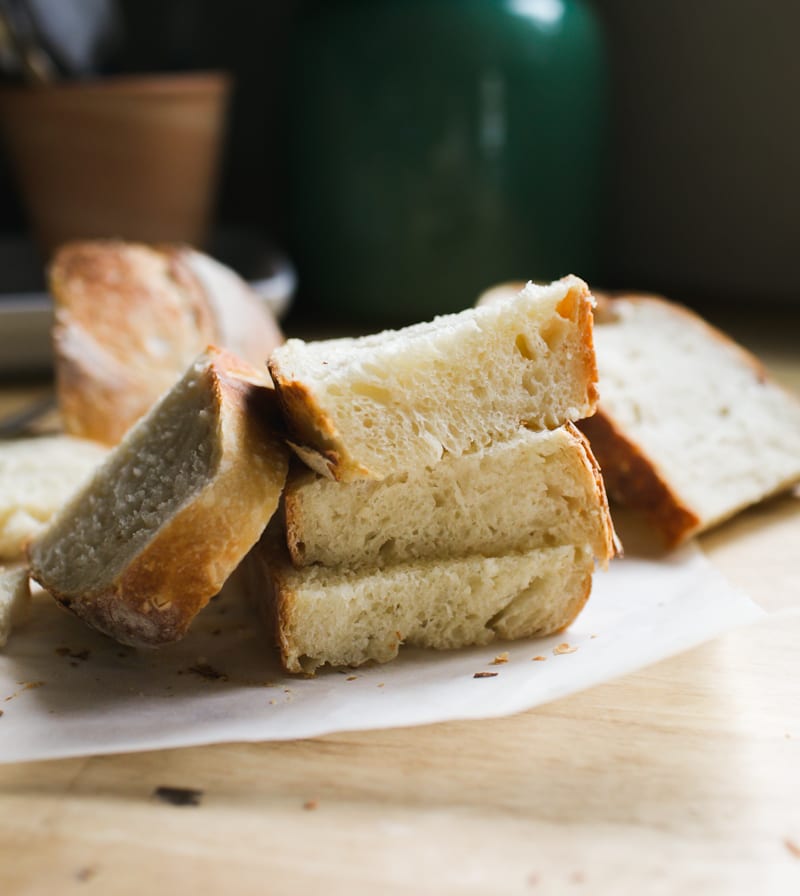
No bread flour? No problem! My artisan sourdough bread recipe with all purpose flour is an excellent substitute. This recipe yields a smaller sized loaf (perfect for up to 4 people) with a crisp crust and a smooth, interior crumb.
Notes & Substitutions
This recipe was formulated to work with King Arthur & Trader Joe’s all purpose flour, which contains 11.7% protein. If using another brand, please see my tip in the recipe below for adjusting the texture of the dough, if needed.
For accuracy and best results: please weigh your ingredients using a kitchen scale.
Ingredients
For a small loaf:
- 50 g (1/4 cup) bubbly, active sourdough starter
- 165 g (1/2 cup + 3 tbsp) water
- 5 g (1 tsp) fine sea salt
- 250 g (2 cups + 1 tbsp) all purpose flour (Trader Joe or King Arthur)
For a larger, standard size loaf:
- 50 g (1/4 cup) bubbly, active sourdough starter*
- 330 g (1 1/3 cup + 1 tbsp) water
- 9 g (1 1/2 tsp) fine sea salt
- 500 g (4 1/4 cups) all purpose flour (Trader Joe or King Arthur)
*Note: I use 50 g of starter for both the small AND standard size loaf. Using a smaller amount of starter with an long, overnight rise will help to prevent over proofed dough in the morning.
Instructions
Make the Dough
In the evening, whisk the starter and water together in a large bowl. Add the flour and salt. Mix with a fork until a stiff dough forms, then finish by hand to fully incorporate the flour. It will feel rough and shaggy, and slightly sticky. Cover with a damp towel or plastic wrap and let rest at room temperature (68 F) for 30 minutes.
After the dough has rested, work the dough into a ball. To do this, grab a portion of the dough and fold it over, pressing your fingertips into the center. Repeat, working your way around the dough until it begins to tighten.
TIP: If the dough feels too wet (and this can happen depending on the brand of flour you’re using), add 1 tbsp. of flour. Mix thoroughly by hand, adding more flour as needed. If you think it’s too dry, add 1 tbsp. of water and see how you go.
Bulk Rise
Cover the bowl (damp towel or plastic wrap) and let rise overnight at room temperature. This will take about 10 to 12 hours at 68 F. The dough is ready when it no longer looks dense and has doubled in size. If using a standard 8-inch bowl, the dough will rise about 1/2 way up the sides.
Optional Step: about 1 hour into the bulk rise, do 1 set of stretch and folds. Repeat 1 hour later. This will increase the overall volume of the bread.
Shape the Dough
The following morning, line a small bowl with a cotton or linen cloth. Sprinkle with flour.
Important: You’re going to shape the dough twice to build extra strength.
Preshape
Remove the dough onto a floured surface. To shape the dough into a round, starting at the top, gently fold the dough over toward the center. Give it a turn and fold over the next section. Repeat until you have come full circle. Using a bench knife, scoop up the dough and flip it over (the smooth side should be facing up). Cover and rest for 20-30 minutes.
Final Shape
After the dough has rested, flip it over again (the smooth side should be facing down now). Shape it again following the steps above. Flip it back over. With floured hands, gently cup the dough and pull it toward you in a circular motion to tighten its shape.
Place the dough into the lined bowl, seam side up. Cover the dough with the cloth overhang.
Second Rise
The dough needs to rise again. Rest for 30 minutes to 1 hour. The dough is ready when it looks puffy and has risen slightly, but has not yet doubled in size.
Preheat your oven to 450. Cut a sheet of non-stick parchment paper to fit the size of your baking pot, leaving enough excess around the sides to remove the bread.
Score the Dough
Place the parchment over the dough and invert the bowl to release. Sprinkle the dough with flour and gently rub the surface with your hands. Using the tip of a bread lame, small, serrated knife or a razor blade, make four shallow 4-inch long cuts at 3, 6, 9, and 12 o’clock around the dough. Use the parchment paper to transfer the dough to the baking pot.
Bake the Dough
Reduce the heat to 425 F. Bake the dough on the center rack for 20 minutes, covered. Remove the lid, and continue to bake for 30-35 minutes and golden brown (40 minutes uncovered for the larger, standard loaf).
When finished, transfer to a wire rack. Cool for 1 hour before slicing, for best texture.
Notes
Sourdough is best consumed on the same day it is baked. To maximize freshness, cool completely and store at room temperature wrapped in plastic, reusable beeswax wrap or bread bag for 1-2 days. Sourdough can also be frozen, for up to 2-3 months. Defrost at room temperature and warm @ 300 F before serving.

Comments
Samantha says
Curious, why no cold proof? Would it be ok to add a cold proof to this recipe?
Lucy Wilson says
I’m wondering this too.
CLEM says
I put mine in the fridge overnight after the first shape, baked it first thing in the morning (no final shape). Turned out great!!
Debbie M says
Such an easy recipe to follow, especially for beginners like me! Ive been diagnosed with Type 2 diabetes and am just wondering how many carbs are in this?
MH says
In the small loaf recipe there are 250g of flour used + 50g sourdough starter. 1g flour = 1g carb. So, roughly 300g carbs per loaf and 1200 total calories per loaf (1g carbohydrate = 4 calories).
Debbie says
Thank you!
Deb says
Absolutely delicious. Excellent crust, chew, and flavor! This was my first go at sourdough bread and it couldn’t have worked out better. Thanks for the great recipe and information on sourdough!
Shannon says
This has been my favorite sourdough loaf recipe thus far! I’ve found that I get a better ear if I pull out of oven after 10 mins and re-slice the slit with my lame. It helps it open up more.
Rachel says
Awesome recipe! It was very easy to follow and a great starting place as I begin my sourdough journey! Thanks for the great tips :)
Glenda says
Can you use this recipe in a bread machine?
Lara Muñoz Pérez says
Love the recipe! It looks very pretty, but my dough was very sticky and the sides cracked during baking. What am I doing wrong? Only just joined the bread baking community.
Gwen says
Did you cut the top of the loaf? If not it will make its own cracks while it rises
Levi says
I love this recipe!! Wondering if I make large bulk batches if I would just double, triple, quadruple, etc all ingredients equally? (Looking to some small farmer markets)
Emilie Raffa says
Hi Levi! Yes, you can do that. If you have a large dough tub (with lid) you can do a double batch in there. That’s what I do. Alternatively, use separate bowls.
Jess says
This is a wonderful, well-written, easy to follow recipe for amazing bread. I’m so glad I found it!
Laura says
Made this for the first time last weekend and it came out perfectly. Great instructions, Emilie, thank you! I’d like to ferment overnight in the fridge. It am not sure how long to do that in order to avoid over-fermenting which I read can easily happen. Success tips, anyone, please.
Jaime says
I discovered your site over a year ago. I have made numerous loaves since then. Each time, perfecting my starter, my methods, timing, & each loaf keeps getting better. I made 3 loaves last week, we’ve eaten 1.5 & I sent the other over to my mom (who shared with friends). I’ll be making 2 more this weekend. I have learned a lot from your site & most importantly, I’ve learned the science behind this amazing bread! Thank you so much!!
Carolyn says
This recipe sounds great using All Purpose Flour, I also read your recipe for light whole wheat flour. I’m wondering if it would work using a small portion of whole wheat flour with the AP flour and continue following the AP flour directions. Thank you
Jaime says
I usually make 3 loaves a weekend. One will be 400g APF & 100G whole wheat flour. They come out amazing.
Carolyn says
What size Dutch oven should the smaller loaf be baked in.
Can it also be baked on a baking stone, would it need a cover.
Kelly says
Just made this…turned out awesome! Used my InstantPot trivet underneath the loaf and bottom did not burn. Appreciate the tip 👍🏼. Will use this recipe again.
Amanda says
I used Robin Hood unbleached all purpose flour as I am unable to get the recommened flour where I am (Canada). It took a bit of testing, but finally after many tries determined that 4 cups of flour and an additional 1/2 cup water made an amazing sourdough. I even long fermented it for 18 hrs (going to try 24 next time) and the bread was unbelievably good! Thank you!
Eliana says
When you did the king ferment, was that in the fridge or at room temp?
Beverly says
First time baking sourdough bread and used this recipe only. Great results every time! Thanks for the step by step recipe!
Anastasiia dH says
What a fantastic recipe!
As an absolute sourdough beginner few months ago, I created my own starter (following your recipe) and have been using your bread recipe ever since!
It only took me a few attempts and adjustments to have a set routine and a perfect sourdough bread every time!
Today I going try out your sourdough focaccia recipe, and I am so excited!
Meghan says
Your blog has been so helpful throughout my almost 2 years of baking sourdough (and cookies and waffles and pancakes, etc). My friend shared your site with me, and now I share it with everyone who asks me about how to bake it! Thank you so much for sharing your wisdom – I genuinely appreciate your hard work!
Bev says
First time making starter and bread! Turned out delicious. Thanks for the recipe and the instructions
Jessie says
Hello,
My family and I absolutely love this recipe. I appreciate that I don’t have to purchase bread flour to have amazing homemade bread.
Any chance anyone knows how to use this recipe with an all purpose gluten free flour? My 5 year old was just diagnosed with Type 1 diabetes and tested positive for celiac disease. We’re not to take her off all gluten so I was thinking of using my good homemade starter and a combination of all purpose and gluten free. Obviously I would then work a slice into her allotted carbs. I feel like I’m asking for a miracle though.
She’s been through so much and during our four day stay in the hospital she said she missed my bread. So now I’m on a mission. Any information is appreciated.
Amanda says
If you long ferment bread it significantly reduces gluten (if not eliminates it!). You just put the final dough in the fridge for up to 72 hours before baking. I’m no pro (ha!), so perhaps ask Google to confirm. I have long-fermented this recipe for 24 hours and it was amazing. I have severe eczema and cannot have gluten and my skin did not react. Next time I am going to try fermenting a bit longer (48hrs!).
Jessie says
My husband is gluten intolerant, not an allergy or celiac, and doing a long ferment (48 hrs) on a loaf enables him to eat a slice each day with very few/no symptoms. Hope you find something that works!
Wendy says
I love this recipe, it turns out great and is so tasty! The last few times I’ve made it, it looks fabulous when I take it out of the oven but when it cools there are air bubbles between the crust and the bread. What am I doing wrong? Thank you so much!
Karli Thompson says
This is my absolute favorite! I use this recipe and follow another person’s directions for proofing and baking in my instapot! So so delicious! Currently making 3 extra loaves to share with my family!
Emilie Raffa says
Karli, that sounds so cool. I’ve never baked bread in an instapot. So glad it worked!
Annie says
This recipe is delicious, super easy even for a first-time sourdough baker like me, and very forgiving. The first time I made it, I followed the instructions exactly and it came out perfectly. The second time, I got interrupted and ended up storing it for hours in the refrigerator between rises and then again overnight before baking. Of my two small breads, one ended up baking covered for too long and then I had to guess at the uncovered baking time. Everything was still pretty perfect and delicious. This is going to be a go-to for me to have fresh bread around all the time, at least until I finish a huge bag of AP flour and move on to other things.
Alison says
Hi! I was looking for a comment about baking in the evening. Do you put the dough in the fridge so that it doesn’t overproof or is it fine on the counter all day? Thanks!
Annie says
When I knew I was going to be delayed by hours during the later phases (second rise, after final shaping, etc.) I put it in the fridge to avoid overproofing, with great results. However, this recipe calls for a bulk rise for 10 to 12 hours. So you could definitely feed the starter at night, mix the dough in the morning, bulk rise on the counter all day, and then do the final steps and bake in the evening, no refrigeration needed. In other words, one long, room-temperature rise is part of the recipe. I put it in the fridge to avoid a second and third long rise later in the process. Hope that makes sense!
Alison says
Thank you so much! I appreciate your response!☺️
Alesha Daniels says
If using King Arthur bread flour how many gram or flour & water would it be?
Elizabeth says
This is the recipe I use almost exclusively. It is so good and so easy and the weights are perfect! Love it so much I purchased the cookbook and have found the recipes in the cookbook just as great! I usually feed my starter at night, form the dough in the morning before work, and bake in the evening. Perfect for someone who works outside the home. Thank you!
Judy says
Can the loaf be baked on a baking sheet? I don’t have a dutch oven.
Rachel Busby says
Hi! I have successfully made this once and it turned out great! I am working on doubling the recipe tonight. Question, should my hands be covered in dough after the initial mixing of the flour and water/sourdough? They have been both times.
Elle says
My first batch of starter was on the stove and I ran the broiler and didn’t realize it would get so hot it would kill it! Eeek! Burnt and horrid. Lesson learned. So I had to wait a second week to try this. Fast forward to week two, new starter. I made this recipe followed to a T. But it’s so cold and dry here the top of the dough became hard after the 18 hr rise (it didn’t rise after 10 or 12 hrs!) (it’s -2 and the house just can’t a get warm!) I wasn’t going to waste it so I folded it in and hoped. Then for the second fold I did the same. And prayed.
Omg it worked and seriously this is the best bread I’ve ever made! I’ve done the artisan in 5 min bread for years. My ex-SO made real hard core multi grain specially ground flour sourdough all the time. Not as good as this recipe. Truly! Wowowow! Even my pup went crazy for a slice. Thank you! So nice to have a sweet tiny loaf for one person too! Though if I wasn’t gorging on it maybe it would be a good size for 2-3!
Una says
I had always wanted to make my own sourdough starter and was delighted to find the clever carrot! I am a rookie baker and have been using this recipe for about 8 weeks now resulting in delicious bread! However, my last two loaves have had a 1-1.5 inch gap between the bread and the crust once I slice into it 😭 I don’t know what I’m doing wrong as I haven’t changed my technique or oven temperature etc. I’m wondering if it’s an issue with the starter?! I really don’t know! Any tips from experienced bakers? Thank you
Sherry says
Sounds like it could have been overproofed! Sourdough doesn’t need to fully double in size during bulk fermentation. Increasing by 1/2 or 2/3 is generally enough. Try that and see if it helps!
Shanelle says
Hi there- after many failed attempts at various artisan bread recipes, this one was a huge success!! YAY! Thanks! Everything I make of yours turns out. One question, I was hoping the bread would be more “sour”–it was a little tasteless in my opinon, anyways to help the sour flavor along? (I followed all directions EXACTLY).
Molly says
After shaping the dough you can put it in the fridge to proof/develop flavor overnight. Make the dough and bulk rise during the day
Zenia says
Love this so much that I’m making multiple loaves! Quick question- I only have one Dutch oven. Can I bake the second loaf at the same time uncovered OR do you think it will be ok waiting until the first loaf is done to be baked? Thanks!
Annie says
This recipe is very forgiving, you can definitely just bake in your dutch oven one at a time. That’s what I did yesterday and it was totally fine. I think that baking covered in the dutch oven provides a period of increased steam so that the bread gets to rise more before starting to form a crust, so you get a bigger loaf. If you bake uncovered you might get a slightly less risen loaf (though I bet it would still be good).
Becky says
I love this recipe! It makes the best easy bread! What size bowl do you suggest when making the double loaf, for the final shape?
Erin says
This recipe is lights out the BEST! First timer here. Followed the steps exactly and it came out perfectly. My daughter said it’s the best bread EVER and I agree. Thank you!
Joyce says
Just made this and it was beautiful! The flavor is incredible and well balanced. My only issue was that my dough didn’t rise that much, so my sourdough was really flat. I’m trying to troubleshoot what went wrong, but I followed all the steps. My house temperature was 70 degrees and my starter passed the float test. My dough was initially on the stickier/wetter side so I added a tablespoon of flour and that helped. Any idea what I could’ve done wrong?
Jamae Lacey says
Did you make the large loaf or the small loaf? I find with the large loaf it takes foreverrrr to rise, so I usually do 100g starter and it rises more routinely.
Joyce says
I made the small loaf and it was tiny because it didn’t rise properly. But it still tasted good!
Jamae Lacey says
Did you do the stretch and folds? That increases the overall volume. Did you let it proof too long? Maximum should be doubled in size, a little bit under double is ideal. Did you shape it really tightly before putting it in the oven? It should be darn near a perfect circle before scoring. I hope this helps!!
Elizabeth says
Thank you! I’ve tried numerous recipes and this one is by far the easiest and best. Came out beautiful! Thank you for using the word “optional “ on the stretch and fold. I didn’t do it and no problem! I reversed the schedule and formed my dough before leaving for work in the am and baked in the evening. Used my instant pot trivet in Dutch oven to prevent burning as one reviewer suggested. Beautiful rounded bottom and high oven spring. Thank you for not making me heat the oven for an hour and for not requiring preheat of the Dutch oven. This recipe makes sourdough bread on a weekday SO easy. I will be getting your cookbook.
Amanda says
HI! super new and cant wait to dive in with all your info/recipes! I looking to use this recipe but would like to make two loafs so would I just double the recipe and then divide the dough? And secondly if thats the case but I only have one vessel to bake in, what point do I put the second loaf in the fridge while it waits for its turn in the over, after the final shape, or after the second rise?? Thanks so much!
Emilie Raffa says
Hi Amanda! Yes: double the recipe and divide the dough after the bulk rise. For the 2nd dough, after the final shape, place it in the fridge for the second rise (in the meantime, your fist dough will be in the oven). Hope this makes sense!
Amanda Moulton says
It does! Thanks so much!!
Kiko says
Great recipe! For whatever reason, my bread turned out better with this recipe using bread flour compared to using bread flour with your other recipe made for bread flour. Either way, both recipes are new favorites at my home. Thank you!
Andrea says
This is such a great recipe… I’ve made it several times with all purpose and with bread flour. With the all purpose it is a little more playing with the texture to get it where you want it. Much easier with bread flour. There’s another site that talks all about sourdough and shows you the difference when you over proof or don’t knead enough or use too much water to show the results – what the crumb looks like and how the taste is different. Too sour – sourdough doesn’t mean you’ve done it right. It is an art so practice practice… it definitely gets easier. Weight measurements and getting a feel for what the dough should feel like will allow you to not stress so much during the process.
Yulia says
Hi Emilie. I have baked your bread 3 times and all the times it came out great. No issues whatsoever. I only have a question that confuses me the most. After I shaped my bread, why can’t I place the dough into the fridge for let’s say up to 36 hours for a cold proof? Some suggest that it can be in the fridge for that long to attain the sour flavor. I’m wondering if I can do it with your recipe. Maybe 12 hours or 24? Or is it not needed? Thank you.
Susan says
Can you use bread flour for this recipe?
Ann says
Thank you so much. 🌹
If I choose to start in the morning, after final shaping can I place in refrigerator and bake it the next day?
If so can it go directly into oven or does it need to sit out a bit before baking?
Tia.
Katie says
This makes the best sourdough bread I’ve ever tasted and it was pretty simple! Thank you
Sharon says
Can you send me the nutrition value and and how many grams. I need to know carbs in the calories. I made this recipe yesterday in my Dutch oven and it turned out fabulous thank you.
Dani says
What if you don’t have a dutch oven pot? Can you use another pot instead?
Jamie says
I made this using cups to measure the ingredients and then using a scale and weighted measurement. The weight measurement is highly superior, fluffier and a lighter crispy crust! Wonderful recipe.
Emilie Raffa says
Hi Jamie! Agreed. In bread baking, you’ll get better results when the ingredients are weighed, rather than measured. It’s more accurate. The flour to water ratio is incredibly important for best texture!
Erin says
Hello! Is the large loaf recipe easily doubled to make two large loaves at once? Would separate the dough into 2 loaves just before forming the dough in the morning. Wondering especially about the amount of starter that would be used for this.
Jackie says
My first time making sourdough. I thought it was going to be a disaster as my dough was sooo sticky in the morning after letting it rest, but i sprinkled rice flour on the surface. Then my toddler pulled the dough out of the tea towel and it looked deflated. I baked it anyway and it actually came our really good!! Very crunchy crust and the inside had nice air pockets, was moist ans delicious. I couldn’t slice much on the top as it was still extremely sticky. It’s a miracle it turned out. This is an excellent recipe and I can’t wait to play around with it abit next time.
Ed says
This is a wonderful recipe along with your instructions for making a sourdough starter. My first loaf was so so, the second pretty good and the third excellent. In between making bread I studied your YouTube along with that from proofbread an all sourdough bakery in Mesa, Az. Each time you watch you pick up a little more information. Little things like tips or techniques. This recipe produces great bread and I’m anxious to try and expand my use of sourdough. Thank you.
Ashley says
This is a great recipe. I have never made sourdough bread before, but it turned out great, and my family loved it. I will use it again.
Beth Rice says
I love this recipe and the simplicity of it. BUT, the bottom of my bread ALWAYS burns…how can I keep that from happening?
Tyler says
Hi Beth! I have had this problem as well. Someone previously asked this and Emilie replied with some tips:
This is actually extremely common. Could be your oven, could be the type of pot you’re using, could be the placement of the pot etc. To remedy this, first use an oven thermometer to determine the exact temp of your oven. Then, place a cookie sheet on the rack below your baking pot (not underneath it); this will shield the heat from the bottom up which should prevent a burnt crust.
LarV says
I put my Instant Pot wire trivet in the bottom of the Dutch oven and put the parchment and dough on top of that. Worked great! No more too-dark bottoms!
Elizabeth says
Thank you for this tip! I did this and it came out perfect!!
Hannah says
I’ve tried this recipe once already with moderate success, so I’m excited to try again and make it even better. I just got a starter a month ago so I’m still learning how to make a good sourdough.
What I like about this recipe is how comprehensive it is, as the step-by-step combined with the pictures make for a clear recipe. I like that a schedule is included, and there is a “long” recipe version and a “short” recipe version. I will be remaking today.