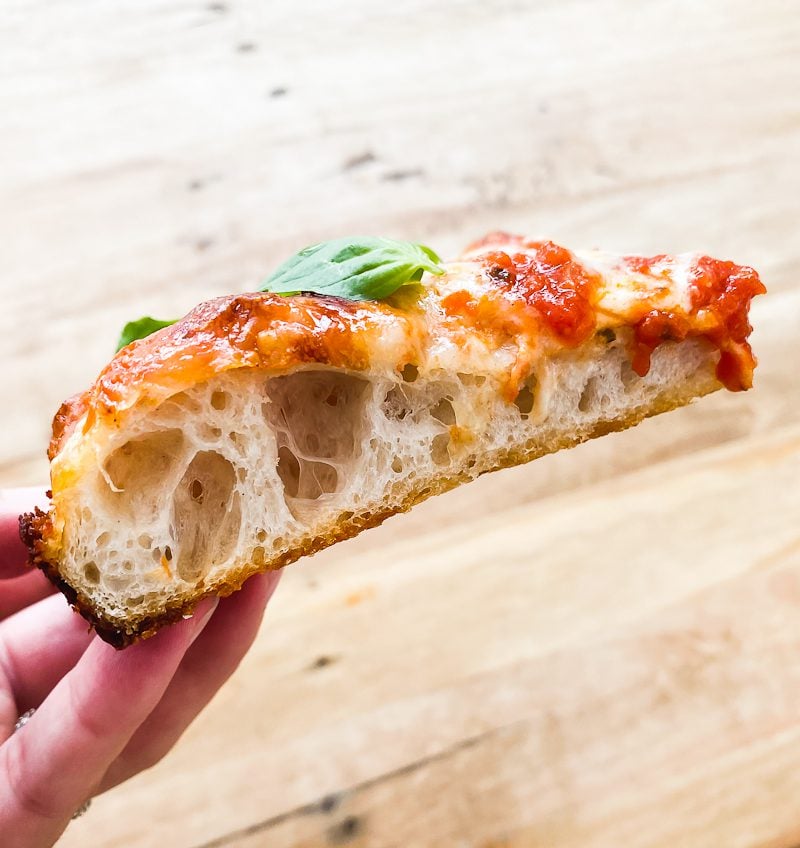
My sourdough pizza crust features a crisp, golden base and an open, airy crumb made with active sourdough starter. This easy pan-baked method includes par-baking tips, a 1-minute “no-cook” pizza sauce, and a step-by-step video to guide you.
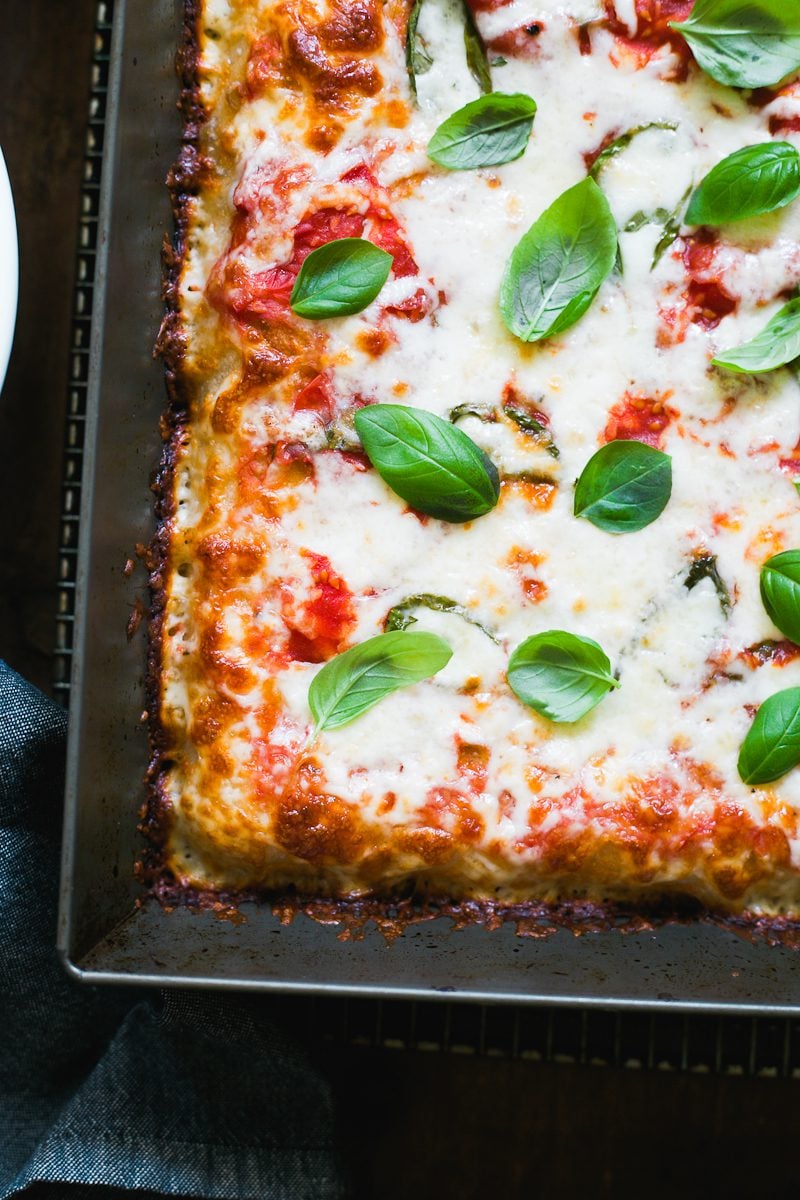
I used to think making sourdough pizza at home required a vault of professional tools – the steel, the stone, the peel! And while helpful for Neapolitan-style pizza, there’s a faster workaround if you’re starting from scratch.
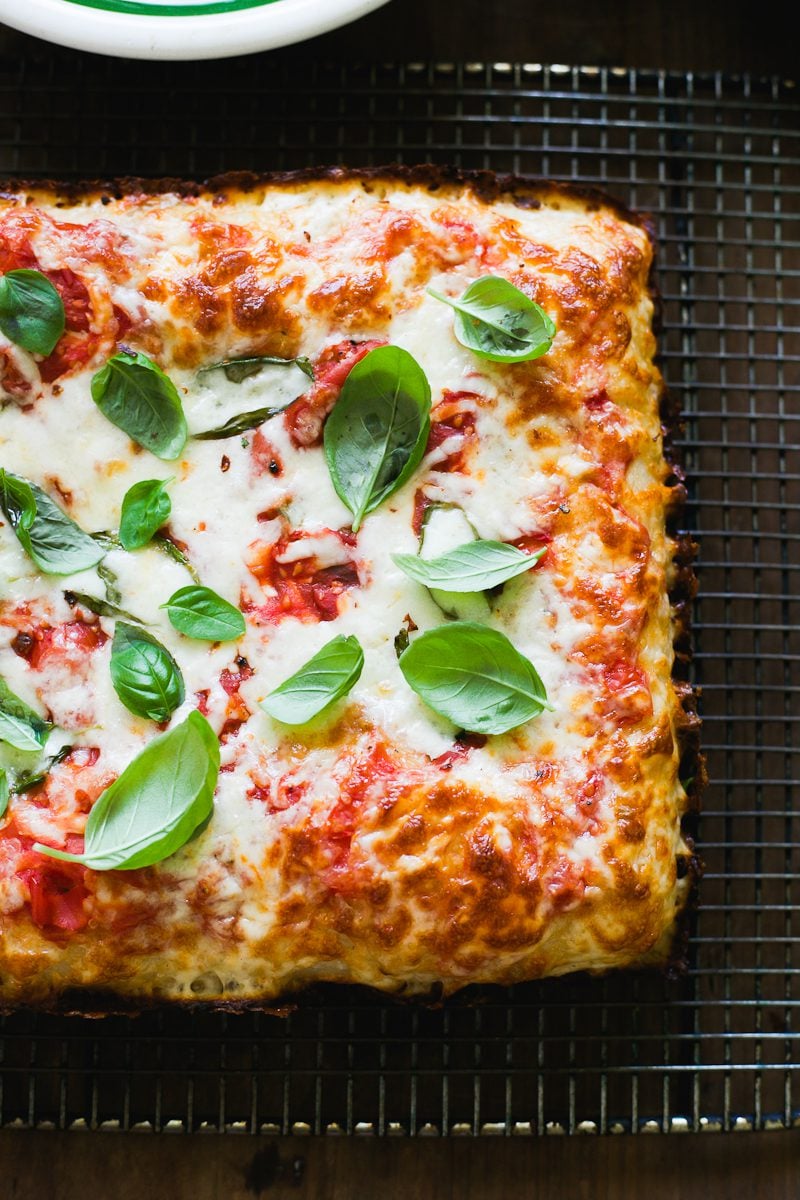
My pan-style sourdough pizza recipe is baked in a standard 9×13-inch pan you probably already own (think: sourdough brownies or lasagna). The results are spectacular: light and airy with crispy, cheesy edges the whole table will fight over!
The dough is adapted from my popular sourdough focaccia recipe in Artisan Sourdough Made Simple with a few tweaks for pizza: less flour for a thinner crust, bread flour for extra strength, and a new dimpling technique to even it out.
What To Expect
In this post, I’ll teach you how to make crispy, pan-style sourdough pizza, step-by-step with a video to guide you. You’ll have enough to feed 4–6 people.
I’ve also included 3 key points to elevate your game:
- A simple par-bake method so you can prep ahead
- A 1-minute no-cook pizza sauce that tastes like it simmered all day
- A flexible baking schedule to make sourdough pizza work on your time
How To Make Sourdough Pizza, Step-by-Step Recipe
Below you’ll find clear step-by-step instructions. For a printable version with measurements, scroll to the end of this post.
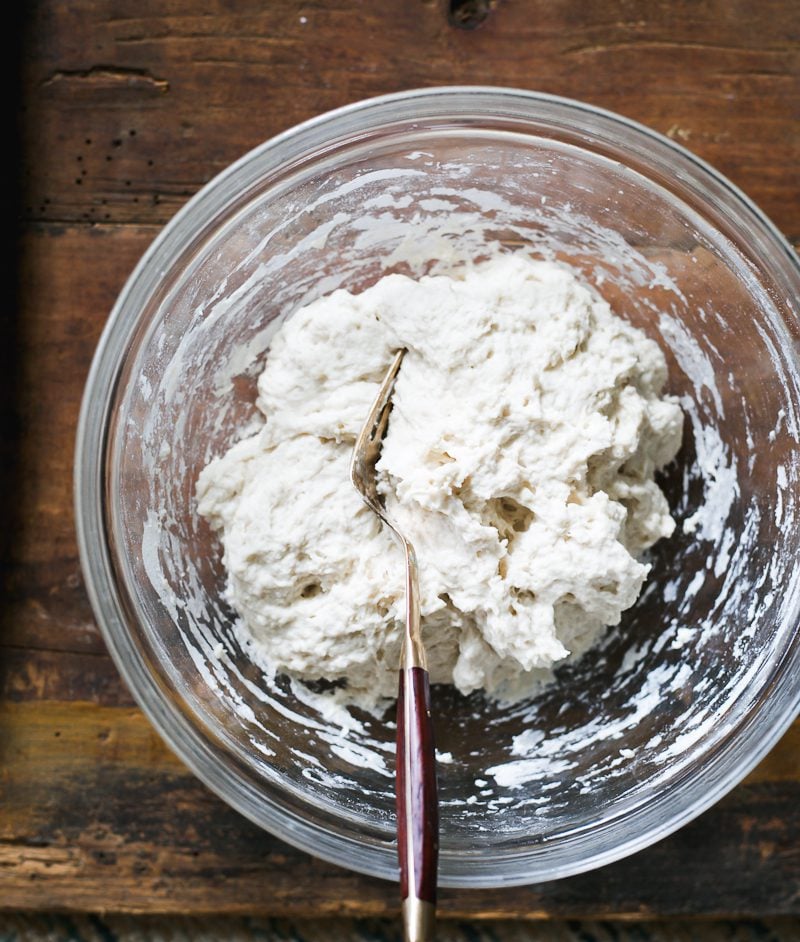
Step 1: Make The Dough
To start, combine the sourdough starter and water in a large mixing bowl. Add the flour and salt. Mix with a fork, and then finish by hand to fully incorporate the flour. Cover and let rest for 30 minutes at room temperature.
Then fold the dough over itself several times, similar to the stretch and fold method, to create a rough ball. The dough is now ready to rise!
Step 2: Bulk Rise
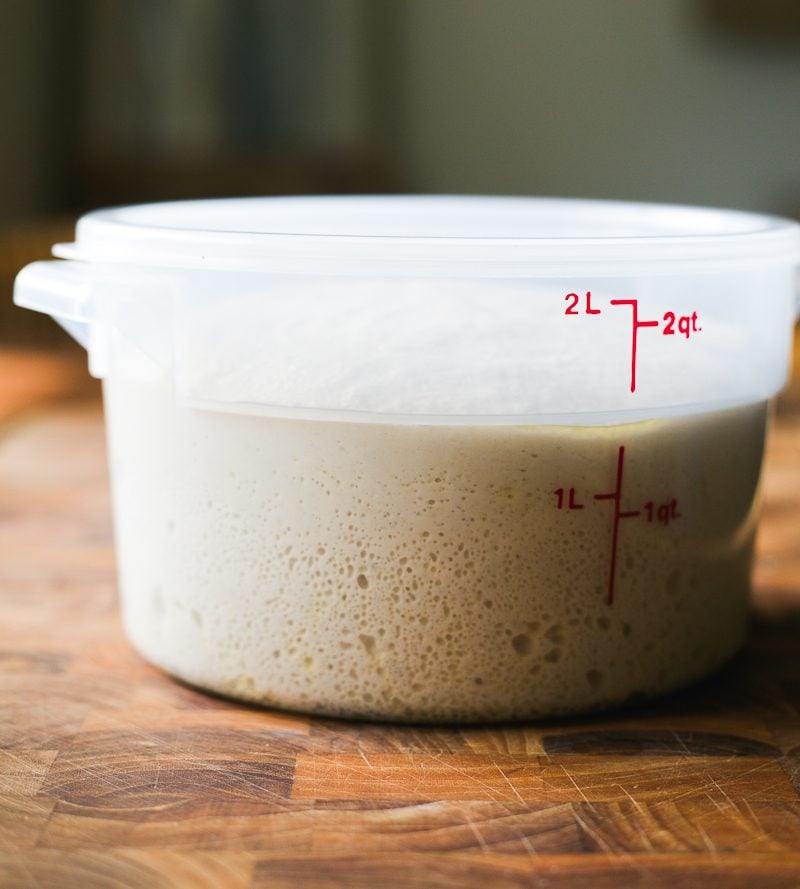
Transfer the dough to a lightly oiled high-sided 2 qt. dough tub. Cover and let rise overnight at room temperature, about 68 F for 10-12+ hrs. The dough is ready when it has almost doubled in size.
Note: if your ambient temperature is warmer /colder than 68 F, the dough will take shorter/longer to rise, respectively. Watch the dough and not the clock. Rise times will be different for every baker.
Get ahead tip: During the bulk rise, use this time to make the pizza sauce, grate the cheese and gather any additional toppings you will need.
Step 3: Dimple The Pizza Dough {2 Times}
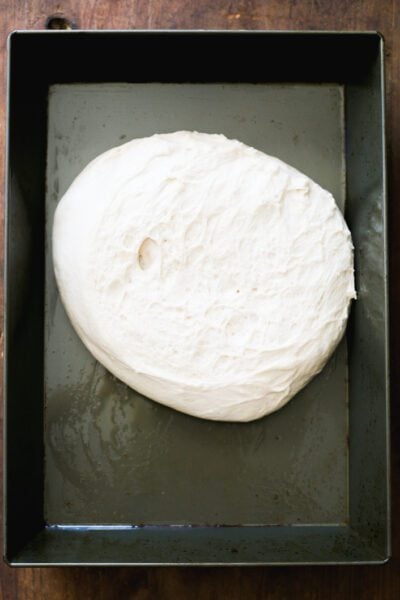
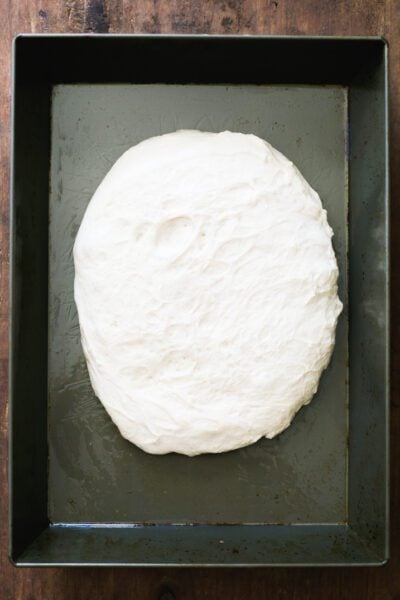
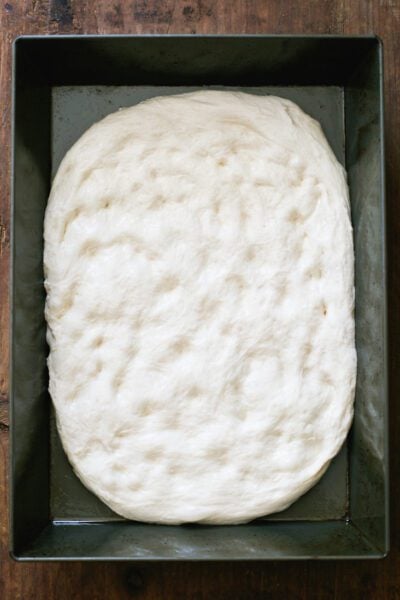
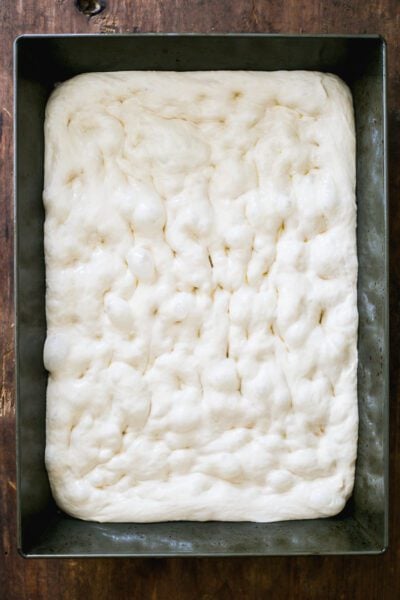
Coat a non-stick 9×13-inch baking pan with olive oil and then place the dough inside. With oiled fingertips, gently dimple and stretch the dough to reach the corners and sides. If the dough is relaxed, it will naturally spread out. If it’s tight, which is normal after a long rise, the dough will resist. Simply take note of your dough at this stage. Don’t force it. Watch my video for visual instruction.
Cover and rest in a warm spot for 30 minutes. Then dimple the dough again, just like you did before, gently lifting and stretching it as you go. Cover and rest for another 30 minutes.
Best warm spot to rise pizza dough? Sourdough pizza dough benefits from a warm rise during the dimpling stage, about 78 F. It really aerates the finished dough when baked. To create your own “warm spot” which is necessary when the ambient temperature is cold, you can do two things: set a proofing box to 78 F OR keep the dough (covered) in a switched off oven with the light turned on for heat. Both tips work like a charm in my drafty kitchen.
About The Baking Pan
I use this non-stick baking pan for sourdough pizza and sourdough focaccia. It’s truly non-stick. Because it’s made with dark, heavy gauge aluminum you will nail a perfect, golden pizza crust every time. Unfortunately, the price has gone up since my initial purchase (as with everything these days). But trust me when I tell you: it’s worth the investment. Remember, it’s not a single use item.
What about glass or ceramic pans? Any pan will work. But glass and ceramic pans conduct heat differently, which means the pizza crust won’t brown the same. Experiment as you see fit, moving the pan closer to the heat source if necessary during baking.
Step 4: Par-Bake the Pizza Crust
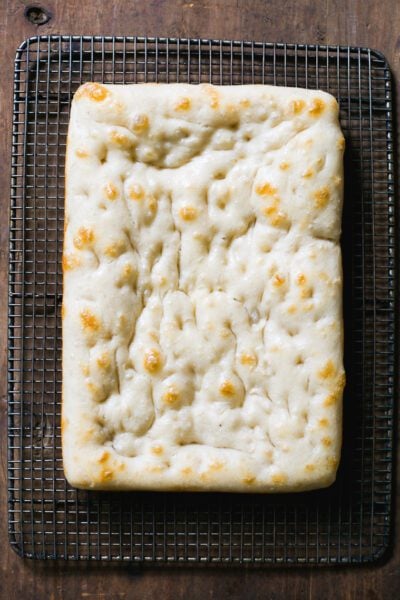
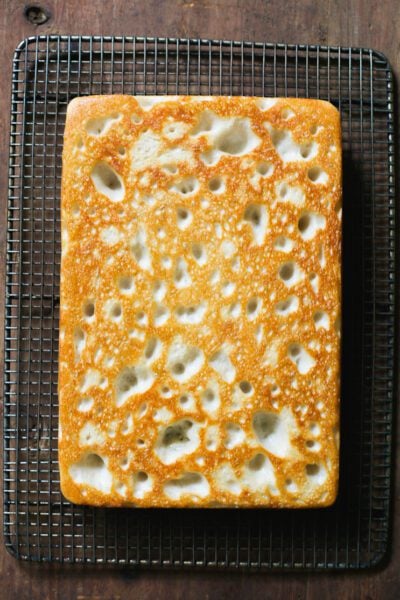
Bake on the bottom rack @ 450 F for 15-18 minutes, or until the surface is set and the bottom crust is golden brown. Use tongs to peek underneath the dough to double check.
Understanding the Par-Bake: Par-baked pizza crust is essential to pan pizza. First, it supports the weight of heavy toppings like sausage, mushrooms, olives, caramelized onions etc. Second, because the dough is baked prior to adding the sauce and cheese, it ensures the dough is fully cooked before the cheese melts (a common problem, fyi). Finally, par-baked pizza crust allows you to make pizza in advance- this is key for timing. Store wrapped par-baked pizza crust at room temperature for up to 6 hours. Or keep in the freezer for up to 3 months.
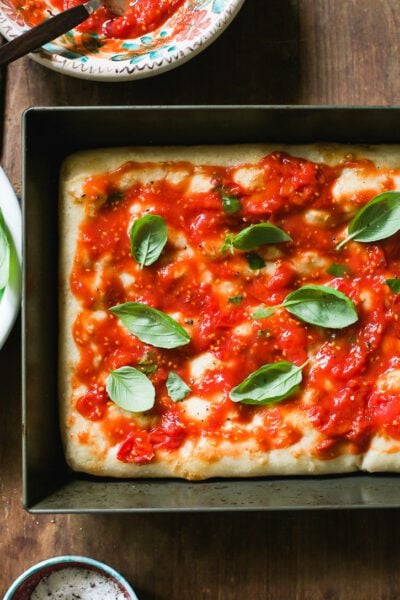
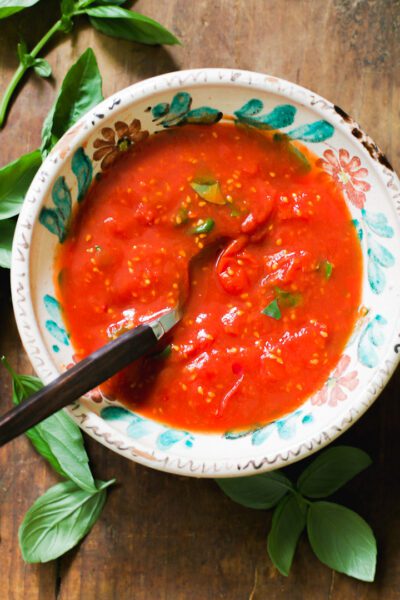
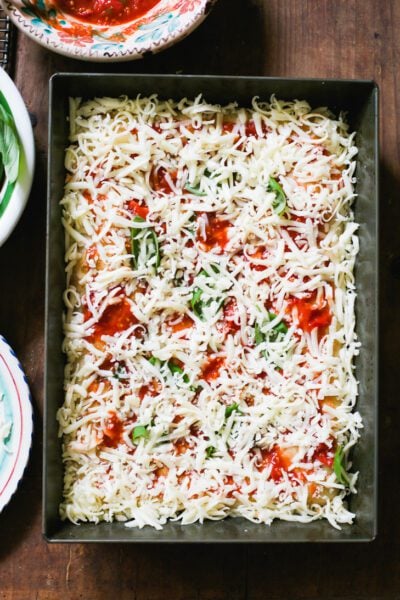
Step 5: Assemble & Bake Pizza
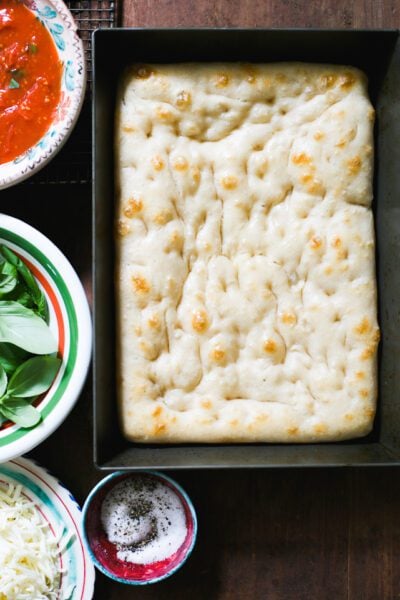
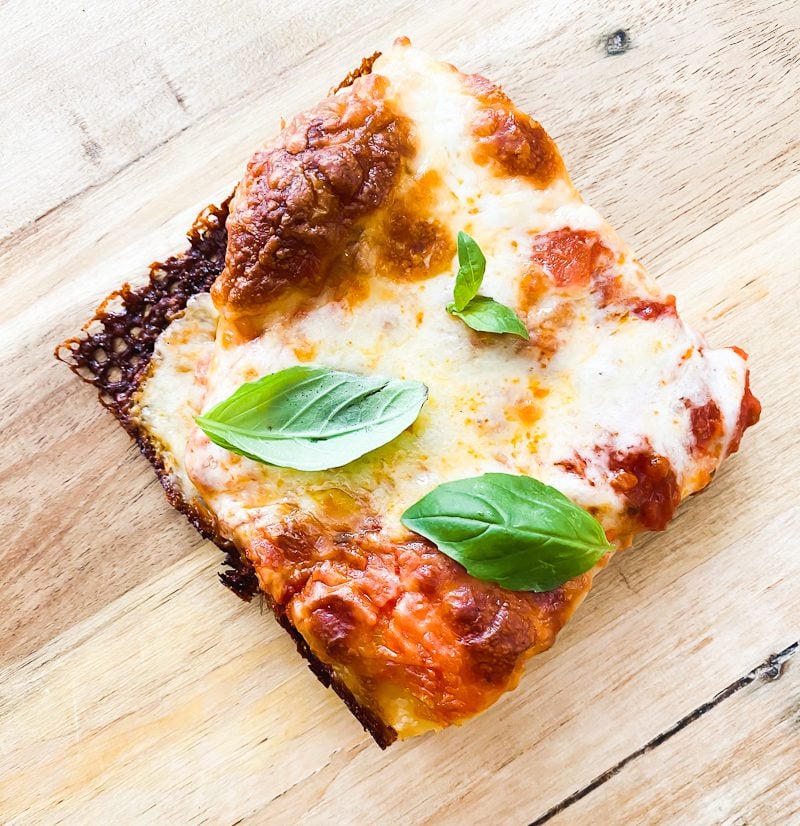
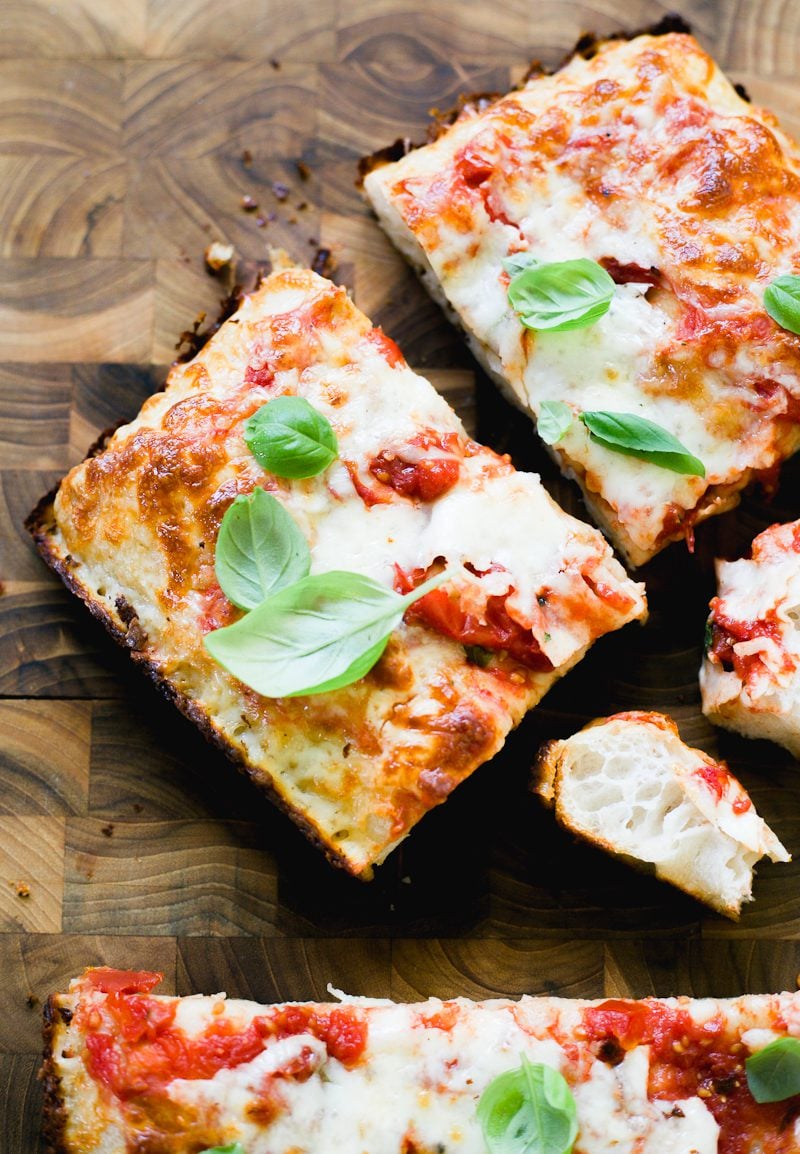
Top the par-baked pizza crust with tomato sauce. I spread it all over the surface including the crust. Season with salt and pepper. Add the basil leaves, a fresh grating of Parmesan cheese and drizzle with olive oil. Sprinkle with mozzarella cheese taking it to the corners and sides for crispy edges. Bake @ 450 F, middle or top rack this time, until the cheese is melted and broiled in some spots, about 12-15 minutes. You can even stick it under the broiler to really crisp it up.
Sample Sourdough Pizza Baking Schedule
There’s no one right way to do this. But here’s my go-to schedule: an overnight rise, a quick par-bake the next day, then assemble and bake by dinnertime. Adjust the timeframes as needed. What matters most is understanding the rhythm.
- Day 1 (PM): Mix the dough in the late evening and let rise overnight at ~68°F (20°C).
- Hot weather tip: In summer, skip the overnight rise; it will overproof. Make the dough in the morning or early afternoon instead.
- Optional: Prep the no-cook pizza sauce and grate your cheese after the dough is mixed.
- Day 2 (AM):
- Par-bake the crust. Store at room temperature (or freeze it).
- Day 2 (PM):
- Assemble and bake fresh, sourdough pizza by dinner.
By signing up, you agree to receive emails from The Clever Carrot. Unsubscribe at any time.
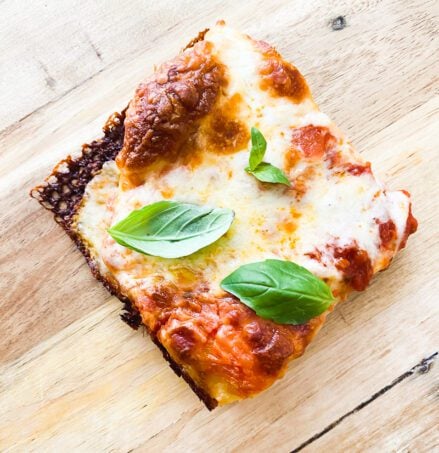
Crispy Sourdough Pizza Crust (No Stone or Steel)
- Prep Time: 14 Hours
- Cook Time: 30 minutes
- Total Time: 14 hours 30 minutes
- Yield: Serves 6
- Category: Sourdough Bread
- Method: Oven-Baked
- Cuisine: Italian
- Diet: Vegetarian
Description
My sourdough pizza crust features a crisp, golden base and an open, airy crumb made with active sourdough starter. This easy pan-baked method includes par-baking tips, a 1-minute “no-cook” pizza sauce, and a step-by-step video to guide you.
Ingredients
For the Sourdough Pizza Dough:
- 50 g active sourdough starter
- 250 g water
- 360 g bread flour
- 7 g fine sea salt
For the Pizza Toppings:
- 240 g (1 cup) quick “no-cook” pizza sauce, Sicilian tomato sauce or pomodoro sauce
- Fine sea salt
- Black pepper
- Handful fresh basil
- Freshly grated Parmesan cheese
- Olive oil
- 226 g (8 oz) whole-milk mozzarella block cheese, shredded, about 2 1/2 cups
Notes & Tips:
- Please watch my video for visual instructions. It’s really helpful when dimpling the dough!
- This is the non-stick baking pan I use. You’ll get perfect, golden pizza crust every time. If using a different pan, especially if it’s not non-stick, line the bottom with parchment paper to fit the inside dimensions of the pan (no overhang). Dark pans are best for heat conduction and crust color.
- I bake my sourdough pizza @ 450 F. I know my oven. However, if you prefer to bake at a lower temperature, approximately 425 F, you can. Increase the bake times to 18-20 minutes, for both the par-bake and actual pizza bake.
- Please use quality whole-milk mozzarella cheese (block cheese, not bagged shredded). Bagged shredded cheese contains too many anti-caking agents which will wreck your pizza. The cheese will taste dry and plasticky. Cube any small chunks that are too small to grate, and stick in the corners of the pan for extra crispy edges.
- Use room temperature ingredients. No cold sauce! This will ensure a crisp, pizza crust crust. It will also keep the oven temperature hot and stable, not steamy.
Instructions
Make the Dough
Before you begin: refer to my pizza baking schedule in the blog post above. This will give you an idea of when to start the dough. Below, I do a long, overnight rise @ 68F.
- In the evening, combine the sourdough starter and water in a large mixing bowl (I use a fork to mix). Add the flour and salt.
- Continue mixing, and then finish by hand to fully incorporate the flour. Cover with plastic wrap or a clean kitchen towel and let rest for 30 minutes at room temperature.
- After resting, return to the bowl and fold the dough over itself several times, similar to the stretch and fold method, to create a rough ball. The dough is now ready to rise.
Bulk Rise
- Transfer the dough to a lightly oiled high-sided 2 qt. dough tub.
- Cover and let rise overnight at room temperature, about 68 F for 10-12+ hrs. The dough is ready when it has almost doubled in size. If your ambient temperature is warmer /colder than 68 F, the dough will take shorter/longer to rise, respectively. Watch the dough and not the clock. Rise times will be different for every baker. (see Note #1).
Get Ahead Tip: While the dough is rising, use this resting time to make the pizza sauce, grate the cheese and gather any additional toppings for your pizza.
Dimple the Dough {2 Times}
- Coat a non-stick 9×13-inch baking pan with 1 tablespoon of olive oil. Use your hands to rub the bottom and sides of the pan.
- Remove the dough directly into the pan. With oiled fingertips, gently dimple and stretch the dough to reach the corners and sides of the pan- that’s the end goal. If the dough is relaxed, it will naturally spread out. If it’s tight, which is normal after a long rise, the dough will resist. Simply take note of your dough at this stage. Don’t force it. Watch my video for visual instructions.
- Cover the pan with an inverted baking sheet and rest in a warm spot, such as a proofing box set to 78F or a turned off oven with the light on, for 30 minutes.
- After 30 minutes has elapsed: return to the pan and dimple the dough again, just like you did before, gently lifting and stretching it as you go. Cover and rest for another 30 minutes. Preheat your oven to 450 F now.
- After the second 30 minutes has elapsed, you’re ready to par-bake the pizza crust.
ParBake Pizza Crust
- Place the baking pan on the bottom rack. Bake the dough @ 450 F for 15-18 minutes, or until the surface is set and the bottom crust is light golden brown. Use tongs to peek underneath the dough to double check. The bottom crust color depends on the type of pan you’re using; adjust the time or oven rack as needed.
- Remove the pan from the oven. You are now ready to assemble and bake pizza (see Note #2).
Assemble & Bake Pizza
- To Make Sourdough Pizza (now): Top the par-baked pizza crust with tomato sauce. I spread it all over the surface including the crust. Season with salt and pepper. Add the basil leaves, a fresh grating of Parmesan cheese and drizzle with olive oil. Sprinkle with mozzarella cheese taking it to the corners and sides for crispy edges. Tuck any remaining cheese cubes into the corners. Bake @ 450 F, middle or top rack this time, until the cheese is melted and broiled in some spots, about 12-15 minutes. You can even stick it under the broiler to really crisp it up.
- To Make Sourdough Pizza (later): Transfer the par-baked pizza crust to a wire rack to cool. You want to aerate the underside so the crust doesn’t get soggy. Once completely cool, cover tightly in plastic wrap and store at room temperature for up to 6 hours. When ready to bake, return the pizza to the same baking pan (don’t bother cleaning it; any leftover oil is fine), assemble and bake as directed above.
Notes
Note #1: Refrigeration Option. after the bulk rise is complete, the pizza dough can be stored in the fridge for up to 1 day if you run out of time. This is optional. To do so: shape the dough into a ball and place into an oiled, non-stick 9×13-inch baking pan. Cover tightly with lightly oiled plastic wrap and chill overnight. When ready to continue, the dough must rest in a warm spot (I use a proofing box set to 78 F OR a switched off oven with the light on) until it comes to temperature and no longer looks dense- this will take a few hours. Then dimple the dough following the directions in the next step.
Note #2: How to Store Par baked Pizza Crust: Wrap cooled par-baked pizza crust at room temperature for up to 6 hours. Or keep in the freezer for up to 3 months. Defrost at room temperature.


Comments
Geneva Black says
This was my first time making a sourdough pizza and it turned out beautifully! I really appreciated the pictures and video, thank you.
S E says
Great pizza, so far it’s the best I’ve been able to make at home.
Sany says
Can I bake this recipe in a pizza stone?
JEG says
You may able to but you may have to adjust the time/temperature as the pan and the stone are different surfaces. To be honest I don’t recommend it as it may require too many adjustments plus it will be a bit of hassle getting it in/out of the oven.
This is in essence Detroit style pizza which is always cooked in a pan like the one Emilie recommends (I have actually ordered one). In some restaurants it is even served in the pan. If you don’t have a pan like Emilie’s you can probably get by with a baking sheet. Just be aware that if the size is different you may not get the same thickness which is one of the elements that make this recipe great.
Deb Winslow says
Hello! This recipe looks amazing, I’m excited to try it. Curious about cold proofing, I’ve been under the impression that I should be doing a cold proof with my sourdough bread/dough, but not seeing that in this recipe (which is actually a great time saver). Thoughts? Thanks!
Lauren Ball says
This pizza is so good!! Thank you for sharing the recipe! and the no cook sauce…chefs kiss!
Mari says
Hello,
Just wanted to ask once you put the dough on the pan and start dimpling/stretching how many 30 minute intervals are there in between this stretching this process?
Claire says
Followed the recipe with all purpose flour and had to add a little extra which I expected. Turned out delicious! Threw on a bunch of different meats I had leftover for toppings; pepperoni, ham, bacon, prosciutto. Also used the no cook pizza sauce and that turned out well.
Carolyn Griffiths says
Can you use “00” flour for this pizza dough? Love your recipes and very clear directions❤️
Emilie Raffa says
Hi Carolyn! You definitely can. Use the same amount by weight. Keep in mind, the texture will change slightly depending on what brand/type/protein content of Tipo 00 used. For example, I’ve played around with Italian 00 and American 00 and they are very, very different. Start with what you have first, and make adjustments from there if you’d like to experiment. Hope this helps!
Carolyn Griffiths says
Thank you so much. I use King Arthur “00”. I’ll play with it-God Bless!
Terence C. Gannon says
Second time through with this recipe, which worked out really well. Your recipes are outstanding and never miss. Superbly detailed with little if anything left to chance. I’ll be doing this one again. Picture, comment, and a link to the recipe posted to Bluesky.
Frankie C. says
First time making sour dough pizza. It was great! Thanks for recipe!
Making it again this week.
Emilie Raffa says
You’re very welcome. Thanks for sharing your feedback, Frankie!
Tami says
Doubled this recipe and made 2 large 16″ pizzas for the family. Will make again turned out delicious. Thank you for sharing.
Emilie Raffa says
Fantastic. Love this feedback, Tami! Thank you!
Joe says
Emilie, I love your pizza dough recipe.
I have been doing sourdough for 5 years and wanted to try something I have had but never made at home. what do you recommend. A pizza sandwich with swiss chard and ricotta. It is cooling now and I have not cut it. I took your recipe and made to pizzas, (after preparing the greens and ricotta) and partially par-baked them for 8 minutes. i took them out and layered the filling on one and filled the second on top and cooke for another 20 minutes. The top is nice and brown.
I have a high – hydration sourdough loaf to bake now.
PS, I use spelt flour for my baking.
Thanks,
Emilie Raffa says
Hi Joe! Thank you. I’m thrilled to hear you’re having success with the pizza dough. How did the swiss chard and ricotta pizza sandwich come out? Sounds incredibly delcious.
Janet says
Hi can I use day old starter for this recipe ? (Discard)
Emilie Raffa says
Hi Janet! This dough requires active starter to naturally leaven the dough. Discard isn’t always reliable (not strong enough), so sometimes, bakers will add instant yeast to the dough for added rising power. It’s up to you.
Lucia says
I bake a lot of sourdough bread, pizza, focaccia, beagles..and this recipe is the bomb! I never write reviews but this one deserves it. A crowd pleaser every time. The pan is the key. I used one of my Siemens drip pans that came with the oven and it came out amazing. Thank you for a wonderful treat!
Emilie Raffa says
This is so kind of you, thanks so much Lucia! I totally agree with you about the pan – it was the best pizza “investment” I’ve made yet. The crust comes out unbelievably crispy and I love when the cheese gets all golden and crunchy too. 🥰
Cam says
Can you use pizza flour? Thanks
Emilie Raffa says
Hi there! Yes, you can. The texture will change slightly depending on the brand/type/protein content you’re using. But you can absolutely experiment and make adjustments as needed.