Think you can’t bake fresh, homemade sourdough bread? This easy sourdough bread recipe—trusted by beginner bakers for over a decade—shows you how, step-by-step. No yeast. No kneading. Just simple ingredients and 10 minutes hands on time for soft, crisp sourdough bread at home.
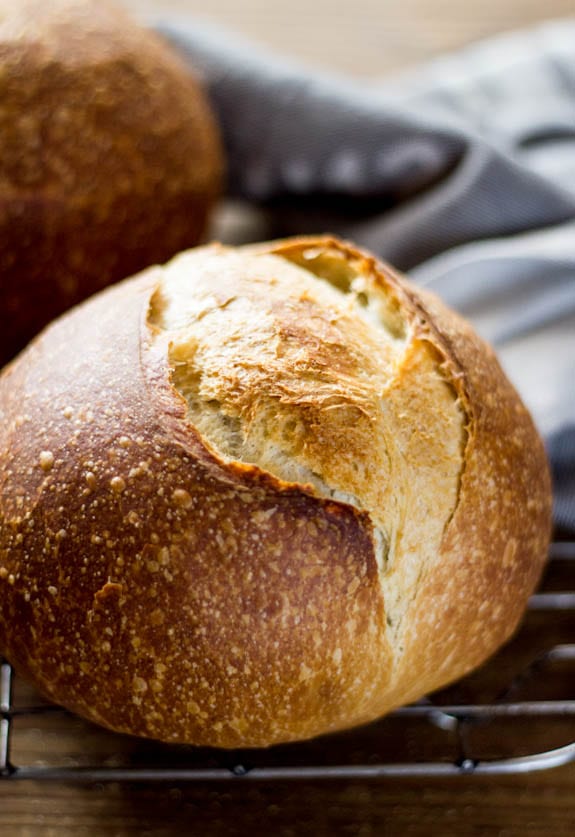
Reader review
“I have tried MULTIPLE sourdough bread recipes and this one has been the very first to make a successful (fully risen) loaf of bread. I am relatively new to sourdough and for some reason, the other recipes just didn’t produce good bread. These instructions and detailed explanations really make a huge difference to someone who is new to the world of sourdough.”
—Savannah
To anyone who thinks their sourdough bread isn’t good enough, I get it. Back in 2013, I set a goal: bake more bread. I tested, failed, succeeded (and tried again). What began with an easy no-knead artisan loaf eventually led to the holy grail: homemade sourdough bread.
Admittedly, I had beginner’s luck. My early scratch-made loaves were light, plump and airy, everything you want sourdough to be! And then? Down the rabbit hole I went: Hydration? Baker’s %? Proofing times?
Now, with 13+ years baking experience and a professional culinary background, I know what holds people back: the confusion, hesitation, comparison. I teach from a straight forward practical perspective because sourdough is not just a written recipe; it’s an understanding.
This sourdough bread recipe has been the most popular on my blog for over a decade- millions of views and the inspiration behind my bestselling book Artisan Sourdough Made Simple, a deeper dive into sourdough bread recipes. So, if you’re at the end of your rope (and just want to make good bread), you’ve made it. Welcome to the journey.
What Sets My Recipe Apart:
- One bowl, 5 ingredients
- Olive oil = soft, plush crumb & crisp, golden crust
- No stand mixer
- No bread machine
- Flexible baker’s schedule
- Personalized support in the comments
But before we make bread, let’s discuss what drives it: your sourdough starter. Once you understand what it is, and how it works, your path will be crystal clear. Have questions? Ask in the comment section. I respond with personalized help.
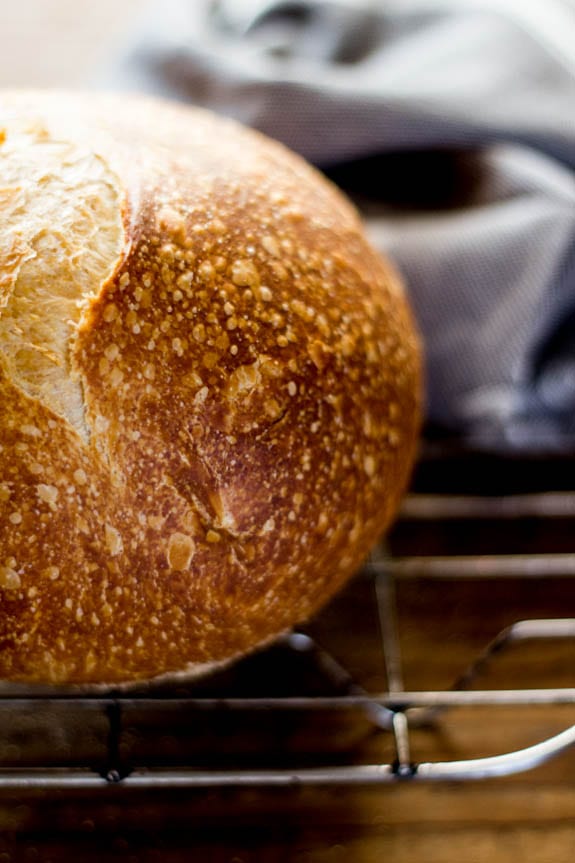
Where To Get A Sourdough Starter
A sourdough starter is a live fermented culture of flour and water. It naturally leavens bread dough without commercial yeast. There are all different types: homemade, purchased or gifted (ask a fellow baker!). I use two different starters at home: one I made myself, and a vibrant Australian starter gifted from my friend Celia.
But is doesn’t stop there. Once your have your own sourdough starter, it must be kept alive and well with regular feedings to maintain its rising power. Sourdough is not static; it’s a living process. Here’s my personal feeding schedule which you can adapt to suit your style:
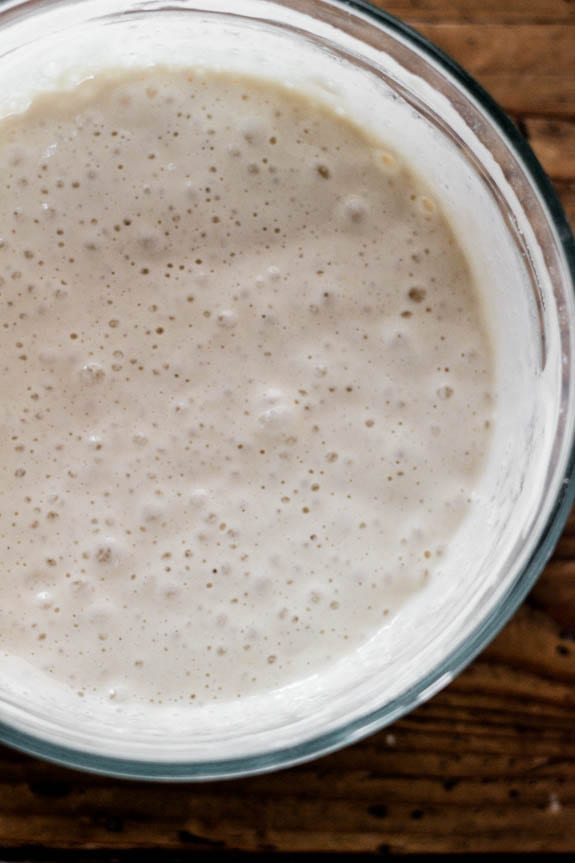
How To Feed Sourdough Starter
- Remove and discard half of your sourdough starter
- Feed what’s left in the jar with equal parts flour and water by weight (1:1:1 feeding ratio).
- Let rise at room temperature (loosely covered or airtight) ideally 75+F until bubbly, active and double in size (2-12 hrs). I use this sourdough starter jar.
Recommended Reading: Feeding Sourdough Starter: My Best Tips & Tricks
When Is Sourdough Starter Ready To Use?
Your fed starter is ready to use when it’s bubbly, active, and doubles in size. This can take 2-12 hours or more, depending on the temperature of your kitchen and the strength of your starter. My best advice? Be patient, plan ahead, and make sure your starter is in a warm place (ideally 75 F). The process is not instant.
Float Test: If you’re unsure whether your starter is ready, drop 1 tsp at peak height into a glass of water. If it floats to the top it’s ready to use. If it sinks, feed your starter again.
Storing Your Starter
Most people don’t realize that your feeding schedule is directly related to your baking preferences. If you only bake a few times a month, store your starter in the refrigerator and feed it once a week. If you bake often, store it at room temperature and feed it once a day.
How To Make Sourdough Bread: Step-By-Step Recipe
To Start: Feed your starter until it’s bubbly and active first (remember this can take anywhere from 2-12 hours, so plan ahead). Then mix the dough. Detailed instructions follow below. For a printable recipe & sample baking schedule, scroll to the end.
Step 1: Mix The Dough
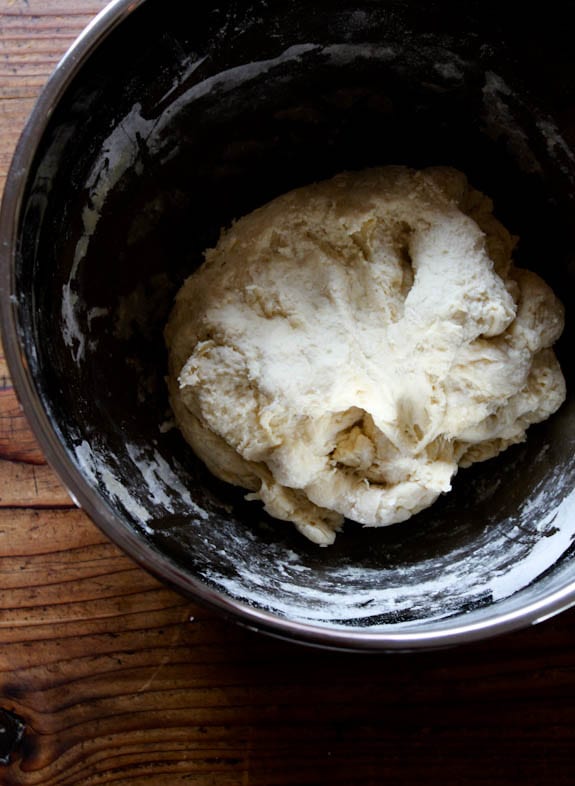
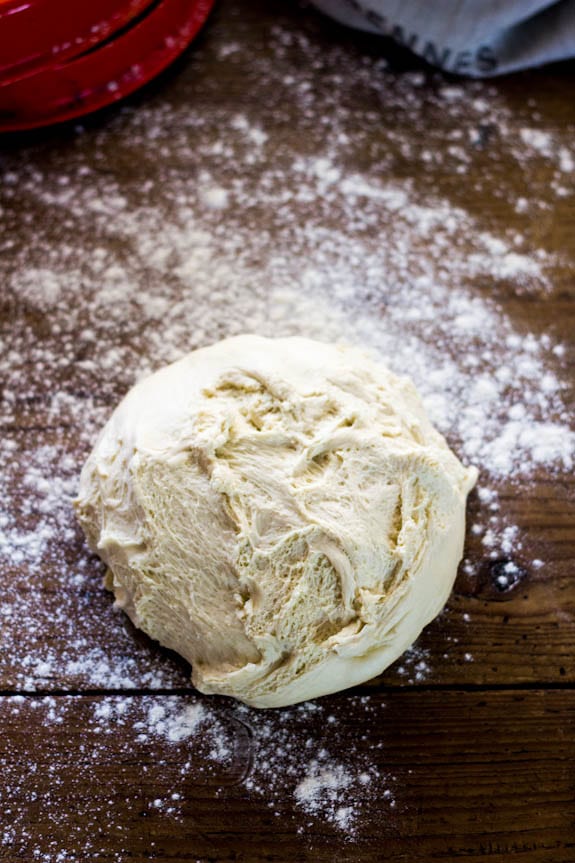
- Add water, sourdough starter, and olive oil to a large bowl. Whisk well to combine, making sure the starter is fully dissolved. Then add the bread flour and salt. Continue mixing (I use a fork at this point) until the flour is absorbed. The dough will feel rough and shaggy, which is normal.
- Cover the bowl and let rest (autolyse) for 30 minutes to 1 hour at room temperature. Then shape the dough into a rough ball. It doesn’t have to look perfect.
Tip: Weigh your ingredients with a digital kitchen scale. Measuring cups vary in size and don’t account for ingredient density which can lead to dry, dense, or overly sticky dough.
Why Autolyse Matters
Autolyse is the first rest after mixing bread dough. It jumpstarts gluten development without kneading, making the dough stronger, stretchier, and easier to shape I never skip it. For this recipe, rest for at least 30-45 minutes (or when time permits, I’ll do 1 hour for an even softer, more manageable dough). To learn more about common sourdough bread terms read my Sourdough Baking Glossary. I’ve included the only 12 you need to know!
A Note on Salt: Some bakers only add salt after autolyse, believing it slows down gluten development. I’ve followed that method for years, but now mix everything at once. It’s simpler, faster, and still makes excellent loaves (plus, you won’t forget to add the salt later on!). I’ll leave the choice up to you.
Want To Add Inclusions?
Mix in flavor additions after autolyse, when the dough is softer and more pliable. This is another reason not to skip the autolyse step. Alternatively, inclusions can be added during the first stretch and fold.
A few ideas:
- Roasted garlic
- Chopped olives
- Fresh or dried herbs (rosemary, thyme)
- Seed or nuts
- Cheese
- Dried fruit (raisins, cranberries)
- Jalapeños

Step 2: Bulk Rise
Now the dough is ready to rise. Cover the bowl with lightly oiled plastic wrap so the dough doesn’t stick to the top, or transfer to a dough tub. Let rise at room temperature, about 68-70 F (20-21 C).
How Long Does It Take For Sourdough Bread To Rise?
The dough is ready when it’s puffy, slightly domed and nearly double in size. This can take 3-12 hours depending on room temperature, the quantity and strength of your sourdough starter, and seasonal conditions. All variables work together. See my example below:
For My Sourdough Bread Recipe (with ~150 g sourdough starter):
- In the summer: ~2-4 hours @ 80 F (26 C)
- In the winter: ~10-12 hours @ 68 F (20 C)
Diving Deeper: Temperature controls time. This is where I see the majority of beginner baker’s make mistakes- the temperature is overlooked. Sourdough takes longer to rise than yeasted bread, and it’s highly dependent on your specific environment. My kitchen might be 75 F. Yours? 68 F. Watch the dough, not the clock. For more details and troubleshooting read my companion article: Why Won’t My Sourdough Bread Rise?
Stretch And Fold The Dough (Optional Step)
About 30 minutes into the bulk rise, you can perform a series of “stretch & folds” to strengthen the bread dough. This step is not mandatory; however it has the potential to add height and structure to the finished loaf. Check out my how to stretch and fold sourdough guide to learn more, step-by-step. It’s easy and fun to do!
Step 3: Divide & Shape The Dough
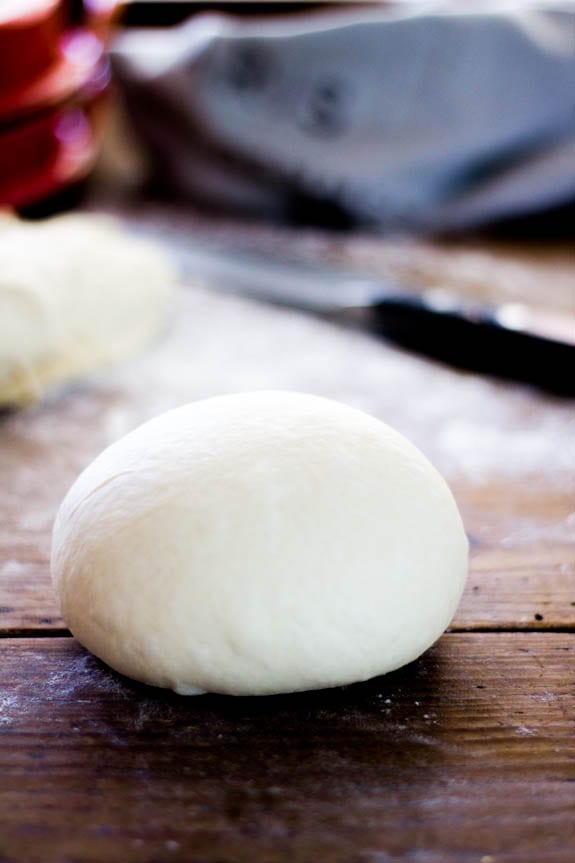
At this stage, remove the dough onto a lightly floured surface. For two smaller loaves, divide the dough in half. For a single, standard size loaf leave it whole.
How To Shape A Round Sourdough Boule (Loaf)
Starting at the top of the dough, fold it over toward the center. Give it a slight turn, and then fold over the next section of dough. Repeat until you have come full circle to form a tight round. This creates surface tension for better oven spring. You can also try the envelope-style fold.
Tip: I used to get so nervous when shaping bread dough because you only had one chance to get it right. So intuitively, I would practice using a piece of Play-Doh or with a kitchen towel to go through the motions at my own pace.

Step 4: Choose The Right Baking Pot
If you want bakery-style results, bake sourdough bread in a Dutch oven. Why? Pots trap steam which is the secret to homemade sourdough with bold rise and golden crust. Without steam, the crust will set too fast casing the loaf to harden, split or bake unevenly. I’ve been there and it’s not pretty.
What If You Don’t Have A Dutch Oven?
You’ll need another oven-safe pot with a lid to create steam. It must be able to withstand up to 450 F/232 C (lid and handles included).
A few options:
- Enamel roasting pan with lid (or sheet pan to cover)
- Cast iron skillet with upside down roasting pan to cover
- Covered sandwich loaf pans
- Clay Baker or Romertopf (soaked first)
- Preheated baking stone w/ metal bowl to cover
Here’s what happened to me: I tried the “no pot” baking route in the past, using just about everything from pizza stones, to baking sheets with no luck! The crust always hardened too quickly. Then I tried various steaming methods to remedy this (e.g. ice cubes in a hot pan, spraying my loaves with water) but my personal oven could not retain enough moisture. The environment was always too dry. For me, using a Dutch oven was the only reliable solution that worked with consistent results.
Step 5: Second Rise (Proofing)
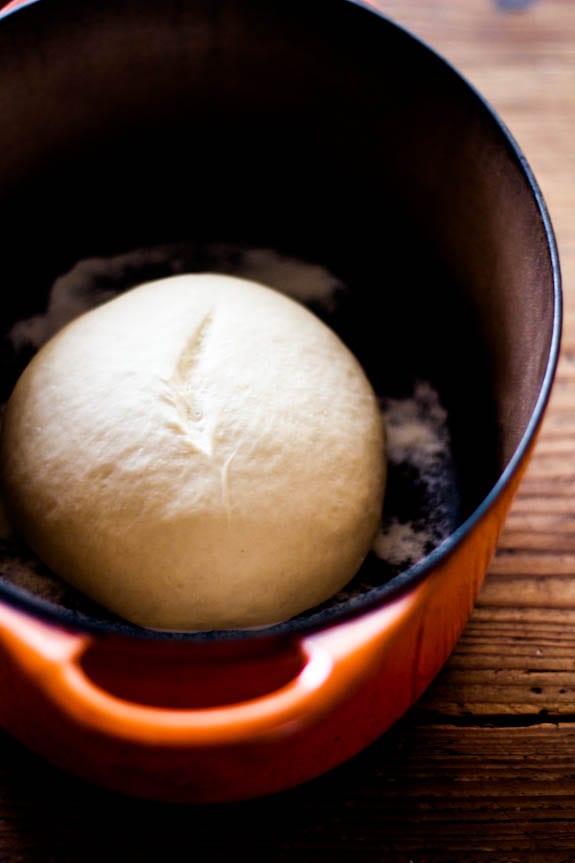
- After shaping, your dough needs to rise again. To do so, generously dust the bottom of your Dutch oven with cornmeal, or line with non-stick parchment paper to prevent sticking. Gently place the dough inside (see tip below)
- Let the dough rise for 30 minutes to 1 hour, or until it’s visibly puffy and no longer feels dense. It doesn’t need to double in size. While the dough proofs, preheat your oven to 450 F (232 C).
Tip: Want better shape and structure? Proof the dough in a floured, cloth-lined, 8-inch bowl or banneton instead of directly in the Dutch oven. This will contain the dough and hold its shape without spreading. Bread flour or rice flour is fine for dusting.
Step 6: Score The Dough
- Right before the dough goes into the oven, make a shallow slash down the center of the dough, about 2-3 inches long. Use a small serrated knife, sharp knife or bread lame. This lets the steam escape, and allows the bread to “bloom” or expand in the oven.
- Admittedly, this step is a bit nerve racking, so I don’t want to gloss over it. Be quick and confident. I’ll share what my sourdough mentor told me: “Slash with panache!”
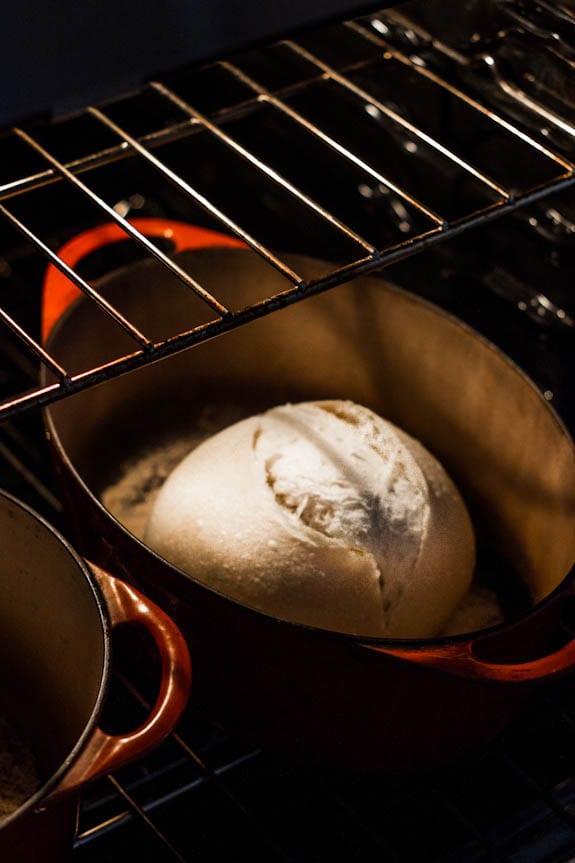
Step 7: Bake The Bread
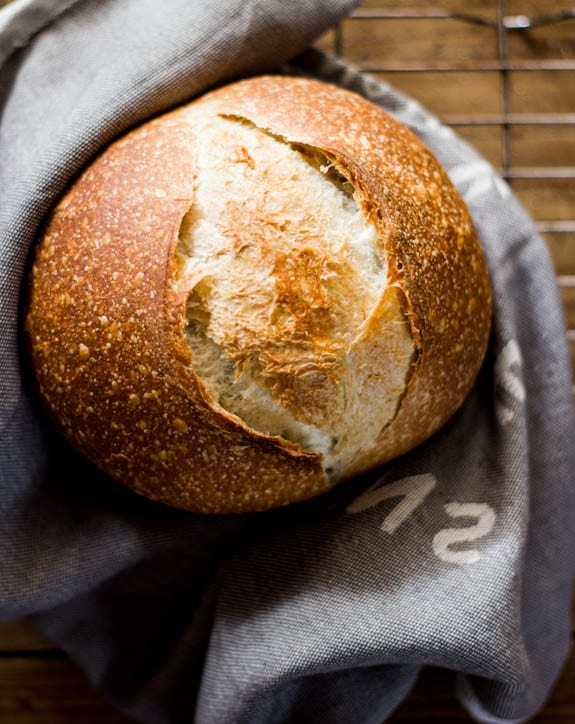
You’re at the finish line now! Bake on the center rack (lid on) for 20 minutes. Then remove the lid. Your bread will look pale and slightly shiny. Then finish baking (uncovered) for 40 minutes or until the crust is deep golden brown. The internal temperature should be 205-210 F/96-98 C.
Tip: During the last 10 minutes of baking, crack open the oven door to let the moisture out. This creates a crispier crust. Or, remove the bread from the hot Dutch oven and bake directly on the oven rack. The latter creates the crispiest finish.
Step 8: Cool & Slice
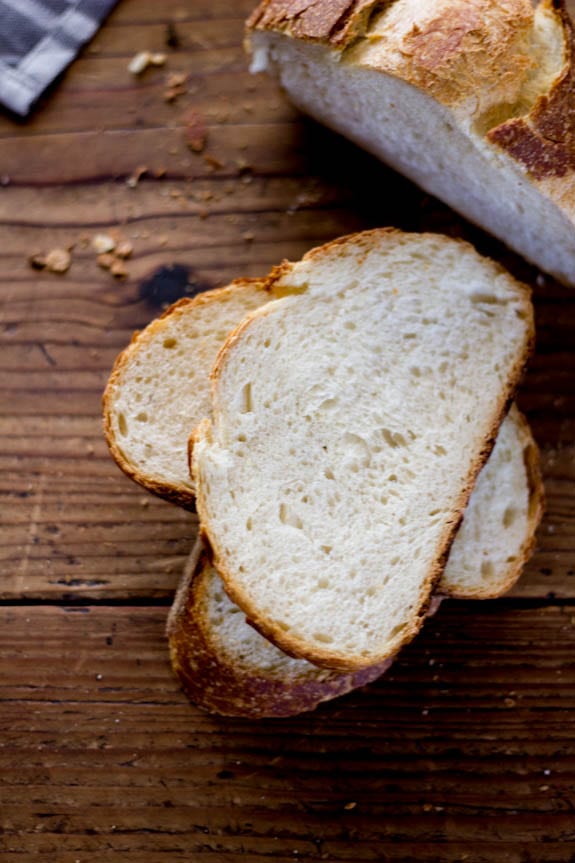
Cool the bread on a wire rack for at least 1 hour before slicing. Be patient! If you cut into it too soon, the texture will be damp and gummy. Life’s too short for sub par bread.
Final Thoughts
There are a gazillion sourdough bread recipes out there. No two loaves look alike. Start with this guide, master the basics and then branch out: try my golden sourdough focaccia recipe, this easy sourdough sandwich bread, or my one-bowl sourdough pancakes for breakfast! Once you have a few loaves under your belt, the process will become an imminent rhythm and you’ll become a sourdough pro in no time.
Sourdough Baking Schedule
- Friday Evening: Feed your starter, cover the jar, and leave it on the counter overnight. If you keep your starter in the fridge, it might need two feedings to perk back up (feed it in the morning & in the evening).
- Saturday Morning: Check your starter: if it’s alive and bubbling, you can make the dough to rise during the day. Or, feed it again in the afternoon to make the dough in the evening for an overnight rise. Remember to use the float test mentioned above to make sure your starter is ready to use.
- Saturday Morning/Evening (or whenever your starter is ready): Make the dough. Leave on the counter to bulk rise at room temperature. In the summer, if your dough rises quickly and you’re not ready to bake, cover the whole bowl with lightly oiled wrap and chill until ready to use.
- Sunday Morning: cut and shape the dough. Place in Dutch oven for second rise. Slash. Bake. Cool. Eat.
By signing up, you agree to receive emails from The Clever Carrot. Unsubscribe at any time.

Sourdough Bread: A Beginner’s Guide
- Prep Time: 13 hours
- Cook Time: 1 hour
- Total Time: 14 hours
- Yield: 1 loaf 1x
- Category: Sourdough Bread Recipes
- Method: Oven-Baked
- Cuisine: American
- Diet: Vegan
Description
New to sourdough? My easy beginner sourdough bread recipe makes the best artisan-style loaf at home with just 5 simple ingredients: bread flour, active sourdough starter, water, salt and olive oil—my signature addition—known for creating a light, plush crumb and a crisp golden crust. Follow my clear, step-by-step instructions and video guidance to bake fresh sourdough bread with confidence (even on your first try!).
Ingredients
- 150g bubbly, active sourdough starter
- 250g warm water (see Note 2)
- 25g olive oil
- 500g bread flour (not all purpose flour)
- 10g fine sea salt
- fine ground cornmeal or non-stick parchment paper
Notes, Tips & Equipment
- Weigh your ingredients with a digital scale for best results
- For a more soft and pliable dough, increase the water up to 300 g- 325 g total. Use a floured, cloth-lined bowl or proofing basket (instead of the Dutch oven) for the second rise.
- You will need a 5 1/2 or 6 quart Dutch oven for baking
- This recipe was tested with King Arthur Bread Flour, Gold Medal Bread Flour, Pillsbury Bread Flour
Instructions
Make The Dough
In a large bowl, add the sourdough starter, water and olive oil. Mix with a fork to combine, then add the flour and salt. Continue mixing until the dough becomes stiff, then squish it together with your hands to incorporate all the flour. The dough will be rough and shaggy.
Cover the bowl with plastic wrap, reusable wrap, or very damp kitchen towel. Let rest (autolyse) for 30 minutes to 1 hour.
After resting, return to the bowl and work the dough into a rough ball, about 15 seconds.
Bulk Rise (First Rise or Bulk Fermentation)
Cover the bowl with lightly oiled plastic wrap. Alternatively, transfer the dough to a high-sided dough tub. Let it rise in a warm place, ideally 70-75 F. The dough is ready when it no longer looks dense and has almost doubled in size.
Note: The bulk rise time will be different for everyone. For example, in the summer, expect ~2-4 hours @ 80 F/ 26 C. In the winter, ~10-12 hours @ 68º F/ 20º C. Watch the dough and not the clock.
Optional Step: Stretch & Fold The Dough
During the bulk fermentation, you can do a series of ‘stretch & folds’ to strengthen the dough. Start 30-45 minutes in: lift a portion of the dough, stretch it upwards, and fold it over itself. Rotate the bowl ¼ turn and repeat until you’ve come full circle (1 set). Do 1-2 additional sets, spaced ~1 hour apart. Click here for a step-by-step video tutorial.
Note: Dough made with 250g water will feel stiffer; 300-325g water will be more stretchy and elastic. Let it rest longer in between sets if it resists stretching.
Shape The Dough
Remove the dough onto a lightly floured surface. Starting at the top, fold the dough over toward the center. Turn slightly, and then fold over the next section. Repeat until you have come full circle. Flip the dough over, seam side down. Gently cup the sides and rotate in a circular motion to tighten the shape. The goal is to build surface tension to create a tight ball (too much flour will cause the dough to slide around).
Second Rise
Now the dough needs to rise again. If you’ve used 250g water, you can do a free-form second rise in the Dutch oven (if not, see note below). Line the pot with a piece of parchment paper (this is what I do) or coat with cornmeal. Place the dough inside, cover and let rise for about 30 minutes to 1 hour. It’s ready when slightly puffy, but not double in size. Preheat your oven to 450 F/ 232 C.
Note: If your dough contains more than 250g water, skip the free-from rise. Your dough will spread. Instead, use a floured, cloth-lined, proofing basket to help hold its shape.
Score The Dough
Right before baking, make a shallow 2-3 inch slash (or longer) in the center of the dough using a bread lame, razor blade, or small sharp knife. The cut should be ~1/4-inch deep.
Bake The Dough
Place the bread in the oven on the center rack (lid on) and reduce the temperature to 400 F/ 204 C. Bake for 20 minutes, then remove the lid, and continue to bake (uncovered) for an another 40 minutes, until deep, golden brown. All ovens are different; feel free to make minimal adjustments to these temperatures.
Check for doneness with a digital thermometer: 205-210 F/ 96-98 C for sourdough.
Remove the bread from the hot Dutch oven, and cool on a wire rack for at least an hour before slicing.


Comments
Connie Connie Plummer says
Emilie! YOU have made a sour dough baker out of me and my family thanks you! Question: I have never divided the dough into halves to make smaller loaves. Does the baking time vary if the loaves are smaller. Connie
Emilie Raffa says
Thank you SO much Connie! But YOU did it! Give yourself a pat on the back too 🥰 When baking the two smaller loaves, you can shave off 10+ minutes of bake time. That should do it.
Susie says
I am UK based and was wondering if your oven temps are fan oven or not please? I have a fan oven. Can’t wait to give this a try!
Emilie Raffa says
Hi Susie! The oven temps are not fan.
Susie Blinman says
Thank you ☺️
Cari says
I made this using the simplest method, without the ‘stretch & fold’. This was my first loaf from my self-started sourdough starter (I’d made sourdough years ago with a purchased starter, and don’t even remember how it turned out). With this I’d used a simple starter recipe using whole wheat and water that I started weeks ago, then went on vacation, and with the weather so hot, never got around to making sourdough bread until this week. This had a chewy and a bit crumbly crust, and the inside was soft but still a bit firm, with just the right amount of not-too-big bubbles (I did a 1-hour 2nd rise). As I’m enjoying it I realized I’m forgetting that I made it and it’s not store-bought. This turned out beautifully, and after reading your tutorial I had the confidence to make it without being stressed or intimidated: keeping it simple was key. Thanks so much for the tutorial, the recipe, and the confidence.
Sian says
Hi Emilie,
I love your recipe, thank you so much for sharing- it’s the most straight forward and fool-proof sourdough recipe I’ve seen, and it’s now my regular bread baking method. My only problem is it’s so delicious that I eat too much bread now! Please tell me the best way to cool and store my sourdough. Should I wrap it in a cloth to cool? Many thanks
Nancy says
This is my go to recipe. I have made it for friends and they love it! I also bought the book. Delicious!
Emilie Raffa says
Thank you Nancy! Appreciate the kind feedback—happy baking and enjoy the book! 🥰
Carol says
What can i use if i don’t have a dutch oven?
Emilie Raffa says
Hi Carol! If you don’t has a Dutch oven, any oven-safe pot with lid will work. If you don’t have that, you’ll need to find an alternate method to add steam to your oven. Steam is essential; it traps in moisture which allows the the dough to expand. Try baking the loaf on a parchment-lined sheet pan (spritz the surface of the dough with water first) and place a deep, high-sided roasting pan on top. This creates somewhat of a make-shift option. You can also try spritzing down the walls and sides of your oven with water too.
Ken Briggs says
Made it. Came out great!
Nora says
This is my first time attempting this! I mixed the starter last night and it’s very thick and dry, is this normal? Almost like a play dough consistency, but dry.
Emilie Raffa says
Hi Nora! Yes: when you first create a sourdough starter from scratch, the texture will be thick and pasty. All normal on Day 1. As you continue, feel free to circle back with any questions on my sourdough starter post (linked here). You’ll find more detailed information!
Colleen Culver says
Why can’t you put the measurements in cups teaspoons or grams???
Emilie Raffa says
Hi there! The recipe is listed in grams & ounces (see printable recipe card—it’s above the comment section).
Kerry says
Hi. What happens if the starter looks bubbly but hasn’t doubled in size? Is it still ok to use it to make the sourdough bread dough?
Emilie Raffa says
Hi Kerry! It’s hard to say without seeing a picture of it. However, try the float test to double check: when your starter is nice and bubbly, drop a tsp. in a glass of water. If your starter floats floats, it’s typically ready to use.
Cilia says
Hi! Can I sub the flour for all purpose King Arthur unblezched flour?
Emilie Raffa says
Hi there! I used to recommend bread flour only for this recipe. However, you can in fact try it with KA all purpose flour instead, using between 250-325g water.
Linda says
I have been feeding my starter for 2+ weeks it doubles in size with bubbles but when I do the float test it sinks do I just keep feeding
Lois Phounsavath says
I love your recipes and content. I tried many recipes before I tried yours. My loaves are more consistent because of your recipe!!!
Thank you for your expertise and talent !!!
Sherri Klossner says
Can I add honey? If so how much and doe’s it change the process much?
Emilie Raffa says
Sure, you can absolutely do that. I’d recommend up to 1-2 tbsp to start. The amount depends on the overall taste and style of bread you’re trying to achieve Adding a sweetener might speed up the bulk fermentation, so watch how fast the dough rises. When baking, watch for browning—honey is notorious for deepening the color quickly.
Shari says
So if I follow your recipe and use 150g of starter. And put the remainder of starter in the refrigerator because I’m not going to make bread everyday. You stated you can feed it once a week. Do you need to let it come to room temp to feed it?, and how much do you feed it??? Thank you.
Emilie Raffa says
Hi Shari! It depends on what you’re using it for. For example: if feeding your starter for maintenance (meaning, just to keep it alive and strong when not in use), you don’t have to wait for it to come to room temperature first. Just feed it, and put it back in the fridge (every 1-2+ weeks is fine).
If feeding to use for bread dough, do so at room temperature. Your starter will need a warmer temperature to re-activate the dormant yeast.
The amount it needs to be fed is best understood by example. I recommend reading my companion article— Feeding Sourdough Starter: My Best Tips & Tricks.
Farzana says
Love this recipe! Its my go to sourdough bread recipe! Wondering if i need to adjust the recipe at all if i want to eliminate using the olive oil? Thank you!
Emilie Raffa says
Thank you, Farzana! 🥰 You can replace the olive oil with the same amount of water (by weight). Fyi: Olive oil is a tenderizer, so replacing it with water will not have the same effect on the final texture of the bread. However, adding back some liquid overall, is beneficial.
andrea Hofer says
At what step would you suggest adding raisins?
Emilie Raffa says
Hi Andrea! After the first rest or autolyse step. The dough will be much softer and the raisins will be easier to incorporate.
Cody says
I’ve used this recipe so many times and I love it! One question though, I have a lot of people telling me I should do a rise in the fridge overnight before baking. Is this necessary in your opinion? Thanks!
Emilie Raffa says
Cody, this is a great question. Thanks for asking. Necessary? No. You can make perfectly acceptable sourdough bread without a second rise in the fridge. Is the cold proof option convenient for the baker’s schedule? Yes. Does it have the potential to enhance the flavor and texture of the bread? Also, yes.
But here’s what you need to know: timing is tricky. Under/over-proofed dough is a common casualty with the cold proof technique. Not all doughs can last up to 24-48 hrs in the fridge. There are many variables to consider, which is why I typically don’t recommend applying this step “blindly” to any sourdough bread recipe. It takes practice and patience.
With that said: if you’d like to give it a go, I recommend asking the recipe creator how to modify their existing sourdough formula to include a cold proof step. Adjustments will need to be made. For example, my recipe here would ask you to bulk rise the dough to about 50-75% (not double in size) followed by up to 8-12 hours in the fridge. There are always exceptions, especially where temperature is a concern, but the above info is a good reference point for understanding. Hope this helps!
Geraldine Watson says
I misread the instructions and made (or tried to make!) my starter for the full seven days with the airtight lid screwed on tight to the top of the just. It was lucky for me that the fermentation gases didn’t make the jar explode! I see lots of bubbles but it didn’t increase in volume. What do you recommend at this point? Should I put the cloth cover on the jar and continue to feed but now at 8-12 hour intervals, or should I throw it out and start again from the beginning??
Thank you for your help!
Emilie Raffa says
Hi Geraldine! Bubbles = activity, so this is good news. Fermentation is happening. In your specific case, your sourdough starter just needs more time to cultivate yeast. The overall process can take up to 2 weeks which is normal.
Goring forward: you don’t need to put a cloth cover over the jar. If you feel your starter needs air, simply give it a few vigorous stirs throughout the day. That’s enough. Or, just rest the lid on top to cover the jar (it won’t be airtight, but you won’t have to worry about the jar exploding). Side note: I’m having a horrendous time with fruit flies in my kitchen right now and they LOVE my starter. It has to stay covered or else it will become infested!🤢
Continue to feed your starter at 8-12 hours intervals noting when a liquid forms on the surface. This will indicate if you need to shorten your feeding window. If the texture is very runny add more flour to thicken it. Do NOT start over. You’re fine where you are. 🥰
Lynn Bruner says
Hi and thank you for your website. I have made several sourdough loaves using your recipe for the starter and the beginners sourdough bread, and its been fun (and delicious). My question is now that I have starter I feed daily do I need to first feed it before I use it to make sourdough?
Emilie Raffa says
You’re very welcome, thank you Lynn! Yes: feed your starter every time prior to making bread dough. You need to activate it first. This takes time, anywhere from 2-12 hours depending on temperature and the overall strength of your starter. An active starter is ready to use when it’s about double in size (or bulk volume) with lots of bubbles throughout. The texture will be slightly stretchy like roasted marshmallows.
Jessica says
Hi Emilie, thank you for all the detailed description. I tried to make this recipe twice now with your easy sourdough starter. My starter is now 9 days olds and has been doubling in size for the last three days. I followed all of the recipe steps precisely but each time my dough is dense and stiff. Its texture is already like that when I do the stretch and folds. It doesn’t really pull apart. I let it bulk rise for almost 12 hours and it’s not really rising, even though it’s relatively warm in my home (78 degrees). What am I doing wrong? Is my starter not strong enough yet?
Jj says
You might be overdoing the bulk rise. If it’s a warm environment like 70-75 degrees. Your bulk rise should be about 3-4 hours or until the dough has expanded by about 50-75%. Doing a stretch and fold 2-3 times during this phase helps as well to develop the gluten elasticity. If you bulk rise for 12 hours it must be at a colder temp to slow down the yeast from consuming all their nutrients and shutting down. If you bulk rise for 12 hours at 70 degrees or more your yeast is probably hungry and had no fuel left to rise during baking, resulting in a dense loaf.
Emilie Raffa says
Hi Jessica! Congrats on your new starter. Can you tell me the amount of water you’re using? And your brand of flour? I have a feeling we need to start there. Thank you! 🥰
Erin says
Hi Emilie, I’ve been wanting to make sourdough bread foreeevver, but I know almost nothing about baking and it has just always seemed so intimidating. Your recipe with straightforward yet perfectly detailed instructions give me a little more confidence to try it. I can tell how much thought and time went into creating this post. Thank you!🤞🏼🙂
Emilie Raffa says
Erin, thank you. I really appreciate that. You’re not alone in feeling this way—most people do! Unfortunately, sourdough carries the stigma of intimidation. However, I’ve noticed a shift: more and more bakers are willing to share their “less than perfect” results with the world which inspires those waiting in the wings. The ripple effect is pure gold. Your confidence will inspire others too! 🥰
Britt says
I’ve been following the sourdough starter recipe for a few weeks now. I’m a complete novice baker so I wasn’t hopeful that the results would be great, but finally I got a bubbly active starter on day 10! Patients is truly key due to the variables in everyone’s environment. I am making this sourdough bread recipe right now! (Wow, this is surely a labor of love!) But, the instructions are detailed and easy to follow and I appreciate all of the explanations behind each step. Thank you 🙏
Emilie Raffa says
Excellent. I love hearing stories like this, especially ones that understand that patience is key. The more you speed up the sourdough process (or take less than practical shortcuts), the more unforeseen variables will slow you down (happens every time!). Thank you for taking the time to comment—what you’ve shared here is truly helpful.
Linda Woodbury says
I made this recipe! The loaf was perfect! It tasted delicious! I tried another recipe from someone else and it wasn’t fabulous. This loaf is a keeper. Thank you for all your marvelous information and research. You do an excellent job!
Emilie Raffa says
Thank you Linda! I appreciate you taking the time to circle back and comment. Happy baking 🥰
sara yasser El-mofty says
helloo there ive loved your stater recipe and am just starting sourdough but i dont have a ditch oven so what can i use instead i also do not have a cast iron
Emilie Raffa says
Hi Sara! Ideally, baking in a covered pot will get you the best, most reliable results when you first start baking sourdough bread. There are additional methods to create steam in your oven; however they require practice, repetition and understanding—and initial results are not guaranteed! Do you have a large roasting pan? Or any other oven-safe pot or deep roasting dish on hand? An easy solution would be to bake your bread on a parchment-lined sheet pan and cover with a large pan to trap the steam.
Kevin says
My go to recipe for sourdough I just started baking when I retired a few months ago and have now baked several loaves that turned out great Thanks and your right timing is everything
Emilie Raffa says
Thanks so much for sharing your feedback with us Kevin. You’re well on your way!
Lynda McIntyre says
Can you proof sourdough bread in the oven on proof setting?
Emilie Raffa says
Absolutely. But, to be truly successful using this setting, be sure to find out the temperature it’s adjusted to. In my experience, it’s usually warm (~80 F). This means your rise time will be short, about 2-4 hours. You can always use an oven thermometer to double check.
Leslie Mladinich says
Hi Clever Carrot:
I am trying to get back into Sourdough Baking. I found your site very helpful during the pandemic.
I have been gifted sourdough starter and it is growing – I can see the bubbles- but it is not passing the float test. I even bought the Italian glass jar mentioned in your post.
Any helpful tips?
Emilie Raffa says
Hi there! For help with your sourdough starter, I recommend reading my companion articles linked below. Both are incredible resources:
1.) Troubleshooting Your Sourdough Starter
2.) Feeding Sourdough Starter: My Best Tips & Tricks
Sallie says
Hi! Is it possible to form the second loaf into rolls and freeze those as dough balls? Thanks!
Emilie Raffa says
Great question! Technically, yes. Will it work? Not always. Oftentimes, sourdough loses its strength in the freezer, so this method is not 100% reliable. The dough might not rise. It’s worth a shot to play around with, if you’d like to experiment.
Candice says
Sourdough pancakes made from the discard are so yummy, best pancake I’ve ever eaten! Thank youuuu
Emilie Raffa says
You’re very welcome! 🥰
Jessica says
Hi Emilie, I just found your recipe online and I’m planning on making it, once my starter is ready. 😃 I was wondering if I could use my bread maker for this recipe?
Emilie Raffa says
Hi Jessica! You can definitely use a bread machine. The process might vary a bit based on your machine’s settings & instructions (e.g. time, temperature etc). But with a few adjustments, it will work. Sourdough is always evolving!
Sofia says
Im sorry if this is a silly question but do you discard half the starter AGAIN when you feed it after using it? Or would the amount of starter you used for the recipe considered the “discard”? Also, do you need to wait for it to fall before feeding it again? Or can you just feed it after taking the “ready to use” bit? Thank you!!
Emilie Raffa says
Hi Sofia! Not silly at all. To answer your question: No, after I take out what’s needed for the recipe, I feed what’s left in the jar (without discarding again—there’s no need to do so). You don’t have to wait for it to fall. You can feed it right after using it.
Sofia says
Thank you for your kind answer!!! I’ve ran into some feeding issues this weekend. Straight out of the fridge I fed my starter and it reacted great but then during the second feeding it didn’t rise at all and just became runny and developed some clear hootch. I discarded and tried feeding again this morning. Now it’s rising but it hasn’t exactly doubled. It passes the float test, though. Can it be used even if it doesn’t *double* or should I wait? I’m aching to make my very first loaf but I don’t wanna mess it up by rushing it.
Sofia says
Tried making bread with my starter (passed the float test though it took a bit to properly rise). It all seemed to be going well until this morning I tried shaping it and it was SO STICKY and it just spread inside the Dutch oven :( I’m baking it right now. Fingers crossed that it rises regardless. But I’m afraid to have done something terribly wrong.
Sara says
I am loving this recipe. Can I do the second rise in the fridge in my Dutch oven overnight?
Thanks!
Emilie Raffa says
Hi there! Great question. Second rise in a Dutch Oven overnight? No. The dough will spread out. In a cloth-lined, well floured proofing basket? YES. The latter option will hold its shape. I’m go glad you like the recipe! 🥰
Cathy says
I was a bit dubious of trying this recipe as it is different and also much quicker than most others I have found. But, it was so easy to do and the sourdough was delicious! I love that I can start it on the Friday evening, let it bulk rise overnight ready for baking and fresh sourdough for Saturday lunch. Thank you for sharing it!
Emilie Raffa says
Hi there! Thanks for sharing your feedback, Cathy. Sourdough should be simple, accessible to everyone, and most of all: fun! I’m thrilled you had success with the recipe. 🥰
Wendy Benya says
I used your starter recipe first and it took about 11 days for it to be ready to use. Then I followed this recipe to make my first sourdough loaf (cheddar chive) and it was soooo tasty. Thank you.
Emilie Raffa says
You’re very welcome, Wendy! Thanks for sharing your feedback with us. I love chives. 🥰
Lauren Roy says
Hello, I just found your website, and I love all the information/recipes, you have put out. I am a newbie at sourdough.
Someone gave me some active starter. I fed it with a 1:1:1 ratio in the afternoon and the next morning it had doubled in size. What do I do now? Do I leave it on the counter? Do I keep feeding it? Thank you in advance.
Emilie Raffa says
Hi there! When it’s double in size, it’s ready to use. Time to make the dough! If you can’t use it right away, which is normal, you can either refrigerate it OR leave it on the counter. Both options require a different feeding process to re-activate, maintain and use. Have a look at my companion article for more detailed info: Feeding Sourdough Starter My Best Tips & Tricks.
Karlene says
Hi, I’m very new to sourdough and have been unsuccessful with producing an edible loaf. With the bulk rise being 2-12 hours, how is it possible to track that if it’s overnight or during a day? Does it need constant monitoring? I understand watching the dough, not the time, but can’t see how that’s possible with such a variable timeframe. Sorry if I sound ignorant, but feeling a little confused. Thanks
M says
I’m not an expert by any means, but have made many loaves in the last year. I would recommend
1. Try starting the dough on a day you have time to check in on it occasionally during the bulk rise. And keep note of your kitchen temp. Mine is usually around 68-70 but the bulk rise took quite a while.
2. Do the bulk rise in the fridge overnight+ if you don’t have the time.
3. Make sure you have a V damp towel and lid to cover the bowl (if not plastic wrap) to keep the dough hydration where it needs to be.
Good luck!
Emilie Raffa says
Thanks for chiming in—excellent feedback! There are so many ways to do it!
Emilie Raffa says
Hi there! Not ignorant at all 🥰 Happy to help.
The answer is temperature— it’s the best way to track. Why? Because temperature controls time. And no, the dough doesn’t need constant monitoring. In your case, the first step is to find out your current ambient temperature. Then apply it to one of the examples below.
In the blog post, I gave you the following rise times as a guideline:
In the summer: ~2–4 hours @ 80ºF (26ºC)
In the winter: ~10–12 hours @ 68ºF (20ºC)
So, let’s say it’s between 75-80 F in your house. The dough will be ready in about 4 hrs. Follow this method: make the dough in the morning, let it rise during the day, and then bake in the late/afternoon or evening.
Alternatively, if it’s cold, follow this method: make the dough in the late evening, let it rise overnight & bake in the morning.
Both options will take practice (as with any skill). But with time and repetition, you’ll get it. Hope this helps!
Beth Kelly says
After feeding one night, my starter was solid like sticky dough. What did I do wrong? How do I fix it? BTW, my first loaf came out perfect!
Emilie Raffa says
Hi Beth! Great to hear about your first loaf— congrats! 👏 As for your starter, sounds like the flour to water ratio was off. While the texture of a sourdough starter can range from medium-thin to thick, my sense is that there was not enough water in your feeding (and/or the type of flour used was very thirsty). If this happens again, add more water until the consistency loosens a bit; do this by eye. It’s fixable.
Beth Kelly says
Will do! Thanks!
Hannah Tice says
Hello! I’ve used this recipe for years and pass it on to everyone I know and love! I have family who I’ve sent it to, but they live in the mountains. Do you have any recommendations for high altitude?
Thanks!
Hannah
Emilie Raffa says
Hi Hannah! So glad you and your family love the recipe! While I do have a bit of working knowledge, I’m not an expert in high altitude baking. I’m going to defer you to King Arthur Baking for more detailed info. They’ve written an excellent article, linked here. Scroll down to the sourdough section.
Andrea Reiher says
I’ve followed this recipe a few times and my loaves keep being dense. Is that just because my starter is so young (I started about a month or so ago). Like just last night, I did some stretch and folds and left my dough to bulk rise overnight. It got bigger, but still looks really dense. Is it maybe because the temperature/humidity both went down? I’m letting it keep rising in the oven with the light on to see if it will get lighter/bubblier looking, but it’s frustrating that my loaves keep being so dense instead of light and airy.
The bottom of my rounds also keep getting burned. Should I try a lower baking temperature? I have a nice cast iron bread dish with a cover and I’ve used it with both parchment paper and by sprinkling flour in the bottom and they both yielded the same kind of burnt bottom.
Emilie Raffa says
Hi there! It could be your flour (some are thirstier than others), paired with the amount of water you’re using + time and temperature. Many variables to consider. Can you tell me the brand/type of flour used? Amount of water (I’ve given a range)? Your current ambient temperature? With more info I can help, plus advise on baking. Thanks!
Andrea Reiher says
I’ve been using gold medal unbleached bread flour, it’s about 66 degrees F here, though I do my bulk rise in the oven with the light turned on, so that’s about 73. I’ve been doing 150 g starter, 250 g warm water, 500 g bread flour, 25 g olive oil and 10 g salt. Maybe I’m not waiting long enough on the bulk rise?
Emilie Raffa says
This info is perfect, thank you. Gold Medal bread flour is fine. That’s not the issue. However, 66 F is cold. Bulking at 73 F is fine, but my sense is that your dough might be colder than 73 F, which means it needs more time to rise (as you’ve indicated). Underdeveloped dough = dense bread.
Three things:
1.) Do you have an internal thermometer? I highly recommend getting one so you can take the temperature of your dough. This will give you a baseline for reference.
2.) Consider using a high-sided dough tub with measuring marks to track the dough as it rises. This way you’ll know exactly when it’s ready without having to guess. For reference, your dough is “double in size” when it hits the ~2 qt line on a standard dough tub.
3.) Try warm water in your dough mix. At 66 F ambient temperature, 80-90 F water temp. is fine for you. Again, this is where that thermometer comes in handy. This will give the dough a boost. You can also go up to 300 g water, instead of 250 g, which will make it more pliable but still manageable.
Have a go with some of these options to start. Feel free to circle back with additional questions from there!
Cing says
Thank you for the recipe. Managed to make a beautiful sourdough bread!
Emilie Raffa says
You’re very welcome! Thanks for sharing your feedback!
Jim Bass says
Grateful for your book, particularly the introduction which I read last night. Also very grateful that I can avoid the myriad “rabbit holes” while I try to get the gumption to try a first loaf myself! Thank you!
Emilie Raffa says
Thank you so much Jim! Appreciate your kind words.
Polina says
Hi Emilie,
Thank you for posting this recipe and your sourdough starter guide, I struggled until I found you, so thank you again. Is there a reason why we should not use a stand mixer for making the dough? I like to use about 300g of water for softer bread and can never dissolve oil fully, keep seeing small “yellows” clumps. Thinking the mixer may help with that?
Emilie Raffa says
Hi there! You can definitely use a stand mixer. There are no set rules (some baker’s just don’t have one and think it’s a requirement for good bread—not the case!). Bottom line: go with what you prefer. As for the small yellow clumps, this just means the dough wasn’t mixed cohesively. Try this next time: add water and starter to the bowl first, whisk vigorously, then once it’s frothy whisk in the olive oil in (again, vigorously). Then add the flour and salt. This should help. You can do this in the stand mixer as well using the whisk attachment to start, then switching to the dough hook once the flour goes in.
Linds says
I’ve been making this recipe for over a year now, and my family absolutely loves it! Thank you for sharing the recipe. I was wondering if I baked the sourdough from this recipe in a cast iron loaf pan (9×5) would I need to alter the bake time?
Thank you.
Emilie Raffa says
Hi there! This is so great to hear– thank you! 🥰 For a 9×5-inch loaf pan, check for doneness around 45 minutes (and then adjust from there as needed). Enjoy!
Amaranthe says
I’ve recently started my sourdough journey and have tried several recipes. I seem to keep either under or over proofing them. I’m trying yours today, and hopefully will get it just right. ;)
However, I do have a question: If I wanted to make this dough in the evening and bake it in the morning, is there an option to (at any point in the process) put the dough into the refrigerator overnight? And if so, at what point would I do this, and how would I move on again in the morning to get it ready to bake?
Emilie Raffa says
Hi there! I totally get this- timing is everything with sourdough. With that said, you can absolutely make the dough at night to bake in the morning.
A few options to consider based on timing:
1.) If you are in the middle of the bulk fermentation (and need to go to bed), cover and chill the whole bowl of dough overnight. Use lightly oiled plastic wrap to prevent sticking or transfer to a high sided dough tub with measuring marks for growth tracking. In the morning, asses the dough: How much did it rise? Does it need more time? If it needs more time to bulk up, allow it to do so at room temperature. Timing will depend on temperature. Then proceed with the rest of the recipe.
2.) If you are about 50-75% done with the bulk fermentation (and want to stop), shape the dough, place it into a floured, cloth-lined proofing basket, cover, and chill overnight. It will continue to proof in the fridge for the second rise. In the morning, asses the dough again. If it looks slightly puffed up and no longer dense, it’s ready to bake.
I hope this helps! Let us know how it turns out. 🥰
Vinnie Billson says
I found your explanation extremely detailed and helpful.
A beginner myself, Sourdough Breadmaking can be a daunting experience, with SO many recipes out on YouTube.
Are you a South African breadmaker?
I ask this primarily because of Flours available & Temperatures that we can reliably relate to and factor into our Sourdough Bread making journey.
Many Thanks.
VINNIE (Pretoria)
Emilie Raffa says
Hi Vinnie! Thank you so much— I’m glad you’ve found value in this tutorial. Sourdough is definitely the new paint store: So. Many. Choices. 🤯 Ironically, I’m not South African but my husband is (!) so I get where you’re coming from. Talk to me about the flour… what types are accessible? And do you know their protein %. With a little more info I can help.
Payton says
Worked like a CHARM for my first two loaves ever! Highly recommend this recipe!
Emilie Raffa says
Excellent! Thanks for taking the time to comment, Payton! 🥰
Bridget says
At what point in the process would it be safe to refrigerate the bread? I’m at the end of bulk fermentation but need to go to sleep! Haha
Emilie Raffa says
Hi Bridget! Great question. Another baker just asked me the same question- see copy and paste answer below. If you have additional questions, please circle back– I’m happy to help.
1.) If you are in the middle of the bulk fermentation (and need to go to bed), cover and chill the whole bowl of dough overnight. Use lightly oiled plastic wrap to prevent sticking or transfer to a high sided dough tub with measuring marks for growth tracking. In the morning, asses the dough: How much did it rise? Does it need more time? In your case, if you are near the end of the bulk before chilling, the dough might be ready to shape for the second rise, which should be short, about 30 minutes.
2.) Alternatively, FYI for another time: If you are about 50-75% done with the bulk fermentation (and want to stop), shape the dough, place it into a floured, cloth-lined proofing basket, cover, and chill overnight. It will continue to proof in the fridge for the second rise. In the morning, asses the dough again. If it looks slightly puffed up and no longer dense, it’s ready to bake.
Laura says
I stumbled across your blog today and I am so glad I did! I have been wanting to make my own bread but because I work M-F I could not figure out how to incorporate bread making into my life to work with my schedule. Thanks to your “sourdough baking schedule” provided above, I now know how to make it work! I’ll check back in when I get all my supplies and ingredients and make my first loaf.
Emilie Raffa says
Hi Laura! Welcome! Sourdough is ALL about timing. And with practice and repetition, your timing (and schedule) will change to what suits you best! Feel free to circle back with any questions as they come up with this recipe.
Catherine Cardelein says
Your recipe says to mix the dough first with a fork then your hands. Can a stand mixer be used at all? thanks
Emilie Raffa says
Absolutely! You can use a stand mixer for the entire dough mixing process.