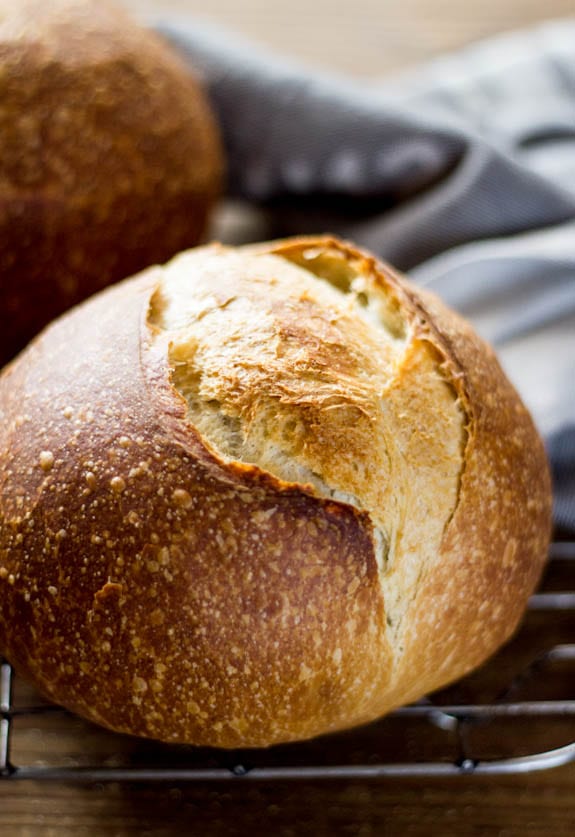
Think you can’t bake fresh, homemade sourdough bread? This easy sourdough bread recipe—trusted by beginner bakers for over a decade—shows you how, step-by-step. No yeast. No kneading. Just simple ingredients and 10 minutes hands on time for soft, crisp sourdough bread at home.
Reader review
“I have tried MULTIPLE sourdough bread recipes and this one has been the very first to make a successful (fully risen) loaf of bread. I am relatively new to sourdough and for some reason, the other recipes just didn’t produce good bread. These instructions and detailed explanations really make a huge difference to someone who is new to the world of sourdough.”
—Savannah
To anyone who thinks their sourdough bread isn’t good enough, I get it. Back in 2013, I set a goal: bake more bread. I tested, failed, succeeded (and tried again). What began with an easy no-knead artisan loaf eventually led to the holy grail: homemade sourdough bread.
Admittedly, I had beginner’s luck. My early scratch-made loaves were light, plump and airy, everything you want sourdough to be! And then? Down the rabbit hole I went: Hydration? Baker’s %? Proofing times?
Now, with 13+ years baking experience and a professional culinary background, I know what holds people back: the confusion, hesitation, comparison. I teach from a straight forward practical perspective because sourdough is not just a written recipe; it’s an understanding.
This sourdough bread recipe has been the most popular on my blog for over a decade- millions of views and the inspiration behind my bestselling book Artisan Sourdough Made Simple, a deeper dive into sourdough bread recipes. So, if you’re at the end of your rope (and just want to make good bread), you’ve made it. Welcome to the journey.
What Sets My Recipe Apart:
- One bowl, 5 ingredients
- Olive oil = soft, plush crumb & crisp, golden crust
- No stand mixer
- No bread machine
- Flexible baker’s schedule
- Personalized support in the comments
But before we make bread, let’s discuss what drives it: your sourdough starter. Once you understand what it is, and how it works, your path will be crystal clear. Have questions? Ask in the comment section. I respond with personalized help.
Where To Get A Sourdough Starter
A sourdough starter is a live fermented culture of flour and water. It naturally leavens bread dough without commercial yeast. There are all different types: homemade, purchased or gifted (ask a fellow baker!). I use two different starters at home: one I made myself, and a vibrant Australian starter gifted from my friend Celia.
But is doesn’t stop there. Once your have your own sourdough starter, it must be kept alive and well with regular feedings to maintain its rising power. Sourdough is not static; it’s a living process. Here’s my personal feeding schedule which you can adapt to suit your style:
How To Feed Sourdough Starter
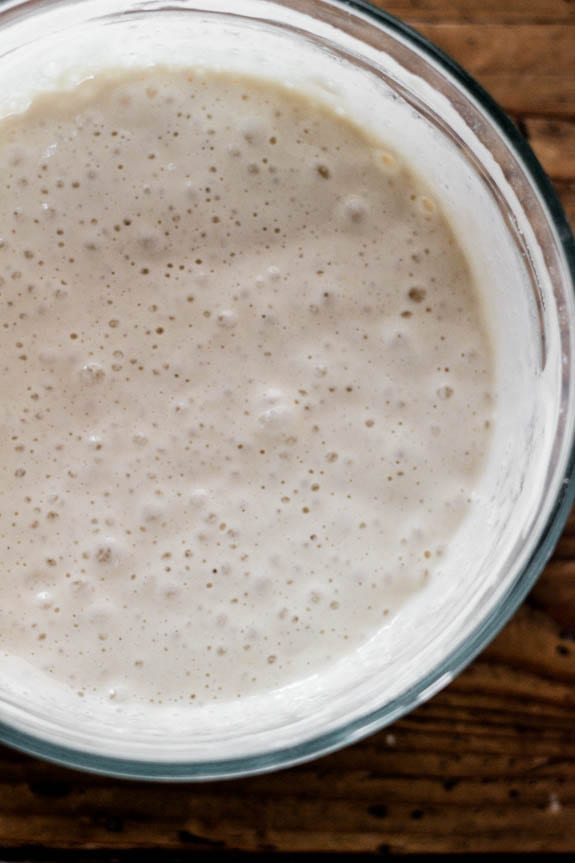
- Remove and discard half of your sourdough starter
- Feed what’s left in the jar with equal parts flour and water by weight (1:1:1 feeding ratio).
- Let rise at room temperature (loosely covered or airtight) ideally 75+F until bubbly, active and double in size (2-12 hrs). I use this sourdough starter jar.
Recommended Reading: Feeding Sourdough Starter: My Best Tips & Tricks
When Is Sourdough Starter Ready To Use?
Your fed starter is ready to use when it’s bubbly, active, and doubles in size. This can take 2-12 hours or more, depending on the temperature of your kitchen and the strength of your starter. My best advice? Be patient, plan ahead, and make sure your starter is in a warm place (ideally 75 F). The process is not instant.
Float Test: If you’re unsure whether your starter is ready, drop 1 tsp at peak height into a glass of water. If it floats to the top it’s ready to use. If it sinks, feed your starter again.
Storing Your Starter
Most people don’t realize that your feeding schedule is directly related to your baking preferences. If you only bake a few times a month, store your starter in the refrigerator and feed it once a week. If you bake often, store it at room temperature and feed it once a day.
How To Make Sourdough Bread: Step-By-Step Recipe
To Start: Feed your starter until it’s bubbly and active first (remember this can take anywhere from 2-12 hours, so plan ahead). Then mix the dough. Detailed instructions follow below. For a printable recipe & sample baking schedule, scroll to the end.
Step 1: Mix The Dough
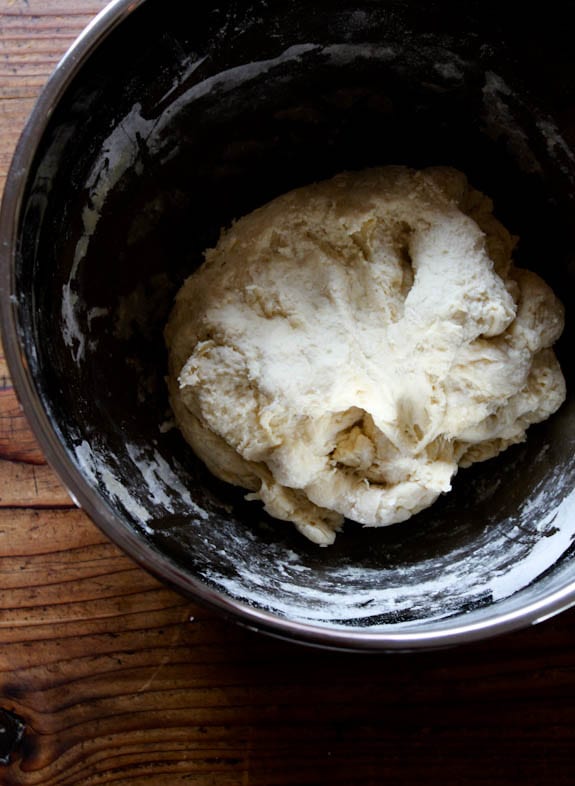
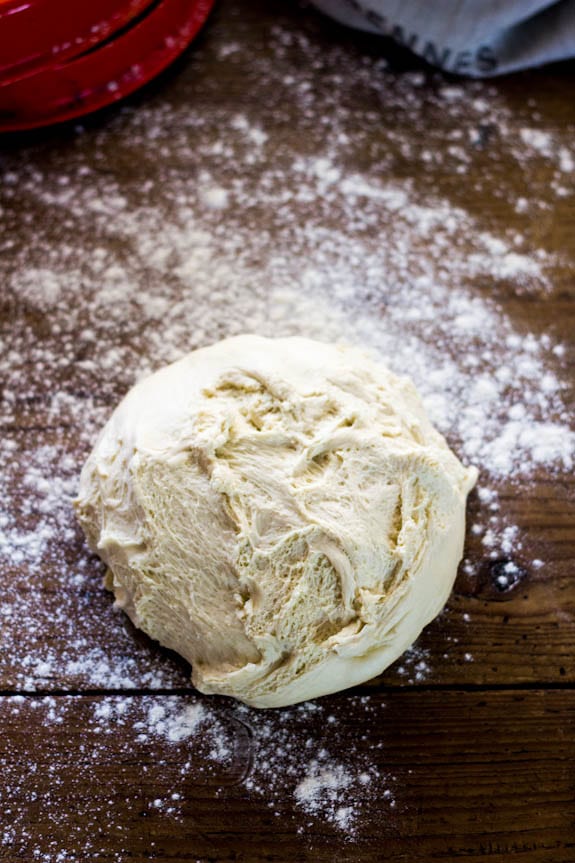
- Add water, sourdough starter, and olive oil to a large bowl. Whisk well to combine, making sure the starter is fully dissolved. Then add the bread flour and salt. Continue mixing (I use a fork at this point) until the flour is absorbed. The dough will feel rough and shaggy, which is normal.
- Cover the bowl and let rest (autolyse) for 30 minutes to 1 hour at room temperature. Then shape the dough into a rough ball. It doesn’t have to look perfect.
Tip: Weigh your ingredients with a digital kitchen scale. Measuring cups vary in size and don’t account for ingredient density which can lead to dry, dense, or overly sticky dough.
Why Autolyse Matters
Autolyse is the first rest after mixing bread dough. It jumpstarts gluten development without kneading, making the dough stronger, stretchier, and easier to shape I never skip it. For this recipe, rest for at least 30-45 minutes (or when time permits, I’ll do 1 hour for an even softer, more manageable dough). To learn more about common sourdough bread terms read my Sourdough Baking Glossary. I’ve included the only 12 you need to know!
A Note on Salt: Some bakers only add salt after autolyse, believing it slows down gluten development. I’ve followed that method for years, but now mix everything at once. It’s simpler, faster, and still makes excellent loaves (plus, you won’t forget to add the salt later on!). I’ll leave the choice up to you.
Want To Add Inclusions?
Mix in flavor additions after autolyse, when the dough is softer and more pliable. This is another reason not to skip the autolyse step. Alternatively, inclusions can be added during the first stretch and fold.
A few ideas:
- Roasted garlic
- Chopped olives
- Fresh or dried herbs (rosemary, thyme)
- Seed or nuts
- Cheese
- Dried fruit (raisins, cranberries)
- Jalapeños

Step 2: Bulk Rise
Now the dough is ready to rise. Cover the bowl with lightly oiled plastic wrap so the dough doesn’t stick to the top, or transfer to a dough tub. Let rise at room temperature, about 68-70 F (20-21 C).
How Long Does It Take For Sourdough Bread To Rise?
The dough is ready when it’s puffy, slightly domed and nearly double in size. This can take 3-12 hours depending on room temperature, the quantity and strength of your sourdough starter, and seasonal conditions. All variables work together. See my example below:
For My Sourdough Bread Recipe (with ~150 g sourdough starter):
- In the summer: ~2-4 hours @ 80 F (26 C)
- In the winter: ~10-12 hours @ 68 F (20 C)
Diving Deeper: Temperature controls time. This is where I see the majority of beginner baker’s make mistakes- the temperature is overlooked. Sourdough takes longer to rise than yeasted bread, and it’s highly dependent on your specific environment. My kitchen might be 75 F. Yours? 68 F. Watch the dough, not the clock. For more details and troubleshooting read my companion article: Why Won’t My Sourdough Bread Rise?
Stretch And Fold The Dough (Optional Step)
About 30 minutes into the bulk rise, you can perform a series of “stretch & folds” to strengthen the bread dough. This step is not mandatory; however it has the potential to add height and structure to the finished loaf. Check out my how to stretch and fold sourdough guide to learn more, step-by-step. It’s easy and fun to do!
Step 3: Divide & Shape The Dough
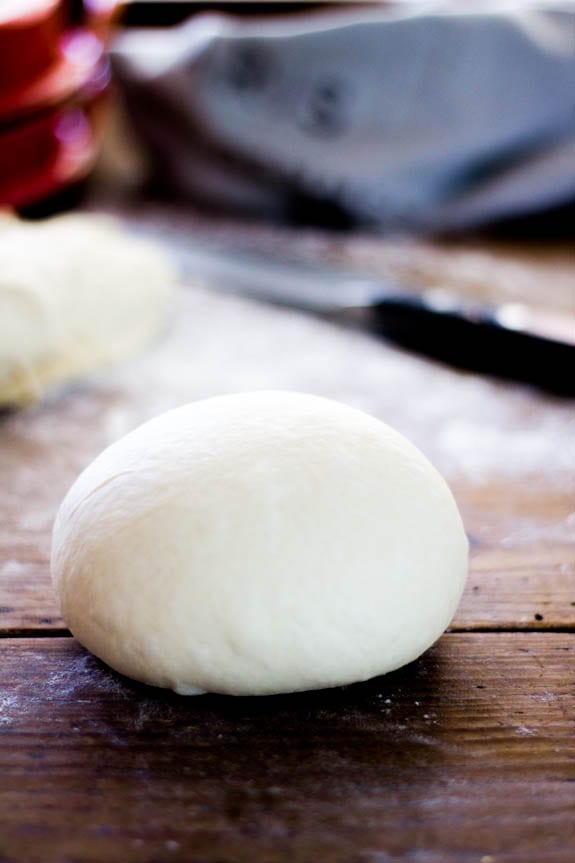
At this stage, remove the dough onto a lightly floured surface. For two smaller loaves, divide the dough in half. For a single, standard size loaf leave it whole.
How To Shape A Round Sourdough Boule (Loaf)
Starting at the top of the dough, fold it over toward the center. Give it a slight turn, and then fold over the next section of dough. Repeat until you have come full circle to form a tight round. This creates surface tension for better oven spring. You can also try the envelope-style fold.
Tip: I used to get so nervous when shaping bread dough because you only had one chance to get it right. So intuitively, I would practice using a piece of Play-Doh or with a kitchen towel to go through the motions at my own pace.
Step 4: Choose The Right Baking Pot
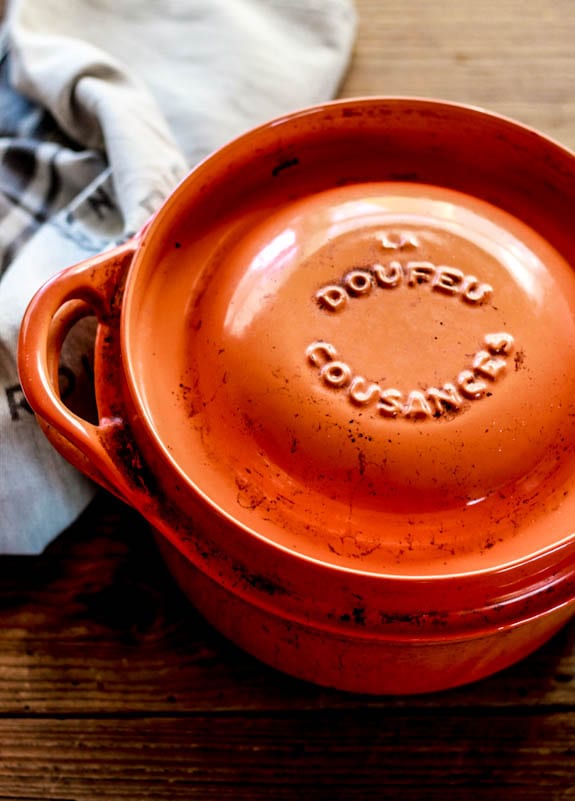
If you want bakery-style results, bake sourdough bread in a Dutch oven. Why? Pots trap steam which is the secret to homemade sourdough with bold rise and golden crust. Without steam, the crust will set too fast casing the loaf to harden, split or bake unevenly. I’ve been there and it’s not pretty.
What If You Don’t Have A Dutch Oven?
You’ll need another oven-safe pot with a lid to create steam. It must be able to withstand up to 450 F/232 C (lid and handles included).
A few options:
- Enamel roasting pan with lid (or sheet pan to cover)
- Cast iron skillet with upside down roasting pan to cover
- Covered sandwich loaf pans
- Clay Baker or Romertopf (soaked first)
- Preheated baking stone w/ metal bowl to cover
Here’s what happened to me: I tried the “no pot” baking route in the past, using just about everything from pizza stones, to baking sheets with no luck! The crust always hardened too quickly. Then I tried various steaming methods to remedy this (e.g. ice cubes in a hot pan, spraying my loaves with water) but my personal oven could not retain enough moisture. The environment was always too dry. For me, using a Dutch oven was the only reliable solution that worked with consistent results.
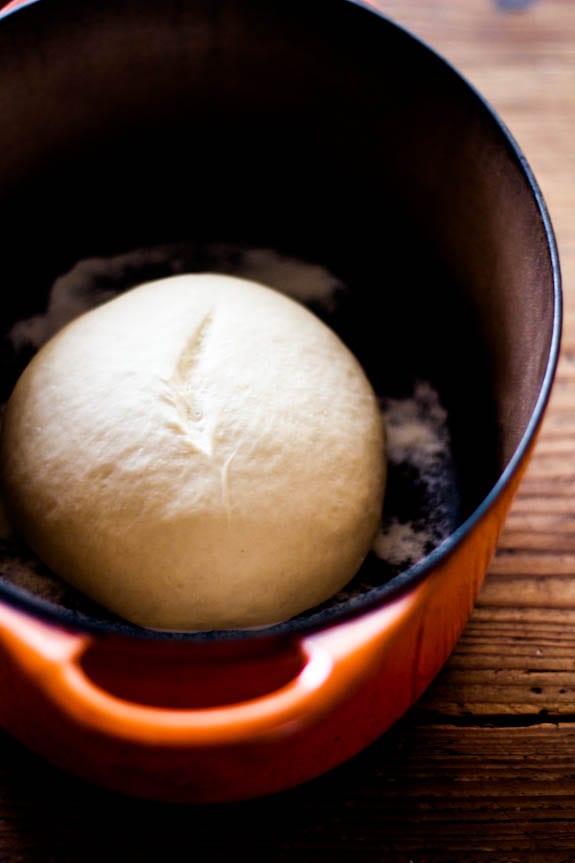
Step 5: Second Rise (Proofing)
- After shaping, your dough needs to rise again. To do so, generously dust the bottom of your Dutch oven with cornmeal, or line with non-stick parchment paper to prevent sticking. Gently place the dough inside (see tip below)
- Let the dough rise for 30 minutes to 1 hour, or until it’s visibly puffy and no longer feels dense. It doesn’t need to double in size. While the dough proofs, preheat your oven to 450 F (232 C).
Tip: Want better shape and structure? Proof the dough in a floured, cloth-lined, 8-inch bowl or banneton instead of directly in the Dutch oven. This will contain the dough and hold its shape without spreading. Bread flour or rice flour is fine for dusting.
Step 6: Score The Dough
- Right before the dough goes into the oven, make a shallow slash down the center of the dough, about 2-3 inches long. Use a small serrated knife, sharp knife or bread lame. This lets the steam escape, and allows the bread to “bloom” or expand in the oven.
- Admittedly, this step is a bit nerve racking, so I don’t want to gloss over it. Be quick and confident. I’ll share what my sourdough mentor told me: “Slash with panache!”
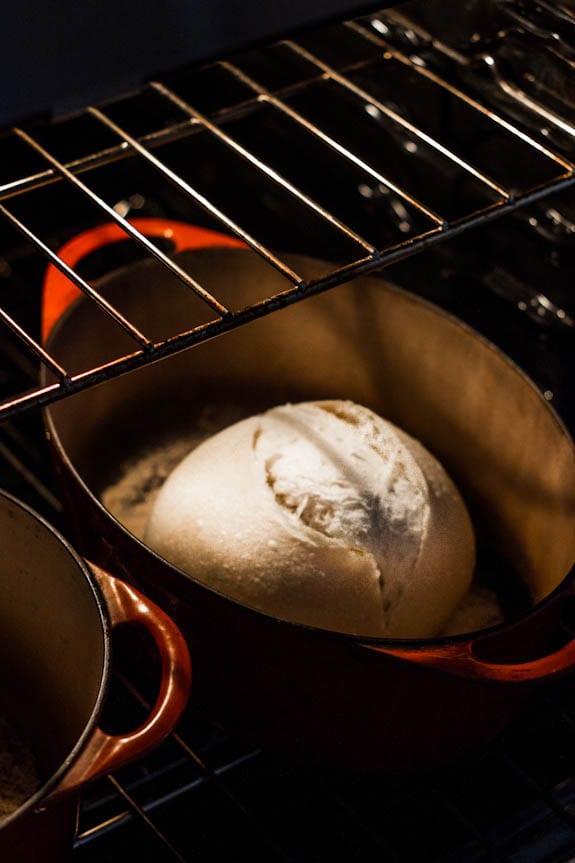
Step 7: Bake The Bread
You’re at the finish line now! Bake on the center rack (lid on) for 20 minutes. Then remove the lid. Your bread will look pale and slightly shiny. Then finish baking (uncovered) for 40 minutes or until the crust is deep golden brown. The internal temperature should be 205-210 F/96-98 C.
Tip: During the last 10 minutes of baking, crack open the oven door to let the moisture out. This creates a crispier crust. Or, remove the bread from the hot Dutch oven and bake directly on the oven rack. The latter creates the crispiest finish.
Step 8: Cool & Slice
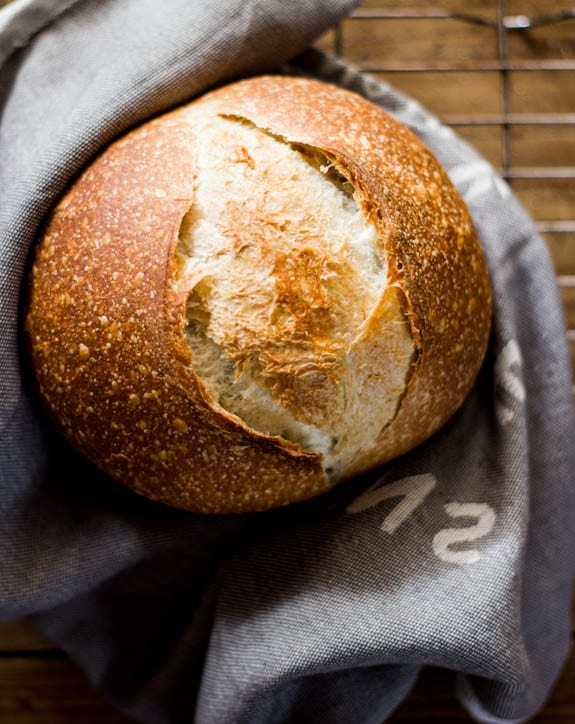
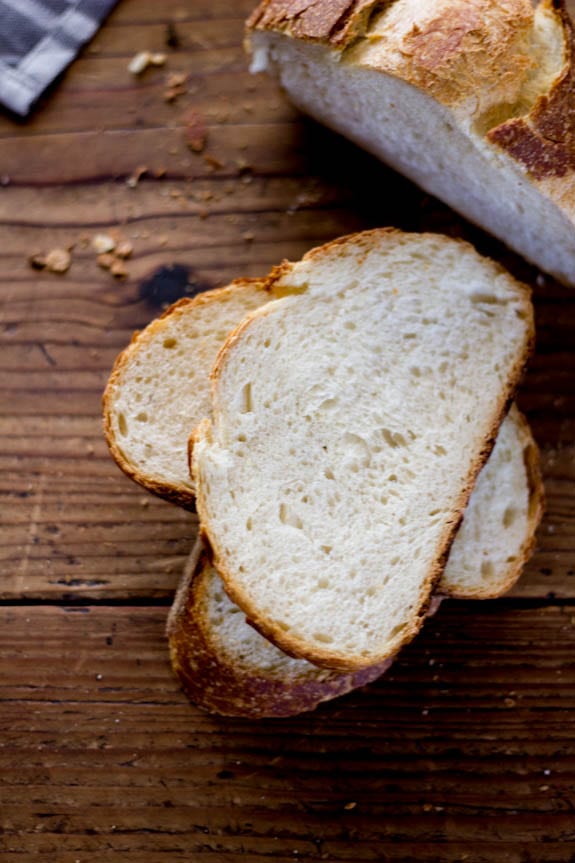
Cool the bread on a wire rack for at least 1 hour before slicing. Be patient! If you cut into it too soon, the texture will be damp and gummy. Life’s too short for sub par bread.
Final Thoughts
There are a gazillion sourdough bread recipes out there. No two loaves look alike. Start with this guide, master the basics and then branch out: try my golden sourdough focaccia recipe, this easy sourdough sandwich bread, or my one-bowl sourdough pancakes for breakfast! Once you have a few loaves under your belt, the process will become an imminent rhythm and you’ll become a sourdough pro in no time.
Sourdough Baking Schedule
- Friday Evening: Feed your starter, cover the jar, and leave it on the counter overnight. If you keep your starter in the fridge, it might need two feedings to perk back up (feed it in the morning & in the evening).
- Saturday Morning: Check your starter: if it’s alive and bubbling, you can make the dough to rise during the day. Or, feed it again in the afternoon to make the dough in the evening for an overnight rise. Remember to use the float test mentioned above to make sure your starter is ready to use.
- Saturday Morning/Evening (or whenever your starter is ready): Make the dough. Leave on the counter to bulk rise at room temperature. In the summer, if your dough rises quickly and you’re not ready to bake, cover the whole bowl with lightly oiled wrap and chill until ready to use.
- Sunday Morning: cut and shape the dough. Place in Dutch oven for second rise. Slash. Bake. Cool. Eat.
By signing up, you agree to receive emails from The Clever Carrot. Unsubscribe at any time.

Sourdough Bread: A Beginner’s Guide
- Prep Time: 13 hours
- Cook Time: 1 hour
- Total Time: 14 hours
- Yield: 1 loaf 1x
- Category: Sourdough Bread Recipes
- Method: Oven-Baked
- Cuisine: American
- Diet: Vegan
Description
New to sourdough? My easy beginner sourdough bread recipe makes the best artisan-style loaf at home with just 5 simple ingredients: bread flour, active sourdough starter, water, salt and olive oil—my signature addition—known for creating a light, plush crumb and a crisp golden crust. Follow my clear, step-by-step instructions and video guidance to bake fresh sourdough bread with confidence (even on your first try!).
Ingredients
- 150g bubbly, active sourdough starter
- 250g warm water (see Note 2)
- 25g olive oil
- 500g bread flour (not all purpose flour)
- 10g fine sea salt
- fine ground cornmeal or non-stick parchment paper
Notes, Tips & Equipment
- Weigh your ingredients with a digital scale for best results
- For a more soft and pliable dough, increase the water up to 300 g- 325 g total. Use a floured, cloth-lined bowl or proofing basket (instead of the Dutch oven) for the second rise.
- You will need a 5 1/2 or 6 quart Dutch oven for baking
- This recipe was tested with King Arthur Bread Flour, Gold Medal Bread Flour, Pillsbury Bread Flour
Instructions
Make The Dough
In a large bowl, add the sourdough starter, water and olive oil. Mix with a fork to combine, then add the flour and salt. Continue mixing until the dough becomes stiff, then squish it together with your hands to incorporate all the flour. The dough will be rough and shaggy.
Cover the bowl with plastic wrap, reusable wrap, or very damp kitchen towel. Let rest (autolyse) for 30 minutes to 1 hour.
After resting, return to the bowl and work the dough into a rough ball, about 15 seconds.
Bulk Rise (First Rise or Bulk Fermentation)
Cover the bowl with lightly oiled plastic wrap. Alternatively, transfer the dough to a high-sided dough tub. Let it rise in a warm place, ideally 70-75 F. The dough is ready when it no longer looks dense and has almost doubled in size.
Note: The bulk rise time will be different for everyone. For example, in the summer, expect ~2-4 hours @ 80 F/ 26 C. In the winter, ~10-12 hours @ 68º F/ 20º C. Watch the dough and not the clock.
Optional Step: Stretch & Fold The Dough
During the bulk fermentation, you can do a series of ‘stretch & folds’ to strengthen the dough. Start 30-45 minutes in: lift a portion of the dough, stretch it upwards, and fold it over itself. Rotate the bowl ¼ turn and repeat until you’ve come full circle (1 set). Do 1-2 additional sets, spaced ~1 hour apart. Click here for a step-by-step video tutorial.
Note: Dough made with 250g water will feel stiffer; 300-325g water will be more stretchy and elastic. Let it rest longer in between sets if it resists stretching.
Shape The Dough
Remove the dough onto a lightly floured surface. Starting at the top, fold the dough over toward the center. Turn slightly, and then fold over the next section. Repeat until you have come full circle. Flip the dough over, seam side down. Gently cup the sides and rotate in a circular motion to tighten the shape. The goal is to build surface tension to create a tight ball (too much flour will cause the dough to slide around).
Second Rise
Now the dough needs to rise again. If you’ve used 250g water, you can do a free-form second rise in the Dutch oven (if not, see note below). Line the pot with a piece of parchment paper (this is what I do) or coat with cornmeal. Place the dough inside, cover and let rise for about 30 minutes to 1 hour. It’s ready when slightly puffy, but not double in size. Preheat your oven to 450 F/ 232 C.
Note: If your dough contains more than 250g water, skip the free-from rise. Your dough will spread. Instead, use a floured, cloth-lined, proofing basket to help hold its shape.
Score The Dough
Right before baking, make a shallow 2-3 inch slash (or longer) in the center of the dough using a bread lame, razor blade, or small sharp knife. The cut should be ~1/4-inch deep.
Bake The Dough
Place the bread in the oven on the center rack (lid on) and reduce the temperature to 400 F/ 204 C. Bake for 20 minutes, then remove the lid, and continue to bake (uncovered) for an another 40 minutes, until deep, golden brown. All ovens are different; feel free to make minimal adjustments to these temperatures.
Check for doneness with a digital thermometer: 205-210 F/ 96-98 C for sourdough.
Remove the bread from the hot Dutch oven, and cool on a wire rack for at least an hour before slicing.


Comments
Stacia Bearden says
I have been baking yeast breads for decades, but this was my first experience with sourdough, and your page was very informative and easy to follow. My bread turned out absolutely delicious! Thank you for providing great detailed information.
However, I do have a question. I am almost out of unbleached flour, and most stores are out of it in my area, but I was able to find a large bag of all-purpose flour at a large warehouse store. Can I use it? How will it differ?
Emilie Raffa says
Hi Stacia! You’re very welcome. Please see the FAQ Section above (I’ve just recently updated it re: flour types). Hope this helps!
Helen says
Hi,
I’ve made your all-purpose flour recipe 3 times now and they all turned out great. I was wondering about some of the small differences between that recipe and this. For example, is there a particular reason you score it down the middle for this one but create 4 cuts for the other one? The other recipe also bakes at 425 but this one at 400.
Thanks!
Helen
Emilie Raffa says
Hi Helen! For scoring, there is no difference. Just preference in style and to provide variety. For the bake time, this dough is dryer than the other one so baking at a higher temp can dry it out.
Leah says
I’ve been told that to make the bread even more sour to do the 2nd rise in the fridge but for a longer time than you have noted. Would this be your recommendation? I obviously LOVE super sour bread!
Emilie Raffa says
Hi Leah! It all depends on the specific recipe you’re following. In my experience, yes, doing the second rise in the fridge can make the dough more sour usually when the bulk rise was done at a warmer temperature, around 80 F. The length of second rise fridge time will vary; it depends on the length of the bulk rise.
Bill Dixon says
HELP!
Have your Artisan Sourdough Book, Have been making Sourdough Pancakes and biscuits from my own starter for years, and making non-sourdough bread for years..mostly the same as above with yeast instead of starter.
I’ve tried this recipe (book) 3 times now, by weight and all I get after 20-24 hours of rising, is a runny goo that in no way can be shaped or coaxed off the bench into a dutch oven…what in the heck, am I doing wrong?
Emilie Raffa says
Hi Bill! Hang in there! If you’ve weighed your ingredients (great!) and are 100% positive you have added the correct quantity of water (hope so!), it’s most likely your flour; it’s not able to absorb the liquid. Are you using bread flour? Or plain ap flour? What brand? Thanks!
Bill Dixon says
AP Flour…(book recipe) Store brand now as it’s what I can get..normally Bobs Red Mill (Local) or Kings…
Bill Dixon says
On my scale, 350G of water is a bit over 1-1/2 cups…..is this my issue? (To be honest, I’d never checked that before…
Bill Dixon says
Emilie, I think the water is my issue…350g converts to 1.48 Cups (1-1/2) 1.33 cups, converts to 315g??
Thank You so much for spending the time trying to help me!!
Emilie Raffa says
Bill, it’s your flour. The Everyday Sourdough (book recipe) calls for bread flour not ap flour; they’re not the same! Using ap flour with 350g of water will make the dough wet and sticky. Plus, it could be the specific brand of ap flour too. Also: use your scale instead of measuring cups to weigh the water. Next time, try the same recipe (using ap flour) with 300 g of water to start. If it’s incredibly dry, increase the water 1 tbsp at a time.
Bill Dixon says
Emilie,,,I have zero idea how I kept overlooking that!
Thank you!!!
Emilie Raffa says
No worries :)
Alex says
Hey thanks so much for posting this recipe? Been looking for a good one everywhere.
Can I use whole wheat flour instead of bread flour to bake the sourdough? My starter is made from an 80/20 mixture of bread and WW flour.
Emilie Raffa says
Hi there! I wouldn’t sub whole wheat flour for bread flour in this recipe. It will be too dense without making additional adjustments. Your starter however, is totally fine to use.
Josh says
Thanks for the back to basics approach, it helped me solve my sourdough rolls. One idea: you said you didnt find pizza stones to work. I’ve been baking mine on my pizza stone. I do my final shaping/rise in a 9 inch wide bowl. Then I turn that upside down onto my preheated pizza stone. I put a 3 gallon pot upside down over it and place it all into my oven, 22 minutes or so with the pot on, 20 with it off. If people want to use the pizza stone (it’s nice for bottom crust), that might be a way to solve to lack of steam injection issue.
Emilie Raffa says
Yes! I’ve heard of this before. Thanks for sharing your tips, Josh. Very helpful!
Kathryn says
Is using bread flour a must? I am having a hard time finding it in my nearby grocery stores. It’s been sold out. I have a lot of unbleached all purpose flour, which is what my starter is made with. Will this be okay to use?
Emilie Raffa says
Hi there! Yes: bread flour is preferred for this particular recipe. The two flours are not always interchangeable in bread baking. As a work around, if you only have all purpose flour on hand please use my Artisan Sourdough with All Purpose Flour recipe instead.
teri says
I just tried this recipe for the first time. The loaf was pretty and yummy, but there wasn’t much sourdough flavor. Is there any way I can make my bread a bit more sour? Thanks!
Molly D says
So, I’m pretty sure I let mine bulk ferment too long. It’s VERY loose! I can’t get it to hold any shape. It’s just a bit tighter than the starter. If this happens again, can I just add more flour to save it?
Emilie Raffa says
Hi there! Make sure to weigh your ingredients first, use bread flour only, and shorten the bulk rise to prevent over proofed dough. Adding flour after the bulk might deflate all of the air bubbles. You can always salvage the dough by making focaccia instead.
Marius Mannix says
i just want to thank you so so so much for this amazing article! Thanks to you I’ve had a successful sourdough starter. Also your details about making bread itself has done me wonders! ive made several great sourdough breads and i even made three of them by juicing spinach instead of water!
Emilie Raffa says
You are quite welcome, Marius! Love the spinach juice idea. Fun! x
Donnatella Alexander says
I’m looking into buying a starter from Thrive market and thought I’d google about baking sourdough and yours was the first (and only) I read before deciding to try. I love sourdough!! Yay your books sold out on Amazon-congrats! I look forward to purchasing it!!
Thnx!
Emilie Raffa says
Thanks so much Donnatella! x
Nancy J Hamilton says
Hi. I don’t have a scale. Can you tell me how the weight measurement of starter translates into cups? I thought I saw the answer to this earlier but now can’t find it…sorry! Hope to hear back soon!
Emilie Raffa says
Hi Nancy! It’s listed in the FAQ section above.
Sarah says
Hello! Thank you for these detailed instructions! Do you adjust the bake time if you make two loafs from this recipe as opposed to one large one? Thanks so much!
Sarah
Emilie Raffa says
Hi Sarah! Please see the FAQ section above! :)
Jennifer Hill says
Hi there!
I’m running out of time during the Bulk Fermentation-it’s 6pm here and I’m only an hour in on the 1st rise.
How do I continue the Bulk Fermentation in the fridge-and then continue the steps in the morning?
Thanks!
Jennfer
Emilie Raffa says
Just pop the dough in the fridge if you’re worried it will over proof on the counter (overnight). It won’t rise much. The next day, leave it out at room temperature to double in size. Then, proceed with the next steps.
Bob hardin says
Howdy, I like to grind my own wheat flour. Do I need to adjust the measurements? It’s getting so difficult to find bread flour.
Emilie Raffa says
Hi Bob! It’s very possible. It all depends on the variety you’re using. You’ll have to go by feel (which can be tricky if you’re just starting out). Consider adding more water to the dough as suggested in the recipe section; the dough should feel soft and manageable and not sticky.
Kit says
Hi thanks for your extremely informative recipe – I’ve been covid baking with yeast and today is my first use of the starter I’ve been tending for 10 days. With your “easy” recipe. I’m excited! This is a question that applies to all bread recipes I’ve tried. After mixing the ingredients and rough shaping for autolyse or first rise the bowl still has sticky bits all over the sides. Do I take the dough out and clean the bowl before proceeding or leave the bowl as is? Thanks!
Emilie Raffa says
Hi there! It’s up to you! If the flour has absorbed the water properly, the sticky bits should be minimal. Either get in there and work the odugh with your hands or simply transfer to a new clean bowl.
Bethany says
Why does this recipe come out looking like brown, rather than the typical white you think of when you think of sourdough bread? Is it because you begin the starter with wheat flour? Or is it the bread flour, and if I made it with all purpose it would be white? It still tasted good, but just wondering what to tweak if I want a more traditional white sourdough. Thanks!
Emilie Raffa says
Hi there! Not sure what you mean? The crust is brown and the inside is white. The bread flour + starter is unrelated. :)
Lu says
I have the same question. The inside is not white like your picture (It’s brownish) and mine also has more “holes.” On the outside it looks just like yours. I followed your instructions to a t
Emilie Raffa says
Hi there! If you’re bread is brown on the inside it must be the type of flour you’re using. Perhaps you’ve added whole wheat? Sourdough made with white bread flour should not turn the inside crumb brown. Sorry I don’t have an answer for you… I’ve never heard of this before :)
lu says
Thank you for the reply….my starter did have 1/2 whole wheat and 1/2 APF because I had read that it is better to use wheat as if absorbs better. I don’t normally use whole wheat but bought some for this purpose. The bread was good it just didn’t look like yours and that’s what turned me onto this recipe! This is the way I want my bread to look! I will try to just feed my starter white flour….would you think it would be ok to use bread flour to feed my starter instead? I’m not sure if you could answer this question or not but figured to ask! Blessings!
Yuri Clingerman says
This recipe with precise step=by-step instructions and photos and tips was such a big help! I did my research and searched for the best recipe out there for an easy and simple sourdough bread recipe and this is it! I especially appreciated the explanation on low vs high hydration dough because I definitely prefer low hydration (i.e. I like my butter to stay on when I spread it instead of flowing out through holes). So happy that my sourdough bread turned out so awesome and yummy! Thank you!
Emilie Raffa says
Fantastic! Enjoy!
Jen says
Hi! Still find your recipe to the best at explaining and results :) I want to try making this as an oval, would a 10″ oval banneton work? Thanks for making us all feel like expert bakers!!
Emilie Raffa says
Hi Jen! Thank you! Yes, the 10″ or 12″ oval banneton will work.
Sara says
Hello! I am currently attempting my very first sourdough loaf! Had some troubles with achieving an active starter, but now, after 3 weeks of patience, it is passing the float test! My question is this: I am having a hard time with finding the right amount of coverage for my starter – some mornings it will develop a skin in which I take off, which appears to be okay, and other mornings I wake to find a lot of condensation on the glass. Do you have any suggestions for covering of the starter as well as the placement of it? I thought perhaps the place I was putting it was too warm (hence the condensation), but if I move it it does not double in size within the 24 hours. Many thanks!
Emilie Raffa says
Hi there! A skin forms when there’s too much air getting in the jar. I’d just use a lid, plastic wrap or reusable wrap. Leave it where it is and see what happens!
Sarah D says
Hi – this looks amazing. But I have scrolled up and down a million times and cannot see a list of the actual ingredients/measurements anywhere! Am I going mad? Or are they in a separate link somewhere?
Emilie Raffa says
Hi there! All of my recipes are listed at the bottom of each post. Perhaps the page didn’t fully load? Also: try refreshing your browser to see it that helps! x
Laura Middleton says
Hi Emilie,
This recipe is great and I am really enjoying my sourdough journey!
I’ve tried this recipe a few times, first time I didn’t wait long enough to cut into the bread and it ended up having a gummy texture. Second time round I left the loaf to cool completely before cutting into it, but it still has a gummy texture. I don’t know if this is because it is under baked or could be because of something else? Any advice would be greatly appreciated :). Thank you, Laura
Emilie Raffa says
Hi Laura! If the loaf was completely cool when you cut into it, it was most likely undercooked. Make sure you’re using an oven thermometer and/or take the dough’s internal temperature.
Diana says
Hi- when you cover the bread during the rises, is it ok to cover the bowl or so you actually put the plastic wrap on the dough itself? (First timer….cannot wait!)
Emilie Raffa says
Hi there! Cover the bowl (not the dough). Have fun!
lisa says
hi, thanks for all the info. I am a little confused why some people have long bulk ferments overnight on the bench, and others have a few hours only before placing into the fridge. A bit confused which is better, a long time on the bench overnight or a long time in the fridge overnight with say 4 hours out on the bench with folds and turns prior. What is better for the overnight? fridge or counter?
Emilie Raffa says
Hi Lisa! It depends on the baker’s schedule, temperature, and preference. One is not better than the other, just different. As you continue to bake and experiment with your specific conditions you’ll see what method suits you better.
Maxine says
This is a fantastic recipe! I’ve recently gotten into baking sourdough after successfully growing my own starter and this recipe has to be the best one I’ve found. I think the olive oil really helped the crust be light and crispy. I let it bulk ferment for about 6 hours and I did three sets of folds after an hour for the first 3 hours. For the second rise, I did about an hour and a half. I did cut the dough into 2 loaves and I baked the first loaf for 20 minutes with the lid on and about 25 with the lid off in a 5 quart Chrissy Teigen Dutch oven and there was plenty of space. So if anyone makes a single large loaf, a 5 quart Dutch oven will be fine. The second loaf is in the fridge and I’ll be baking it tomorrow. I have high hopes! I’ve been looking for overnight sourdough recipes and if the loaf tomorrow turns out well, this will definitely be my go to recipe for years to come! Thank you so much!!
Emilie Raffa says
This is so wonderful to hear! Thanks, Maxine!
Rachel says
Hi! I made this recipe with the starter also from your site (thank you!) and both were great! I’m baking again but I think I started to early in the evening (6pm). It’s about 11pm more and I think my bulk fermentation is done. I want to go to bed :) can I put it in the fridge over night? What needs to happen before I bake? Do I need to let it come to room temp before I shape and proof? Any guidance here is greatly appreciated. I hate to waste this good flour during lockdown!! Cheers!
Emilie Raffa says
Hi Rachel! Yes, you can put the dough in the fridge. It won’t rise much. The next day, wait for it to double and proceed with the next steps.
Kristen says
Thank you so much for this recipe. I have been trying to make sourdough bread for months with little success. My starter seems robust, and I always follow the instructions as close as possible, but the other recipes I followed never resulted in a good loaf. I can bake other yeasted goods with no problem so the learning curve with sourdough has been frustrating. I kept looking up information to learn as much as possible about the sourdough process… and still kept failing. I was 100% ready to give up, but I had enough ripe starter to give it one more try and I felt bad throwing it out… so I decided to try this recipe and I finally got a good loaf!!! I think a low hydration dough is going to be the way for me to go moving forward. Thank you for giving me enough hope to not give up on sourdough.
Emilie Raffa says
Excellent! You are very welcome! Keep on baking, Kristen :)
Karen Hilgartner says
This is a great recipe for beginning sourdough bakers. This is my third time using the recipe. Since the pandemic began, I have been unable to find bread flour, so I have been using wheat and all-purpose in different combinations. The starter was originally made and fed with whole wheat, but later fed with all-purpose (depended on what I could find in stores). The 100% wheat came out tasting like a dark German beer bread and the half wheat/half all-purpose made a nice white/wheat combo. My favorite is the all-purpose only–the dough is a little more gluey, but using your stretching and strengthening method (2 times, 1 hr. apart), and then covering with plastic wrap and a towel all night worked great. I cut, shaped and baked the next morning. I used corning wear casserole dishes with glass lids and parchment paper in the bottom every time. The first two times, I baked 2 large boules, the last time, I baked 4 small. (I made 2 recipes of the dough each time). I reduced the bake time (with the lid off) to 30 min. with the smaller boules. Thank you for all of the great tips–made everything really easy to follow–I am now getting a feel for the dough, and delighted to “Feed” my starter babies once a week! :)
Emilie Raffa says
Thanks so much for sharing your tips, Karen! Absolutely wonderful!
Dylan says
I made this! I’ve had a few disasters trying to make sourdough foccacia since we’re in lockdown and I can’t get yeast anywhere, but thought it was time to try a proper boule – and it worked out great!
I only have plain flour so I used that, but made sure to do two stretch and folds before bulk fermenting overnight to help the gluten. Ditto with a dutch oven, but I used a cast iron pan lined with parchment, and a metal mixing bowl inverted over the top, and a small tray underneath with water in, and go a great oven spring!
I really look forward to making this again, I’m not the biggest fan of sourdough in general but have a mighty love of bread and I’m determined to be able to make a consistent good loaf until I can get a good stock of yeast back in my pantry!
Emilie Raffa says
Dylan, this is great! Thanks for sharing your tips! :)
Lorna McCombe says
I am so delighted to have found you and your book -i t arrived two days ago, my starter has been doing nicely, I’ve bubbles but not quite growing as fast but it’ll get there, your book it’s just a joy, it is full of recipes I just can’t wait to try, I’m going to go slowly with beginner bread but they all look fab. I’ve had 3 daughters and always baked and made my own bread but played safe with yeast, it’s actually my youngest daughter’s friend who had said go for it, it’s not as scary and bewildering as you think 😊 I’m in the UK just in case you’re interested how far your reaching. Thanks Emilie. Lorna x
Emilie Raffa says
Hi Lorna! Thank you for taking the time to comment. Very much appreciated. Enjoy sourdough, it’s absolutely incredible! x
Lorna says
Success!! My sourdough is just wonderful thank you thank you thank you.
Xxx
Emilie Raffa says
Lorna, so nice to see you back here! I’m thrilled for you! x
Stephanie says
Hi Emilie!
I’m hoping you see and respond to this before I get too far into the bulk fermentation. So I’m attempting the “fold” technique but my dough is a bit dry and crumbly do it’s kind of hard, even with wet hands. Any thoughts?
Also, how long do you suggest the fold technique at 30 min/hour intervals? One full revolution of the ball (4 times)?
Thanks in advance for the feedback! I’m excited to be making my first loaf 😊
Emilie Raffa says
Stephanie, the dough should not be dry or crumbly at all. There might be too much flour in the dough or it wasn’t mixed properly! Did you weigh or measure the ingredients?
Regarding the stretch and folds, I have a video in this post. Scroll down to the “Stretch and Fold” section.
For this particular dough, the intervals should be appx. 45 minutes to 1 hour apart. At the 30 minute mark, the dough might still be too stiff to stretch. One full revolution (4 folds) is one set. Good luck!
Stephanie says
Thank you for your response. I wish I could send you a picture ☹️ I measured because I don’t have a scale…wish me luck!
Stephanie says
Now it looks like it’s getting smoother & more manageable! Maybe it can be salvaged after all😊!
Stephanie says
Hi Emilie,
Thank you so much for your feedback. Despite being somewhat discouraged initially because it was dry, I hung in there and the recipe turned out great! My first sourdough loaf and everyone in the family said it was wonderful!
Thank you so much for the great recipe and being available to respond!
Emilie Raffa says
Ahh! I’m so glad you came back to report! Sourdough just takes practice, that’s all. The more you do it, the more you’ll get to know the dough. You’re doing great! xx
Deanna Donnelly says
Thank you so much for the wonderful sourdough starter and bread recipes! My goal during this lockdown was to learn to bake….I am an avid and joyful cook but have never enjoyed baking…..you changed this for me! I baked one loaf of bread prior to finding your site and then jumped in to the holy grail……SOURDOUGH! Your recipes are easy to follow and give great tips…..thank you so much! I stored my starter in the fridge and it woke up beautifully- over the top of the jar or be exact; my 2nd loaf is bulk fermenting as I type and I will definitely be making often! Cannot wait to try more of your awesome recipes! Thank you again!
Emilie Raffa says
Deanna, this is so nice to hear. You are quite welcome. Enjoy sourdough… it’s such a fantastic, rewarding (and delicious!) craft.
Lennart says
Great recipe. Have been working on a starter since the pandemic outbreak. Somewhere during the second week the starter became predictable. I would recommend others to stick to whole wheat a little longer and transition to white flour once the starter becomes more predictable. I altered the bread recipe to have 20% whole wheat, 80 grams of raisins and 80 grams of hazelnuts (crush ’em). It comes out really nice: good balance between sourness of the bread and sweetness of the raisins and the hazelnut crunch just makes a great bite. Thanks for the great recipe and inspiration!
Emilie Raffa says
Thank YOU for the fantastic tips! x
Tammy says
Hi
Can you please give a recipe with instructions for starter
I am starting from absolute scratch
Thx
Tammy
Emilie Raffa says
Hi Tammy! It’s linked above in the Sourdough Starter section.
Yemaya says
Hello!
I am currently experiencing my first sourdough bread (or any bread) making experience. I’ve encountered a small obstacle. I mixed the flour into a jagged ball (not all the flour incorporated easily so I wet my hands during mixing… was this bad?), left it on the counter overnight, and by morning it had expanded to fit the shape of the bowl but was still very dense looking with not much rise. I thought it might be cold so I stuck it in the oven with the light on. In the oven, it expanded, it bubbled, and 12 hours later, seemed ready. I slid it out of the bowl to fold it and found it to be super sticky and unmanageable so I’ve placed it back in the bowl to proof longer. I’m thinking I proofed the top of the dough and not the bottom (is that a thing?). Is it possible to continue proofing after the dough has been taken out? Does the entire surface of the dough need access to air when proofing? Thanks!
Emilie Raffa says
Hi there! Regarding the stickiness: it sounds like there was either too much water in the dough and/or the dough itself was too warm from sitting in the oven. Weigh your ingredients for best results and/or shorten the length of time when warming it up.
To answer your questions: it’s possible the top of the dough was warmer than the bottom. I would not continue the bulk rise after the dough comes out of the bowl. You should proceed to the next step. The surface of the dough should not come into contact with air; it will dry out and form a skin. Keep the bowl covered with lightly oiled plastic wrap or a damp kitchen towel.
TY says
Hi and thanks so much for all of the lovely info on your website. Any advice on how to make a whole wheat loaf? If I wanted to add some whole wheat flour to this recipe, what ratio of bread flour would you swap out, and would you increase the water? Thanks in advance!
Emilie Raffa says
Hi there! Adding whole wheat flour to this particular dough will make it too dense. I’m posting a new recipe with whole wheat soon with more specifics. Stay tuned.
Kimi says
Thank you so much for this recipe!! I have been playing with it for the last two months with great joy :) I was curious to know if I could divide this into 4 smaller boules rather than two? Has anyone tried this and/or what would the estimated baking time be? Thank you!!!
Dawn says
Where did you get your gray tea towel? I love it! Thanks for the great recipe.
Emilie Raffa says
Hi Dawn! I got it years ago from from Sur La Table :)
PKS says
Hi! I’ve made this recipe a few times with the bulk ferment on the counter and it’s been perfect–thank you! Last night I tried to do the bulk ferment overnight in the fridge and it doesn’t feel like it really doubled (or even came close). Should I leave it on the counter and wait for it to expand? It’s a somewhat warm day here (mid-60s now right now). Are there other ways than size to test if the bulk fermentation is done?
Thank you!
Emilie Raffa says
Hi there! You are correct. Wait for it to almost double at room temp, then chill it overnight. It will not rise that much in the fridge. Give it more time if necessary the following day.
Some bakers use the poke test, but it’s not my favorite as it can be inaccurate and doesn’t apply to cold dough. The window pane test is another one you can try.
Viviane says
I am in lock down in the UK. I am trying to bake my own bread, sourdough if I can handle it. This was a great help but I have one question: I received some Mad Millie starter in sachets. It explains how to make 2 loafs with one sachet. Can I just make a starter with it that I can feed and store as it is hard to buy yeast or starters right now. Thank you for the detailed explanation.
Cannot rate the recipe as I did not try it but will rate your explanation instead!
Emilie Raffa says
Hi there! Unfortunately, I’m unfamiliar with Mad Millie so I’m unable to advise properly. However, it doesn’t hurt to experiment! If you do use it to make a starter, it will still need to be fed with additional flour and water to keep it alive. So I don’t see why not! Hope this helps a bit, Viviane :)
Peter says
Just to note, the ounce conversions could be rounded to more convenient numbers. e.g. 5 ½ oz / 9 oz / 1 oz / 18 oz. They might not be the same precise % of increase for each one, but it shouldn’t matter. Some scales use fractions of ounces, so it’s not easy with the decimal versions.
Emilie Raffa says
Hi Peter! Yes, good point re: the types of scales. Do as you see fit!
Peter says
Thanks for your reply. I meant it would be easier for people looking at this in the future if the recipe was updated. The current ounce measurements are awkward to work with.
Molly says
I noticed the recipe calls for a 5.5 or 6 quart Dutch oven, but I only have a 7.5 quart. Will this greatly affect the final product? Will it not bake/rise properly, or not keep its shape?
Emilie Raffa says
Molly, you’ll be fine! The dough is not supposed to touch the sides of the pot so bigger is definitely doable.
Kirstin Carlin says
Hi there I am writing from New Zealand. I have started your beginner sourdough recipe a bit late in the day and it has just started Bulk Fermentating now at 5pm.
Is it okay to leave this dough in the fridge overnight (it is Autumn here and about 18 degrees right now).
Many thanks
Emilie Raffa says
Hi Kristin! Yes, the dough will be fine in the fridge overnight. In the morning, give it more time to double in size if needed.
Jon K says
Hi, I have used your site to create my first sourdough starter and now my first sourdough bread- which is fabulous. I have a couple of questions – how large a dutch oven should I be using? Mine is 26cm and my bread seems to be quite flat. Is there another reason why my soudough might be a big flat – still lovely though!
Thanks
Emilie Raffa says
Hi Jon! I recommend a 5 1/2 qt or 6 qt Dutch oven for baking. A baking pot larger than this should not effect the overall shape of the bread; your loaf is flat for other reasons. The dough could be over proofed during the bulk stage or second rise (rose for too long), shaping issues, too much water in the dough, dough never doubled during the bulk rise etc. There are many factors to consider. Perhaps something rings a bell here? Hope this helps!
Patrick says
I had the exact same problem. I followed the directions precisely, but the dough was still on the wet side. Starter passed the float test. Dough never seemed to really swell, even with the oven’s proofing mode to keep it warm on this relatively cool day. And I could never get a real tension on the surface during the final shaping.
Dennis says
Just started on my sourdough journey and have had excellent results with this recipe.
Question if I may – would it be a reasonable approach to form the dough into two long loaves after bulk fermentation, let the loaves rise, and bake on a baking sheet or stone: in other words, not bake in a Dutch Oven ?
Cheers
Emilie Raffa says
Hi Dennis! Fantastic! Bread baking is tricky without a pot because you’ll have to add another steaming method to your oven. It can in fact be done on a sheet pan or a stone, but it will takes some experimenting to get the conditions. Plus, this is a low hydration dough. It needs moisture as it bakes.
Now, they do make oval size baking pots and roasters if that’s of any interest to you. The Challenger Bread Pan is another option and it accommodates both round and oval loaves.
Hope this helps!
Aliza says
OMG, thank you so much for this recipe. This was my fourth attempt, finally got perfection. So moist, perfect crust and oh so delicious. And the family agreed.
Emilie Raffa says
Excellent! Thanks for your feedback, Aliza! xx
Dympy says
Hi Emilie,
Wow great instructions! new to sour dough baking and have a question, I cant seem to get my starter to pass the float test. Even though I know my “pet” doubles, triples in size…. can I still use it, what mostly happens the teaspoon remains a ball when dropped in water but just floats at the bottom. It does not float to the top of the cup. Is it ready to use? I have had the starter for 10 days baked once when it actually floated to the top. The loaf was delicious a little dense for my liking…..(I have been a sourdough consumer for over 20 years) after reading your tutorial I will hydrate a little more and experiment and make it “mine” as time goes on with my environment. Getting back to the float test, everyday for a week I have fed it twice and watched the “Pet” but it does not pass the float test! I want bread! so can I just use the starter when I see it had tripled or sometimes quadrupled and has a nice dome on it when in the starter jar. That is before it gets hungry again.
thanking you in advance. I am yet to try your recipe with the olive oil….. Next time
Emilie Raffa says
Hi there! You could be doing the float test too late (after it has collapsed or started to fall). Do it when the starter is at peak height. This will help. If you are already doing this, perhaps it’s the type of starter you’re using. Stiffer starters that are not 100% hydration, or ones made with different types of flour may or may not pass the test in the same way. All possibilities. See if anything rings a bell?
Ellen says
This was definitely my most successful bread to date and very encouraging. Thank you!
I was wondering, if I want the larger air pockets, can I just omit the olive oil and keep everything else the same?
Emilie Raffa says
Ellen, larger air pockets is achieved from a combination of factors: type of recipe, technique, baker’s finest and practice! This beginner recipe is a low hydration dough, and because it’s more dry, we typically do not see large pockets in this type of bread (with to without oil). So omitting it here won’t necessarily get you the results you’re looking for. I would try my Artisan Sourdough with All Purpose Flour instead. See if you like that.
Ellen says
I will try that recipe today, thank you for the quick response!! I am enjoying yesterday’s loaf as I write.
:)
Kathy says
Hi my dough is coming out really wet, it rises fine then settles out in the oven even if I used a proofing basket, any ideas, thanks
Emilie Raffa says
Hi Kathy! This dough shouldn’t be wet. So, it’s possible there’s too much water in the dough and/or the type of flour you’re using is not absorbing the extra liquid. Weigh your ingredients for best results. Also, if the dough is over proofed (rose for too long) it might become wet and sticky. All things to consider. Hope this helps!
Lisa M. says
Wow!! The sourdough bread was so amazing! First time baking bread. I made a round loaf and 2 small loaves. I did one with cornmeal bottom and other with parchment paper. They both turned out great.
Thanks for your detailed instructions. I did the fold and stretch twice and starter in late evening too, to let it proof over night. I didn’t cover with a towel. Just used saran wrap. It worked well, I was able to write the times on it so I could recall when I stretched it last etc.
I do have a few questions, I will be making bread again this weekend. I read somewhere that if the starter(which is in the fridge) has a weird layer on top of the starter, i should pour it off. Is that correct?
My other questions is, if i wanna make more then one batch, when I make a new starter. Do I have to allow the starter to become active before I can take half and make a new starter? From what I can understand, I would need it to be active prior to making a new starter.
Thanks again, I ate almost a whole loaf by myself lol. And the person I got the starter from, my bread taste better ;)
Emilie Raffa says
That’s fantastic, Lisa! Yes: pour the liquid off with any discolored starter underneath. Some bakers store it back in (I do not). To create a second starter, it does not need to be active first. Just pour off the amount you need from your original starter and feed that amount separately. Have fun!
Lisa M. says
Thank you for the information. Is there a minimum amount of starter that I should use to make a new starter? I want to give one as a gift 🎁.
I received one with 100g, I believe.
Emilie Raffa says
Hi Lisa! Believe it or not, 1 tbsp is all you need. However, that won’t really look that pretty in a jar ;) 100g is better.