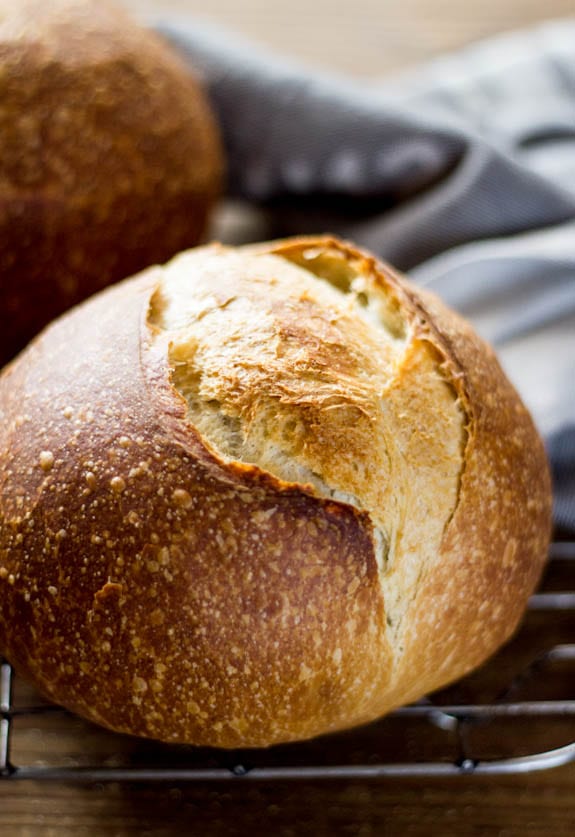
Think you can’t bake fresh, homemade sourdough bread? This easy sourdough bread recipe—trusted by beginner bakers for over a decade—shows you how, step-by-step. No yeast. No kneading. Just simple ingredients and 10 minutes hands on time for soft, crisp sourdough bread at home.
Reader review
“I have tried MULTIPLE sourdough bread recipes and this one has been the very first to make a successful (fully risen) loaf of bread. I am relatively new to sourdough and for some reason, the other recipes just didn’t produce good bread. These instructions and detailed explanations really make a huge difference to someone who is new to the world of sourdough.”
—Savannah
To anyone who thinks their sourdough bread isn’t good enough, I get it. Back in 2013, I set a goal: bake more bread. I tested, failed, succeeded (and tried again). What began with an easy no-knead artisan loaf eventually led to the holy grail: homemade sourdough bread.
Admittedly, I had beginner’s luck. My early scratch-made loaves were light, plump and airy, everything you want sourdough to be! And then? Down the rabbit hole I went: Hydration? Baker’s %? Proofing times?
Now, with 13+ years baking experience and a professional culinary background, I know what holds people back: the confusion, hesitation, comparison. I teach from a straight forward practical perspective because sourdough is not just a written recipe; it’s an understanding.
This sourdough bread recipe has been the most popular on my blog for over a decade- millions of views and the inspiration behind my bestselling book Artisan Sourdough Made Simple, a deeper dive into sourdough bread recipes. So, if you’re at the end of your rope (and just want to make good bread), you’ve made it. Welcome to the journey.
What Sets My Recipe Apart:
- One bowl, 5 ingredients
- Olive oil = soft, plush crumb & crisp, golden crust
- No stand mixer
- No bread machine
- Flexible baker’s schedule
- Personalized support in the comments
But before we make bread, let’s discuss what drives it: your sourdough starter. Once you understand what it is, and how it works, your path will be crystal clear. Have questions? Ask in the comment section. I respond with personalized help.
Where To Get A Sourdough Starter
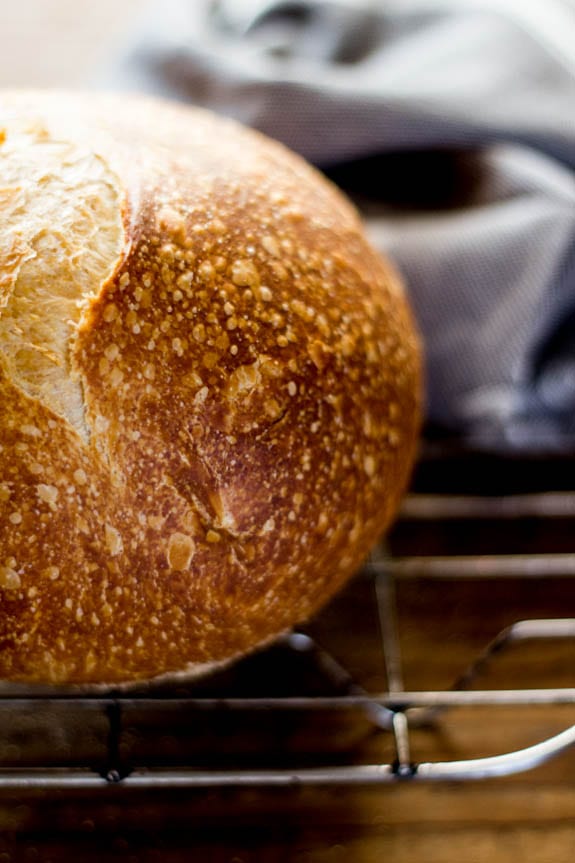
A sourdough starter is a live fermented culture of flour and water. It naturally leavens bread dough without commercial yeast. There are all different types: homemade, purchased or gifted (ask a fellow baker!). I use two different starters at home: one I made myself, and a vibrant Australian starter gifted from my friend Celia.
But is doesn’t stop there. Once your have your own sourdough starter, it must be kept alive and well with regular feedings to maintain its rising power. Sourdough is not static; it’s a living process. Here’s my personal feeding schedule which you can adapt to suit your style:
How To Feed Sourdough Starter
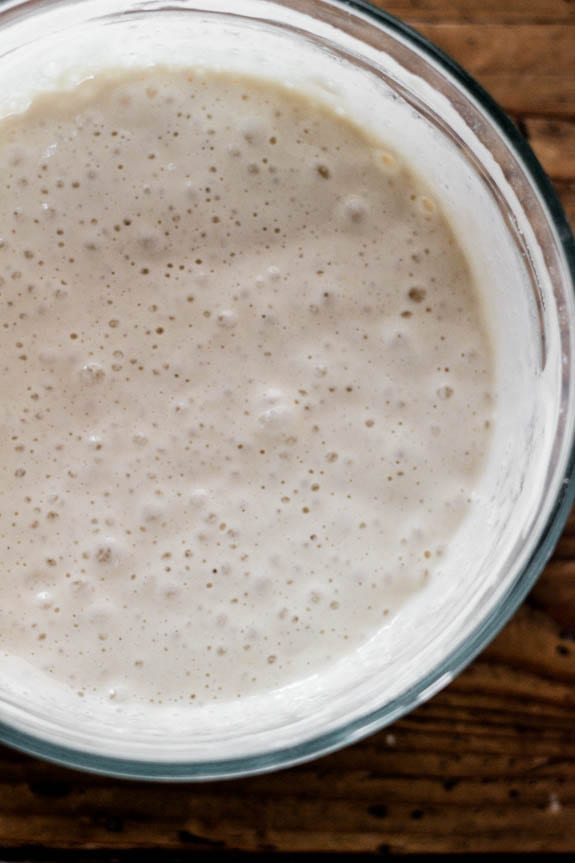
- Remove and discard half of your sourdough starter
- Feed what’s left in the jar with equal parts flour and water by weight (1:1:1 feeding ratio).
- Let rise at room temperature (loosely covered or airtight) ideally 75+F until bubbly, active and double in size (2-12 hrs). I use this sourdough starter jar.
Recommended Reading: Feeding Sourdough Starter: My Best Tips & Tricks
When Is Sourdough Starter Ready To Use?
Your fed starter is ready to use when it’s bubbly, active, and doubles in size. This can take 2-12 hours or more, depending on the temperature of your kitchen and the strength of your starter. My best advice? Be patient, plan ahead, and make sure your starter is in a warm place (ideally 75 F). The process is not instant.
Float Test: If you’re unsure whether your starter is ready, drop 1 tsp at peak height into a glass of water. If it floats to the top it’s ready to use. If it sinks, feed your starter again.
Storing Your Starter
Most people don’t realize that your feeding schedule is directly related to your baking preferences. If you only bake a few times a month, store your starter in the refrigerator and feed it once a week. If you bake often, store it at room temperature and feed it once a day.
How To Make Sourdough Bread: Step-By-Step Recipe
To Start: Feed your starter until it’s bubbly and active first (remember this can take anywhere from 2-12 hours, so plan ahead). Then mix the dough. Detailed instructions follow below. For a printable recipe & sample baking schedule, scroll to the end.
Step 1: Mix The Dough
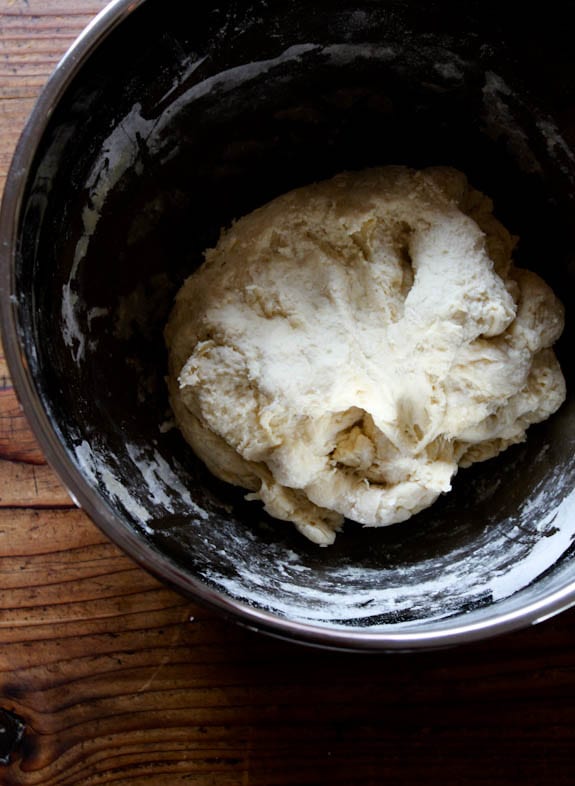
- Add water, sourdough starter, and olive oil to a large bowl. Whisk well to combine, making sure the starter is fully dissolved. Then add the bread flour and salt. Continue mixing (I use a fork at this point) until the flour is absorbed. The dough will feel rough and shaggy, which is normal.
- Cover the bowl and let rest (autolyse) for 30 minutes to 1 hour at room temperature. Then shape the dough into a rough ball. It doesn’t have to look perfect.
Tip: Weigh your ingredients with a digital kitchen scale. Measuring cups vary in size and don’t account for ingredient density which can lead to dry, dense, or overly sticky dough.
Why Autolyse Matters
Autolyse is the first rest after mixing bread dough. It jumpstarts gluten development without kneading, making the dough stronger, stretchier, and easier to shape I never skip it. For this recipe, rest for at least 30-45 minutes (or when time permits, I’ll do 1 hour for an even softer, more manageable dough). To learn more about common sourdough bread terms read my Sourdough Baking Glossary. I’ve included the only 12 you need to know!
A Note on Salt: Some bakers only add salt after autolyse, believing it slows down gluten development. I’ve followed that method for years, but now mix everything at once. It’s simpler, faster, and still makes excellent loaves (plus, you won’t forget to add the salt later on!). I’ll leave the choice up to you.
Want To Add Inclusions?
Mix in flavor additions after autolyse, when the dough is softer and more pliable. This is another reason not to skip the autolyse step. Alternatively, inclusions can be added during the first stretch and fold.
A few ideas:
- Roasted garlic
- Chopped olives
- Fresh or dried herbs (rosemary, thyme)
- Seed or nuts
- Cheese
- Dried fruit (raisins, cranberries)
- Jalapeños

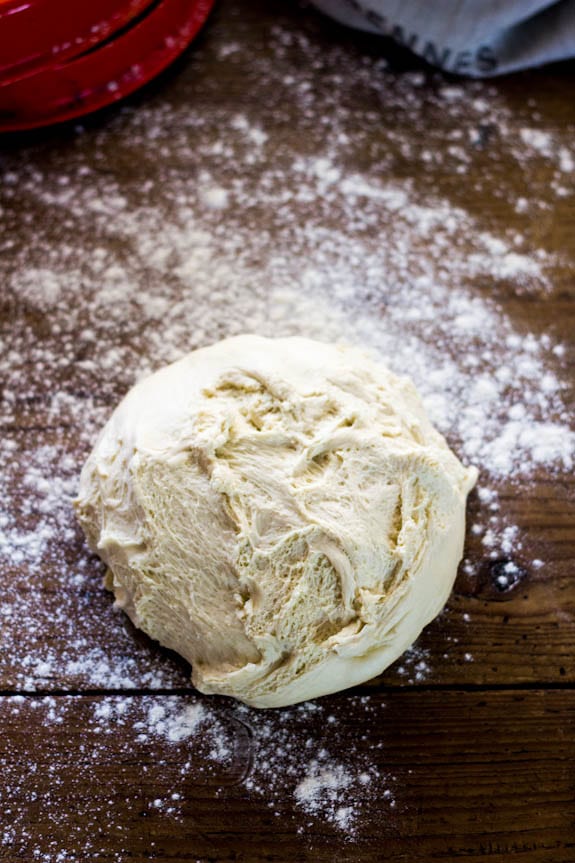
Step 2: Bulk Rise
Now the dough is ready to rise. Cover the bowl with lightly oiled plastic wrap so the dough doesn’t stick to the top, or transfer to a dough tub. Let rise at room temperature, about 68-70 F (20-21 C).
How Long Does It Take For Sourdough Bread To Rise?
The dough is ready when it’s puffy, slightly domed and nearly double in size. This can take 3-12 hours depending on room temperature, the quantity and strength of your sourdough starter, and seasonal conditions. All variables work together. See my example below:
For My Sourdough Bread Recipe (with ~150 g sourdough starter):
- In the summer: ~2-4 hours @ 80 F (26 C)
- In the winter: ~10-12 hours @ 68 F (20 C)
Diving Deeper: Temperature controls time. This is where I see the majority of beginner baker’s make mistakes- the temperature is overlooked. Sourdough takes longer to rise than yeasted bread, and it’s highly dependent on your specific environment. My kitchen might be 75 F. Yours? 68 F. Watch the dough, not the clock. For more details and troubleshooting read my companion article: Why Won’t My Sourdough Bread Rise?
Stretch And Fold The Dough (Optional Step)
About 30 minutes into the bulk rise, you can perform a series of “stretch & folds” to strengthen the bread dough. This step is not mandatory; however it has the potential to add height and structure to the finished loaf. Check out my how to stretch and fold sourdough guide to learn more, step-by-step. It’s easy and fun to do!
Step 3: Divide & Shape The Dough
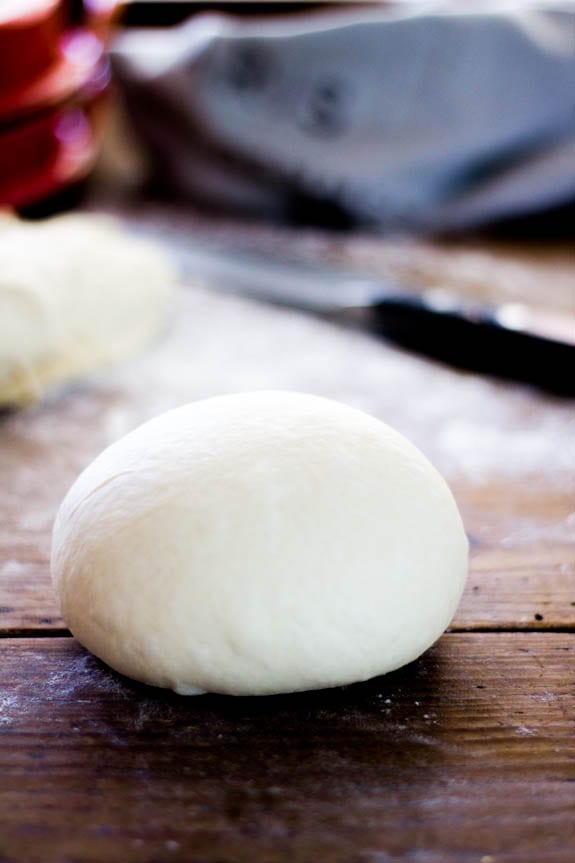
At this stage, remove the dough onto a lightly floured surface. For two smaller loaves, divide the dough in half. For a single, standard size loaf leave it whole.
How To Shape A Round Sourdough Boule (Loaf)
Starting at the top of the dough, fold it over toward the center. Give it a slight turn, and then fold over the next section of dough. Repeat until you have come full circle to form a tight round. This creates surface tension for better oven spring. You can also try the envelope-style fold.
Tip: I used to get so nervous when shaping bread dough because you only had one chance to get it right. So intuitively, I would practice using a piece of Play-Doh or with a kitchen towel to go through the motions at my own pace.

Step 4: Choose The Right Baking Pot
If you want bakery-style results, bake sourdough bread in a Dutch oven. Why? Pots trap steam which is the secret to homemade sourdough with bold rise and golden crust. Without steam, the crust will set too fast casing the loaf to harden, split or bake unevenly. I’ve been there and it’s not pretty.
What If You Don’t Have A Dutch Oven?
You’ll need another oven-safe pot with a lid to create steam. It must be able to withstand up to 450 F/232 C (lid and handles included).
A few options:
- Enamel roasting pan with lid (or sheet pan to cover)
- Cast iron skillet with upside down roasting pan to cover
- Covered sandwich loaf pans
- Clay Baker or Romertopf (soaked first)
- Preheated baking stone w/ metal bowl to cover
Here’s what happened to me: I tried the “no pot” baking route in the past, using just about everything from pizza stones, to baking sheets with no luck! The crust always hardened too quickly. Then I tried various steaming methods to remedy this (e.g. ice cubes in a hot pan, spraying my loaves with water) but my personal oven could not retain enough moisture. The environment was always too dry. For me, using a Dutch oven was the only reliable solution that worked with consistent results.
Step 5: Second Rise (Proofing)
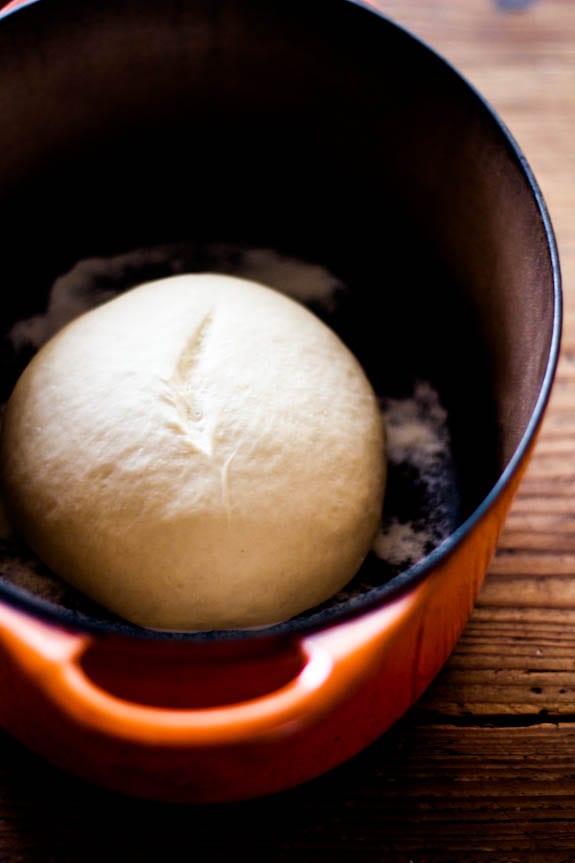
- After shaping, your dough needs to rise again. To do so, generously dust the bottom of your Dutch oven with cornmeal, or line with non-stick parchment paper to prevent sticking. Gently place the dough inside (see tip below)
- Let the dough rise for 30 minutes to 1 hour, or until it’s visibly puffy and no longer feels dense. It doesn’t need to double in size. While the dough proofs, preheat your oven to 450 F (232 C).
Tip: Want better shape and structure? Proof the dough in a floured, cloth-lined, 8-inch bowl or banneton instead of directly in the Dutch oven. This will contain the dough and hold its shape without spreading. Bread flour or rice flour is fine for dusting.
Step 6: Score The Dough
- Right before the dough goes into the oven, make a shallow slash down the center of the dough, about 2-3 inches long. Use a small serrated knife, sharp knife or bread lame. This lets the steam escape, and allows the bread to “bloom” or expand in the oven.
- Admittedly, this step is a bit nerve racking, so I don’t want to gloss over it. Be quick and confident. I’ll share what my sourdough mentor told me: “Slash with panache!”
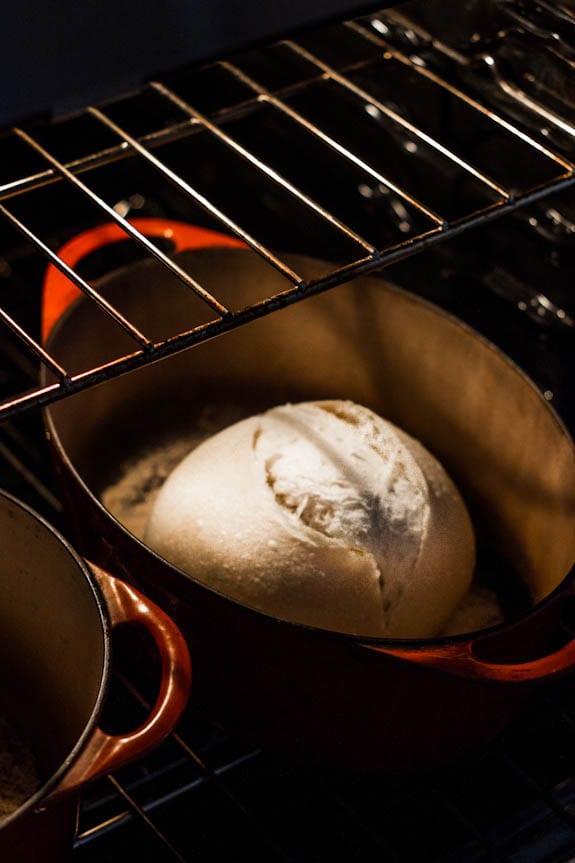
Step 7: Bake The Bread
You’re at the finish line now! Bake on the center rack (lid on) for 20 minutes. Then remove the lid. Your bread will look pale and slightly shiny. Then finish baking (uncovered) for 40 minutes or until the crust is deep golden brown. The internal temperature should be 205-210 F/96-98 C.
Tip: During the last 10 minutes of baking, crack open the oven door to let the moisture out. This creates a crispier crust. Or, remove the bread from the hot Dutch oven and bake directly on the oven rack. The latter creates the crispiest finish.
Step 8: Cool & Slice
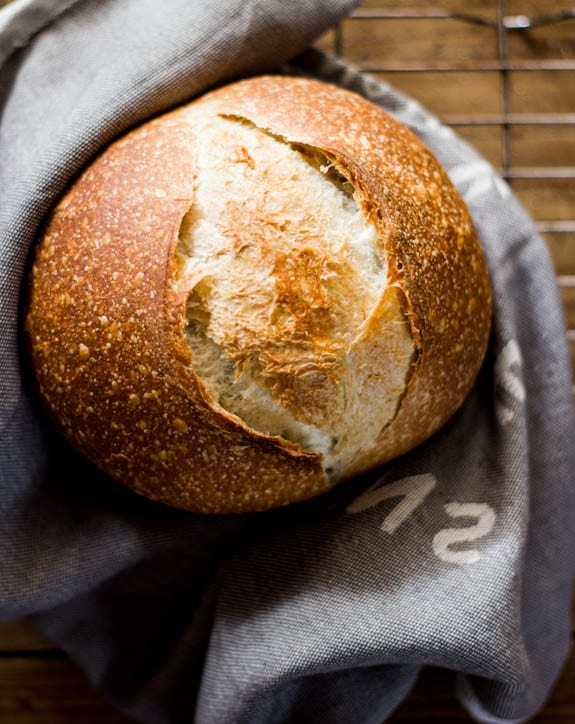
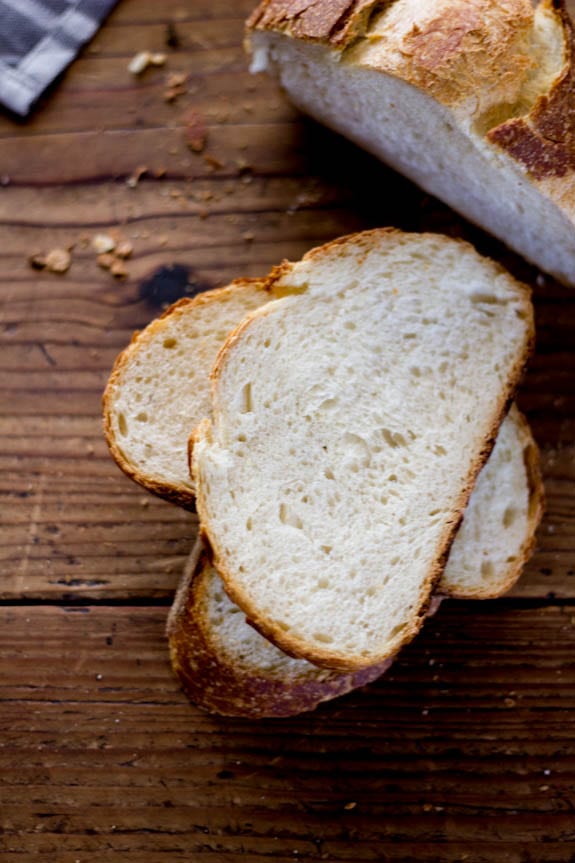
Cool the bread on a wire rack for at least 1 hour before slicing. Be patient! If you cut into it too soon, the texture will be damp and gummy. Life’s too short for sub par bread.
Final Thoughts
There are a gazillion sourdough bread recipes out there. No two loaves look alike. Start with this guide, master the basics and then branch out: try my golden sourdough focaccia recipe, this easy sourdough sandwich bread, or my one-bowl sourdough pancakes for breakfast! Once you have a few loaves under your belt, the process will become an imminent rhythm and you’ll become a sourdough pro in no time.
Sourdough Baking Schedule
- Friday Evening: Feed your starter, cover the jar, and leave it on the counter overnight. If you keep your starter in the fridge, it might need two feedings to perk back up (feed it in the morning & in the evening).
- Saturday Morning: Check your starter: if it’s alive and bubbling, you can make the dough to rise during the day. Or, feed it again in the afternoon to make the dough in the evening for an overnight rise. Remember to use the float test mentioned above to make sure your starter is ready to use.
- Saturday Morning/Evening (or whenever your starter is ready): Make the dough. Leave on the counter to bulk rise at room temperature. In the summer, if your dough rises quickly and you’re not ready to bake, cover the whole bowl with lightly oiled wrap and chill until ready to use.
- Sunday Morning: cut and shape the dough. Place in Dutch oven for second rise. Slash. Bake. Cool. Eat.
By signing up, you agree to receive emails from The Clever Carrot. Unsubscribe at any time.

Sourdough Bread: A Beginner’s Guide
- Prep Time: 13 hours
- Cook Time: 1 hour
- Total Time: 14 hours
- Yield: 1 loaf 1x
- Category: Sourdough Bread Recipes
- Method: Oven-Baked
- Cuisine: American
- Diet: Vegan
Description
New to sourdough? My easy beginner sourdough bread recipe makes the best artisan-style loaf at home with just 5 simple ingredients: bread flour, active sourdough starter, water, salt and olive oil—my signature addition—known for creating a light, plush crumb and a crisp golden crust. Follow my clear, step-by-step instructions and video guidance to bake fresh sourdough bread with confidence (even on your first try!).
Ingredients
- 150g bubbly, active sourdough starter
- 250g warm water (see Note 2)
- 25g olive oil
- 500g bread flour (not all purpose flour)
- 10g fine sea salt
- fine ground cornmeal or non-stick parchment paper
Notes, Tips & Equipment
- Weigh your ingredients with a digital scale for best results
- For a more soft and pliable dough, increase the water up to 300 g- 325 g total. Use a floured, cloth-lined bowl or proofing basket (instead of the Dutch oven) for the second rise.
- You will need a 5 1/2 or 6 quart Dutch oven for baking
- This recipe was tested with King Arthur Bread Flour, Gold Medal Bread Flour, Pillsbury Bread Flour
Instructions
Make The Dough
In a large bowl, add the sourdough starter, water and olive oil. Mix with a fork to combine, then add the flour and salt. Continue mixing until the dough becomes stiff, then squish it together with your hands to incorporate all the flour. The dough will be rough and shaggy.
Cover the bowl with plastic wrap, reusable wrap, or very damp kitchen towel. Let rest (autolyse) for 30 minutes to 1 hour.
After resting, return to the bowl and work the dough into a rough ball, about 15 seconds.
Bulk Rise (First Rise or Bulk Fermentation)
Cover the bowl with lightly oiled plastic wrap. Alternatively, transfer the dough to a high-sided dough tub. Let it rise in a warm place, ideally 70-75 F. The dough is ready when it no longer looks dense and has almost doubled in size.
Note: The bulk rise time will be different for everyone. For example, in the summer, expect ~2-4 hours @ 80 F/ 26 C. In the winter, ~10-12 hours @ 68º F/ 20º C. Watch the dough and not the clock.
Optional Step: Stretch & Fold The Dough
During the bulk fermentation, you can do a series of ‘stretch & folds’ to strengthen the dough. Start 30-45 minutes in: lift a portion of the dough, stretch it upwards, and fold it over itself. Rotate the bowl ¼ turn and repeat until you’ve come full circle (1 set). Do 1-2 additional sets, spaced ~1 hour apart. Click here for a step-by-step video tutorial.
Note: Dough made with 250g water will feel stiffer; 300-325g water will be more stretchy and elastic. Let it rest longer in between sets if it resists stretching.
Shape The Dough
Remove the dough onto a lightly floured surface. Starting at the top, fold the dough over toward the center. Turn slightly, and then fold over the next section. Repeat until you have come full circle. Flip the dough over, seam side down. Gently cup the sides and rotate in a circular motion to tighten the shape. The goal is to build surface tension to create a tight ball (too much flour will cause the dough to slide around).
Second Rise
Now the dough needs to rise again. If you’ve used 250g water, you can do a free-form second rise in the Dutch oven (if not, see note below). Line the pot with a piece of parchment paper (this is what I do) or coat with cornmeal. Place the dough inside, cover and let rise for about 30 minutes to 1 hour. It’s ready when slightly puffy, but not double in size. Preheat your oven to 450 F/ 232 C.
Note: If your dough contains more than 250g water, skip the free-from rise. Your dough will spread. Instead, use a floured, cloth-lined, proofing basket to help hold its shape.
Score The Dough
Right before baking, make a shallow 2-3 inch slash (or longer) in the center of the dough using a bread lame, razor blade, or small sharp knife. The cut should be ~1/4-inch deep.
Bake The Dough
Place the bread in the oven on the center rack (lid on) and reduce the temperature to 400 F/ 204 C. Bake for 20 minutes, then remove the lid, and continue to bake (uncovered) for an another 40 minutes, until deep, golden brown. All ovens are different; feel free to make minimal adjustments to these temperatures.
Check for doneness with a digital thermometer: 205-210 F/ 96-98 C for sourdough.
Remove the bread from the hot Dutch oven, and cool on a wire rack for at least an hour before slicing.


Comments
Sarah says
My first loaf ever is in the oven!
I bought your book and I noticed that the measurements in this recipe are different than the beginner recipe in you book.
Your book recipe only calls for 50g of starter where this one calls for 150g. What would be the difference in the result with more or less starter?
Toney says
Your website is very easy to understand & it walked me through every step! my 1st loaf turned out great & looking forward to next loaf, but now 2 days after 1st loaf I was feeding my starter & realized I added the feed WITHOUT removing the discharge!! What do I do?
Tiffany says
New to this. Is it possible to use about 50g of starter instead of 150g? I don’t quite have 150 established yet & I’ve noticed some recipes are only calling for 50-75g? Or had anyone tries this & had any luck?
Jean Colona says
How do you use sourdough after it cooks. I made a loaf, but it has no flavor.
Stacey says
Hey! Thanks for sharing your recipe. Can you explain why you don’t cold proof?
Emilie Raffa says
Hi Stacey! Absolutely. First, a cold proof is an optional step in sourdough baking, not a requirement. I don’t use it for this recipe, because in my experience, the timing can be tricky for beginners to master due to lack of initial practice and much needed repetition. While beneficial in many regards, a cold proof does not always guarantee big open holes or an enhanced sour taste. In order for that to be true, every single step prior to the cold proof must be completed properly. Everything is connected.
Katheline says
So glad I found your sourdough starter recipe ,I’m on my 5th day ,so far so good ,just wandering after the 7th day, do I continue feeding everyday ? Plus do I keep it in the fridge after thev7th day ? Thank you ,can’t wait to try making your bread,Thank you for all your help .
Shannon says
Would I be able to cold proof this recipe and if so, how would you go about it?
Margie says
This was my first time using sourdough starter. I followed the instructions word for word. I am thrilled with the end product. I didnt bake as long as directed because it was browned with less time. Thanks so much!
Emilie Raffa says
You’re very welcome! Thanks for your feedback, Margie.
Lisa says
I’m a beginner and this is only the second recipe I’ve used. I’m so happy I found it, as your instructions are so helpful and my bread was great! I decided to try to make some smaller loaves-I made 3 out of this dough-do that there wouldn’t be as much bread to eat/share! Stuck my neck out and added some herbs, lemon and cheese to the loaves and it was a hit! Thank you for sharing!!
Emilie Raffa says
Love this! Such a practical idea to make 3 smaller loaves out of this dough. And herbs! Yum. Thank you for sharing, Lisa!🥰
Julie Stewart says
This recipe gave me the confidence to bake my first loaf of sourdough bread. It was delicious and turned out fantastic. Since then I have made this recipe eight times and it has been a success every time. Thank you so much for explaining everything in detail.
Emilie Raffa says
Wow, 8 times! I’m so impressed. Looks like you are well on your way! Happy baking 🥰
Dana Morton says
Hi!
I started my starter 11 days ago. The last several days it doubled in size. Today I did the sink test and the starter floated! So I got out supplies to make my first loaf. I didn’t have 150gm starter! I had about 130gm. I scraped it out of the bowl and put it in a fresh jar. I’m going to feed it and let it double again and put it in the fridge until Saturday. Do I have to discard half everytime I feed it? Any idea what I did wrong?
Emilie Raffa says
Hi Dana! With an already established starter, you don’t always have to pour off half. Just a little off the top is fine, especially if it’s been sitting in the fridge for a while. This is to get rid of any water or discoloration on the surface. Then feed what’s left in the jar with fresh flour and water following a feeding ratio of your choice. More info on feeding sourdough starters in this article {linked here}.
Margaret Douglas says
Great recipe. Excellent instructions. Makes a delicious sourdough loaf.
Emilie Raffa says
Thank you Margaret! Glad to hear you were successful with the recipe.🥰
Tina says
I’ve been cooking and baking forever but never tried my hand with sourdough. My daughter brought me some starter when she came to visit in mid Dec. I’ve been faithfully feeding weekly with the 1:1:1 ratio and keeping in the fridge. She didn’t give me a recipe for making bread. Bought a Dutch oven (at Goodwill, of course) and decided to finally make bread. I found your recipe and followed it exactly (may not have had 150g of starter, may have been less). Started early in the morning, fed my starter just once. Did the bulk rise in my furnace room at 75-77 degrees covered and checked every 2 hrs. Did no stretches at all. Baked as directed. Cooled it overnight and cut it this morning. Absolutely gorgeous.!!!! Easiest sourdough recipe EVER!!!
Emilie Raffa says
Ahhh…. love this! Congrats! I really enjoyed reading your comment. I’m always fascinated how other baker’s do it. We can learn so much from each other.
Steven Trogal says
Hi, Your recipe looks like the clearest I have come across.
However, I do not understand the point of discarding starter.
This looks like complete wastage. Every recipe I have come across does this discard but NOBODY gives a satisfactory explanation of why.
Why not simply make the starter using less, say half the quantity of flour and water?
No wastage.
I only want to make sourdough bread.
Also can I substitute water for the olive oil?
Olive oil prices have gone through the roof here in the UK.
Many thanks.
Emilie Raffa says
Hi Steven! In my experience, the process of discarding sourdough starter is widely misunderstood. I’ve written a separate article to provide further clarification. You can access it here: Sourdough Discard 101.
At a glance, discarding is necessary to refresh and balance the acidity levels within the starter itself, and to prevent it from growing exponentially in size. Good quality discard can be utilized to make a variety of sourdough discard recipes like sourdough pasta or pancakes. Alternatively, create a levain which is essentially taking out only what you need from your mother jar of starter and feeding it in a separate bowl to activate for baking. Hope this helps!
Sandra Exley says
Can you bake in cast iron Dutch ove
Emilie Raffa says
Yes! You can absolutely do that.
Joanna Garaventa says
Hi
My bread didn’t rise much but was very flavorful and had a great crust!
Emilie Raffa says
Hi Joanna! There are so many variables to consider when bread dough (especially sourdough) doesn’t rise as expected. I’ve written a companion article on this topic if you’d like to have a read {linked here}.
Tracy Campanaro says
Hi! I messed up on the discarding I am on day 5 and have only been discarding 60g of started and adding 60g water and flour. Do I need to start over? I’ve already feed my started today.
Thanks!
Emilie Raffa says
Hi there! Don’t worry! You don’t need to start over. I don’t know where you are in the process right now, but you can easily adjust by calculating the total weight of your starter (without the jar), see which day it matches up with, then go by the feeding amount indicated on that day. It doesn’t have to be exact. Temperature is usually the main issue, not feeding amounts, when trying to create a starter from scratch.
Anne Hund says
We’re on our 3rd starter with no luck. Followed all directions. We’ve been starting with whole wheat flour and then feeding it with all purpose. Just doesn’t want to double and is lacking lots of bubbles. We live in CO so maybe an altitude issue… please help!
Rebecca Miller says
I found that feeding it with bread flour instead of all purpose helps, and to just keep consistent with it. It doesn’t rise for the first 3-5 days really and then suddenly it will but it will be weak so if you’re consistent and paying attention to it, it will get stronger
Emilie Raffa says
Hi there! It very much could be the altitude, which I’m not an expert on. My best advice is to go by texture instead of relying solely on the indicated feeding amounts. You want it to look like thick pancake batter. Make sure to let it rest in a warm spot, ideally 75 F+. (try leaving it in a warm water bath on the counter for an added boost). And as another baker suggested, try using bread flour.
M says
Do I not need to preheat the Dutch oven?
Emilie Raffa says
Hi there! No, you do not need to preheat the Dutch oven for this recipe. However, you’re more than welcome to do it. Just make sure to omit the free form second rise in the pot, opting to do so in a cloth-lined and floured proofing basket instead.
Lidia says
The first two times I used Trader Joe’s organic all-purpose flour and the bread turned out amazing. This time I’m using Kings Arthur bread flour and I’m curious how different it’ll turn out. Each time l cold proofed the dough for 48 hrs. I’ve tried couple different recipes for sourdough bread but this recipe is by far the best. Thank you!
Emilie Raffa says
Hi Lidia! How’d it go? I imagine there was a notable difference depending on how much water was used both times. KA bread flour is very thirsty! From experience, I know it can handle more water than TJ’s all purpose flour. Either way, it’s fun to play around! 🥰
Maria Bidgood says
Do I need to make adjustments of the recipes for high altitude baking?
Cp says
This recipe gets the most compliments! Thank you!
ika says
I’m a bit confused, at which steps I work on the dough that it look”soft” ? I see “After the dough has rested: return to the bowl and work the dough into a rough ball, about 15 seconds.” but I don’t think 15 secs will be enough for me lol or I just never work on the dough, except only at the stretch&fold time
Emilie Raffa says
Hi there! The dough will only look soft as it begins to rise and/or if you do stretch and folds. So for example, when you mix the dough and it will be rough and shaggy at first. Then you let it rest for 30 minutes to 1 hour. Right after that, you work the dough into a ball which takes around 15 seconds or so. If your dough needs more time, by all means, go for it! Just keep in mind, at this stage, the dough still won’t be perfectly smooth. As it continues to rise the texture will change.
Iki says
Thank you so much for the reply ! 💖💖
Lauren says
Hi! I’ve loved your recipe and it was the first one I ever used to bake sourdough. One thing I’m finding is that sometimes the oil does not mix in very well and forms clumps in the bread. Do you have recommendations for how to prevent that from happening?
Fiona says
Not an expert but I experienced this too and what solved it for me was putting a small amount of the flour in first (~100g or so) and stirring until smooth, then proceeding to add the rest of the flour
Emilie Raffa says
Hi Lauren! Great question. So, basically the oil needs to be more evenly incorporated with the wet ingredients before the flour goes into the bowl. Try whisking the water and starter first, then add the oil. This will help. Once it looks blended, then add the flour and salt.
Sue says
I’m new at sourdough baking . I had tried numerous recipes and techniques with varying results, until I tried your recipe with the olive oil. It was amazing, delicious and friends totally raved about the bread!! I live in Hawaii and fellow bakers here mentioned that our climate and humidity may be variables for us. Thank you!!!!!
Emilie Raffa says
Hello Sue! You are absolutely right. Humidity and other variables will 100% affect your sourdough baking experience whether you use my recipe or another one. You’ll always need to adjust things like your rise time, proofing time, and visual clues because it’s so warm where you live. But now you know! Thanks so much for your comment. I hope to visit Hawaii soon- it’s one of my favorite places! 🥰
Bertha says
First time making sourdough bread and it turned out amazing. Thank you for the easy to follow instructions.
Emilie Raffa says
You’re very welcome Bertha! Thanks for sharing your feedback 🥰
Scott Hellesto says
The recipe is shockingly simple and a great jump-off point! I’ve made sandwich loaves and boules that are solid and delicious. I currently have 24 dinner rolls in their final proofing! This recipe takes the guesswork out of a fun hobby!
Irm says
Hi! This article is sooooo helpful and clear! Thank you!
One question: when you use a Dutch oven to bake, with the second rise, you say put in the pot, and preheat your oven.
But don’t i need the Dutch oven empty in the oven to preheat it with? That it will slowly get on temperature?
Joy says
Many other recipes I have seen call for the Dutch oven to be preheated along with the oven. Yours doesn’t do that, am I correct? I’m going to be making this recipe later in the week and will be very interested to see the difference.
(Total sourdough newbie)
Emilie Raffa says
Hi Joy! Preheating your Dutch oven is common. But you don’t have to.
When I first started with sourdough, I always preheated my pot because most recipes promised a 20-30% increase in rise if you did it. However, too many burnt wrists from accidentally touching the pot made me stop!
But I didn’t stop baking altogether. With more and more practice and repetition, I learned through my own findings that I could still achieve excellent results without preheating the pot. In fact, I learned that this 20-30% increase in rise was only a potential, not a guarantee. Meaning, an increase in rise could only hold true if every step prior to baking was done properly, from having a strong starter, to mixing, handling, shaping the dough and more. Hope this info helps as you continue to bake!
Emilie Raffa says
Hi there! I do not preheat my Dutch oven for this recipe. Only the oven itself. Therefore, you can do the freeform second rise directly in the pot (assuming you are using the lowest amount of water in the initial dough mix- it will spread otherwise). Alternatively, if you’d like to preheat your Dutch oven, you’ll need to do your second rise in a cloth-lined and floured proofing basket instead.
Sharon says
I am new to sourdough and love the detail on your website. I’ve tried this recipe and the all-purpose flour version. I decided to buy your book and baked the basic sourdough bread this morning. It tastes amazing! I do have one question on the bake time. My loaf has a blackened base and is very well done compared to the image in the book. Should I reduce temperature or time?
Thank you!
Emilie Raffa says
Hi Sharon! First, I’d get an oven thermometer to rule out any oven temperature discrepancies. Then, assess your baking pot: what material is it made out of? A Thinner material will give you different results compared to a heavy bottom cast iron etc. Finally, if you place a baking sheet on the rack directly below your pot, this will shield the heat from the bottom up, helping to prevent a blackened crust. Try these tips first before reducing the baking temperature.
Kate Denholm says
Hi.
I have a question about feeding the starter please.
You say to feed prior to baking to activate it. Once activated and you take 150g of the starter for baking, do you have to use the 1:1:1 method to feed back up what’s left in the jar?
Hope that makes sense. Thanks for your advice.
Emilie Raffa says
Hi there! Essentially, yes. Or, you can use another feeding ratio of your choice (1:2:2 etc). This way, you’ll have starter to use for next time. You always have to keep the process going.
Amanda R says
Is it okay to do the Bulk Rise while I’m gone? Is it possible for it to set too long? It’s possible it will set for about 6.5-7 hours. It is winter so it may need longer anyways but just wanting to confirm if setting longer in the bulk rise step can cause an issue? Thank you!!
Emilie Raffa says
Hi there! You can do the bulk rise when you’re out of the house. The length of time will depend on your current ambient temperature. If it’s cold, you have more wiggle room. If it’s warm, the dough might rise faster than you planned on. Baker’s will always have to adjust their rise times based on their own specific conditions. The indicated rise times are only guidelines. Hope this helps!
Rachel says
I’m a beginner and had this same question but I read somewhere else on her blog that you can refrigerate it to basically pause the rise! It will still rise some but not nearly the way it would at room temp+. I’ve let mine rise for a couple hours, refrigerated overnight, and let it finish rising the next day, and those loaves have actually been the most successful for me! We live at around 5300 feet, not sure if that makes a difference but realizing I could refrigerate it helped a TON!
Aleyna says
What temperature of water does the 250g need to be?
Emilie Raffa says
Hi there! In winter, I’ll use 90-95+ F. In summer, I’ll use cooler water to control the rise. It depends on your current ambient temperature and/or how fast/slow you want the dough to rise. It’s flexible.
Katie N says
Thank you, thank you, thank you! I hadn’t tried to make a loaf in over a year after multiple sub-par attempts. The only thing though is I didn’t have bread flour. So I let it go for an hour before two stretch and folds an hour apart. Your tips were very helpful. I haven’t cut it yet but it looks beautiful! 🤩
Emilie Raffa says
I’m so glad! Thanks for sharing your feedback Katie!
Maria Bidgood says
My 2nd day starter had a crusty top. What do I do?
Emilie Raffa says
Hi there! If your starter has a crusty top, this means it was exposed to too much air. Are you using a lid to cover your jar? This will prevent a crust from forming, compared to using cheesecloth only.
Azzy says
Hi! My bread worked out well the first time I baked it, although a bit dense. Same after the third loaf. What’s the trick to create an open crumb/airy holes?
Thanks!
Romy says
I started making sourdough this past summer and have used every recipe I have found online for beginners. My parents are elderly and love having a toasted slice of it for breakfast each day. After experimenting with so many recipes, they say that hands down this one is the best!
MrsJennifer M Wright says
How much sour dough starter to how much flour and olive oil please
Colleen says
Can I half this recipe?
Nicole says
I had mini loaf Pans. So I divided the recipe into 4 loaves which were delicious. so it should world halfed too. I just cut the cooking time by about a third.
Wendy says
Hi I my starter is ready to make my bread but it’s two o’clock in the afternoon will I have time to make it before I go to bed at twelve o’clock?as it New year eve I same staying up later.?when I made my first bread I felt in to proof the second time on my work top and wend to bed.to bed.Well it over proofed then I put in in the fridge it rise very much very when I baked it.i was a heavy,I need help please
Amanda Dumas says
Love this recipe! I just did one with 300g water and one with the 250g and both came out really nice!! Very pleased with this and looking forward to my next loaf that is BFing now with inclusions (lower hydration recipe). Thank You for all the great info on this website!!
Jenny says
I used this recipe to make first ever loaf of sourdough and it’s delicious! After a month of growing my starter, I was nervous to make my first loaf. Thank you for making it so easy for newbies to follow!
Janis Reed says
So after my starter has developed, and I am feeding it to keep it going, do I, remove an amount of the starter (how much), and then put in flour and water (equal amounts). Is that right? Thanks very much
Jordan says
Yes! Equal weight of water and flour mixed back into the starter. I usually change jars at this point as well. The amount of starter left does not matter as well.
John Harvey says
I received a starter kit by a company named Kikkerland for Christmas. The recipe is at odds (and simpler) than yours and others I have seen. Basically, 60g each rye/whole wheat and water, followed by adding 10g rye/whole wheat and 15g water on days 2-7; no all purpose flour, no discard. Will this work?
Gail says
Getting ready to start my first loaf(s). I actually have two starters, which I bought. Came from different places, just because I like to experiment. I’m feeding them every day in preparation for my first loaf(s). But what happened today? I’ve done everything exactly the same to both starters, and discovered this morning one is NOT bubbling and doubled and the other is. What’s up with that?? It’s cool in the house and they are in a cabinet, mostly covered (lid cocked off to the side.)
Also: shall I preheat the Dutch oven?
I’ll report back on my results. Merry Christmas!
Jessine Dew says
I wanted to know how to start sourdough bread and how to feed it every day
Julie says
I’ve been making your sourdough recipes for about two years now but with the cooler winter weather we came up with a DIY proofing box. What temperature would you set it for and with the regulated temperature would you change the rising times? Thank you!
Chris says
I would love to see and know how you made your proofing box.
Emilie Raffa says
Hi Julie! Great question. So, the answer is up to you ultimately. The warmer the temp. inside your proofing box, the faster the dough will rise. This may (or may not) be optimal for you because I don’t know what your baking schedule looks like.
For example, if you want same-day sourdough, I’d make the dough in the early morning (150g starter), and let rise in your proofing box set to 75-78 F. When it’s done you can bake it right away, or hold in the fridge until ready to do so. Does that make sense? Something to play around with! I’ve included approximate rise time guidelines based on temperature in the written post.
Nell F McKay says
Hello, I have followed your recipe and had fun making a few loaves. I also ordered your book and the recipe is a little different from what is here on your website. Is there another book that more closely follows your website?
Additionally, I have an ad blocker on and can not get onto this site unless I remove it. I am very disappointed that I would have to leave myself open to possible problems if I follow you. I think you are terrific but I’m going with internet safety. Thank you for all the help I have received so far and I wish you the best. Nell
Allyssa says
HELP! Everything was clearly laid out in your instructions but for some reason i keep getting a flat, dense abd gummy bread. I’m using starter that has doubled in size, and because my house is colder (69F) I’ve increased rising/bulk fermentation time. My dough appears to rise but still feels very dense when shaping. What am i doing wrong???
Keith says
This is a terrific, simple recipe, I love it, and something I can easily do weekly. I prefer the reduced water content (did 300g), and let the dough rise 12 hrs overnight in a cold oven after 2 “stretch-n-folds.” My house temp is 70F. Had not had good results with refrigerating dough overnight or higher hydration recipes, baked loaves never rose much when baking. Also like baking longer, 60 minutes, at lower, 400F temp. I did preheat my oven at 450F, including my Dutch oven base, and “carefully” lowered in the dough using parchment paper “ears” after the second rise in a proofing basket. Look forward to baking again next week, thanks!
Brooke says
Hi! I was wondering if I am supposed to preheat my dutch oven for awhile before putting in the loaf of bread to bake. Thank you!
Lynn says
I can, with 100% confidence, say YES! The lid too!
Ilya says
Hi! I’m trying this recipe for the first time, my dough did rise during the bulk rise, it took closer to 12 hours than 3, now I’m doing the second rise in the Dutch oven and it doesn’t seem to be rising at all – should I expect it to take longer than an hour since this dough seems to be slower? How do I know if I’ve overproofed it?