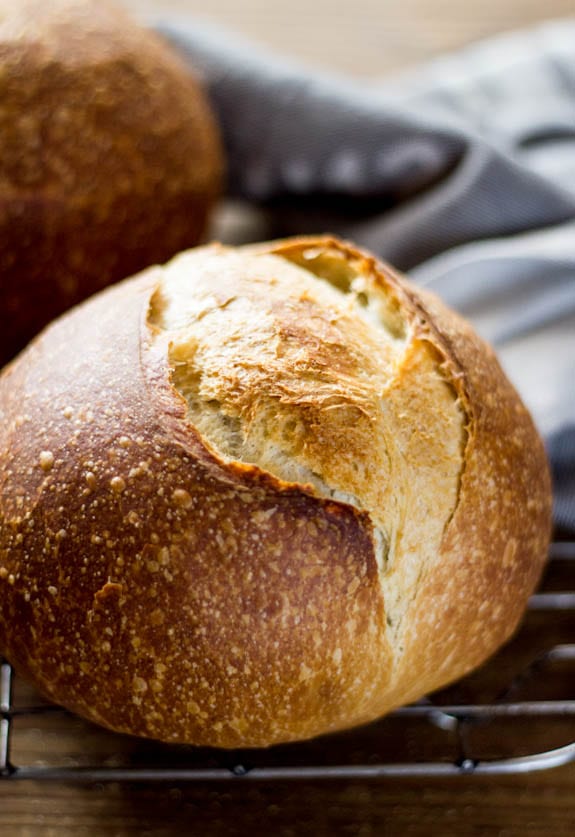
Think you can’t bake fresh, homemade sourdough bread? This easy sourdough bread recipe—trusted by beginner bakers for over a decade—shows you how, step-by-step. No yeast. No kneading. Just simple ingredients and 10 minutes hands on time for soft, crisp sourdough bread at home.
Reader review
“I have tried MULTIPLE sourdough bread recipes and this one has been the very first to make a successful (fully risen) loaf of bread. I am relatively new to sourdough and for some reason, the other recipes just didn’t produce good bread. These instructions and detailed explanations really make a huge difference to someone who is new to the world of sourdough.”
—Savannah
To anyone who thinks their sourdough bread isn’t good enough, I get it. Back in 2013, I set a goal: bake more bread. I tested, failed, succeeded (and tried again). What began with an easy no-knead artisan loaf eventually led to the holy grail: homemade sourdough bread.
Admittedly, I had beginner’s luck. My early scratch-made loaves were light, plump and airy, everything you want sourdough to be! And then? Down the rabbit hole I went: Hydration? Baker’s %? Proofing times?
Now, with 13+ years baking experience and a professional culinary background, I know what holds people back: the confusion, hesitation, comparison. I teach from a straight forward practical perspective because sourdough is not just a written recipe; it’s an understanding.
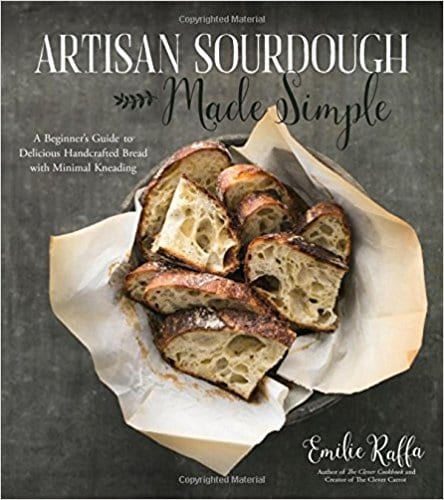
This sourdough bread recipe has been the most popular on my blog for over a decade- millions of views and the inspiration behind my bestselling book Artisan Sourdough Made Simple, a deeper dive into sourdough bread recipes. So, if you’re at the end of your rope (and just want to make good bread), you’ve made it. Welcome to the journey.
What Sets My Recipe Apart:
- One bowl, 5 ingredients
- Olive oil = soft, plush crumb & crisp, golden crust
- No stand mixer
- No bread machine
- Flexible baker’s schedule
- Personalized support in the comments
But before we make bread, let’s discuss what drives it: your sourdough starter. Once you understand what it is, and how it works, your path will be crystal clear. Have questions? Ask in the comment section. I respond with personalized help.
Where To Get A Sourdough Starter
A sourdough starter is a live fermented culture of flour and water. It naturally leavens bread dough without commercial yeast. There are all different types: homemade, purchased or gifted (ask a fellow baker!). I use two different starters at home: one I made myself, and a vibrant Australian starter gifted from my friend Celia.
But is doesn’t stop there. Once your have your own sourdough starter, it must be kept alive and well with regular feedings to maintain its rising power. Sourdough is not static; it’s a living process. Here’s my personal feeding schedule which you can adapt to suit your style:
How To Feed Sourdough Starter
- Remove and discard half of your sourdough starter
- Feed what’s left in the jar with equal parts flour and water by weight (1:1:1 feeding ratio).
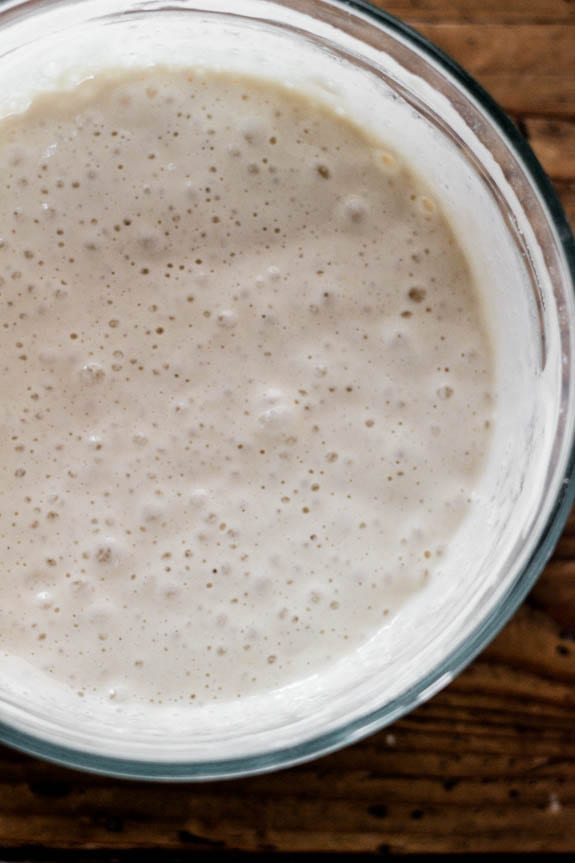
- Let rise at room temperature (loosely covered or airtight) ideally 75+F until bubbly, active and double in size (2-12 hrs). I use this sourdough starter jar.
Recommended Reading: Feeding Sourdough Starter: My Best Tips & Tricks
When Is Sourdough Starter Ready To Use?
Your fed starter is ready to use when it’s bubbly, active, and doubles in size. This can take 2-12 hours or more, depending on the temperature of your kitchen and the strength of your starter. My best advice? Be patient, plan ahead, and make sure your starter is in a warm place (ideally 75 F). The process is not instant.
Float Test: If you’re unsure whether your starter is ready, drop 1 tsp at peak height into a glass of water. If it floats to the top it’s ready to use. If it sinks, feed your starter again.
Storing Your Starter
Most people don’t realize that your feeding schedule is directly related to your baking preferences. If you only bake a few times a month, store your starter in the refrigerator and feed it once a week. If you bake often, store it at room temperature and feed it once a day.
How To Make Sourdough Bread: Step-By-Step Recipe
To Start: Feed your starter until it’s bubbly and active first (remember this can take anywhere from 2-12 hours, so plan ahead). Then mix the dough. Detailed instructions follow below. For a printable recipe & sample baking schedule, scroll to the end.
Step 1: Mix The Dough
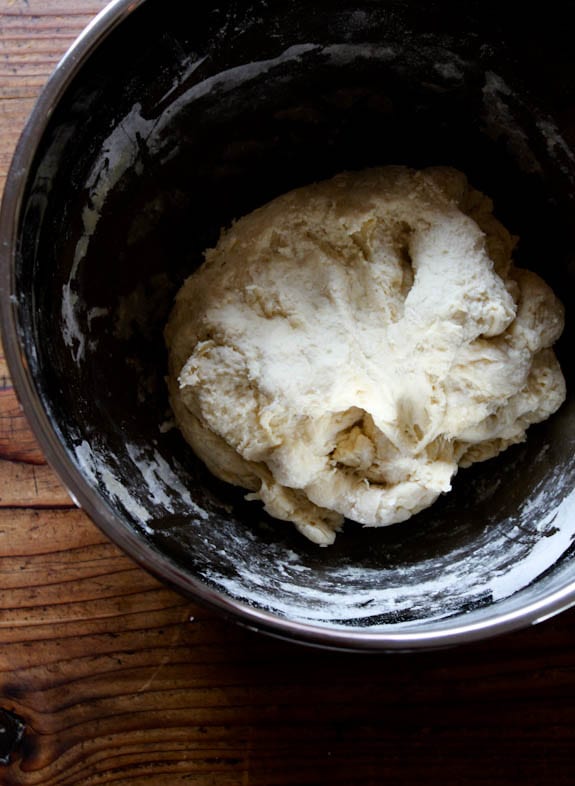
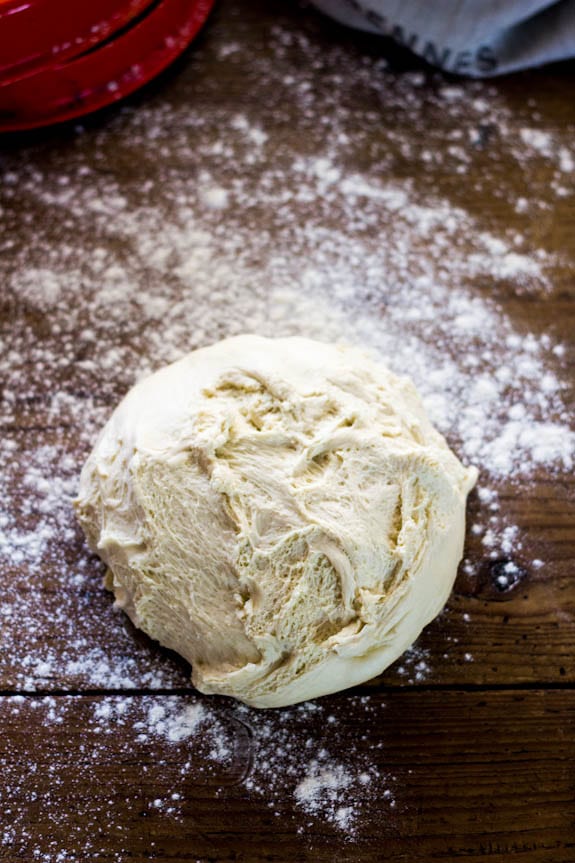
- Add water, sourdough starter, and olive oil to a large bowl. Whisk well to combine, making sure the starter is fully dissolved. Then add the bread flour and salt. Continue mixing (I use a fork at this point) until the flour is absorbed. The dough will feel rough and shaggy, which is normal.
- Cover the bowl and let rest (autolyse) for 30 minutes to 1 hour at room temperature. Then shape the dough into a rough ball. It doesn’t have to look perfect.
Tip: Weigh your ingredients with a digital kitchen scale. Measuring cups vary in size and don’t account for ingredient density which can lead to dry, dense, or overly sticky dough.
Why Autolyse Matters
Autolyse is the first rest after mixing bread dough. It jumpstarts gluten development without kneading, making the dough stronger, stretchier, and easier to shape I never skip it. For this recipe, rest for at least 30-45 minutes (or when time permits, I’ll do 1 hour for an even softer, more manageable dough). To learn more about common sourdough bread terms read my Sourdough Baking Glossary. I’ve included the only 12 you need to know!
A Note on Salt: Some bakers only add salt after autolyse, believing it slows down gluten development. I’ve followed that method for years, but now mix everything at once. It’s simpler, faster, and still makes excellent loaves (plus, you won’t forget to add the salt later on!). I’ll leave the choice up to you.
Want To Add Inclusions?
Mix in flavor additions after autolyse, when the dough is softer and more pliable. This is another reason not to skip the autolyse step. Alternatively, inclusions can be added during the first stretch and fold.
A few ideas:
- Roasted garlic
- Chopped olives
- Fresh or dried herbs (rosemary, thyme)
- Seed or nuts
- Cheese
- Dried fruit (raisins, cranberries)
- Jalapeños

Step 2: Bulk Rise
Now the dough is ready to rise. Cover the bowl with lightly oiled plastic wrap so the dough doesn’t stick to the top, or transfer to a dough tub. Let rise at room temperature, about 68-70 F (20-21 C).
How Long Does It Take For Sourdough Bread To Rise?
The dough is ready when it’s puffy, slightly domed and nearly double in size. This can take 3-12 hours depending on room temperature, the quantity and strength of your sourdough starter, and seasonal conditions. All variables work together. See my example below:
For My Sourdough Bread Recipe (with ~150 g sourdough starter):
- In the summer: ~2-4 hours @ 80 F (26 C)
- In the winter: ~10-12 hours @ 68 F (20 C)
Diving Deeper: Temperature controls time. This is where I see the majority of beginner baker’s make mistakes- the temperature is overlooked. Sourdough takes longer to rise than yeasted bread, and it’s highly dependent on your specific environment. My kitchen might be 75 F. Yours? 68 F. Watch the dough, not the clock. For more details and troubleshooting read my companion article: Why Won’t My Sourdough Bread Rise?
Stretch And Fold The Dough (Optional Step)
About 30 minutes into the bulk rise, you can perform a series of “stretch & folds” to strengthen the bread dough. This step is not mandatory; however it has the potential to add height and structure to the finished loaf. Check out my how to stretch and fold sourdough guide to learn more, step-by-step. It’s easy and fun to do!
Step 3: Divide & Shape The Dough
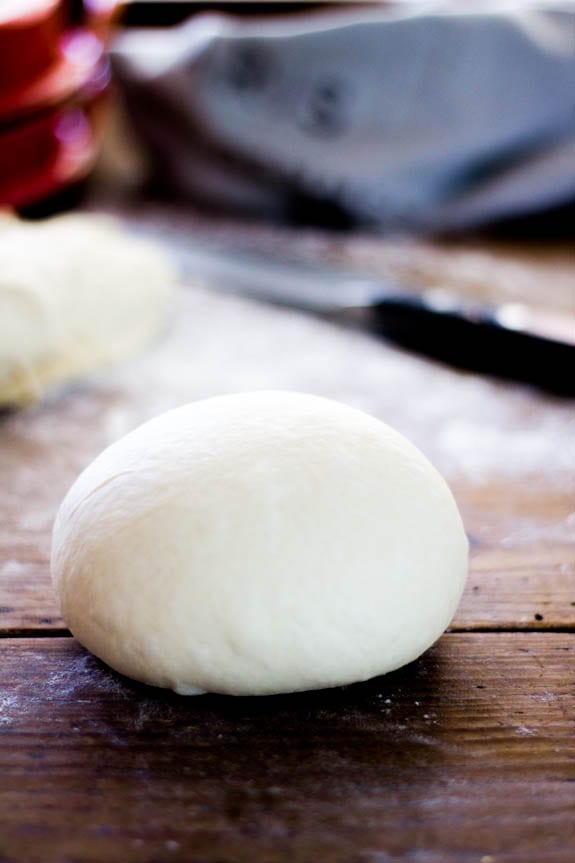
At this stage, remove the dough onto a lightly floured surface. For two smaller loaves, divide the dough in half. For a single, standard size loaf leave it whole.
How To Shape A Round Sourdough Boule (Loaf)
Starting at the top of the dough, fold it over toward the center. Give it a slight turn, and then fold over the next section of dough. Repeat until you have come full circle to form a tight round. This creates surface tension for better oven spring. You can also try the envelope-style fold.
Tip: I used to get so nervous when shaping bread dough because you only had one chance to get it right. So intuitively, I would practice using a piece of Play-Doh or with a kitchen towel to go through the motions at my own pace.

Step 4: Choose The Right Baking Pot
If you want bakery-style results, bake sourdough bread in a Dutch oven. Why? Pots trap steam which is the secret to homemade sourdough with bold rise and golden crust. Without steam, the crust will set too fast casing the loaf to harden, split or bake unevenly. I’ve been there and it’s not pretty.
What If You Don’t Have A Dutch Oven?
You’ll need another oven-safe pot with a lid to create steam. It must be able to withstand up to 450 F/232 C (lid and handles included).
A few options:
- Enamel roasting pan with lid (or sheet pan to cover)
- Cast iron skillet with upside down roasting pan to cover
- Covered sandwich loaf pans
- Clay Baker or Romertopf (soaked first)
- Preheated baking stone w/ metal bowl to cover
Here’s what happened to me: I tried the “no pot” baking route in the past, using just about everything from pizza stones, to baking sheets with no luck! The crust always hardened too quickly. Then I tried various steaming methods to remedy this (e.g. ice cubes in a hot pan, spraying my loaves with water) but my personal oven could not retain enough moisture. The environment was always too dry. For me, using a Dutch oven was the only reliable solution that worked with consistent results.
Step 5: Second Rise (Proofing)
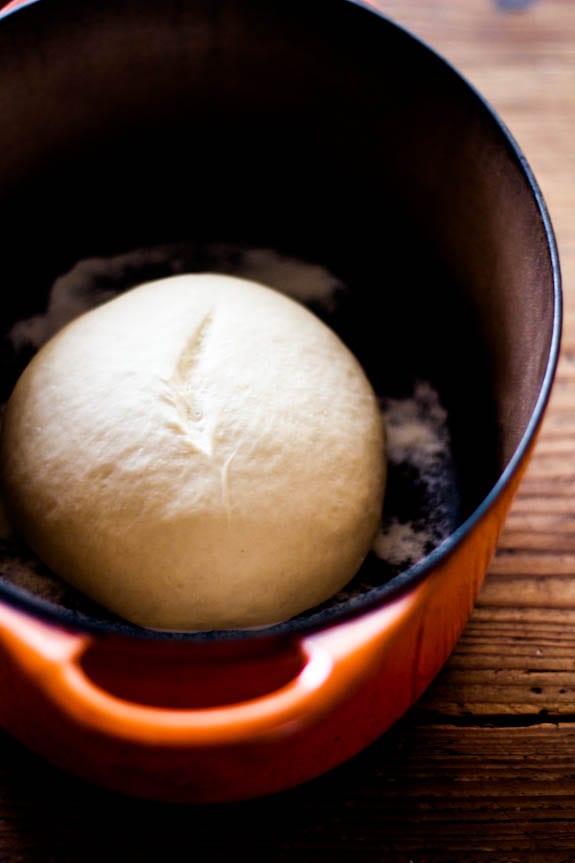
- After shaping, your dough needs to rise again. To do so, generously dust the bottom of your Dutch oven with cornmeal, or line with non-stick parchment paper to prevent sticking. Gently place the dough inside (see tip below)
- Let the dough rise for 30 minutes to 1 hour, or until it’s visibly puffy and no longer feels dense. It doesn’t need to double in size. While the dough proofs, preheat your oven to 450 F (232 C).
Tip: Want better shape and structure? Proof the dough in a floured, cloth-lined, 8-inch bowl or banneton instead of directly in the Dutch oven. This will contain the dough and hold its shape without spreading. Bread flour or rice flour is fine for dusting.
Step 6: Score The Dough
- Right before the dough goes into the oven, make a shallow slash down the center of the dough, about 2-3 inches long. Use a small serrated knife, sharp knife or bread lame. This lets the steam escape, and allows the bread to “bloom” or expand in the oven.
- Admittedly, this step is a bit nerve racking, so I don’t want to gloss over it. Be quick and confident. I’ll share what my sourdough mentor told me: “Slash with panache!”
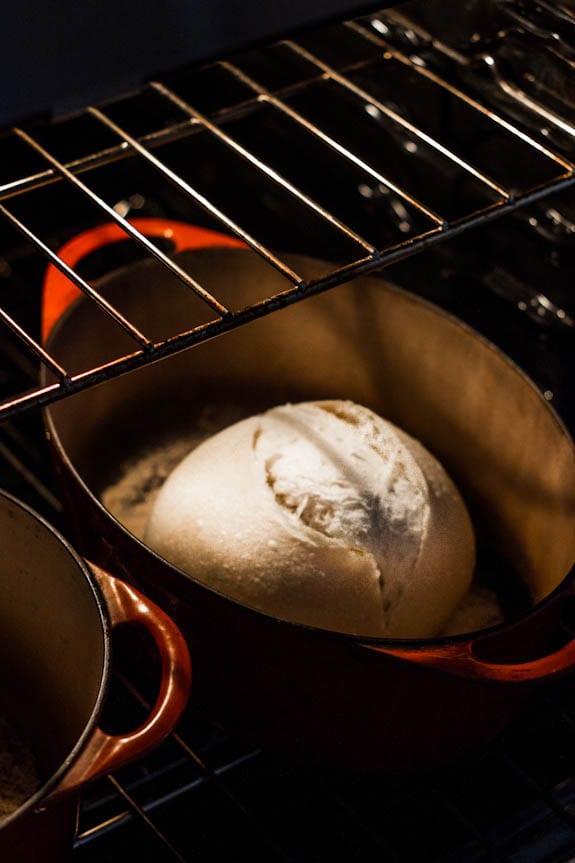
Step 7: Bake The Bread
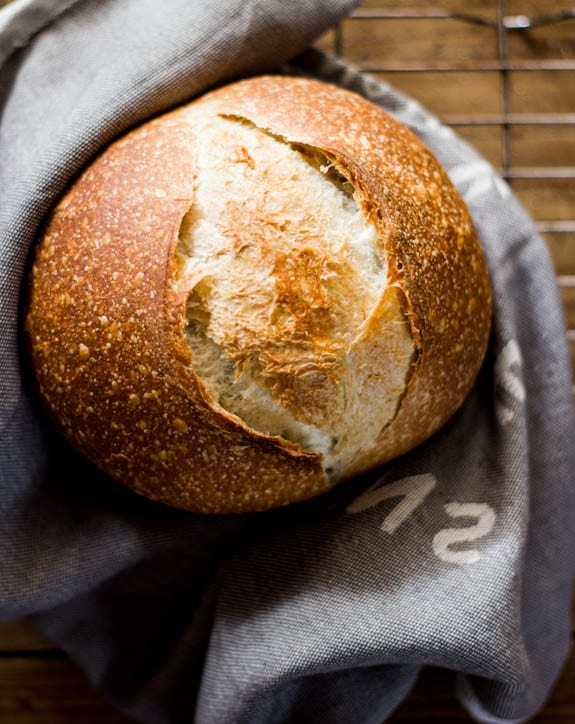
You’re at the finish line now! Bake on the center rack (lid on) for 20 minutes. Then remove the lid. Your bread will look pale and slightly shiny. Then finish baking (uncovered) for 40 minutes or until the crust is deep golden brown. The internal temperature should be 205-210 F/96-98 C.
Tip: During the last 10 minutes of baking, crack open the oven door to let the moisture out. This creates a crispier crust. Or, remove the bread from the hot Dutch oven and bake directly on the oven rack. The latter creates the crispiest finish.
Step 8: Cool & Slice
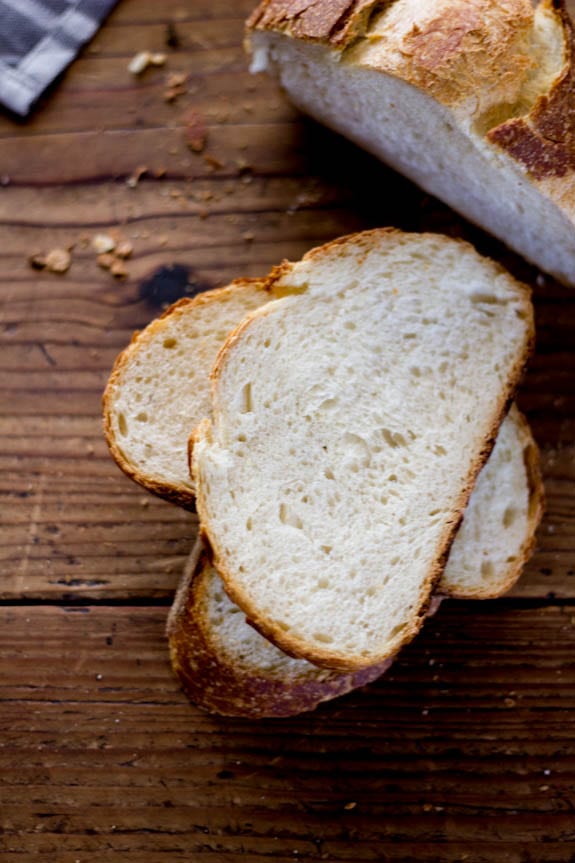
Cool the bread on a wire rack for at least 1 hour before slicing. Be patient! If you cut into it too soon, the texture will be damp and gummy. Life’s too short for sub par bread.
Final Thoughts
There are a gazillion sourdough bread recipes out there. No two loaves look alike. Start with this guide, master the basics and then branch out: try my golden sourdough focaccia recipe, this easy sourdough sandwich bread, or my one-bowl sourdough pancakes for breakfast! Once you have a few loaves under your belt, the process will become an imminent rhythm and you’ll become a sourdough pro in no time.
Sourdough Baking Schedule
- Friday Evening: Feed your starter, cover the jar, and leave it on the counter overnight. If you keep your starter in the fridge, it might need two feedings to perk back up (feed it in the morning & in the evening).
- Saturday Morning: Check your starter: if it’s alive and bubbling, you can make the dough to rise during the day. Or, feed it again in the afternoon to make the dough in the evening for an overnight rise. Remember to use the float test mentioned above to make sure your starter is ready to use.
- Saturday Morning/Evening (or whenever your starter is ready): Make the dough. Leave on the counter to bulk rise at room temperature. In the summer, if your dough rises quickly and you’re not ready to bake, cover the whole bowl with lightly oiled wrap and chill until ready to use.
- Sunday Morning: cut and shape the dough. Place in Dutch oven for second rise. Slash. Bake. Cool. Eat.
By signing up, you agree to receive emails from The Clever Carrot. Unsubscribe at any time.

Sourdough Bread: A Beginner’s Guide
- Prep Time: 13 hours
- Cook Time: 1 hour
- Total Time: 14 hours
- Yield: 1 loaf 1x
- Category: Sourdough Bread Recipes
- Method: Oven-Baked
- Cuisine: American
- Diet: Vegan
Description
New to sourdough? My easy beginner sourdough bread recipe makes the best artisan-style loaf at home with just 5 simple ingredients: bread flour, active sourdough starter, water, salt and olive oil—my signature addition—known for creating a light, plush crumb and a crisp golden crust. Follow my clear, step-by-step instructions and video guidance to bake fresh sourdough bread with confidence (even on your first try!).
Ingredients
- 150g bubbly, active sourdough starter
- 250g warm water (see Note 2)
- 25g olive oil
- 500g bread flour (not all purpose flour)
- 10g fine sea salt
- fine ground cornmeal or non-stick parchment paper
Notes, Tips & Equipment
- Weigh your ingredients with a digital scale for best results
- For a more soft and pliable dough, increase the water up to 300 g- 325 g total. Use a floured, cloth-lined bowl or proofing basket (instead of the Dutch oven) for the second rise.
- You will need a 5 1/2 or 6 quart Dutch oven for baking
- This recipe was tested with King Arthur Bread Flour, Gold Medal Bread Flour, Pillsbury Bread Flour
Instructions
Make The Dough
In a large bowl, add the sourdough starter, water and olive oil. Mix with a fork to combine, then add the flour and salt. Continue mixing until the dough becomes stiff, then squish it together with your hands to incorporate all the flour. The dough will be rough and shaggy.
Cover the bowl with plastic wrap, reusable wrap, or very damp kitchen towel. Let rest (autolyse) for 30 minutes to 1 hour.
After resting, return to the bowl and work the dough into a rough ball, about 15 seconds.
Bulk Rise (First Rise or Bulk Fermentation)
Cover the bowl with lightly oiled plastic wrap. Alternatively, transfer the dough to a high-sided dough tub. Let it rise in a warm place, ideally 70-75 F. The dough is ready when it no longer looks dense and has almost doubled in size.
Note: The bulk rise time will be different for everyone. For example, in the summer, expect ~2-4 hours @ 80 F/ 26 C. In the winter, ~10-12 hours @ 68º F/ 20º C. Watch the dough and not the clock.
Optional Step: Stretch & Fold The Dough
During the bulk fermentation, you can do a series of ‘stretch & folds’ to strengthen the dough. Start 30-45 minutes in: lift a portion of the dough, stretch it upwards, and fold it over itself. Rotate the bowl ¼ turn and repeat until you’ve come full circle (1 set). Do 1-2 additional sets, spaced ~1 hour apart. Click here for a step-by-step video tutorial.
Note: Dough made with 250g water will feel stiffer; 300-325g water will be more stretchy and elastic. Let it rest longer in between sets if it resists stretching.
Shape The Dough
Remove the dough onto a lightly floured surface. Starting at the top, fold the dough over toward the center. Turn slightly, and then fold over the next section. Repeat until you have come full circle. Flip the dough over, seam side down. Gently cup the sides and rotate in a circular motion to tighten the shape. The goal is to build surface tension to create a tight ball (too much flour will cause the dough to slide around).
Second Rise
Now the dough needs to rise again. If you’ve used 250g water, you can do a free-form second rise in the Dutch oven (if not, see note below). Line the pot with a piece of parchment paper (this is what I do) or coat with cornmeal. Place the dough inside, cover and let rise for about 30 minutes to 1 hour. It’s ready when slightly puffy, but not double in size. Preheat your oven to 450 F/ 232 C.
Note: If your dough contains more than 250g water, skip the free-from rise. Your dough will spread. Instead, use a floured, cloth-lined, proofing basket to help hold its shape.
Score The Dough
Right before baking, make a shallow 2-3 inch slash (or longer) in the center of the dough using a bread lame, razor blade, or small sharp knife. The cut should be ~1/4-inch deep.
Bake The Dough
Place the bread in the oven on the center rack (lid on) and reduce the temperature to 400 F/ 204 C. Bake for 20 minutes, then remove the lid, and continue to bake (uncovered) for an another 40 minutes, until deep, golden brown. All ovens are different; feel free to make minimal adjustments to these temperatures.
Check for doneness with a digital thermometer: 205-210 F/ 96-98 C for sourdough.
Remove the bread from the hot Dutch oven, and cool on a wire rack for at least an hour before slicing.


Comments
Kathleen says
Thanks for such great instructions. One question: how deep should the slash be?
linda Azuar says
About 2 inches deep.
Kathleen says
Thank you. After I read the instructions again where it said to make a slash 2″ long, I thought you probably meant 2″ deep. Or do you mean a slash that is both 2″ long and 2″ deep?
Thanks for clarifying.
Emilie Raffa says
Hi there! The cut should be 2-3 inches long and about 1/4-inch deep (in comparison, 2-3 inches deep would be too much!). Hope this helps :)
Amalia says
I use this recipe every week ! Yhank you for sharing :)
Emilie Raffa says
You are very welcome! Enjoy :)
Donna says
Hi Emilie
I am enjoying your sourdough instructions/recipes and just found that your starter’s “mother” was from Australia and shared my mother’s name – Priscilla.
You may not be aware that your link to your baking schedule is not working (anchor #baking-schedule)
cheers
Julie Mazzoleni says
Hi Emily
I have your book and its the only one i use. I have a question – I love your high hidration dough, i love the fact that I shape in the AM and I can then put in the fridg and bake it later in the day – when I’m ready. This schedule really works for me. Can I do this with ALL your breads in the book? most all others list to bake in an hour or so. I’d like to shape, rest in the fridg and bake later in the day.
If you recommend not doing with other breads, can you explain why.
Thanks much
Julie
Emilie Raffa says
Thank you Julie! So great to hear ;) Yes: this schedule can be done with most other breads in the book. Just keep an eye on the bulk rise. You don’t want it to go for too long, otherwise the dough won’t survive a long second rise in the fridge (it will be over proofed). You can always shorten the bulk slightly, to give it extra time as needed in the fridge.
Lindsay says
Followed the instructions to the letter and ended up with a beautiful looking and very tasty sourdough loaf
Ivan says
Hi Emilie! Thank you for your knowledge. I have just backed my bread with this recipe and it came out all pale. I kept it with the closed lid for 20 minutes at 204C, and then removed the lid, reduced temperature to 98C and kept for 40 minutes more. Did I do something wrong in terms of the temperature?
Martin says
I may be wrong but it’s the internal temperature of your bread that should reach 98c for it to be cooked. Re read the instructions and check what temperature the oven should be at.
Rob says
Excellent for a bread-baking newbie:
Best bread recipe I have followed yet. I was gifted some sourdough starter and have been trying out various recipes- this is the first that has yielded positive (dare I go so far as to even say ‘edible’) results.
The directions are thorough and well explained and my resulting bread was delicious. I tried a variation with less salt (about 30%) and replaced it with 7g of mixed seasoning (garlic granules, cardamom, rosemary, and oregano) which also resulted well.
Definitely following this recipe for future endeavors.
Steve says
Very helpful for a first timer. Thanks.
Sandra says
My go-to recipe for sourdough!
Len says
Really like this recipe. I’m often short on time, so I do a second rise overnight in the fridge, tightly wrapped in a rice flour dusted cloth lined bowl or basket. Next morning, unwrap and let rise under a clean kitchen towel. At room temperature of 76 degrees, it takes about three hours to reach an internal temp of 65 degrees. Bake as per recipe.
Emilie Raffa says
Sounds fantastic, Len! Thanks for sharing your tips with us.
Teri says
I’ve been baking with my sourdough starter for a little over a year now. This is by far the easiest and tastiest loaf I’ve baked. I really appreciated not having to pre-heat the Dutch oven. It came out beautifully. Thank you for this recipe.
Emilie Raffa says
Excellent, Teri! Glad you’ve had success with the recipe :)
John MacEachern says
I made this Sourdough Bread recipe and it was nothing short of FANTASTIC! My wife gave it an A++ which is very difficult to achieve. what a great and simple recipe! Thank You.
Emilie Raffa says
So great to hear, John! Thank you! I appreciate your feedback. Happy baking :)
Lydia says
I found this simple recipe and method in standard measurements very helpful in beginning my attempts at making sourdough bread. Thank-you for your thoughtful instruction! I did make some adjustments, at the advice of a friend who has more experience making sourdough bread. I added 2 Tbls olive oil with the water and used 3 Cups unbleached all purpose flour and 1 Cup whole wheat. The results were delicious!
Emilie Raffa says
Lydia, I appreciate your feedback. Thanks so much! Your variation sounds wonderful.
Cam D' Toro says
Thanks for your recipe, followed the steps and results were great. Just something to add, would it be possible to put the temperature in Celsius? You know that we can read this from the rest of the world, and not necessarily we are measure temperature in Fahrenheit.
Emilie Raffa says
Sure thing! I’ve updated and post and recipe to include the Celsius conversions.
Steve Timbrook says
I’ve made well over 100 loaves since starting to use this recipe in April 2020. All have been successful, with good crumb, crust and tang. But, I never seem to get much of a second rise. I was reminded of this when I used a loaf pan yesterday. Good oven spring, but very little volume increase in second rise. Bulk fermentation always at least doubles, sometimes more. Finger push test depresses and slowly rises back up. Should I just quit obsessing about little second rise? BTW, took the bagel Zoom class and made a batch the next weekend. They turned out great.
Emilie Raffa says
Hi Steve! In short, the answer is yes ;)
Here’s why: a second rise that follows a long bulk rise (i.e. bulk dough that has more than doubled/tripled in volume) will not rise much during the second fermentation. You’re looking for the dough to become slightly puffy and less dense, not necessarily notably risen.
Conversely, a second rise that follows a shorter bulk (i.e. 3-4 hrs @ 78 F) will need a much longer second rise. All recipe formulas are different. If you can spot the difference, you’ll be one step ahead. PS: if you have good oven spring, following the method you’re currently using, then you’re doing it right!
Steve Timbrook says
Thanks, Emilie.
Steve
Crystal says
I love this recipe. It is the best one I have found for a simple sour dough. I have been making it for over a year now and have it memorized. The flow of making it is simple and it tastes so good.
Maureen Welsh says
So I am totally new to sourdough bread, I have had a few flops but I keep trying. Am I understanding correctly. Feed my starter, let it bubble, measure, mix, rise, rise, etc etc. But once I take off what I need for the bread (my starter), do I put the remaning starter in frig or do I feed that which was just fed before putting remainder in the frig (I bake once a week currently). So the leftover, if using the next week, goes right into frig or do I feed it again. Thank you for your time and for sharing your talent with all of us.
Angela says
Hi Maureen. I am new to sour dough bread making too. I put my starter straight back in the fridge, without feeding again. When i take it out again i let it get to room temperature then feed it. X
Brenda says
i have done maybe ten sourdough loaves using this recipe. all taste good but the shape was off, it spread in my dutch oven, so i added some of the optional water. one time i did try using a cloth lined bowl, but the recipe does NOT say to flour it. yikes, what a mess. i just saw that it should be floured in the additional notes. so, next time i will do that as the loaf has spread each time. it makes the most awesome toast or dry bread for bruschetta! it is such fun to make sourdough bread, thank you!
Giulia says
Struggled for so long to get a good rise and a proper ear on my sourdough but this recipe worked amazingly. I used 400g strong white plus 50g malt/wholegrain bread flour and 50g kamut flour (despite me later reading comments which suggested not to use wholegrain unless adjusting water content! Whoops). Loved the inclusion of a suggested baking schedule which worked great. Got a fantastic rise and a lovely ear, best loaf I’ve made yet. Recently received ‘Artisan Sourdough Made Simple’ as a gift and I can’t wait to try out more.
Ruth says
Hi there, is there such a thing as gluten free sourdough bread?
Thanks
Emilie Raffa says
Sure thing! You’ll need a dedicated GF starter to make GF sourdough bread. There are many recipes online for both!
Cindy King says
This by far is the simplest Set of directions for sourdough that I have come across. Thank you, Cindy King
Tori Roessler-Studebaker says
I’ve made this bread twice now, and I’m finding that the rise isn’t as high as I normally get it to be while baking. Am I doing something wrong/
Marcia says
I love this recipe! Beautiful, large loaves! In the past 6 or 7 months though, my loaves keep coming out flat. I replaced my starter, bought a digital scale…. made it last night and the dough looked just right. But it came out of the oven flat. I don’t have a proofer, so I try to use a windowsill for proofing. Any suggestions?
Christina says
So easy & delicious!!
Steven Timbrooki says
I just bought Artisan Sourdough Made Simple and want to make the quick baguette twist recipe. I have a two trough metal baguette pan. Can I just divide the dough into two instead of three loaves? Would I still bake to an internal temperature of 209-210 F like I do for your basic sourdough recipe, which works perfectly for me? Maybe extend the bake time by 5-10 minutes?
Emilie Raffa says
Hi Steve! Yes: two loaves + the metal baguette pan should work. The bake time will increase (internal temp will stay the same). Alternatively, for 3 loaves, bake 2 in the pan, followed by the 3rd one when you’re ready. PS: thanks for your support!
Steve Timbrook says
Great Zoom bagel class, Emilie. I made a batch last weekend and my bagel snob friend from NYC pronounced them “Good!”
kim says
made my first loaf using your instructions. It came out great! This is such a good resource! Next I’m planning to experiment with increasing the hydration and possibly adding some raisins and walnuts. Wish me luck!
Emilie Raffa says
Sounds fantastic, Kim! Enjoy!
helene says
I made this recipe with 3/5 strong wholemeal flour and 2/5 all purpose flour. It was all looking perfect. the dough was raising beautifully even after I divided and shaped (I had to leave to raise a little longer than the hour suggested). I do not have s dutch oven, so I put the dough in thick bottom pan with a lid in the oven.
the breads completely collapsed and I got more thick pancakes than boules.
what did I do wrong? was it my flour (that’s the only thing I had in the house St the time)
Emilie Raffa says
Hi Helene! Oh no, sorry to hear that. With bread, anytime you make changes to the original recipe, there’s a bit of trial and error involved; all steps are connected. The combination of flours could’ve been the culprit (it’s best to use strong bread flour, exclusively). Additionally, based on what you’ve described, it sounds like the dough was over proofed (rose for too long). This could’ve happened during the bulk rise, or second rise, my guess is the latter. I’d shorten the second rise a bit next time, it’s better to err on the side of under proofed for the second rise. Hope this helps!
Diana Bontecou says
I have had some success with this recipe and some not so great. Right now I am struggling with my starter. Fed it on last Saturday and it is doing nothing. What should I do?
Rick B says
I just made this recipe, turned out great. I do have a question.
Can i use my stand mixer for the mixing as my hands dont operate like they used to……
Thanks
Rick
Emilie Raffa says
Hi Rick! Absolutely. A stand mixer works perfectly well for this recipe.
Rick says
Thank You
Nina Paul says
Thanks for sharing this, can you please tell if this is a vegan recipe or not.
Emilie Raffa says
Hi Nina! This recipe is vegan. Enjoy :)
Does Size Matter? says
Hi there, I finally got my starter going after 1 month of it looking dead in the cool Canadian winter (to anyone else feeling disheartened: I was there – don’t give up!!).
Now I want to make my 1st loaf, but I only have a 2-qt. Pyrex round glass casserole dish, with lid. Is it too small or can I use that to bake? If yes, how do I adjust the recipe and baking times? Do I halve all the measurements? Please help! Thank you :)
Mackenzie says
I cut it in half, I should bake one at a time right? First time making sourdough😉
Emilie Raffa says
Hi there! If you only have 1 baking pot, bake one dough at a time. You can keep the second dough in the fridge while the first one bakes :)
Klare says
Hi Clevercarrot, I’m following your sourdough starter recipe and am soon to embark on my first loaf. Your recipe calls for 130 grams of starter but your starter recipe is 120 grams. Do I keep feeding the starter to get 260 grams and then remove half? Sorry, I’m a confused courgette 🤪
Emilie Raffa says
Hi there! If you do not have enough starter (which is absolutely fine!), discard less at your next feeding and keep adding more flour and water until you’ve reached your desired amount. It’s flexible :)
Joanne Atkinson says
Hi = I am new to sourdough baking so will be giving your recipe a try. Here in Melbourne, Australia I have flavoured olive oils. Garlic and Rosemary flavoured olive oil is my favourite. Could I use this in the recipe instead of basic olive oil to add flavour or will the difference “interfere” with it in some way? Thanks & cheers. Jo.
Nicole says
Hey there Emilie,
I am trying to work out how to make gluten free sourdough do you have any recipes for me? I would be forever grateful.
I have a gluten one going too but live in Australia and I have to make a few loaves of gluten free to feed 20 people on a retreat that have many allergies. I am so grateful for any help you can give me desperate Nicole 😂
Emilie Raffa says
Hi Nicole! Unfortunately, as of right now, my GF sourdough is still not perfected :( I’ll update here when the recipe is edible (lol).
Nicole says
Thank you i really appreciate that. 🙏 before August 18 would be awesome (lol) thats when the retreat is 🤣
Jerry says
I use one of those cookie sheets that are insulated under my Dutch oven and it works perfectly to stop bottom of bread from over baking
Emilie Raffa says
Excellent tip, Jerry!
Charlie says
Many thanks for taking the trouble to reply and the clarification. Great recipe!
Jessica says
Going to make this tomorrow but quick question – do you preheat the oven the 450 and put the loaf in then reduce to 400 or wait until it’s down to 400 to put the loaf in?
Judy says
I’ve just sliced into the best sourdough loaf I’ve ever made and certainly the most delicious! Thank you for your recipe, video and easy to follow instructions. I’ve been making all types of bread for over a year now and have tried several sourdough recipes. I can say I’ve found my recipe! I did the folding during the first rise period and did five folds in total (folded about every 30 to 45 minutes). I am just so excited about this recipe and can not wait to make some loaves to share with family and friends.
Charlie says
Hi, have I missed something in the instructions or is there no kneading stage? It seems to go from autolyse directly to bulk rise. In which case what would be the difference between the 2? In any case I did a kneading stage and the results were pretty good for a first effort.
Emilie Raffa says
Hi Charlie! Kneading not necessary in this recipe. However, I do include the optional step of stretch and folding the dough, which is a minimal kneading technique. Either way, you are more than welcome to knead the dough for this recipe. It’s up to you.
To further clarify: there are a few differences between autolyse to bulk rise. First, the autolyse stage is much shorter than the bulk rise (30 minutes). Second, after autolyse, you return to the bowl to work the dough into a ball (before the bulk rise). This is a significant step. It’s the last time you can adjust the dough. Meaning, if it needs more flour or water, or if there are some clumpy bits that need more mixing, now’s the time to do it. Finally, working the dough into a ball after autolyse allows for more even fermentation (bulk rise).
Hope this helps!
Claire says
Hi. These are the clearest instructions for sourdough I have seen. I plan to try it having completed my starter (also from your instructions). I got stumped at the measurements. Baking is a science so precision is needed, but I don’t have a digital scale. So Inhad to abort my plans to bake today. Is there anything I can do to adjust to a regular scale and liquid measuring cup?
Emilie Raffa says
Hi Claire! Thank you. I’m glad you’ve found this guide helpful. If you have a regular kitchen scale, as opposed to a digital one, you can still use it to weigh all of the ingredients including the liquid. For volume measurements, I’ve included the approximate equivalents in the FAQ section. Hope this helps!
Claire says
Thank you, I will try this.
JJ says
Thank you so much! I am making today!
JJ says
This is my first time trying sourdough and your recipe for the starter is perfect and mine has now more than doubled on day 7. Not much sour smell now though. When. Bread making do I add the starter when it is at its peak, or after it falls before discard when it is hungry? Sorry if I missed it somewhere and thank you so much for sharing your info!
Emilie Raffa says
Hi there! Yes: use your starter at peak height for best results. Keep in mind: the starter can also be used when it falls, if you catch it early on before it loses all strength.
Daniela says
It worked it worked it worked! I diligently followed your starter instructions and then baked this lovely bread once it was ready. Beautifully sour and so delicious. Thank you!
Pamela says
I have made the most gorgeous, delicious batards using your recipe. Thanks!
Susan Poolarea says
I followed this exactly and it was amazing. I consider this the authoritative guide to making sourdough. Thank you for how thorough it is!
Emilie Raffa says
Excellent, thank you Susan! You are very welcome. Appreciate the kind words :)
Winkles46 says
hi there,
first time making sourdough!
The dough took overnight to rise, but is so so sticky, that I cannot do the folding. I’m going to stick it in the oven anyway after the second rise, but wondered what happened?
I stuck to the measurements in the recipe
Emilie Raffa says
Hi there! Could be a few things: type/brand of flour used, warm dough and/or over proofed dough. All lead to sticky textures. Next time, cut back on the amount of water used and shorten the bulk rise is necessary. That should help!
Tammy Miller says
Thank you so much for this recipe! I bought an amazing starter online and used her recipe and it was an epic fail. Yours was foolproof and it tasted awesome!
Emilie Raffa says
Thanks Tammy! I’m so glad it worked it for you. Sourdough is one of those things… its more of an understanding rather than a recipe, which was the inspiration and drive behind this post. Happy baking :)
Rona Gregory says
Sorry I’m a sourdough virgin and a little confused! why do you preheat the oven to 450F while the bread is rising, presumably on the side as the instructions don’t mention putting it in the oven … only to reduce it to 400F when it’s time to bake it? Many thanks!
Emilie Raffa says
Hi Rona! To boost the rise. Since all ovens are different, and most are slightly inaccurate, starting at a higher temperature helps to promote better oven spring. The temperature is then reduced for the duration of the bake, as this particular dough requires a lower temperature.
Bob McClellan says
Very instructive-reading through the early information for beginner’s helped begin the journey of sourdough bread baking.
I am wondering if you use the same bread recipe for baguettes? If so, do you have a video on shaping baguettes? If you use a different recipe for baguettes where can it be found?
Emilie Raffa says
Fantastic Bob, thank you! For baguettes, it’s a totally different ball game. You need a wetter dough, a different flour (sometimes ap flour is used) and the method itself is different. I wouldn’t modify this recipe. I don’t have a specific sourdough baguette recipe on the blog; you can find my beginner baguette “twists” in my book.