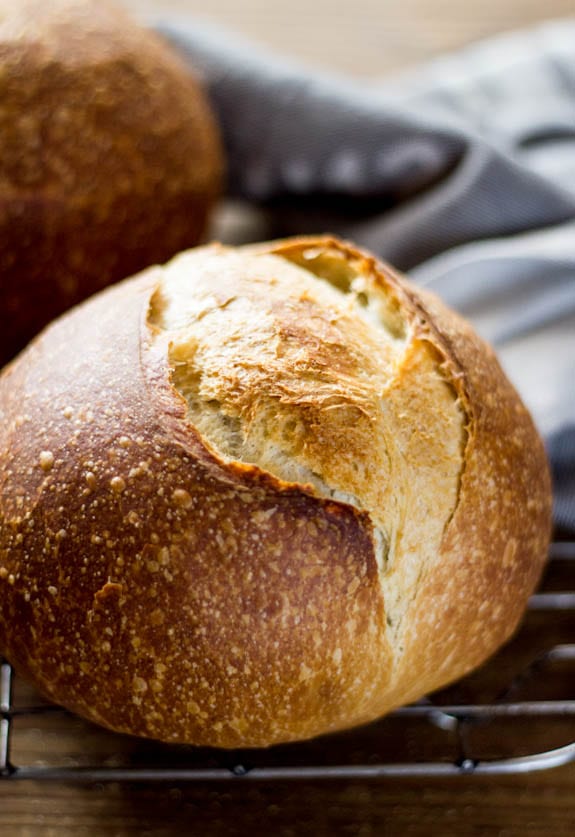
Think you can’t bake fresh, homemade sourdough bread? This easy sourdough bread recipe—trusted by beginner bakers for over a decade—shows you how, step-by-step. No yeast. No kneading. Just simple ingredients and 10 minutes hands on time for soft, crisp sourdough bread at home.
Reader review
“I have tried MULTIPLE sourdough bread recipes and this one has been the very first to make a successful (fully risen) loaf of bread. I am relatively new to sourdough and for some reason, the other recipes just didn’t produce good bread. These instructions and detailed explanations really make a huge difference to someone who is new to the world of sourdough.”
—Savannah
To anyone who thinks their sourdough bread isn’t good enough, I get it. Back in 2013, I set a goal: bake more bread. I tested, failed, succeeded (and tried again). What began with an easy no-knead artisan loaf eventually led to the holy grail: homemade sourdough bread.
Admittedly, I had beginner’s luck. My early scratch-made loaves were light, plump and airy, everything you want sourdough to be! And then? Down the rabbit hole I went: Hydration? Baker’s %? Proofing times?
Now, with 13+ years baking experience and a professional culinary background, I know what holds people back: the confusion, hesitation, comparison. I teach from a straight forward practical perspective because sourdough is not just a written recipe; it’s an understanding.
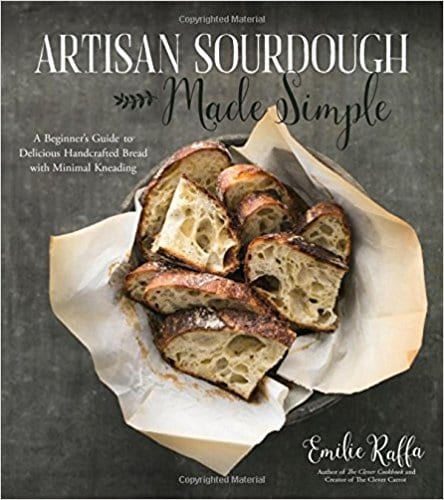
This sourdough bread recipe has been the most popular on my blog for over a decade- millions of views and the inspiration behind my bestselling book Artisan Sourdough Made Simple, a deeper dive into sourdough bread recipes. So, if you’re at the end of your rope (and just want to make good bread), you’ve made it. Welcome to the journey.
What Sets My Recipe Apart:
- One bowl, 5 ingredients
- Olive oil = soft, plush crumb & crisp, golden crust
- No stand mixer
- No bread machine
- Flexible baker’s schedule
- Personalized support in the comments
But before we make bread, let’s discuss what drives it: your sourdough starter. Once you understand what it is, and how it works, your path will be crystal clear. Have questions? Ask in the comment section. I respond with personalized help.
Where To Get A Sourdough Starter
A sourdough starter is a live fermented culture of flour and water. It naturally leavens bread dough without commercial yeast. There are all different types: homemade, purchased or gifted (ask a fellow baker!). I use two different starters at home: one I made myself, and a vibrant Australian starter gifted from my friend Celia.
But is doesn’t stop there. Once your have your own sourdough starter, it must be kept alive and well with regular feedings to maintain its rising power. Sourdough is not static; it’s a living process. Here’s my personal feeding schedule which you can adapt to suit your style:
How To Feed Sourdough Starter
- Remove and discard half of your sourdough starter
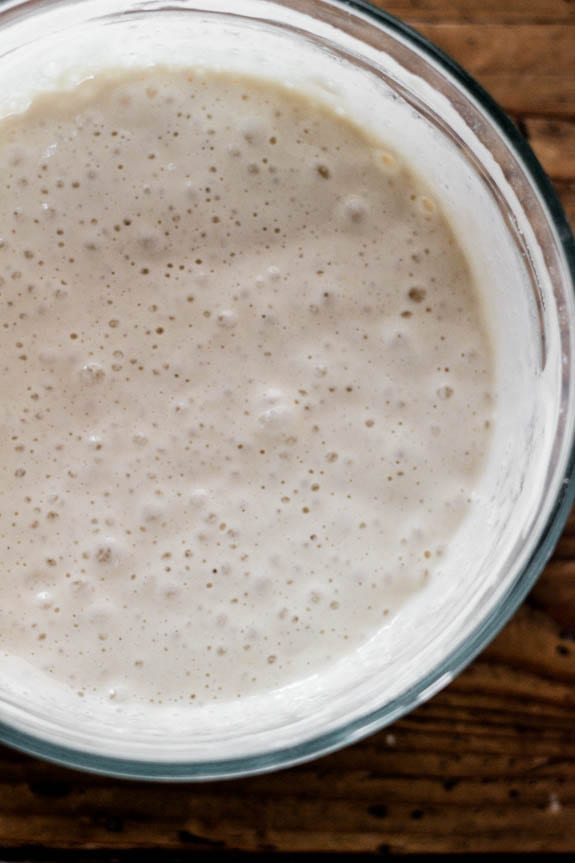
- Feed what’s left in the jar with equal parts flour and water by weight (1:1:1 feeding ratio).
- Let rise at room temperature (loosely covered or airtight) ideally 75+F until bubbly, active and double in size (2-12 hrs). I use this sourdough starter jar.
Recommended Reading: Feeding Sourdough Starter: My Best Tips & Tricks
When Is Sourdough Starter Ready To Use?
Your fed starter is ready to use when it’s bubbly, active, and doubles in size. This can take 2-12 hours or more, depending on the temperature of your kitchen and the strength of your starter. My best advice? Be patient, plan ahead, and make sure your starter is in a warm place (ideally 75 F). The process is not instant.
Float Test: If you’re unsure whether your starter is ready, drop 1 tsp at peak height into a glass of water. If it floats to the top it’s ready to use. If it sinks, feed your starter again.
Storing Your Starter
Most people don’t realize that your feeding schedule is directly related to your baking preferences. If you only bake a few times a month, store your starter in the refrigerator and feed it once a week. If you bake often, store it at room temperature and feed it once a day.
How To Make Sourdough Bread: Step-By-Step Recipe
To Start: Feed your starter until it’s bubbly and active first (remember this can take anywhere from 2-12 hours, so plan ahead). Then mix the dough. Detailed instructions follow below. For a printable recipe & sample baking schedule, scroll to the end.
Step 1: Mix The Dough
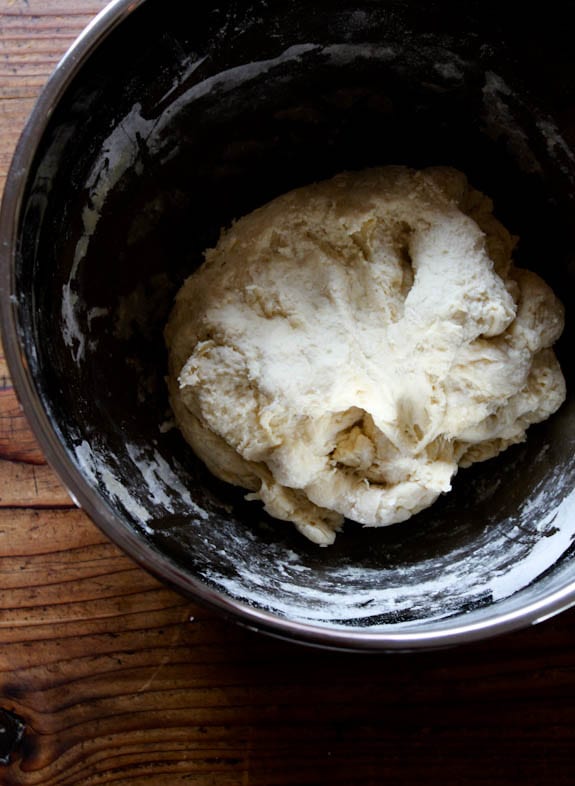
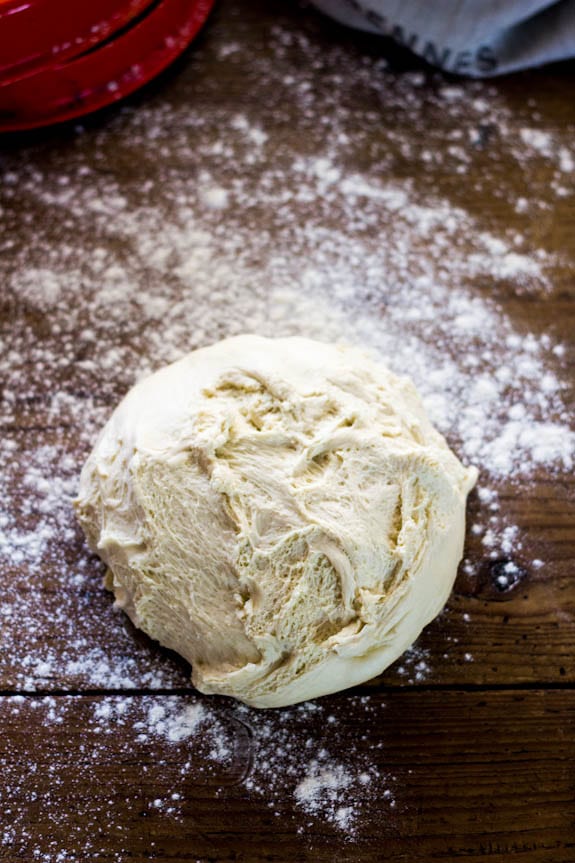
- Add water, sourdough starter, and olive oil to a large bowl. Whisk well to combine, making sure the starter is fully dissolved. Then add the bread flour and salt. Continue mixing (I use a fork at this point) until the flour is absorbed. The dough will feel rough and shaggy, which is normal.
- Cover the bowl and let rest (autolyse) for 30 minutes to 1 hour at room temperature. Then shape the dough into a rough ball. It doesn’t have to look perfect.
Tip: Weigh your ingredients with a digital kitchen scale. Measuring cups vary in size and don’t account for ingredient density which can lead to dry, dense, or overly sticky dough.
Why Autolyse Matters
Autolyse is the first rest after mixing bread dough. It jumpstarts gluten development without kneading, making the dough stronger, stretchier, and easier to shape I never skip it. For this recipe, rest for at least 30-45 minutes (or when time permits, I’ll do 1 hour for an even softer, more manageable dough). To learn more about common sourdough bread terms read my Sourdough Baking Glossary. I’ve included the only 12 you need to know!
A Note on Salt: Some bakers only add salt after autolyse, believing it slows down gluten development. I’ve followed that method for years, but now mix everything at once. It’s simpler, faster, and still makes excellent loaves (plus, you won’t forget to add the salt later on!). I’ll leave the choice up to you.
Want To Add Inclusions?
Mix in flavor additions after autolyse, when the dough is softer and more pliable. This is another reason not to skip the autolyse step. Alternatively, inclusions can be added during the first stretch and fold.
A few ideas:
- Roasted garlic
- Chopped olives
- Fresh or dried herbs (rosemary, thyme)
- Seed or nuts
- Cheese
- Dried fruit (raisins, cranberries)
- Jalapeños

Step 2: Bulk Rise
Now the dough is ready to rise. Cover the bowl with lightly oiled plastic wrap so the dough doesn’t stick to the top, or transfer to a dough tub. Let rise at room temperature, about 68-70 F (20-21 C).
How Long Does It Take For Sourdough Bread To Rise?
The dough is ready when it’s puffy, slightly domed and nearly double in size. This can take 3-12 hours depending on room temperature, the quantity and strength of your sourdough starter, and seasonal conditions. All variables work together. See my example below:
For My Sourdough Bread Recipe (with ~150 g sourdough starter):
- In the summer: ~2-4 hours @ 80 F (26 C)
- In the winter: ~10-12 hours @ 68 F (20 C)
Diving Deeper: Temperature controls time. This is where I see the majority of beginner baker’s make mistakes- the temperature is overlooked. Sourdough takes longer to rise than yeasted bread, and it’s highly dependent on your specific environment. My kitchen might be 75 F. Yours? 68 F. Watch the dough, not the clock. For more details and troubleshooting read my companion article: Why Won’t My Sourdough Bread Rise?
Stretch And Fold The Dough (Optional Step)
About 30 minutes into the bulk rise, you can perform a series of “stretch & folds” to strengthen the bread dough. This step is not mandatory; however it has the potential to add height and structure to the finished loaf. Check out my how to stretch and fold sourdough guide to learn more, step-by-step. It’s easy and fun to do!

Step 3: Divide & Shape The Dough
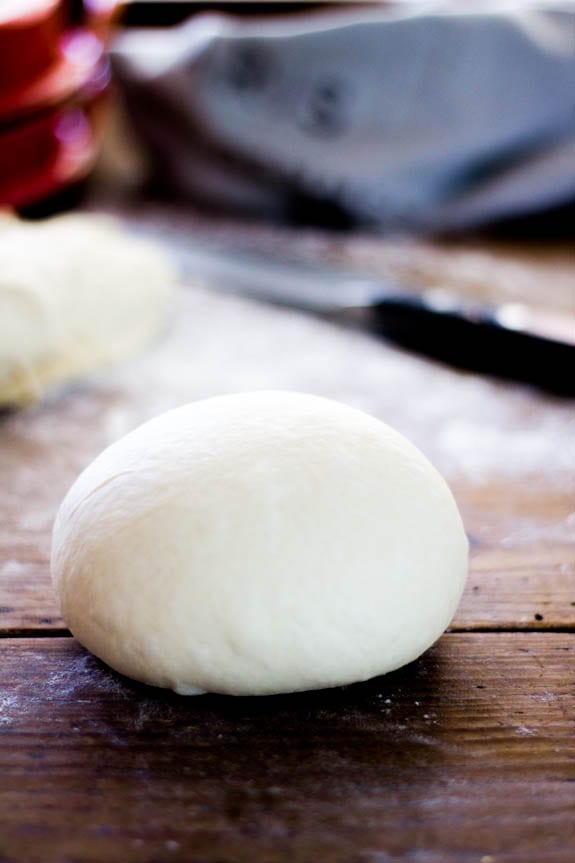
At this stage, remove the dough onto a lightly floured surface. For two smaller loaves, divide the dough in half. For a single, standard size loaf leave it whole.
How To Shape A Round Sourdough Boule (Loaf)
Starting at the top of the dough, fold it over toward the center. Give it a slight turn, and then fold over the next section of dough. Repeat until you have come full circle to form a tight round. This creates surface tension for better oven spring. You can also try the envelope-style fold.
Tip: I used to get so nervous when shaping bread dough because you only had one chance to get it right. So intuitively, I would practice using a piece of Play-Doh or with a kitchen towel to go through the motions at my own pace.

Step 4: Choose The Right Baking Pot
If you want bakery-style results, bake sourdough bread in a Dutch oven. Why? Pots trap steam which is the secret to homemade sourdough with bold rise and golden crust. Without steam, the crust will set too fast casing the loaf to harden, split or bake unevenly. I’ve been there and it’s not pretty.
What If You Don’t Have A Dutch Oven?
You’ll need another oven-safe pot with a lid to create steam. It must be able to withstand up to 450 F/232 C (lid and handles included).
A few options:
- Enamel roasting pan with lid (or sheet pan to cover)
- Cast iron skillet with upside down roasting pan to cover
- Covered sandwich loaf pans
- Clay Baker or Romertopf (soaked first)
- Preheated baking stone w/ metal bowl to cover
Here’s what happened to me: I tried the “no pot” baking route in the past, using just about everything from pizza stones, to baking sheets with no luck! The crust always hardened too quickly. Then I tried various steaming methods to remedy this (e.g. ice cubes in a hot pan, spraying my loaves with water) but my personal oven could not retain enough moisture. The environment was always too dry. For me, using a Dutch oven was the only reliable solution that worked with consistent results.
Step 5: Second Rise (Proofing)
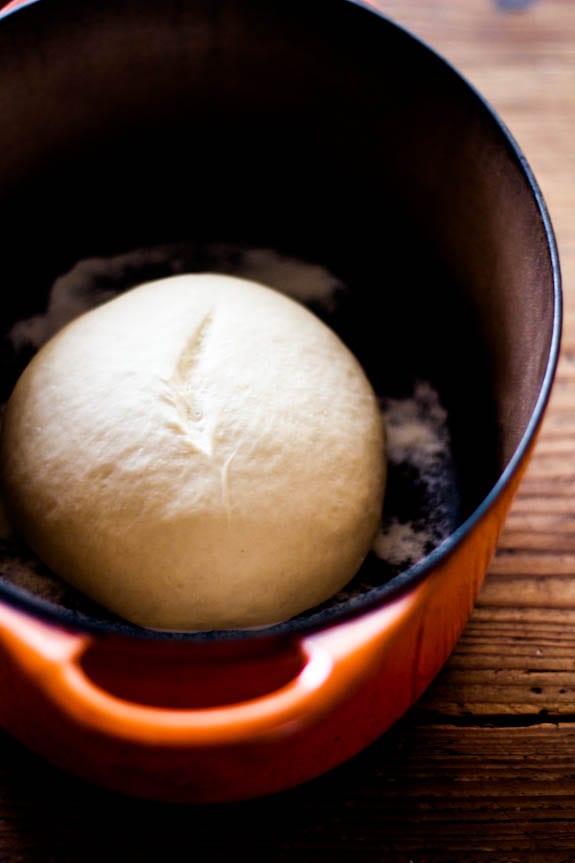
- After shaping, your dough needs to rise again. To do so, generously dust the bottom of your Dutch oven with cornmeal, or line with non-stick parchment paper to prevent sticking. Gently place the dough inside (see tip below)
- Let the dough rise for 30 minutes to 1 hour, or until it’s visibly puffy and no longer feels dense. It doesn’t need to double in size. While the dough proofs, preheat your oven to 450 F (232 C).
Tip: Want better shape and structure? Proof the dough in a floured, cloth-lined, 8-inch bowl or banneton instead of directly in the Dutch oven. This will contain the dough and hold its shape without spreading. Bread flour or rice flour is fine for dusting.
Step 6: Score The Dough
- Right before the dough goes into the oven, make a shallow slash down the center of the dough, about 2-3 inches long. Use a small serrated knife, sharp knife or bread lame. This lets the steam escape, and allows the bread to “bloom” or expand in the oven.
- Admittedly, this step is a bit nerve racking, so I don’t want to gloss over it. Be quick and confident. I’ll share what my sourdough mentor told me: “Slash with panache!”
Step 7: Bake The Bread
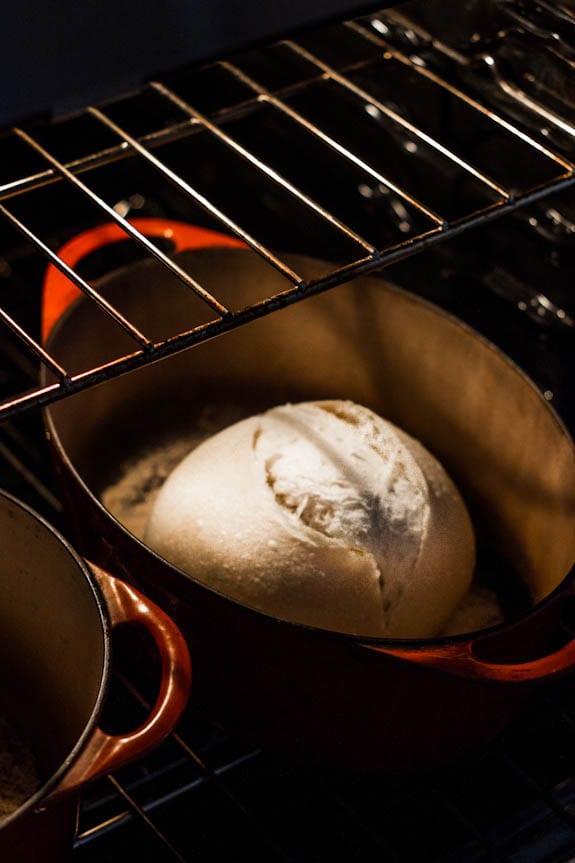
You’re at the finish line now! Bake on the center rack (lid on) for 20 minutes. Then remove the lid. Your bread will look pale and slightly shiny. Then finish baking (uncovered) for 40 minutes or until the crust is deep golden brown. The internal temperature should be 205-210 F/96-98 C.
Tip: During the last 10 minutes of baking, crack open the oven door to let the moisture out. This creates a crispier crust. Or, remove the bread from the hot Dutch oven and bake directly on the oven rack. The latter creates the crispiest finish.
Step 8: Cool & Slice
Cool the bread on a wire rack for at least 1 hour before slicing. Be patient! If you cut into it too soon, the texture will be damp and gummy. Life’s too short for sub par bread.
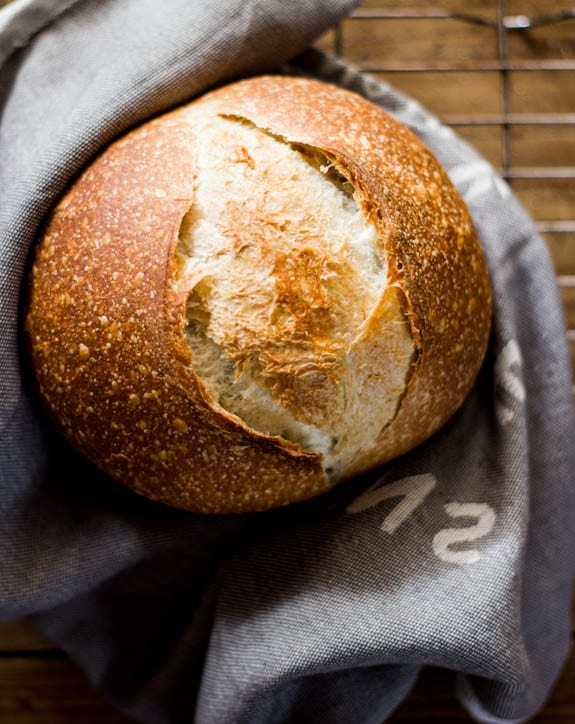
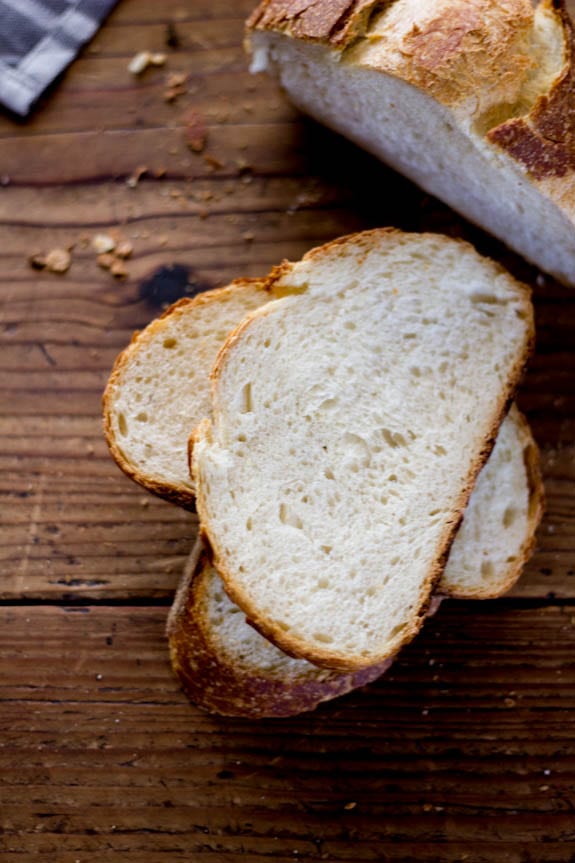
Final Thoughts
There are a gazillion sourdough bread recipes out there. No two loaves look alike. Start with this guide, master the basics and then branch out: try my golden sourdough focaccia recipe, this easy sourdough sandwich bread, or my one-bowl sourdough pancakes for breakfast! Once you have a few loaves under your belt, the process will become an imminent rhythm and you’ll become a sourdough pro in no time.
Sourdough Baking Schedule
- Friday Evening: Feed your starter, cover the jar, and leave it on the counter overnight. If you keep your starter in the fridge, it might need two feedings to perk back up (feed it in the morning & in the evening).
- Saturday Morning: Check your starter: if it’s alive and bubbling, you can make the dough to rise during the day. Or, feed it again in the afternoon to make the dough in the evening for an overnight rise. Remember to use the float test mentioned above to make sure your starter is ready to use.
- Saturday Morning/Evening (or whenever your starter is ready): Make the dough. Leave on the counter to bulk rise at room temperature. In the summer, if your dough rises quickly and you’re not ready to bake, cover the whole bowl with lightly oiled wrap and chill until ready to use.
- Sunday Morning: cut and shape the dough. Place in Dutch oven for second rise. Slash. Bake. Cool. Eat.
By signing up, you agree to receive emails from The Clever Carrot. Unsubscribe at any time.

Sourdough Bread: A Beginner’s Guide
- Prep Time: 13 hours
- Cook Time: 1 hour
- Total Time: 14 hours
- Yield: 1 loaf 1x
- Category: Sourdough Bread Recipes
- Method: Oven-Baked
- Cuisine: American
- Diet: Vegan
Description
New to sourdough? My easy beginner sourdough bread recipe makes the best artisan-style loaf at home with just 5 simple ingredients: bread flour, active sourdough starter, water, salt and olive oil—my signature addition—known for creating a light, plush crumb and a crisp golden crust. Follow my clear, step-by-step instructions and video guidance to bake fresh sourdough bread with confidence (even on your first try!).
Ingredients
- 150g bubbly, active sourdough starter
- 250g warm water (see Note 2)
- 25g olive oil
- 500g bread flour (not all purpose flour)
- 10g fine sea salt
- fine ground cornmeal or non-stick parchment paper
Notes, Tips & Equipment
- Weigh your ingredients with a digital scale for best results
- For a more soft and pliable dough, increase the water up to 300 g- 325 g total. Use a floured, cloth-lined bowl or proofing basket (instead of the Dutch oven) for the second rise.
- You will need a 5 1/2 or 6 quart Dutch oven for baking
- This recipe was tested with King Arthur Bread Flour, Gold Medal Bread Flour, Pillsbury Bread Flour
Instructions
Make The Dough
In a large bowl, add the sourdough starter, water and olive oil. Mix with a fork to combine, then add the flour and salt. Continue mixing until the dough becomes stiff, then squish it together with your hands to incorporate all the flour. The dough will be rough and shaggy.
Cover the bowl with plastic wrap, reusable wrap, or very damp kitchen towel. Let rest (autolyse) for 30 minutes to 1 hour.
After resting, return to the bowl and work the dough into a rough ball, about 15 seconds.
Bulk Rise (First Rise or Bulk Fermentation)
Cover the bowl with lightly oiled plastic wrap. Alternatively, transfer the dough to a high-sided dough tub. Let it rise in a warm place, ideally 70-75 F. The dough is ready when it no longer looks dense and has almost doubled in size.
Note: The bulk rise time will be different for everyone. For example, in the summer, expect ~2-4 hours @ 80 F/ 26 C. In the winter, ~10-12 hours @ 68º F/ 20º C. Watch the dough and not the clock.
Optional Step: Stretch & Fold The Dough
During the bulk fermentation, you can do a series of ‘stretch & folds’ to strengthen the dough. Start 30-45 minutes in: lift a portion of the dough, stretch it upwards, and fold it over itself. Rotate the bowl ¼ turn and repeat until you’ve come full circle (1 set). Do 1-2 additional sets, spaced ~1 hour apart. Click here for a step-by-step video tutorial.
Note: Dough made with 250g water will feel stiffer; 300-325g water will be more stretchy and elastic. Let it rest longer in between sets if it resists stretching.
Shape The Dough
Remove the dough onto a lightly floured surface. Starting at the top, fold the dough over toward the center. Turn slightly, and then fold over the next section. Repeat until you have come full circle. Flip the dough over, seam side down. Gently cup the sides and rotate in a circular motion to tighten the shape. The goal is to build surface tension to create a tight ball (too much flour will cause the dough to slide around).
Second Rise
Now the dough needs to rise again. If you’ve used 250g water, you can do a free-form second rise in the Dutch oven (if not, see note below). Line the pot with a piece of parchment paper (this is what I do) or coat with cornmeal. Place the dough inside, cover and let rise for about 30 minutes to 1 hour. It’s ready when slightly puffy, but not double in size. Preheat your oven to 450 F/ 232 C.
Note: If your dough contains more than 250g water, skip the free-from rise. Your dough will spread. Instead, use a floured, cloth-lined, proofing basket to help hold its shape.
Score The Dough
Right before baking, make a shallow 2-3 inch slash (or longer) in the center of the dough using a bread lame, razor blade, or small sharp knife. The cut should be ~1/4-inch deep.
Bake The Dough
Place the bread in the oven on the center rack (lid on) and reduce the temperature to 400 F/ 204 C. Bake for 20 minutes, then remove the lid, and continue to bake (uncovered) for an another 40 minutes, until deep, golden brown. All ovens are different; feel free to make minimal adjustments to these temperatures.
Check for doneness with a digital thermometer: 205-210 F/ 96-98 C for sourdough.
Remove the bread from the hot Dutch oven, and cool on a wire rack for at least an hour before slicing.


Comments
rene says
Okay How do I CONVERT GRAMS INTO U.S CUPS ??
Emilie Raffa says
Hi there! Scroll down past the recipe. I’ve included the cups measurements in the FAQ section.
Renee says
Okay, Thank you :-)
Tara M Fakhoury-Bryant says
Hey there! I love this recipe so much and I not only use it every time I bake my sourdough now but I also share it with everyone I share my starter with. I just have one question; how can I get it to come out a bit crunchier on the outside? More rustic.
Emilie Raffa says
That’s wonderful. Thank you! Try removing it from the Dutch oven during the last 10 minutes of baking, and bake directly on the oven rack. You’ll get more air circulation that way. You can even allow the loaf to cool down for a few minutes inside the oven (turned off) with the door ajar.
Tara says
Thank you so much! I’m baking a loaf in the morning and I will try this method
Rebecca says
I’m currently making the starter according to the directions on this website. Is it only going to be enough for one recipe? I have begun a second starter recipe. Can I not discard 60g with a feed and just double feed it?
Emilie Raffa says
If you’re following my sourdough starter recipe, you’ll end up with approximately 1 cup of sourdough starter. This is more than enough starter for this beginner sourdough bread recipe, with enough leftover to continue the feeding process. You can create a second starter, however it’s not necessary. Just increase your current feedings to build up what you have.
Lea says
I made this sourdough the other day and it was delicious! My only change that I would make is to add a little bit of citric acid for a more sour flavor, but that’s just personal preference. 10/10 recommend giving it a shot!
Emilie Raffa says
Fantastic! Appreciate your feedback :)
Emily says
I’ve been loving this recipe! I use it every time I bake. I’m just wondering now, if I want to add inclusions, what step do I add them on? Thank you!
Emilie Raffa says
For inclusions, add them after the autolyse step (first rest). The dough will be much softer to work with at that point, making them easier to incorporate.
Jacquelyn says
Thank you for this recipe! I have followed it to make probably at least 10 loafs but I continue to have the same problem. Although I let my dough rise enough as soon as I transfer from the cloth lined bowl for second rise to Dutch oven, my dough loses its shape and structure immediately and always bakes flat. It tastes good but it so frustrating because I can’t seem to figure out how to fix it. I have used from 250g to 325g of water in my loafs. I would love some guidance! Thank you!
Emily PJ says
I’m having the same problem!
Emilie Raffa says
You are very welcome! Happy to help. If using 250 g water w/ bread flour, the dough shouldn’t spread much when doing a free form second rise in the pot. In fact, the dough is quite stiff. What brand of flour are you using? And is it definitely bread flour (not all purpose?) If you’re still having challenges, skip the free form second rise. Do it in a cloth-lined floured bowl or proofing basket instead. It will hold its shape during the second rise. PS: the more water you add to dough, the more it will spread.
Jacquelyn says
Thank you for your reply, Emilie! I am using King Arthur Bread Flour for the recipe but I sometimes feed my starter with a whole wheat flour. I typically do the second rise in the cloth lined bowl. I actually think what the problem was was that I was letting my dough rise too long and it was overproofing. I had success with my last loaf and I did not let it rise as long, so maybe that was the only issue? Thanks for the tip about the water. I do notice that it is much more stiff and spreads more (sometimes sticky) with more water but I do like the more open crumb !
Emilie Raffa says
Yes! I think you are correct about letting it rise for too long. Always take notes. With sourdough, unless every single variable is controlled (which is nearly impossible since most of us are home bakers, not professionals) you’ll get slightly different results every time. It’s normal. So it’s great to have your observations written down to look back on. And when in doubt, just trust your gut.
Michael Villaire says
Hi Emilie, thank you so much for your clear and concise steps for creating a starter (and for a first-timer sourdough loaf recipe that I was able to knock out of the park).
Now that I’m a grizzled veteran, a few questions for you, please:
1. I’m ready to transfer my starter from its current home in my oven to the refrigerator. Other than changing the feeding schedule from once daily to once weekly, any other tips? Just pop it in the fridge?
2. When I pull the starter out to use it to bake, do I need to let it come to room temp first?
3. I bought the jar you recommended and it works great. (One strong recommendation to my fellow bakers: Weigh your jar first before you start your starter. Makes removing 50% of the starter for each feeding much easier–just a little math involved.) Okay to secure the lid with the latch? I checked a few times on my first few nights to make sure it wasn’t building up pressure and it wasn’t. You mentioned at one point that one source for natural yeast is the air surrounding the starter, but with the lid securely fastened it’s not getting much fresh air.
Thanks again for your thoroughness and attention to detail here. It truly helped and is much appreciated.
–Michael
Emilie Raffa says
Michael, this is so great to hear. Fantastic! See below for the answers to your questions :)
1.) For fridge starters: feed them 1x/ week. To do so: remove the sourdough starter from the fridge, give it fresh flour and water, and then pop it back in the fridge; no need to leave it at room temperature first. That’s it.
2.) Yes! In fact, when ready to use your sourdough starter for baking, think ahead. You’ll typically need to feed it at room temperature for a few days, to perk it back up. Or it might be ready to use sooner. It depends on the condition and vibrancy of your starter.
3.) You are correct- weighing the jar first is a great tip. So here’s the deal with the latch, which is probably the most common question I receive. You can keep it airtight to build up pressure as needed. However, when you think your starter needs a little air, just loosen the latch and let it rest on top of the jar (or keep it wide open- your choice). Or, just give it a stir several times with a fork. I like having the lid option handy when it’s fruit fly season.
Please let me know if I’ve addressed your questions sufficiently and/or if you need additional clarification. You are well on your way!
Michael Villaire says
Yes, thank you so much. I appreciate your time and attention to detail. One last question: My starter seems a bit listless. I’m thinking of 2 strategies to perk it up (prior to storing in the fridge), and would love to hear your thoughts too: 1) Start feeding 2x/day, and 2) adding in some bread flour or whole wheat flour to the regular flour feeding.
Emilie Raffa says
My thoughts: for a boost, switch to bread flour. That’s your best bet. Whole wheat flour is fine too, but it will change the overall composition of your starter, making it a whole wheat starter instead of a white flour starter. You may (or may not) want this. Perhaps a 50/50 blend of both bread flour & whole wheat might be a good compromise? Either way, if you make the switch, pay attention to the texture of your starter after feeding it (it will become thicker). These types of flours absorb ore water compared to regular ap flour, so you’ll need to add more water by eye to adjust the consistency.
As for feeding your starter, I don’t believe you need 2x/ day feedings at this point. Only do this if your starter rises and falls quickly. Otherwise, you’re just over feeding it. And finally, make sure your starter is resting in a warm spot! You can do all the things in the world to our starter, but if temperature is overlooked, you’re gonna fall flat. 72- 75 F is ideal. Or create a hot water bath for your starter and leave it on the counter. Change out the water regularly when you can remember.
Michael Villaire says
Great, thank you! (No need to post this). I appreciate your prompt response.
Philip says
I looked all over the internet for help and I think you are the best person ever to help us beginners!
Emilie Raffa says
You are so sweet, thank you. Appreciate that ;)
Echo says
My friend gave me a starter a few weeks ago that I’ve been feeding and discarding over and over because I was too intimidated to actually make something. I used this recipe to make my first loaf last night and it turned out so good! My husband and I have already eaten half the loaf. I can’t wait to make more! Note: I don’t have a dutch oven so I followed tips from another blog to bake it in a loaf pan by putting a pan of water on the lower rack to help create some steam. I pulled the water pan out at the point in the recipe you said to take the lid off the dutch oven. I think it worked pretty well!
Emilie Raffa says
I totally get this, lol. I actually still do this sometimes when I mess up my timing. I’m glad to hear you had success with this sourdough bread recipe and your alternative baking method worked. Thanks for sharing!
Gayatri says
Hi ,
I made your starter and bread.
Everything went really well. But the only problem I have is my bread expanded horizon And did not rise vertically. I see perfect texture a lot of big bubble, perfect sourdough texture. Could you please tell me what causes this horizontal growth rather than vertical bulge?
Emilie Raffa says
Ahhh… usually with bread troubleshooting, it’s a multitude of things. But in your case, my sense is that your dough was over proofed (rose for too long either during the bulk, second rise or both. Shorten if needed). Also, you want to make sure your oven is hot enough to create adequate vertical oven spring. Double check with an oven thermometer. You’d be surprised at off most ovens are. Oh and one last thing- do your second rise in a cloth-lined floured bowl during the second rise to contain its shape.
Susan says
I’m a beginner baker with sourdough starter. My first loaf turned out great.I used Gold Medal All-purpose flour. No problems. I chose the option of stretch and fold.. Yummy bread.. I’ve caught the bug.. on my third loaf..Tomorrow I making discard donuts.
Emilie Raffa says
So great to hear! Welcome to the club Susan! xx
Lauren says
Hi! This is my first time with the sourdough starter and first time with the bread. So I’m very excited! It’s going to be like 4am when the 12 hours of 2nd rise time is up. I assume I can keep letting it rise until the morning & bake then. Correct? Thanks for your feedback 😀
Emilie Raffa says
Hi there! For the second rise, are you referring to the dough? Or the starter? The bulk rise should be the long one, and the second rise only 30 minutes- 1 hour. I wasn’t sure what you meant! Thanks :)
Leah says
This is my first time working with a starter! I noticed that you start with whole wheat flour then switch to all purpose. May i continue growing the starter with whole wheat flour?
Emilie Raffa says
Yes. You’ll just have a whole wheat sourdough starter :)
Cami says
I seriously can’t express enough how easy to follow this recipe was!! My first loaf ever and it turned out flawless!! I’m sure I’ll adjust a few things here and there to my preference but I have zero complaints!! It’s a keeper recipe 100%
Emilie Raffa says
Yay! I’m thrilled to hear this. Thanks so much for sharing your feedback- it’s super helpful for others starting their sourdough bread journey as well :)
Kelly says
First time sourdough baker over here, and followed your recipe exactly, and my first loaf came out great! Thank you for your simple, easy to follow instructions. I am now going to purchase a loaf shaped pan to make sourdough for sandwiches. Thank you!
Emilie Raffa says
Kelly, this is SO GREAT. You are very welcome. Thank you for taking a minute to share your experience. Happy baking :)
Bailey says
Can this be made in a 3-quart? Do I need to half the recipe? And would this affect the cooking time? Thank you!
Emilie Raffa says
Hi there! I would divide the dough in half and then bake the loaves back-to-back in your 3 qt. Dutch oven. Reduce the bake time by only 10 minutes or so. Always double check!
Christine says
I’m new to baking with sourdough and have been trying for a few weeks now and love it thanks to your straight forward recipes, my daughter is a convert too, thank you so much Emilie
Emilie Raffa says
You are very welcome! Enjoy Christine!
Angela says
I have a starter I’ve been feeding and baking from for a few months now.. I just fed and it tripled in size in 4 hours- I won’t be able to bake with it until morning. (It will be about 15 hours since feeding), it seems like a healthy starter- think I can bake without refeeding? I’m leaving the starter on the counter overnight.
Thank you!!
Angela
Emilie Raffa says
Congrats! This is amazing! As for using your starter without feeding it again… it all depends on what it looks like in the morning. I doubt it will still be at peak 15 hours later. But again, it depends on the type of starter you’re using, the temperature, the flour you’re feeding it with, and other variables. So have a look in the morning. Did it collapse? By how much? Do the float test to see where its strength is at. If you end up using it to bake with, just know that it might not be at optimal strength with can effect the overall rise.
Emily says
Day 5, yet to feed but I have a brown liquid on top and no rise. What’s gone wrong, what do I do to correct. Or isit dead? Thank you x
Lisa says
I am very new to sourdough …. When receipe said it should double in size …. Mine really didn’t does that mean my starter was not active enough?
Emilie Raffa says
It depends. Sourdough needs 3 things in order to rise: a strong starter, warm-ish ambient temperature, and adequate time for proper fermentation. To troubleshoot, make sure your starter is well fed and passes the float test before using, try to let the dough rise @ 72-75 F, and use a high-sided dough tub with measuring marks to track the dough’s growth as it rises. This way, you can visually see what double in size looks like.
Makenzie says
Can I refrigerate the dough overnight after the bulk rise and bake it in the morning? If so, would I do the second shorter rise after taking it out of the fridge or bake it directly after taking it out?
Emilie Raffa says
After the bulk rise: if you shape and chill the dough overnight, this is your second rise. So essentially, if the dough was properly fermented, the next day you can bake it directly after taking out of the fridge. I like to let my dough rest at room temp. while the oven heats up.
Shelley Monahan says
Emilie, is there a specific type water that is best to use?? Anxiously awaiting my first batch!! Thank you!! Shelley
Emilie Raffa says
Whatever is good enough to drink is good enough to use. I use filtered (because that’s what we drink) but many baker’s have had success with tap that doesn’t smell like chlorine!
Lori LaMere says
Hi Emilie!
My friend, Cecelia, gave me your starter a few months ago. I was a bread machine person in the 90s so I was very skeptical to try making this sourdough bread! I had a fail the first time I tried making a loaf but since (about 10 loaves now), everything has worked out fantastic. I’ve even branched out and have made the pizza crust and bagels! (Everything has turned out delicious). I would like to try dividing the dough to make 2 loaves. You mentioned in previous comments to decrease the time baked and to bake back to back. My question(s) is, can you bake the smaller loaves at the same time if you have 2 Dutch ovens? Baking temps stay the same while baking smaller loaves? and do you leave the lid on for 20 mins at first?
Many thanks! I LOVE this recipe!!
Ilze says
Thank you, Emilie! I tried several other recipes, which did not work out too well. But following yours I successfully made two beautiful bread loaves. One small, using half of the given amounts; the other big loaf, which turned out soft, puffy and huge. For the big one I needed to add 40ml more water and did the stretches with about an hour in between.
le says
What is the carb count?
Emilie Raffa says
Hi there! Unfortunately, I don’t have that information for you. Feel free to use an online nutritional calculator for more detailed info.
Stacey says
I’m making this bread for the first time ever! I used your starter recipe first. However when my dough came together it is so dense! It’s seriously like a brick! Definitely different from other breads I’ve made that were light and stretchy. What have I done wrong!?
Emilie Raffa says
If using the lower amount of water in this recipe (I’ve given a range) the dough will be denser after the initial mix. This is normal. You didn’t do anything wrong! Lower hydration doughs just need more time resting time during the stretch and fold sets to make the texture more elastic. Comparatively speaking, doughs made with more water will be naturally stretchier. One dough is neither right or wrong; just different. Also: make sure to always weigh your ingredients to ensure the flour to water ratio is correct.
Savannah says
I only have a 4.5 qt Dutch oven. Will that work?
Emilie Raffa says
Yes, this size will work.
Deja says
If I wanted to make this in a long loaf pan would I have to half it still or can it be left whole?
Emilie Raffa says
You don’t need to cut it in half; you can make it in a long loaf pan as is.
Diane says
My sourdough starter has been wonky and I’ve been too impatient, so I added a package of yeast to your recipe and a bit of sugar to proof it. I followed the rest of your recipe and I FINALLY had the best loaf of bread thus far! The crust was crispy and it had a wonderful flavor. Thanks so much!
Emilie Raffa says
Excellent! Glad you didn’t give up and found something that works for you :)
Marilyn says
I need a recipe to make gluten free sourdough bread. Help? So far unsuccessful 😢😢
Emilie Raffa says
Same here. I’ve tested several GF sourdough’s to no avail. I could post one of my recipes here but if I’m honest, it’s not up to snuff lol. If I tinker with it more, I’ll update the site.
Bob says
What’s the reason to preheat the oven to 450 if you’re baking at 400? Just to warm up the room?
Awesome recipe, this is the first thing I’ve ever baked in my life and using your recipe, I’m making sourdough that my whole family loves from the first attempt. Thank you!
Sis says
I may not be right but I think the higher temperature preheat is to get a better oven spring.
Emilie Raffa says
It’s to boost the oven spring! Glad you enjoyed the recipe :)
Stephanie says
What is the best way to store sourdough bread so that it stays fresh, for just two people?
Emilie Raffa says
Either cut the loaf in half and freeze whatever you’re not eating right away, and/or store in a zip top bag. I’ve written a separate post with more detailed info here: https://www.theclevercarrot.com/2021/09/how-to-store-fresh-bread/
Diana says
Hi – a quick question, can i cut the recipe in half and make a smaller loaf?
Emilie Raffa says
Yes you can. Or, make the recipe as written, divide the dough in half after the bulk rise and bake the dough(s) back-to-back. Freeze whatever you’re not eating right away.
Plumber Joe says
This pathetic lonely old plumber has never baked bread but has become good at feeding the starter and has yet to commit time to the daunting bread process. Must the starter be at peak rise when I mix it with water and olive oil? I’m aware of the float test.
Thanks.
Emilie Raffa says
But that’s OK! You’ve started the process which is 100% the hardest part. Most people only *think* about sourdough for YEARS before even attempting to create a sourdough starter. So please do give yourself credit :) Yes: the starter must be at peak, or double in size before adding to the dough. This is standard for all sourdough bread recipes using active sourdough starter.
Jennifer Feldman says
Can you freeze the dough at the step right before putting it into the oven ?
Emilie Raffa says
Yes and no. Sourdough (dough) is finicky when frozen and sometimes it loses its rising power when baked. It’s reliability is just not a guarantee. I recommend making a smaller test batch to see for yourself.
Cindy says
As of today I am a confident sourdough baker. I have followed this recipe to the letter. I have had a few fails, but that was my impatience. I have taught and shared with friends and family and even my postman. I make sourdough bread just for the pleasure and give it away. Everyone loves sourdough. ♥️🌟♥️ Many Thank You.
Joanna Perez says
Hi, I was wondering if I can put the dough in the fridge for more flavor? Thank you!
Emilie Raffa says
Yes, absolutely. Bulk rise the dough to about 75% (not quite double in size), shape, and proof in the fridge for 8-10+ hours overnight. Bake the following day.
Emilie Raffa says
CONGRATS to you! Love to hear this. And yes! Please do share, share, share. That’s what sourdough is all about: community, connection and lots of ❤️ ❤️ ❤️
Tara Santillo says
Love the recipe. Can I proof in the fridge for around 25 hours. Trying to work out a mid week baking schedule.
Emilie Raffa says
For the bulk rise, yes. However, it won’t rise much during the 25 hrs in the cold fridge. So give the dough more time to bulk up (at room temp) when ready to continue with the rest of the recipe. As for a 25 hr cold proof 2nd rise, yes and no. Not sure if it will survive for that long; it depends on the length of your bulk rise and the temperature of the dough. I’d shorten the length of the bulk to about 75% risen height to play it safe!
Marlene says
I’m not a beginner, per se, but this is my all time favorite, go to, recipe. ❤️ Many Thanks!
David says
Awesome guide.
I followed this step by step, beginning with making my own starter and learning what she (‘Ernestine’, yes I did name her!) liked and didn’t like. It was a little tricky, because it’s been quite cold here and we don’t have central heating – so around 8-15 deg C indoors (that’s about 45 to 59 deg F). In the end I kept Ernestine’s jar on the cat’s electric blanket (set low).
EVERYTHING Emilie has written has panned out. The dough seemed too dry and stiff, but after autolysing it was (a little) better. Doing ‘stretch and fold’ during the bulk rise, I observed the initially slacker dough stiffening up on the third and especially the fourth fold, exactly as Emilie had said. Because of the cold temperatures, the bulk rise took 14 hours(!) to double in size, overnight, even in a relatively warm place. Again, the dough didn’t seem to rise enough before baking (guide: ‘not double in size’), but it did take on the puffy look that this guide described. Imagine my joy when I took the lid off after the first 20 minutes of baking and a properly risen loaf was ready for the final stretch.
With Emilie’s guide leading me by the hand (and me listening, man though I am) I ventured to attempt my very first loaf of sourdough bread and it was a COMPLETE SUCCESS!
THANK YOU, Emilie! Sourdough bread will be my family’s default bread from now on!
Lynne says
I followed the recipe, left it on the side overnight, folded it a couple of times. I put it in a floured sourdough basket and left it to rise, preheated the oven. I didn’t have a Dutch oven so put it in a cake tin on parchment and baked for 45 minutes. It came out a strong brown colour that I thought might have been burnt but wasn’t, eagerly waiting for it cool down.
I think this has to be the best sour dough loaf I have ever made. If I had bought it I would have been pleased with my purchase.
I did add 1 gram of bread yeast to my starter mix because I was eager to get making my loaf. The only downside to making this loaf was my son was visiting and hovering around to see what it tasted like and ended up taking half of it home with him.
I used stone ground organic flour which was a present for my hubby, 25kg bag arrived one morning!!! This was prompted by the amount of additives in commercial bread and wondering what they are doing to our bodies!
If you have never made bread or tried to make sourdough bread before I say give this a try, I think it is one of the most forgiving doughs I have ever used! And definitely the best tasting sourdough.
Thank you Clever Carrot, I will be using this recipe from now on, probably going to bin my bread machine.
Good luck everyone 😁
Sarah says
My first time making sourdough bread and it turned out perfectly!! Had a comment from my friend who is a chef: “great crumb!” Thank you :)
Maryl says
Why on this site do you add olive oil to the recipe yet in your book the recipe does not add olive oil?
Emilie Raffa says
It’s just a different recipe for variety! Both beginner friendly.
Beverly Stirman says
Do you have a recipe for gluten free sourdough bread? I have a starter but haven’t been able to make a satisfactory gf bread.
Lady Luck says
I tested my starter and it floated great! I used my kitchen scale set on grams, and measured everything you said. Now I’m in the “first rise” and it’s not rising. It’s been 4 hours. Looks exactly the same as when I put it in the bowl. I even did the stretching and spinning thing that was optional. What happens if it doesn’t rise? Do I just toss it? Or can I go back and work with it somehow?
Emilie Raffa says
You need 3 key factors for bread dough to rise: a strong sourdough starter, warm temperature, and adequate time. They all work together. It sounds like your starter was strong enough to use, so we can rule that out. Temperature is most likely the culprit. I would move the dough to a warmer spot to rise, ideally 72-75 F+. Then, give it time (watch the dough, not the clock). More detailed troubleshooting info here: https://www.theclevercarrot.com/2018/01/why-wont-sourdough-rise/.
Lady Luck says
Yep! It finally doubled in size. And I baked it in a stone bread dome. And it was perfect! I’m going to try your sourdough pasta this weekend! I watched your video and you made it look so easy! I can’t wait! Thank you for the quick response!
Emily says
Is the 5.5-6 quart dutch oven for 1 bigger loaf or is that the size you need if you do 2 half loaves? I have a 4 quart dutch oven and am trying to see if that would be big enough to do a half loaf.
Emilie Raffa says
The 5-6 qt is for a regular standard loaf. You can use your 4 qt to bake a smaller, half loaf.
Emily says
Thank you! Is the cook time different for the half loaf?
Emilie Raffa says
Slightly less. Check at the 45-50 minute mark and make your adjustments from there.
Adrienne Deans says
I love this recipe
Thank you!
Jennifer says
Can you use whole wheat flour?
Emilie Raffa says
For this recipe, if it’s your first time, I recommend making it as written. Adding whole wheat flour without making additional changes will change the overall taste and texture. I do have a light whole wheat sourdough bred recipe if you prefer that instead: https://www.theclevercarrot.com/2020/06/whole-wheat-sourdough-bread/
Monett says
Omg!! I followed your recipe and instructions to the T , did low hydration.. and I was soo confident with my 1 month old homemade sourdough starter named Sally that I made 2 batch of huge loaves..and boy I was ecstatic!!! I danced with joy when I opened the lid after 20mins to see the breads rising beautifully!! I am inlove! Had my 2nd slice already it was still a little warm when I cut. Next batch I will try high hydration and spray water on the bread before baking see of it softens the crumbs a little bit.. I used bobs red mill artisan unbleached bread flour. This recipe will be my keeper!!! Thanks so much!!
Emilie Raffa says
Fantastic! You’re very welcome :)
Deb says
Something I don’t understand or not explained. You need 150g of starter to make your bread recipe yet you start out with 60g. That is short for the bread recipe?.what am I missing.
Emilie Raffa says
Hi there! I’m not sure… where are you getting the 60 g from? Are you referring to my sourdough starter recipe? Thanks!
Diane Dunn says
Emilie, thank you!!! I’ve tried so many starters who failed. I then came across you!! You are a gift to my journey down the sourdough rabbit hole! I made your starter and simultaneously given one by my daughter. I think they saw each other as competition to each other. One day one would rise a bit more than the other and then reversed the next day. I’ve name one Carrot and the other Kristen. I’m making bread often. I still have scoring, bulk proofing and bake time to improve upon, but you are responsible for my successes!! Thank you my friend.
Emilie Raffa says
Omg I LOVE this. Thank you so much for writing! But please do give yourself credit too- you are the one who made it all happen :)