This no-knead artisan bread recipe is perfect for beginner bakers. Made with instant yeast and baked in a Dutch oven, my easy step-by-step photos and instructions will teach you exactly how to make crusty, bakery-style bread at home— no kneading required.
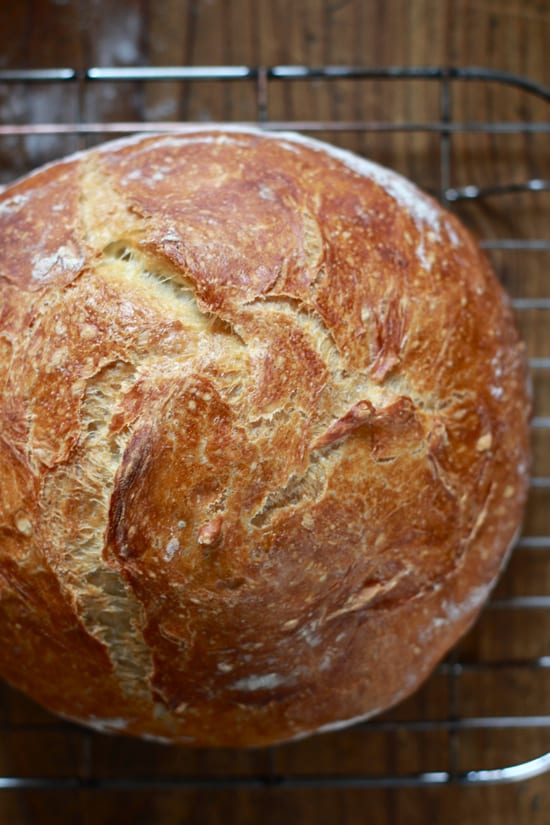
Interested in baking homemade bread? Jim Lahey’s No-Knead Bread recipe is an excellent starting point. His method follows an incredibly easy formula: mix the dough and let it rise overnight. That’s it.
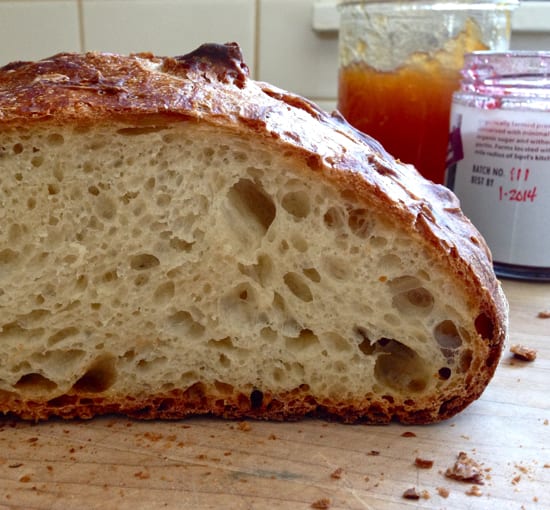
You don’t need a stand mixer or a bread machine, and there’s no kneading involved! Just 2 minutes of prep time and the rest is hands-off. The result? A gorgeous, perfectly golden crusty loaf with a soft, chewy interior.
How To Make Easy Homemade Bread (Step-By-Step Recipe)
Step 1: Mix The Dough
First, clear away all kitchen clutter: bills, toys, rogue phone chargers— you’ll want a clean surface to work on.
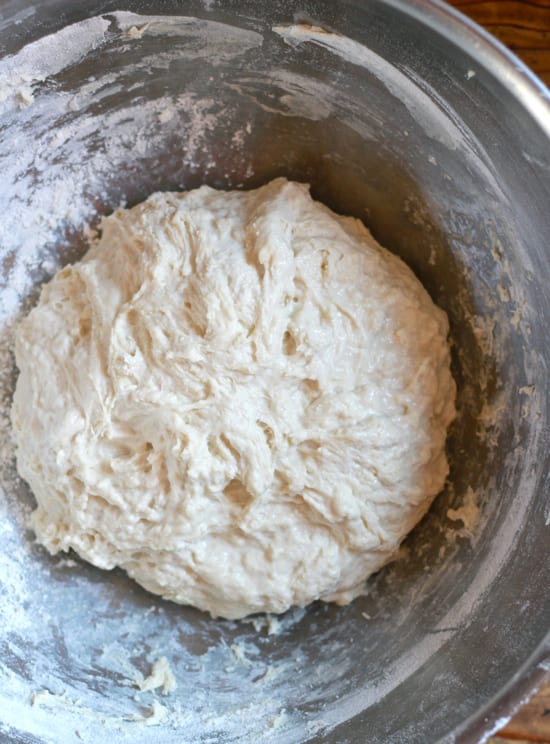
In a large bowl, mix the dry ingredients: flour, instant yeast, and salt. Add water and stir to combine. As the dough thickens, switch to your hands and bring everything together. It’ll look shaggy, wet, and sticky.
Instant Yeast vs. Active Dry Yeast: What’s The Difference? While both types of yeast make bread dough rise, instant yeast can be added directly to the dough. Active dry yeast needs to be dissolved (or “bloomed”) in warm water first. If that’s what you’re using, bloom it before mixing.
Step 2: Let The Dough Rise (Overnight)
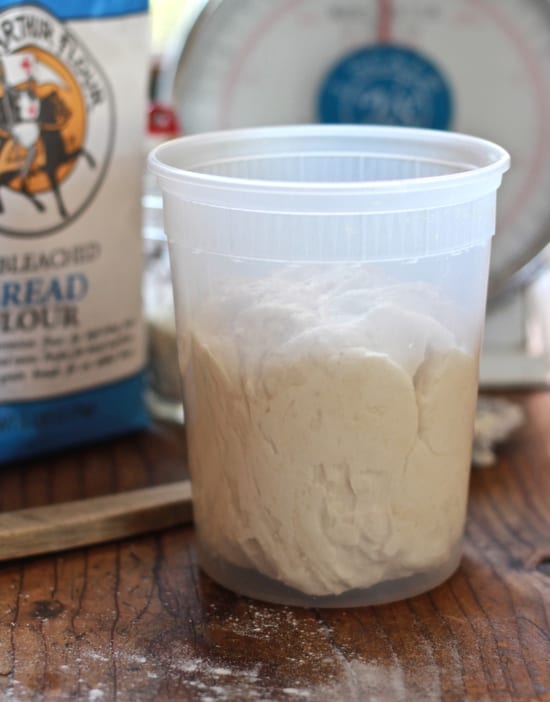
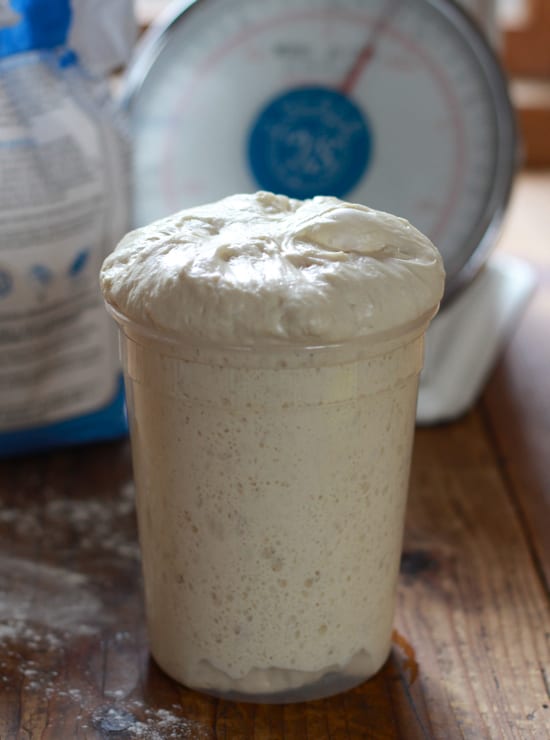
Transfer the dough to a lightly oiled container and cover loosely with oiled plastic wrap to prevent sticking. Let it rise at room temperature (about 68-70 degrees F) for 12 hours to overnight.
Your dough is ready when it has puffed up in volume, about 1.5–2x the original size. You will also see lots of bubbles.
Pro Tip: If your kitchen’s chilly and the dough seems sluggish, place it in the microwave with the light on (door ajar). The gentle warmth helps wake up the yeast (my friend Celia gave me this genius tip!).
Step 3: Shape The Dough (And Let It Rest Again)
Flour a piece of parchment paper. Remove the dough from its container and place it on top. Fold the dough in half (like a book) and then fold it again. Sprinkle the surface with more flour to prevent sticking.
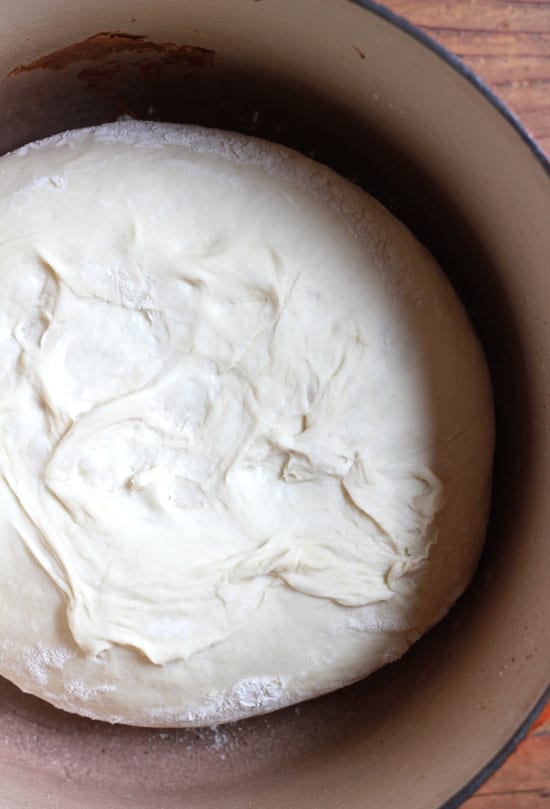
To shape: gently tuck the edges of the dough under itself to form a round ball. Place seam side down on the parchment like so…
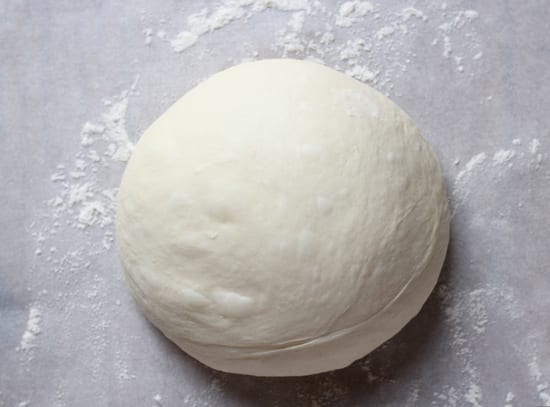
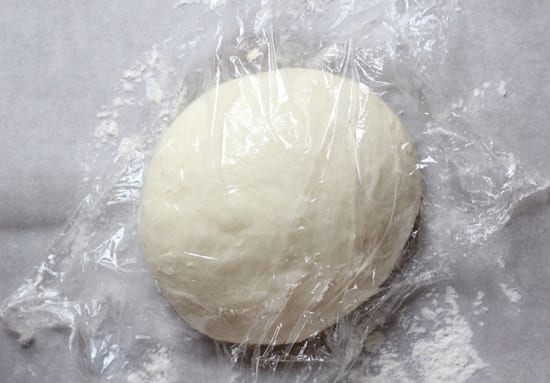
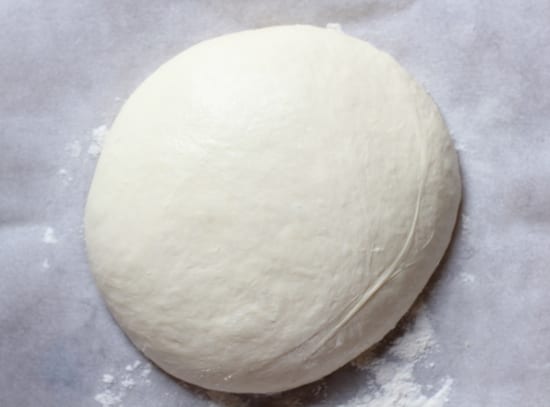
Cover loosely with oiled plastic wrap and let it rest again until puffy. It will start to spread out slightly as it rises- this is ok. The 2nd rise will not take as long as the first, but expect to wait about 30 minutes- 1 hour depending how warm your kitchen is.
Step 4: Preheat The Oven
About 30 minutes before baking, preheat your oven to 500 F with a Dutch oven inside (lid on).
Why a Dutch oven? Steam is essential for that shiny, crisp crust. The pot traps moisture, which allows the dough to form a beautiful, artisan-style crust (for reference, baking without steam might cause the crust to harden too quickly which equates to dense and heavy bread). No Dutch oven? Any heavy oven-safe pot with a lid will do, as long as it can heat up to 450 F+.
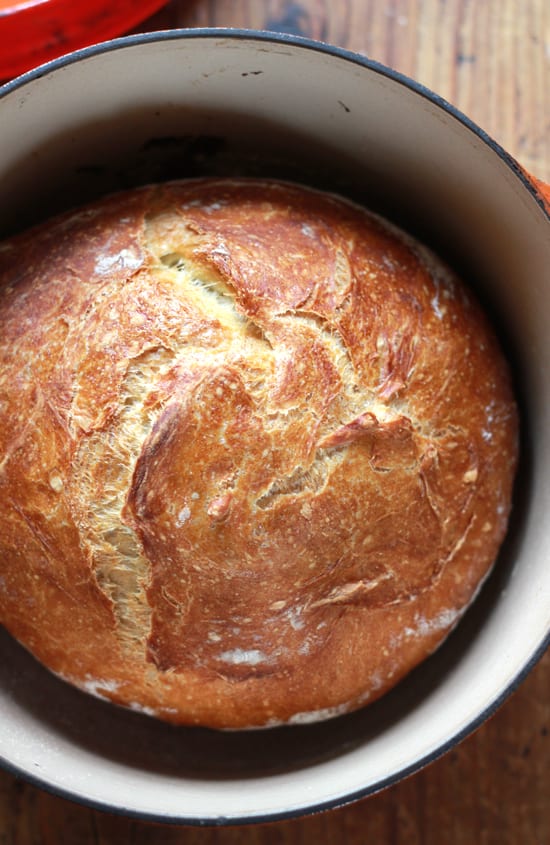
Once the pot is hot, carefully slide your hand underneath the parchment paper and invert the dough into the pot. The seam will now be facing up. Take a look…
Step 5: Bake The Dough
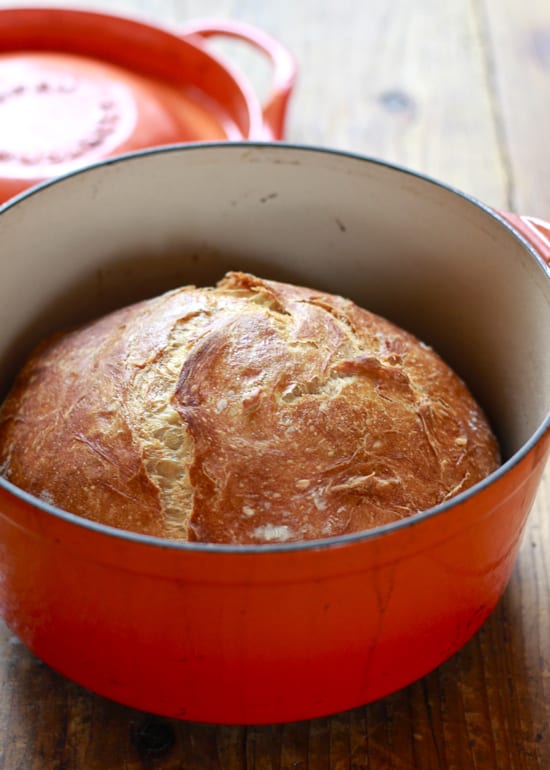
Place the pot in the oven and immediately lower the heat to 400°F. Bake covered for 40 minutes, then uncover and bake for another 15–20 minutes until the crust is deeply golden.
Want to be sure it’s fully baked? Check the internal temperature. It should read 200–205°F. I use this digital thermometer and swear by it.
Step 6: Let It Cool
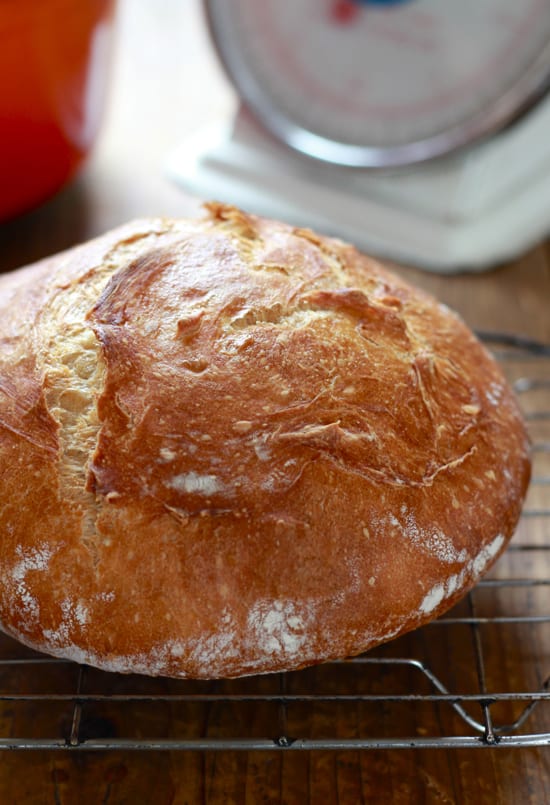
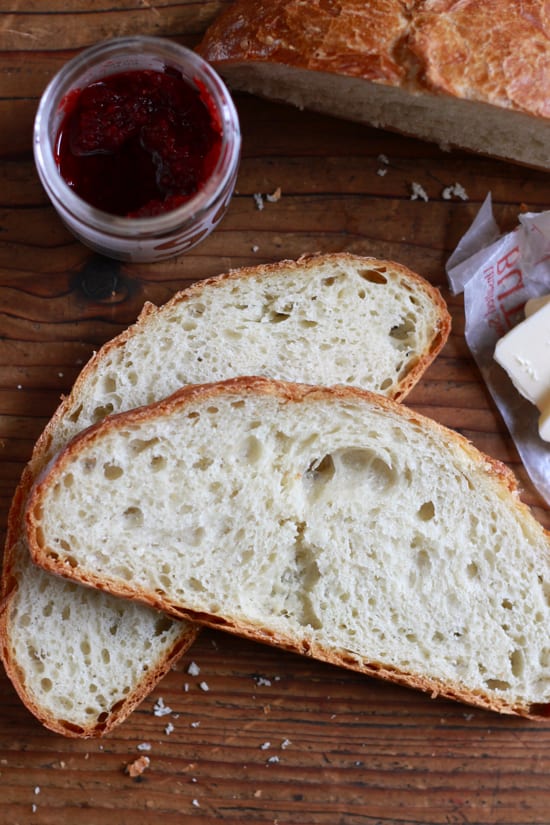
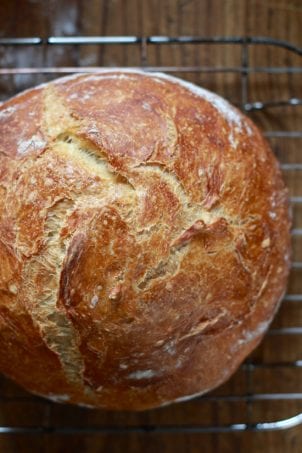
Transfer the loaf to a wire rack. Tap the bottom— it should sound hollow and feel light. You’ll hear it crackle as it cools (bread music!). Let it rest for at least 1 hour before slicing. Cutting too soon can result in a gummy crumb. Trust me, I speak from experience. And there you have it: easy, no-knead artisan bread!
Final Thoughts…
When I first started baking, I had no idea what I was doing. Jim Lahey’s no-knead method changed that. It’s forgiving, low effort, and tastes like you bought it from a fancy bakery! If you’re just beginning your bread journey, this recipe will give you the confidence to level up— to sourdough bread, light brioche hamburger buns (fan favorite!), pull apart brioche rolls, and beyond. Not only does it taste good, this loaf cost less than $1 to make!
By signing up, you agree to receive emails from The Clever Carrot. Unsubscribe at any time.
Jim Lahey’s Easy No-Knead Artisan Bread
- Yield: 1 loaf 1x
- Category: Yeast Bread
- Method: Oven-Baked
- Cuisine: American
- Diet: Vegan
Description
An incredible recipe for no-knead artisan bread baked in a Dutch oven. I like to make the dough in the evening (after dinner) to rise overnight. It’s fantastic for sandwiches, crostini, and to mop up delicious sauces! Recipe adapted from Jim Lahey’s No-Knead Artisan Bread.
Ingredients
- 390g (3 cups) bread flour (not all-purpose) + more for dusting
- ¼ teaspoon instant yeast
- 1¼ teaspoons fine sea salt
- 320g (about 1 1/3 cups) water
Notes
I use King Arthur Bread Flour & SAF instant yeast. You can use any 5 1/2- 6 quart Dutch oven, cast iron, enamel, Pyrex or ceramic bakeware (with lid) that can heat up to 500 degrees F.
Instructions
In a large bowl add the flour, yeast, salt and water. Stir until a rough dough forms. If it seems very dry, add more water.
Transfer to an oiled container and cover loosely with plastic wrap. Let rise for 14 hours- overnight, at room temperature (about 70 degrees). Your dough is ready when it has puffed up in volume, about 1 1/2 -2x its original size. *See note below.
Lightly flour a sheet of parchment paper and place the dough on top. Fold dough in half and then fold it in half again.
Shape the dough into a ball by tucking the sides underneath itself, and place onto the paper, seam side down. Cover and rest again until puffy but not fully risen, about 30 minutes- 2 hours depending on how warm your kitchen is.
Preheat your oven to 500 F. Put a (6 quart) dutch oven pot inside for 20 minutes. When ready to bake, remove pot from the oven. Place your hand underneath the parchment paper and invert the dough into the pot. The seam will be facing up. Cover the pot with the lid.
Place your bread into the oven, and reduce the temperature from 500 to 400 F. Bake for 40 minutes, covered. Remove the lid and bake for an additional 15 to 20 minutes, until golden brown.
To make sure that the bread is completely cooked through, take its temperature. Carefully tip the bread onto its side and insert a thermometer into the bottom. It should read 200-205 F. If not, place it back into the oven until it is ready (extra time in bread baking is a good thing). If you’re worried about the top getting too brown, put the lid back on.
When your bread is ready, transfer to a wire rack to cool. It should feel light and make a hollow sound when you give it a knock underneath. Let it cool for at least 1 hour. Cutting it too soon might ruin the texture resulting in a gummy crumb!
Notes
If your dough isn’t puffed and bubbly after the initial rise, place it in the microwave with the light on (keeping the door ajar). The warmth from the light will give the yeast a boost. My friend Celia gave me this tip and it works like a charm, especially in chilly kitchens!

Comments
Paul C says
Good morning! So excited to try this recipe!
I’ve seen in other parts of the website that you have moved to not heating the Dutch oven in the oven during preheat, as you’ve tested and not found a discernible difference…. does that apply here as well?
Thank you!!
Emilie Raffa says
Hi Paul! It does. But it’s up to you how you’d like to proceed. Jim’s recipe calls for the preheat, which is why I’ve included it here.
Paul C says
Thank you!!!
Paul C says
I’m sorry to bother you with another question on this but…
I just completed the overnight first rise after using bread flour and following all the instructions and measurements (grams) as provided. I went to fold and shape the dough and it was so wet and formless I couldn’t get it into a ball. Any idea what I may have done wrong? It grew at least 2x in volume overnight. Looked great and then glop
It’s on second rise now and we will see – going to power through 😀
Thank you again!
Emilie Raffa says
Hi there! It’s supposed to be a wet dough, which, if you’re not used to it might seem strange. Additionally, it’s possible that it might be slightly over proofed if it wasn’t easy to form (but it’s hard to say without seeing a picture). Hopefully it still came out ok. Bread is a learning experience!
Paul C says
I did it!!! The one I baked yesterday turned out ok… BUT, I made some dough last night and tried to be super thoughtful about ever step and today it turned out fantastic! Thank you for the encouragement. I will post a picture later and tag. You’re the best!!!
Ella says
Hi there! Please help, I’m having such trouble with what everyone else seems to think is a fool-proof recipe! It’s been almost 24 hours since I left my dough to do it’s initial rise, and it’s only risen from a level of about 550ml to 800ml (I left it in a plastic measuring jug). I made it late last night and left it overnight in the warmest room in the house (about 19c) and when not much had happened this morning I tried the trick of leaving it in the oven with the light on, adding bowls of boiling water and blasting the oven on for 30 seconds or so to warm it up (I’ve been doing this ALL day), but still not much movement, and definitely not a rise of 1.5-2 times its original size. I’m wondering whether I should just get on with shaping it and doing the second rise, or whether I should wait it out, but my worry with the latter is will I ruin it somehow if I leave it for another night and therefore circa 36 hours total? Thanks in advance!
Emilie Raffa says
Hi there! It’s either two things: your yeast isn’t fresh and/or the temperature is too cold (19c is chilly). You don’t have to leave it for another night to rise, you need to find a warmer spot (assuming your yeast is working properly). Some bakers keep the bowl of dough in the microwave (tuned off) with the light on which creates a warm environment.
Cori says
Hi – my dough doubled in size in about 5 hours, is it ok to use it in less than 14 hours or should I let it continue to rise anyway?
Thanks!!
Emilie Raffa says
Yes! Always watch the dough and not the clock. In the warmer summer months, you should always expect the dough to rise faster than “room temperature” which is typically 68-70 F.
Lynn says
Are there any special adjustments you would make when using fresh milled wheat? I use hard white and hard red wheat berries for my bread flour. So far I have tried your beginner sourdough with my hard white wheat berries and it turns out great.,I did use the extra water option on my last loaf and think I will keep doing that, the crust was formed a little better. I am really enjoying your recipes, thank you.
Emilie Raffa says
Hi there! You would most likely need to add more water as whole grain flours absorb more liquid than white flour.
Katie says
Please tell me this recipe is named after Trailer Park Boys…
Emilie Raffa says
Omg… I don’t even know what that is? Lol.
Mary says
I haven’t tried this recipe because I have a small Breville convection oven that will not hold a dutch oven. Or could I free form into a ball or place in 9X5 loaf pan? any suggestions on how long to cook this way?
Emilie Raffa says
Hi Mary, I wouldn’t do a free from ball in the small oven. The dough might not fit. Plus, for artisan style loaves, you still need a steaming element to achieve a nice rise and crust. Perhaps you might want to start with a sandwich loaf recipe instead and bake in the 9×5 inch pan? I haven’t tested this particular recipe in a 9×5 (dough might be too wet). Hope this helps!
Adrianne Gallo says
Can the recipe be doubled?
I’m asking because I’ve only fallen massively in love with this load. I’ve sent this recipe to a dozen of my friend and we all feel like bonafide bread bakers. It’s delicious and fool proof. I find myself making loaf and after loaf- giving my only Dutch oven a real run for its money. Thanks for the recipe and many good memories already created around the enjoyment of eating this bread.
Emilie Raffa says
Absolutely! I would make two separate bowls of this dough if you do not have a large enough container to rise the double batch at once.
Fiona says
Hi Hi,
I am being really dim but I don’t understand the measurements…..how much is 3 c of flour? And how much is ! 1/2 c of water? I work in grams or ounces, pints or mls!
I have made your bread (not sure how!) and it was such a success and can’t wait to make it again tomorrow!
Looking forward to hearing from you, many thanks XXX
Emilie Raffa says
Hi Fiona! Jim’s recipe was never published in grams. But I agree with you: it will be much more accurate to follow with weighed ingredients. I’ve updated the recipe with the approximate conversions.
Francesco says
https://www.theclevercarrot.com/wp-content/uploads/2013/02/IMG_63871.jpg
Hi,
Just wondering where you got that image of the dough in a glass bowl sitting on a timber bench? Stage 2 of the process. Looks very familiar. Do you know that chef?
Emilie Raffa says
Hi there! All the pictures you see here on the blog were taken by me. Thanks!
Carolyn Brown says
I am 66 years old and have never had any luck with yeast breads. Never.
So my dough bubbled and rose the first time, but the second, not so much. But I carried on. When I put it in the dutch oven it was gooey and sticky and didn’t have any form. Bottom line though, it turned out great and now I have confidence that I can be a bread maker.
I found the comments extremely helpful. I did use AP flour. I did use more than recommended because it was so sticky. And I did take it’s temperature.
Thanks for the recipe, and the comments everyone!
Emilie Raffa says
Thanks Carolyn! x
Jules says
If you don’t have instant yeast can you use active dry yeast?
Emilie Raffa says
Hi Jules! Yes: using either type of yeast is fine.
kathleen m peterson says
Could this bread be baked in loaf pans or make rolls with it.
Thanks
Emilie Raffa says
Hi there! I haven’t tested it, but I’m sure it could be done. One thing to note: the dough is on the sticky side, so be mindful (and have patience!) when shaping.
Janice says
Can I use sourdough and if yes how much?
Emilie Raffa says
Hi there! Sure, 50 g of 100% hydration starter will work.
Mr David Ross says
Hello. Thanks for such a simple, well thought out recipe….
Just wondering, how much is a Cup in Grams ?
:)
Emilie Raffa says
Hi there! Unfortunately, weight and volume measurements are not equivalent (only approximate). What ingredient were you referring to specifically?
Eileen says
Whoops, I totally missed the step about turning the oven down after you put the bread in. I baked it at 500 for about 25 minutes with the lid on, at which point it smelled VERY done. I checked the recipe, kicked myself and took it out. And you know what? It’s still fantastic.
Lisa says
Hi Emilie
We are newbies and Im trying to find the perfect dutch oven. Would you mind sharing which dutch oven you have pictured in this recipe? And is it ceramic or enameled? I will be buying a Lodge 2qt cast iron dutch oven but I also want a 5 or 6 qt dutch oven and I am really curious which dutch oven you use exactly. If you could share the Brand, size, type, color, EVERYTHING lol
Thanks so much!
Lisa
Emilie Raffa says
Hi Lisa! All of my Dutch ovens (I have a bunch) are enameled cast iron. The are from Le Creuset with the exception of a few from France (family heirlooms). See below for more info:
Round: 5 1/2 qt
Oval: 6 3/4 qt
Color: whatever you like- white gets really dirty.
Lisa says
Omg thank you for responding!
Waiting for my flour and yeast to be delivered today cant wait to start. Im using my plain Lodge cast iron dutch oven (just a 2qt) for my very first loaf. So excited. Im going to check out some enameled dutch ovens (wish I could afford the Le Creuset!) Thanks again!
Emilie Raffa says
You are very welcome, enjoy! x
Kathy says
Martha Stewart has affordable dutch ovens. Macy’s sells them and has sales on them quite often. I used my Martha Stewart dutch oven and my first-try bread turned out great!!
Gay says
I have 2 lodge. 5 and 61/2. I think. They work great for bread making. And for everything. I love them. So much cheaper.
Andrea says
Could gluten free flour be substituted? I plan to make this for the family, but have to make gluten free for me! Thanks!???
Emilie Raffa says
Hi Andrea! GF bread is very specific (it’s not an even swap). I haven’t tested a GF version of this, so I’m unable to advise. Apologies!
Andrea says
This bread looks fabulous! Reminds me of the bread my grandmother used to make! Definitely going to make this ?!
Emilie Raffa says
Wonderful! Enjoy :)
avery says
Hi! Do I need to score the bread? I noticed that there were no instructions to and the picture also makes it seem unscored, but I’m nervous my bread will rip!
Emilie Raffa says
Hi there! You do not need to score the bread in this particular recipe. When the dough goes into the pot, it’s placed seam side up, which will open and expand during baking to emulate a score.
Cindy says
Hi! Do you think I can could use a Q4 Staub Cocotte?
Emilie Raffa says
Hi Cindy! Yes: this will work.
Cindy says
Thank you so much! :) I used the ceramic part of my crock pot and that worked as well, but I would love to keep its roundness. :)
Emilie Raffa says
You’re welcome! Fantastic idea. Thanks for sharing :)
Anne laure Lunsford says
Hello Emily! Thank you for sharing this recipe in such details. I’m about to try my very first bread making and I’m very excited! I only have an oval Dutch oven. Should I try to make an oval loaf instead of a boule? Will the consistency change?
Emilie Raffa says
Hi there! You’re very welcome! An oval Dutch oven is fine. I would shape the dough into an oval to match. However, depending on how large the pot is, a round loaf might actually fit. Either way, the consistency will not change.
Anne laure Lunsford says
THANK YOU!!! Thank you thank you thank you! I’ve been wanting to try and make my own bread for years but never had/took the time. As a bread passionate (I’m French) I can say this is the perfect recipe for a successful, easy AND tasty (very important) bread!!
Emilie Raffa says
Hello! You are very welcome! I’m thrilled you like the recipe. Keep on baking :) x
PS: I’m French too- we need good bread!
Christine says
I have never made bread before, tried this recipe with my daughter and happy to report– it was super easy and delicious! I guess this is one good thing about being told to quarantine at home…trying new things! Thank you!
Emilie Raffa says
Hi Christine! This is so wonderful to hear! Thanks so much for your feedback :)
brinacyl says
Hello, I read all comments and you mentioned you’re working on whole-wheat recipe. May I ask for the recipe/link please? many thanks
Emilie Raffa says
Hi there! Here you go. Click here.
Roshi says
No Dutch oven?// no recipe state alternative bakeware
Emilie Raffa says
Hi there! Any oven safe pot with lid will work. Make sure it can withstand heat up to 450 F, including the handles.
Jamie says
Can Activated Dry Yeast be used instead of instant for this recipe? Would you just use the same amount and mix with warm water prior to mixing the dough?
Thank you!
Emilie Raffa says
Hi Jamie, yes and yes! :)
Denise says
This bread is amazing and super easy to make!!!
sydney says
This seems to be a good thread for the no-knead bread people, so maybe you can answer a question I can’t find an answer for otherwise: I’ve been successful with the no-knead recipe as is. I want to try making it into a sweeter bread. Possible? I want to try soaked raisins; cinnamon; and maybe a quarter cup of sugar with the original (18-hour) rise. Will the sugar wreck the chemistry of the recipe? Thanks!
Paul says
After reading a few of the more recent comments (excerpts noted in quotes, below) from other bakers – but not seeing a reply – I’ll ask a couple of similarly-related questions here:
1. My dough was also VERY sticky after the 14-hour period (“stuck to everything . .”), which made it very difficult to fold it, and later, after the second-rise period, invert it and put it into the Dutch oven, without having to pull it off the parchment with some effort. Would more flour on the parchment have helped with this? Was the dough too wet to begin with (even though I followed the measurements to a “T”)?
2. While the loaf baked nicely, I, too, ended up with a loaf that had “flattened out . .”, as opposed to keeping its boule shape when I formed it. This flattening actually started to occur during the second-rise period, so, again, I’m wondering what I could/should have done differently to end up with a loaf like the one pictured in your recipe. Thanks!
Emilie Raffa says
Hi Paul! This dough is indeed very sticky. It’s just the nature of the recipe- overnight doughs tend to be this way. But, the dough shouldn’t be so sticky that it’s impossible to work with. It could be a measurement error (too much water) or the brand of flour used (some brands absorb less water than others). And yes: more flour on the parchment paper will help. For flat loaves, based on what you described, it sounds like your dough was over proofed. When you do the second rise next time, place the dough in a cloth lined 8-inch bowl; this will contain it’s shape. Hope this helps!
Paul says
Thank you for the quick reply, Emilie! It all makes perfect sense and I will make these adjustments the next time.
Emilie Raffa says
You got it :)
Amy Norris says
I tried this but the dough was waayy too wet. There was a puddle in the bottom of the bowl and the dough couldn’t keep its shape at all even after adding quite a bit of flour to the parchment. Had to throw it out. Not sure what went wrong :(
Sara P says
This turned out SO WELL. Mine looks JUST like the photos, minus some uniformity, lol. I am a very impatient baker with a history of yeast related failures, everyone in my family is shocked I pulled this off. Definitely a go to recipe. For other readers, I used a ceramic casserole dish with a lid since I didn’t have a cast iron dutch oven, and it worked VERY well. I did not need anything in the crock because it was so hot nothing at all stuck, it looked nearly clean when I took the loaf out. Thank you for this recipe!
Emilie Raffa says
Thanks for your feedback, Sara! Glad you enjoyed it! xx
Renee Hewitt says
This bread is the best ..I added in herb and garlic seasoning to recipe ,came out awesome,added an egg wash with dried herbs on top with sesame,I did add a little more water to accommodate the added dry ingredients. Also did not remove the parchment paper and didn’t invert…. just cut a few slits to top used a cast iron 4 1/2 quart pot ..This bread is so forgiving ,Thanks for sharing
P.S.warms nice and toasty in an air fryer as well, a couple of minutes and just like it came out of oven! yummy yummy
Renee
Emilie Raffa says
Oh my goodness, I’m drooling. Seriously, I can just smell this loaf as I type! Thanks for stopping by with your feedback :)
J Bob says
Hi. Just getting ready to try this, and paused when I reviewed ingredients. Wondering if I’m confused.
1/4 teaspoon instant yeast I think is LESS THAN A GRAM?
That’s like, not a lot of yeast, nothing like a recipe I’ve ever seen. Did I read this right? 3 cups of flour and less than 1 gram of yeast?
Thanks kindly
J Bob
Veracruz
Emilie Raffa says
Hi there! 1/4 tsp of yeast is correct. Typically, when a dough requires a long, overnight rise it’s usually paired with a small amount of instant yeast. If you use too much yeast, the dough will rise too fast which defeats the purpose of the “low and slow” method. It’s not wrong; the method is just different and is the preference of the baker. As an alternative however, you could always use more yeast in this recipe, let the dough rise in a notably warmer spot, and it will most likely double in only a few hours. And then it would be a different style of bread altogether… make sense? Hope this helps!
Liz says
My first time baking a yeasted bread and it came out wonderfully. I feel like I’ve gained entry to a secret club—who knew making bread is so simple? I had always been intimidated by it.
Thanks for the excellent recipe. I’m looking forward to making this artisan loaf all winter.
Emilie Raffa says
Hi Liz! Oh, I’m so glad to hear that. And I totally know what you mean about the “secret club.” Bread baking can be intimidating at first, just because it’s not something we normally do everyday, but once you get the hang of it, it’s quite liberating, don’t you think? Happy baking!
Jacqui says
Hi. The first time I made this loaf it was perfect but since then I’ve had a couple of problems.. the dough rises massively within 10 hours – should I leave it for another 4? Also the dough was so sticky that I couldn’t fold or shape it and it stuck to everything! Is this because I’m not leaving it to rise for the full 14 hours or should I be adding more flour/less water?
Thanks
Jacqui
dianne says
This is a fabulous recipe. I make it ALL the time and it’s delicious! I used the recipe originally because I had some left over bread flour –I had always used a.p. for no-knead bread before trying this.
I tend to let mine rise for about 24 hrs instead of 14 and it works and tastes great.
The only problem I had with no-knead breads were the way they tend to flatten in the dutch oven making the slices from the loaf longer and skinnier than I prefer.
I tried using a bit less water (dough seems to hold it shape better for me) and cooking it in a 3.2-quart dutch oven. Cooks in the same time as the recipe and produces a rounder loaf.
I thank you so much for this great recipe!
Violeta Spirkoska says
This is a lovely recipe, but I do find the dough way too sticky. I added quite a bit more flour. I also added quite a bit more yeast as I did not think it was enough for the quantity of flour. I’m no expert baker but I have made bread on the odd occassion and usually use more yeast. The cast iron worked beautifully and no oil required. I loved the result. I added olives to mine as my family all love olive bread. Wonderful results. Thanks so much for the recipe.
Emilie says
Hi Violeta! Sounds great! Baking is all about adapting the art and science to your personal preference and you sound like you’re well on your way! Thanks so much for sharing your feedback with us. And the addition of olives sounds great! I happen to be a huge olive fan myself. :)
Carmella says
Hello, Is it necessary to complete the 1st rise in a separate bowl or can i let it rise in the mixing bowl?
thanks
Emilie says
Hi Carmella,
You can certainly do the 1st rise in the mixing bowl. No problem!
Robin says
Eager to make this bread but I only have a 4 quart Dutch oven. What do you think would happen if I halved the recipe? I’m afraid if I made the full recipe, it would be too much volume for the Dutch oven.
Linda says
My question is about preheating the dutch oven — as most manufacturers do not recommend heating a dry pan. I am concerned about cracking the interior. You have not had any problems with this?
Emilie says
Hi Linda,
I’ve never had a problem with this, but I’m only speaking from my experience. If you don’t feel comfortable preheating your pot, you don’t have to. Put the dough in cold and bake it following the recipe instructions.
Minty says
I’m having problems with the second rise. My yeast and flour are fresh, I get a wonderful first rise after 12 – 18 hours, but when I take it out of the container and fold and shape it it becomes flat and runny, and does not rise again at all. What is the problem?
Emilie says
Hi Minty,
The second rise is always the most challenging to judge. And there could be a number of reasons for a flat and runny dough. I would shorten the bulk rise (first rise) to 12 hours. When doing the second rise, place the dough in a cloth lined bowl (8 inches is good) to prevent it from spreading. Let is rest for 30 minutes. Then, continue with the rest of the instructions and see if that helps. Good luck!
Rochelle Pederson says
Found this recipe last night and followed it to the letter. Made the most perfect loaf of bread on my first try! Great tutorial. Wish I could post a picture of it. Never using another recipe for bread again.
Emilie says
That’s fantastic! Thanks for the feedback- So glad you had a successful loaf :)
Sarah says
Hi there! I’ve been making this bread for a few months now and I still love it! I’ve been experimenting with whole wheat flour and have found that half white and half wheat makes a delicious loaf! I also double this recipe without any problems. I live in Chile and haven’t found real bread flour so I’ve always just gone with all-purpose and its always good! Thanks again for the tutorial! Cheers!
Sarah says
I made this last night/today and I finally just took a bite…IT IS SOOO GOOD!!! My bread usually comes out way too lofty and it can’t even stand up to soft butter. This bread, however, is sturdy and has tons of flavor. It looks like something I could buy from Sainsbury’s. I am so proud of myself! Haha thank you for posting this recipe, it’s changed my bread game forever. I’m going to make another loaf tonight/tomorrow! (cause I’m pretty sure my husband and I will eat this whole thing tonight haha). Cheers!
Queene says
H.E.L.P. – I would like nothing more than to master this recipe. Have tried it twice and twice I got the same results. Followed the recipe exactly, specifically,…to the “T”. Still the results were no where as illustrated. First try resulted in a thick, hard crust (nearly cracked a tooth!), with a thick, heavy and dense inner bread. No nooks and crannies. Second attempt was pretty much the same but since I pulled it out before browning too much, the crust wasn’t as hard. Still, dense inner bread. I know from past baking experience, I am NO baker but this is one I thought I’d have no problem since it sounds SO easy. I would appreciate any help since this is one baking hurdle I really want to accomplish because my troop at home inhales ANY artisan bread within 50 feet of them. Thanks so much.
Alicia says
I have had the same problem!! I’ve tried this twice with the exact same results you’ve described. Its so disheartening, since the peasant bread on this blog works perfectly every time. I don’t have a dutch oven, I’ve been using a ceramic pot with a lid, but I think it may be the problem. Oh and the dough doesn’t rise at all (cold house syndrome), but even when I put it in the oven after turning it on for 1 minute (this trick works perfectly for the peasant bread) it still doesn’t rise :(
Dina says
Hi, Emilie.
My mom is 85 and she’s been baking her own bread since she was a child. Naturally, I’ve been using her method but it’s the traditional way, with lots of kneading etc. and it’s not easy to find the time… When I saw your recipe yesterday, I jumped on it. I was preparing a lunch for friends today and thought it would be lovely to be able to offer fresh-baked bread. I followed your recipe and tutorial with the following exceptions: I didn’t have time to go to the store for bread flour so I used all-purpose (I figured if it’s a bust, I had a back-up store-bought baguette I could serve) and instead of a round Dutch oven, I used my oval 4.5L Le Creuset.
It’s clear to me the bread flour would raise this loaf to the next level however, it came out quite good. Lots of little air pockets and gorgeous crust, everyone loved it.
I noticed some folks who posted here had trouble with the dough sticking to the parchment paper, even when well-floured. My trick, (my mom’s trick actually), is to rub my hands with a small amount of olive oil before I handle the dough. I ease it from the paper with little disruption and also don’t get any of it stuck on my hands which can cause the dough to deflate and collapse. If you like, I can send you a photo of the final product.
Thank you for a great recipe, I am back to making home-made bread now, thanks to you.
Dina
Emilie says
Hello Dina!
Oh, this is such a wonderful story. Thank you for sharing this with me. The no-knead method is absolutely fantastic and sure saves a lot of elbow grease! I use this same method for my sourdough as well… and thank you for the tips about sticking! This is why bread baking is so great- there are so many different tips & tricks to share. Just lovely.
PS- I saw your pic on Insta! All you need is some of your golden olive oil for dunking… xx
Irene says
Hi Emilie, I made the bread today and I noticed that the initial step of combining 3 cups of flour and 1.5 cups water produced a very dry and crumby dough. It seemed that there was too much flour for the water to wet. I did manage to knead it all together because stirring it didn’t bring it together. I let it rise for 18 hours, and then 3 hours after, but when I flipped it into the hot pan I noticed that it did not rise but stayed pretty flat after I flipped it into the pan. It still looks and tastes great, but I am wondering if my dough was too dry and if I let it rise for too long in the second rise? I am going to try it again and see if i can make something that looks closer to your photo.
Thanks. I love your website, especially the gorgeous pictures!
Emilie says
Hello Irene,
Thank you for your note!
For this particular dough, it’s best to begin stirring with a spoon and then switch to mixing with your hands (which I think you did). This will hep to ensure that the flour absorbs all of the water. It is stiff in the beginning, but after your keep wiring it, it will come together nicely.
With regards to rising, the initial 18 hours wass fine, but the additional 3 hours was too long. This is the reason why your bread came out flat (not because the dough was dry). Next time, shorten that second rise to about 1 hour or so and you should see a difference.
Hope this helps!
Merielle says
This was so easy…I have rheumatoid arthritis and can no longer knead traditional recipes…I haven’t been able to make good bread for several years (I know they are convenient but I don’t like bread machine bread). Rhis was perfect. The only issue I had was my loaf shape disintegrated when I was putting it in the Dutch oven…I just put the lid on, popped it in the oven, and crossed my fingers! It came out perfect! Can’t thank you enough…I shared the heck out of your page all over my social media!
Jorge Costa says
Hi Emilie. Very nice article.
I have 2 questions:
Do you add yeast and salt at same time?
And do you use air circulation on the oven?
Many thanks
Emilie says
Hi there! Yes, add them both at the same time :) You can use convection if you’d like, but it’s not necessary.
Lynn says
Hi Emilie, we love the crust and taste of this bread, however, we end up with a doughy interior, not at all what yours looks like. We do live in a very humid area. Our dough seems to spread before rising, so we have somewhat of a disk at the end of rising. Could we use less water and more yeast to get a firmer dough that won’t spread? Any suggestions? We’ve made 5 of them up to now and are itching to get it right.
Emilie says
Hi Lynn,
Spreading is normal when bread dough rises, especially when the water content or hydration % is particularly high (like this recipe).
There are a couple of things you can do:
1.) Add more flour to the dough- this will help to firm it up, and it will be easier to handle, however the interior won’t have as many open holes.
2.) Allow your dough to rise in a cloth lined basket or banneton, both dusted in flour. This will contain the dough’s shape as it rises so it won’t spread out to the sides.
Also, if the crust is brown on the outside and the inside is doughy, your bread is undercooked. Try lowering the baking temp by 25 degrees, and/or keep the lid on a little longer. You will need to cook out all of the water for the dough to become light and fully cooked through. Extended baking time with the lid on will help.
Good luck! Let me know how it goes!
Lynn says
Emilie, thanks SO much for your prompt reply. Attempt #6 today failed, but we’ll try another one shortly using your suggestions and will let you know.
Thanks again,
Lynn
Emilie says
No worries, I know the feeling ;) Please let me know if you have any other questions! Good luck!
Lynn says
Emilie, attempt #7, much closer, but still a little doughy. I adjusted covered time and cooking time, and lowered the temp, as you suggested. I really think part of it is our high humidity. Attempt 8 coming up shortly. Will see if there’s a way I can post a picture.
Laura says
Hi, do you think you could make his with spelt flour? Also, do you think a stainless steel caserole pot with lid would work as a Dutch oven substitute? Thank you!
Emilie says
Hi Laura,
Sure. It depends on how much spelt flour you want to use- 100% will yield a more heavy and dense bread, compared to my artisan loaf. I would replace a small amount with spelt flour first and take it form there. Experiment until you find what you like. It’s a matter of personal taste. You’ll have to increase the water as well as whole grain flours absorb more than regular & bread flour.
M-R says
I once tried to make this, and ended up driving Jim mad by email with my constant whingeing about my inability to produce dough ‘dry’ enough to even fold over !
So I have boiled Jim’s recipe down to something so simple, even *I* can produce a perfect loaf every time. :)
Perfect Bread
Ingredients:
• 450g baker’s flour
• ¼ tsp yeast
• 1 tsp salt
• 350ml water
Method:
combine first 3 ingredients in bowl that gives you room for stirring, and mix them well
add water by thirds, incorporating by hand each time: the dough will end up wet and sticky (and this is as it should be)
cover bowl with plate and put aside somewhere that isn’t cold
leave for a minimum of 12 hours (any extra time is unimportant – it simply depends on what suits): next day the dough will have risen lots, and be completely full of tiny bubbles
put an empty lidded pot into oven, set to 250º and let it heat up for 25 min.s
with hands well protected take pot out and transfer dough into it; put lid on, put bowl back into heated oven, set timer and bake at 250º for 30 min.s (I like to bake for half the time in one position and the other half turned 180º)
remove from oven, take lid off pot; re-set timer for 20 min.s and put back in (ditto)
remove pot from oven and loaf from pot; put it onto a rack to cool
Don’t cut it before an hour of cooling!
Emilie says
Fantastic! Persistence pays off, doesn’t it? Glad you found something suitable for you. I’m sure your loaves are beautiful.