The internet is a beautiful thing.
Back when I postedthe recipe for no-knead artisan bread, I made a new friend on facebook. Her name is Hendrika, and she is from the Netherlands.
Hendrika (also a baker) recommended making a whole grain version. She said to replace 25% of the flour with whole grain flour, and increase it up to 50% for a heartier bread. Then roll the dough in old fashioned oats before the second rise.
I took her suggestion…
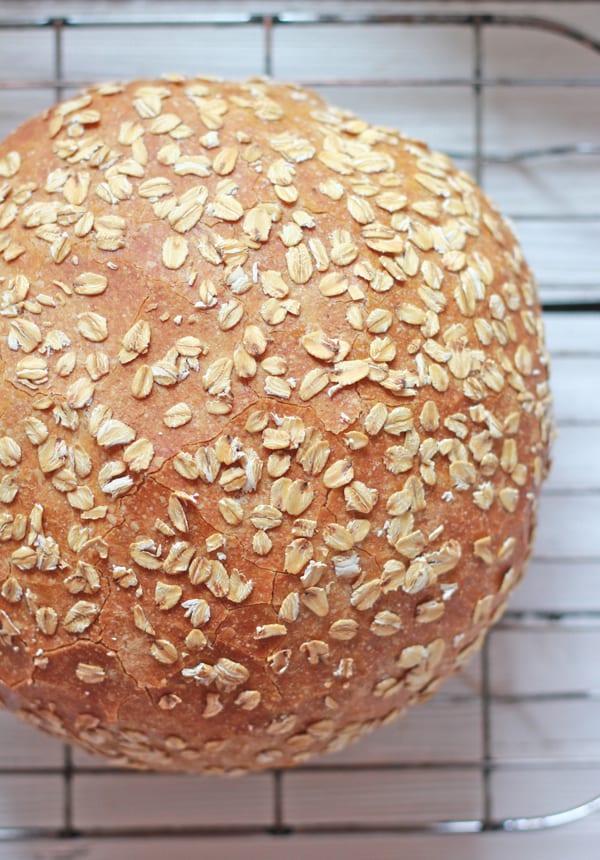
And it worked beautifully! I even added a little honey for a hint of sweetness.
What’s great about this recipe, is that it’s made in the exact same fashion as the original no-knead bread (who doesn’t love baking in a dutch oven?!) The only difference is the ingredients.
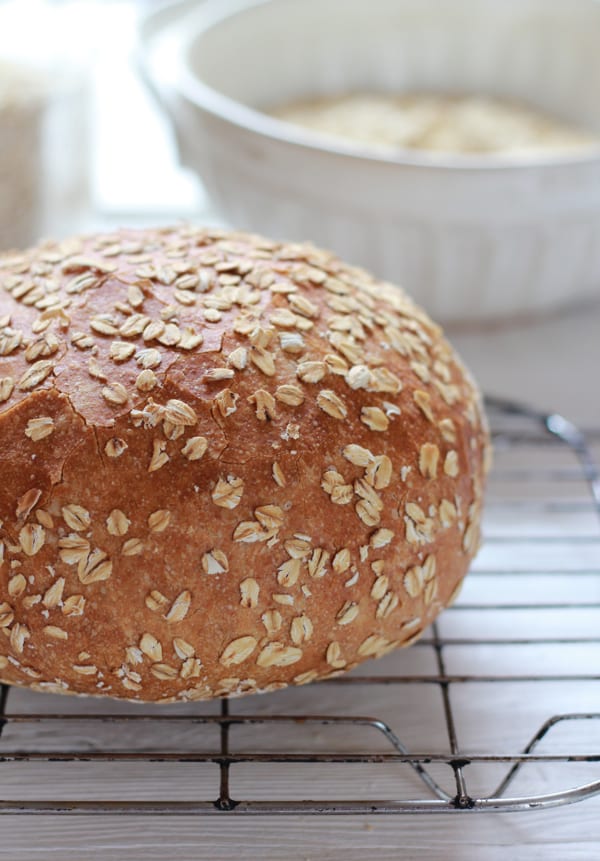
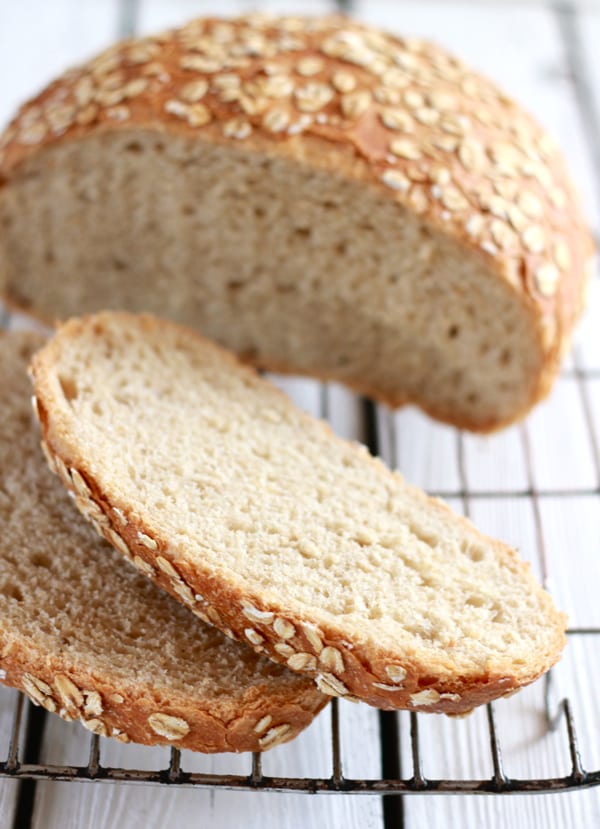
I went with a smaller amount of whole wheat flour as I prefer a lighter, less dense bread. However, I’ve made it using a 50/50 ratio and it was just as good- it’s simply a matter of personal taste. I also added a touch more salt to enhance the flavor. The result was a nutty, golden bread bread with a soft and chewy interior. The crust was perfectly crisp.
And that is the beauty of the internet. It brings together like minded people.
As for us, we’ve been enjoying the fruits of my labor in sandwiches, french toast and dunking in soup. The kids go crazy for this bread. Any leftovers are blitzed into breadcrumbs and stashed away in the freezer. As I’ve mentioned before, there’s nothing like making your own bread and once you get started the possibilities are endless. Thanks Hendrika, for the fabulous idea!
For a step-by-step tutorial on making no-knead artisan bread, click here!
*It’s interesting to note that this dough is not as wet as the original version. Whole wheat flour absorbs more water resulting in a drier dough. Keep in mind that you might need to add additional water to bring the dough together. Do this 1 tablespoon at a time until you reach your desired consistency.
RECIPE:
Ingredients
- 2¼ c. bread flour (not all-purpose) + more for dusting
- ¾ c. whole wheat flour
- ¼ tsp. instant yeast
- 1½ tsp. fine sea salt
- 2 tbsp. honey
- 1½ c. water
- ¾ c. old fashioned oats, for rolling
Tip: I use King Arthur bread & whole wheat flour and SAF instant yeast. For baking, you can use any 6 quart dutch oven, cast iron, enamel, Pyrex or ceramic bakeware (with lid) that can heat up to 500 degrees F.
Instructions
- Make the dough: In a large bowl whisk together the bread flour, whole wheat flour, yeast and salt. In a separate bowl, combine the honey and water. Add the water mixture to the dry ingredients, and stir with a wooden spoon until combined; the dough will be wet and sticky. If it seems very dry, add more water (do this 1 tablespoon at a time) until desired consistency is achieved.
- Transfer dough to a lightly oiled container and cover with lightly oiled plastic wrap to prevent sticking. Let the dough rise for 14 hours- overnight, at room temperature, about 70 degrees F. The dough is ready when it has puffed up in volume, about 1½ -2x its original size. *See note below below.
- Shape the dough: Lightly flour a sheet of parchment paper and place the dough on top. Fold the dough in half and then fold it in half again.
- Add more flour to the parchment paper and sprinkle the oats on top. Shape the dough into a ball by tucking the sides underneath itself, and then roll it around in the oats to coat. Place the dough onto the paper seam side down. Cover and rest again until puffy in shape. This will take 30 minutes- 2 hours depending on how warm your kitchen is.
- Preheat your oven to 400 F. Put a 6 quart dutch oven pot inside for 20 minutes. When the dough is ready, remove pot from the oven. Place your hand underneath the parchment paper and invert the dough into the pot. The seam will be facing up. Cover the pot with the lid.
- Bake the dough: Place your bread into the oven, and immediately reduce the temperature from 400 to 375 F. Bake for 30 minutes, covered. If you find that your bread is browning too quickly, reduce the temperature to 350 F. Remove the lid and bake for an additional 20 to 25 minutes, until golden brown.
- To make sure that the bread is completely cooked through, take its temperature. Carefully tip the bread onto its side and insert a thermometer into the bottom. It should read 200-205 F. If not, place it back into the oven until it it’s cooked through. If you’re worried about the top getting too brown, loosely tent the pot with foil.
- When finished, transfer the bread to a wire rack. It should feel light and make a hollow sound when you give it a knock underneath. Let it cool for at least 1 hour. Cutting it too soon might ruin the texture resulting in a gummy crumb!
Note:
* If your dough isn’t puffed and bubbly after the initial rise, place it in the microwave with the light on (keeping the door ajar). The warmth from the light will give the yeast a boost. My friend Celia gave me this tip and it works like a charm, especially in chilly kitchens!

Comments
Donna Woods says
Emily, If I use starter instead of yeast, should I do a series of stretch and fold for the first rise then proceed with your instructions? I can’t wait to try this bread but want to use starter instead of yeast. Thanks Emily
Wendy Azpeitia says
Hello. Can I use my bread machine to process this recipe?
Thank you.
Peter says
Hey Emilie,
Do you suppose a tablespoon or so of wheat gluten would open the bread bread more?
Thanks,
Peter.
ROBERT says
LOVED THIS!
Emilie Raffa says
Wonderful to hear- thank you!
Diane says
Thank you for this wonderful bread recipe. I made it exactly as it was written and it
Passed with flying colours with the family!
** Can you anyone tell me if this bread would freeze well? If yes, how long will it be good in the freezer? **
I’m off to make more but look forward to a reply. Thanks
Emilie Raffa says
Fantastic, Diane! This is so great to hear :)
To answer your question, yes: you can absolutely freeze this bread. Once completely cool, tightly wrap the loaf in a few layers of plastic wrap to prevent freezer burn, label, date and pop in the freezer. It should last 2-3 months. To use, defrost at room temperature and then reheat in the oven.
Enjoy!
Patricia says
Hello Emilie, I made Honey Whole Wheat Bread & it toasted up lovely! I have some questions about recipe instruction steps and process:
1) “desired consistency is achieved”: How do I determine if the wet sticky dough is appropriately wet-sticky or too wet?
2) “puffed up”: Do you mean that the dough actually puffs up into a dome? My dough did not dome. Kitchen ambient temp was 67-68F and dough fermented for 16 hours; doubled in size and was very bubbly active, so I proceeded to next step
3) parchment paper & folding: Can you post a video showing steps 3 & 4 ? After folding and carefully managed tucking into ball, I placed dough on parchment and in banneton to help hold its shape b/c it was sort of “gelatinous”, a little loose. I had bit of trouble w/steps 3 & 4
4) proof rise 1/2hr – 2hrs: Can you give relative temp & time?….like, @70F approx 90min proof rise or 78F approx 60min
5) 400/375F oven temp: Why does this bread bake at lower temp VS white flour NK Bread 500/450F
6) “if browning too quickly, reduce temp 350F. Remove lid and bake 20-25min” If crust is browning too quickly, shouldn’t the lid stay on?
Also….
Do you recommend using the poke test towards end of proof rise?
Why are No-Knead Breads not scored?
Thank You!!
Dannielle Heraclides says
Hi! I want to make this. I love all of the recipes I’ve made from your site and am looking forward to this one. But…I’m very confused about why there’s only 1 g /1/4 tsp of yeast. I’m going to make it according to my gut which is to use a packet of active dry.
Emilie Raffa says
There’s only 1/4 tsp of yeast in this recipe because it’s an overnight, which follows a very long bulk rise. If you were to add an entire packet of yeast, with the overnight rise, the dough would rise too quickly and you’ll end up with over proofed dough.
Denise says
I followed this recipe to the letter and with 1/4 tsp of yeast the dough doubled in size overnight. It is in the oven now. I baked the white bread last weekend and it turned out perfectly. Thank you for your recipes!
Zerina Pai says
Hi Emilie, what am I doing wrong? I made your artisan bread and it came out perfect so I decided to try this whole-wheat recipe. It rose beautifully but it’s a bit odd (not exactly runny) but won’t come off the parchment. I’ve tried adding more flour but it’s still stuck.
Any advise as my husband loves whole wheat bread.
Jessica Carbajal says
I have a 100% hydration starter, how could I use it instead of a yeast packet?
Emilie Raffa says
Jessica, you can try using 50g of starter in this recipe instead of the yeast. :)
Heidi says
This bread is delicious! I realized after I made it that the oats were not supposed to go into the dough, but I had put them in and I loved the texture of the bread. Thanks for a great recipe!
Emilie Raffa says
Ahh…glad it all worked out! And tasted good too! x
Gen says
I did the bread and it worked perfectly fine. Just wondering for the look, mine crack on top ( i cooked half the time with a foil paper on top so it doesn’t get to brown. Why yours look so perfect (no cracks) ?
Thanks a lot!
Emilie Raffa says
Hi there! It’s hard to say without seeing a picture… practice I suppose! :)
brinacyl says
Hello Do you think I can bake in a loaf pan? Many thanks
Emilie Raffa says
I haven’t tested it myself… but I do believe so. Let us know how you go if you experiment!
Janine Magnuson says
I use my pressure cooker in yogurt setting to proof the dough for 3 hours. Works like a charm!
Emilie Raffa says
Fantastic! Thanks for the tip!
Jennifer says
Hi! Where is the recipe? It seems to have left the site! Thanks!
Jennifer says
Still can’t find the recipe! Can you post it again?
Emilie Raffa says
Hi Jennifer! Yes: I will repost. Sorry it keeps disappearing… I see it on my backend but once it’s published, it vanishes! Stay tuned…
Jennifer says
Sorry to be such a nag, but this is my favorite bread recipe! I’ve made it a lot, but I never wrote it down. :-(
Emilie Raffa says
Hi Jen! You’re totally not a nag. Out of all the recipes on this site, this particular one disappears every time I repost it. I have no idea why! Anyway, the recipe is listed at the end of the post. Unfortunately, it doesn’t have a print button. If you’d like a hard copy, I’d recommend copying and pasting into a new document to print! Apologies for the hassle. Hope you enjoy! x E
Annabelle says
Hello Emilie:
Is there a reason that this recipe is repeated? Thanks for your response.
Emilie Raffa says
Hi Annabelle! Thanks for catching this- it’s a glitch on my site (the recipe shouldn’t be repeated- yikes!). Will fix now… x E
Jeanette says
I, like many of you, love baking bread, and I was excited to see this recipe. My only complaint is that the recipe is given only in volume. I believe that you’ll have better success weighing your ingredients so after 3 successful Boules this is my version in weight.
290 g Bread Flour
135 g Whole Wheat Flour
1 g Instant Yeast (1/4 tsp)
9 g Sea Salt (1.5 tsp)
45 g Honey
350 ml Room Temperature Water
Handful of oats (3/4 c)
I preheat the oven and a 4 qt Dutch oven for 30-60 minutes at 475°.
I allow the boule to rise in a banneton for 1.5 hrs with the seam side down. Turn it out using a sheet of parchment then place it in the very hot pot, trim the parchment, if you like, cover and place on center rack so bottom doesn’t burn. I cook it 30 minutes at this temperature. Then I uncover it and allow it to cook 10-15 minutes. You want the internal temperature to be around 210°. You can cover it with foil if you are concerned about it browning too much.
I lost my fear of baking bread after I purchased a scale and a thermometer. Thank you Amazon and Thermoworks. I especially want to thank Emilie for her Awesome recipe. I’m so glad I found it as it is in my recipe collection app and it has a Heart ❤️ next to it. Have Fun Baking…….I do
Dannielle Heraclides says
Thank you for this. Volume measurements are my pet peeve. I was so grateful when I found your comment!
Sherie says
This recipe looks amazing. I am new to making bread and I have tried a complete 100% whole wheat one and I didn’t like the way it turned out. So I want to try this one I am just curious if I could add some sunflower seeds and flax seeds or if it would ruin the recipe and when should I add them if I can? Also when I tried to do the other recipe it was no knead recipe but I found it too hard to mix in the bowl. Would I be able to use my kitchen aid mixer with the attachment?
Jeanette says
Try mixing your dough in a bowl using a plastic scraper (plastic bench knife). It keeps your hands out of it. You want the dough to be wet so you get those beautiful holes. Remember that whole wheat flour will absorb your water slowly. If you are new to baking bread get a scale to weigh your ingredients. It’s worth the money. You can get a good one for less than $20. Happy baking
Jeanette in AL
Lisa Nesbitt says
And one other question – I went ahead and followed your directions to letter (as far as I can tell) but my dough seems to have overproofed in about 4 hrs. I’m using quick rise instant yeast. Maybe the ‘quick rise’ part is giving me grief? I discarded the first batch and made a second with the same results after 4 hrs – a very thin dough that doesn’t hold its shape. I’m going to bake it up this time and see what happens but I’m not hopeful.
Any suggestions most welcome :-)
Thanks,
Lisa
Emilie says
Hi Lisa,
Did you add any sourdough starter this time around? I wasn’t sure based on your previous comment. Thanks!
Lisa Nesbitt says
Thanks SO much for your reply :-)
I did not add starter either of the 2 times as I’m trying to get your basic recipe down first. The one other difference tho was that I used AP flour not bread flour. Also, in case it makes any difference, the whole wheat flour I used is a red fife.
Really appreciate your advice!!
Thanks,
Lisa
Emilie says
Hi Lisa,
There’s a big difference between AP flour and bread flour when used to make bread. Bread flour has a higher gluten content which gives your loaves more structure and a higher rise. That’s why you were having difficulty with the dough not holding its shape. Use bread flour next time for best results! Red fife is very high in minerals and enzymes, which can speed up the rise too. And that’s most likely why the dough was so quickly paired with the quick rise yeast.
Lisa Nesbitt says
Thank you SO much. I’m going to try your suggestions as this looks like a very nice loaf. Really appreciate you taking the time :-)
Lisa Nesbitt says
Hi Emilie,
Thank you so much for your recipes! I’m new to bread baking and really love your beginner’s sourdough. Hence my question: could I add a bit of starter to this recipe to amp up the flavour? I can figure out the proportions I think to adjust flour and water from reading about that but I have no idea what the extra activity would do to the dough. Would it proof too fast?
Thanks for your thoughts!
Lisa
Emilie says
Hi Lisa,
You are quite welcome! You could absolutely add some starter to this recipe. The extra activity will depend on several factors, including the amount of starter you add, paired with how it will react with the yeast, honey, and ww flour. I know from experience, whole grain sourdoughs ferment quickly, depending on temperature and if there’s honey in the dough. So yes, it might proof faster than usual. You’ll have to experiment and see what works best for your personal environment.
Michelle says
Awesome – thank you!
Emilie says
No problem! x
Michelle says
I made this last weekend and it was AMAZING!
BUT … my bread stuck to my dutch oven and we lost all the bottom crust (it still tasted great and we ate that too!). I want to make it again though without that happening, so what did I d wrong? Should I lightly oil the dutch oven or flour it? Thanks!
Emilie says
Hi! This has happened to me before and I actually have a new method! I always line the bottom of my Dutch oven with parchment paper now. Nothing else. No flour, no cornmeal, no nothing. Just parchment. Try it! It works like a charm. And sometimes, you can reuse it if it still looks good. xx
Emilie says
Oh and PS: NO OIL! It will burn :)
Tim.P.Pastella says
I have a 6 quart cuisinart cast iron porcelain Dutch oven, however the instructions say lid is good for 375 degrees. Would this work with the high temperatures?
Emilie says
Hi Tim,
I would would stick to what the instructions say, just to be safe. I wouldn’t use it with the high temperatures.
Sara says
Just FYI, if for some strange reason the loaf doesn’t get eaten fast enough you can slice it up and let it finish going stale for beautiful french toast, breakfast bake, bread pudding, or cube it for wonderful croûtons for salads or stuffing.
Not getting eaten before it starts to go stale is a rarity in our house (4 kids and a bread loving husband), but I did have that problem this holiday season with all the extra baking. The french toast is to die for. NOMNOMNOM
Emilie says
Hi Sara! Absolutely! Stale bread or any leftovers for that matter, never go to wast in this house. Thanks for the tips and happy holidays to you and your family! x
Carol Douglass says
I came across this recipe last week and decided to try it camping in our dutch oven over charcoal. It was the hit of the weekend! I can’t tell you how many people I had to share the recipe with. We will be making it every chance we get, it is a wonderful addition to our evening meal. I am going to try a few variations using garlic and cheddar and maybe a cinnamon raisin.
Sandra Art says
Hi, I tried making this bread and I found that the dough rose nicely after 14 hours but as soon as I pour it onto the parchment paper, the dough turned out to be too wet, almost like a thick pancake batter consistency. I tried to revive it by putting a lot of flour but it was too sticky that I couldn’t even shape it. I will just try to bake it and hopefully at least it will taste good.
Emilie says
Hi Sandra!
It’s wonderful to hear that your dough rose nicely, but what a bummer about the consistency! I have a feeling not enough flour was added to the dough during the initial mixing. This is not your fault; sometimes a bread dough will need extra flour on certain days hence the reason why you added some after is rose. Perhaps a little more in the beginning next time will help.
Also, instead of doing your second rise free-form on the parchment paper, try doing it in a cloth-lined bowl (kitchen towel will do). The bowl will contain the spreading.
Hope this helps! Let me know how it goes! :)
Sandra Art says
Hi Emilie,
Thanks for the response, I will definitely try to make this recipe again as my husband really love whole wheat bread. The bread turned out a little bit flatter than I like (I like the round/boule shape like the one in your pictures) but my husband actually likes the taste and density of the bread. Thanks for the recipe!
Emilie says
Hi Sandra!
In order to increase the volume of your bread, you might want to shorten your second rise. This is usually the #1 cause of bread that turns out a little flat. Of course, there are other factors involved (oven temperature, length of bulk fermentation) but I have a feeling if you followed the directions correctly you can rule those 2 factors out. Also, whole grain bread never rises as high as bread made with bread flour.
Try a shortened second rise and let me know of that works! Good luck :)
Marianne says
I wanted you to know that since I found your recipe, I never buy bread. I make this at least once a week (or when my DH begs me to make it). This bread is by far, my favorite bread of all time. Thank you from the bottom of my heart. I have a fresh loaf sitting on my counter, cooling. Wait…. What’s that I hear?!? I do believe that loaf of bread is calling my name! Thanks again for this wonderful recipe.
Emilie says
Wow. Marianne, it is so sweet of you to take the time to comment. I really appreciate the feedback! I have a huge smile on my face :) Enjoy that warm loaf of yours!!
Morgan says
Like everyone else, I love this recipe :) I make it weekly now. I’m new to bread and have ZERO dough-sense, so a recipe like this where you handle it as little as possible is perfect for me. I have one quick question, though. Your recipe calls for 1/4 tsp yeast, but I have packets from my grocery that I believe are typically for a bread machine. I was like “Eh, whatever!” and threw the whole packet in. I’ve made it that way three times, and it has turned out wonderful. This last time I made the bread, however, I ran out of the packets so I bought a container of yeast and actually followed the recipe. It was a MUCH smaller amount of yeast, and you could see it in the bread. I looked at an old packet and noticed it said 1/4 oz on it. Are you sure you meant 1/4 tsp and not 1/4 oz? Long story for a short question :X Thanks again for the great recipe!
-Morgan
Emilie says
Hi Morgan!
Great question! Although it sounds odd, 1/4 tsp. is indeed the correct amount.
When coupled with a wet dough and a long rise, you only need a small amount. Yeast is not the only factor that determines rise; one must have a sufficient (long) bulk ferment, handle the dough properly (do not over shape), use a covered pot for baking with the correct oven temperature. When all the these factors work together you will have bread with an excellent rise.
However, if you preferred the results with an increased amount of yeast, by all means, go for it!
Hope this helps :)
Bonnie Baxter says
FWIW, I haven’t made this recipe, but I have used SAF yeast and found that I needed a LOT less of it than of “regular” instant dry yeast in packets–at least 4X less–to get the same results.
Liz-12-12-14 at 7:44 says
Goodmorning!!! I’d like to use all whole-wheat flour, how much? Does anything else change? This bread looks soooo GOOD. Thanks, LIz
Emilie says
Hello Liz!
You know, I’ve never tried this with 100% whole wheat flour. I do know from baking in general, that you will most likely have to add additional water to the recipe. Whole grain flours absorb more than regular flour. But I do not have an exact measurement for you as I’ve not done this myself. Do you have experience with bread? Perhaps you’ll be able to tell by feel? The dough should be pretty sticky.
Also, when using 100% whole wheat, the loaf will be more dense.
If you experiment, I’d love to hear back. Happy baking & good luck!
MJ says
Hi! I’ve been making Jim Lahey’s bread for awhile now. I am eager to try this variation with whole wheat and honey. I’m curious why this loaf is baked at a lower temperature. Is it because the addition of honey would make it brown more easily at the higher temp?
Emilie says
Hello MJ! You are absolutely correct! This loaf is baked at a lower temperature because of the honey, which makes it brown faster. When I originally posted this recipe, the initial temperature was higher (450 F?) and I didn’t have a problem with over browning. However, when several people commented that their bread was browning too fast I decided to adjust this. I’ve found that as long as there is sufficient oven spring in the beginning, then lowering the temperature shouldn’t hurt it for the duration of the bake. If you are comfortable playing around with the temperatures, see what suits you best! :)
Bread baker says
THIS IS AMAZING!! I have been experimenting with no knead cast iron bread for a few weeks. This recipe is the best, by far, of any I have made. Thank you!! Love your website!
Emilie says
Hi there! Isn’t it great baking with cast iron? It’s like your own professional oven and the results are fantastic. So glad you liked the recipe! Thanks for stopping by :)
Paul Stretch says
Emilie,
I found your bread recipe this evening and decided to make it. The trouble is I don’t have a Dutch Oven so will use a 10″ cast iron skillet and a baking dish full of water. I think I’ll start at 500 for 10 minutes then 375 for 40 minutes.
Rather than the microwave, I use my oven instead with the light. Works the same, I use the oven all the time when I make bread really speeds the rising when you use yeast.
I put together a healthy soda bread that I cook in a 8″ cast iron skillet. It takes 20 minutes to prepare and 50 minutes in the oven. Done. I am sending you the recipe if you would like to try it. I’ll let you know how the bread turns out.
Paul’s Skillet Oatmeal Yogurt Soda Bread
2 C w/w flour
1/2 C wheat bran ( no bran use 1/2 C A/P flour , 1/2 C w/w flour or oatmeal )
1/2 C old fashion oatmeal
1 C A/P flour
2 TBS glutton
1 tps sea salt
1TBS baking powder
1 tps baking soda
1 TBS brown sugar
1 C plain yogurt
1/2 C buttermilk
1/4 C olive oil
1/4 C honey
2 TBS melted butter (opt )
1. Turn oven to 375 degrees.
2. Mix all dry ingredients in medium bowl.
3. Mix all wet ingredients in small bowl.
4. Combine ingredients mix with wooden spoon until flour leaves side
of bowl and no dry indredients. Kneed 3 or 4 times in bowl to combine.
5. Put mix in a 8″ cast irion skillet.
6. Bake in oven for 45-50 min.
7. Cool on wire rack for 30 min.
Thank you,
Paul Stretch
Lea.Ann says
if not all purpose flour then what kind is it ? I always use it for everything. some people say cake flour too but i use only the all purpose? what kind do u call cake or bread flour? brand name if you will please?
Emilie says
Hi there! I use bread flour (it’s listed under ‘ingredients’ in the recipe above). The brand that I use varies; King Arthur or Gold Medal.
I prefer bread flour to all purpose, as it has more gluten in it giving it more structure, different crumb composition, and chewiness. I’m sure you could sub with all purpose flour, the results will be different. I’ve never used cake flour in bread baking. Hope this helps! If you have any other questions, please let me know!! :)
Rebecca Duckworth says
Was there a typo? Only 1/4 teaspoon of yeast? Surely there is more yeast than that; I’ve been baking bread for some time now and never seen a recipe with so little yeast.
Emilie says
Hi Rebecca!
Nope! Not a typo… 1/4 tsp. is correct ;)
.
This recipe is an adaptation of Jim Lahey’s No-Knead Bread. See this link: http://www.sullivanstreetbakery.com/recipes
I posted a version as well: https://www.theclevercarrot.com/2013/03/no-knead-artisan-bread/
He uses a small amount of yeast to achieve a ‘slow rise.’ Using a larger quantity would speed up the fermentation process, thus making the rise time considerably shorter (which is probably what you’re used to). This shorter rise time would yield different results than his original recipe.
I’ve made this bread a million times, and it totally works! I hope this all makes sense! I’d be happy to answer any other questions that you might have :)
Bonnie Baxter says
I know I said this above as well, but in my experience it’s also true that SAF yeast is MUCH more active per unit volume than “regular” grocery store yeast (Red Star, Fleischman’s, etc). When using SAF I use no more than 1/4 of what the recipe calls for, if the recipe uses “regular” dry yeast. Conversely, since this recipe calls for SAF yeast, I’d use 4X as much if I were using anything else. Just my personal experience, mostly with pizza and not bread dough, but some bread as well.
Lara says
HI Emilie… Thanks for dropping by. I have to say your recipe worked beautifully. How satisfying it is to bake one’s own bread?! I have to say I never dared before but you made it simple:) I lobe your blog and i will always drop in to get inspired:)
Wendy says
This is a beautiful loaf of bread and I imagine your kitchen smelled heavenly while it baked! No knead bread was designed with me in mind…assuming I can make peace with yeast. :) I’ll be giving this a try soon!
Emilie says
Hi there Wendy! Oh, yes! The kitchen smelled quite delicious :) The no-knead approach is really great, especially for beginners. I hope you find the step-by-step tutorial helpful (found in the original no-knead artisan bread recipe). If you have any questions, I’m here to help :)
Mandy says
Wonder if I did 1/2 of the dough…. how long to cook it. Looking for 2 smaller loafs… ;)
Barbara Bamber | justasmidgen says
Look at you go.. you’re the ultimate bread baker now Emilie!! You make it sound so easy.. and it turned out just perfect! I bet there isn’t a crumb left to make crumbs with:) Happy Easter!! xx
Emilie says
Ahhh, thank you Celia! xx
celia says
That looks beautiful! You’re such a clever baker, Em! :)