The secret to this authentic Ragù Bolognese sauce recipe is cooking the meat in milk first before adding white wine and tomato paste. The texture will melt in your mouth! Serve with fresh homemade pasta, lasagna noodles or homemade gnocchi for a classic old world taste.
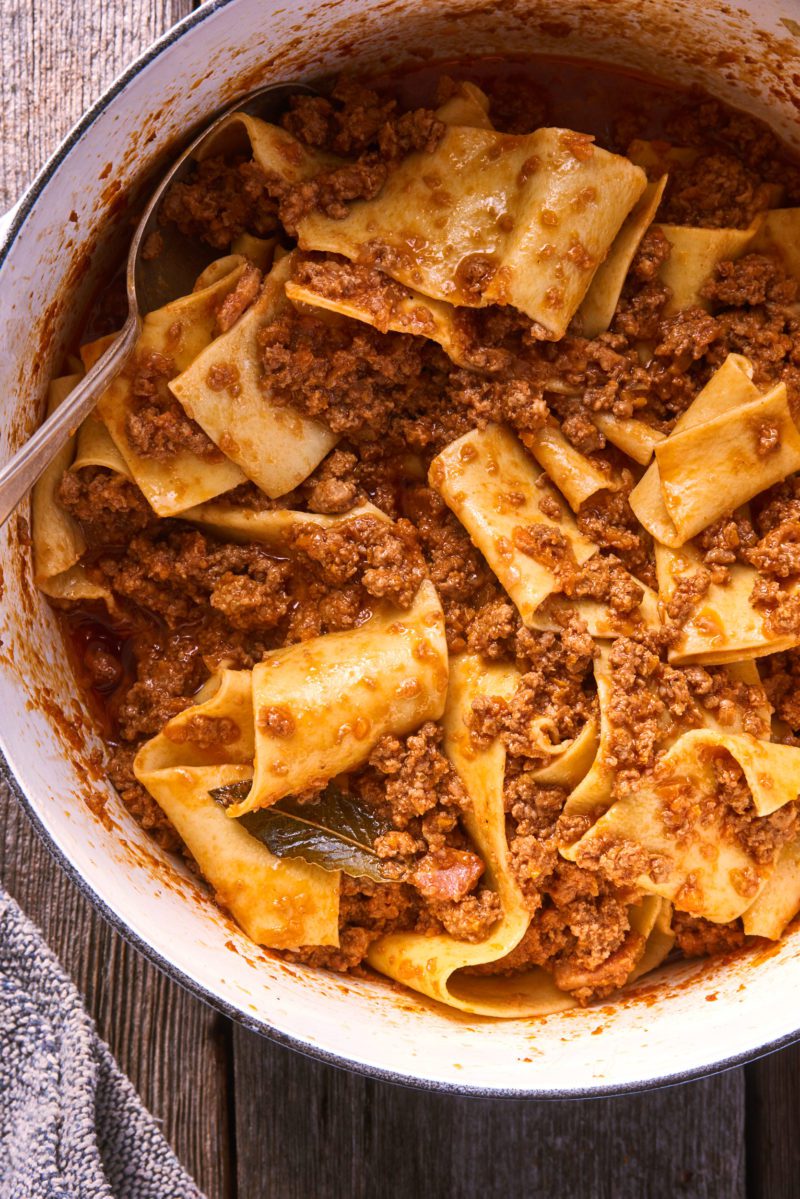
The Bolognese sauce I grew up with wasn’t exactly authentic. Made with lean ground beef, red wine and plenty of canned tomatoes, it was undeniably delicious, true to our Italian-American kitchen, and perfect for a busy weeknight. I never questioned it.
But then I fell down a rabbit hole researching authentic Italian pasta sauce recipes from northern Italy, specifically Bologna (birthplace of Ragù Bolognese), tasting and testing notes from two of the greatest Italian chefs of all time Marcella Hazan and Anna Del Conte.
This new-to-me Bolognese was so soft and so tender it practically melted in my mouth! The tomato component was not dominant at all. It was an accent rather, a flavorful one, and when combined with milk and white wine I couldn’t help but wonder: was it really meat sauce at all?
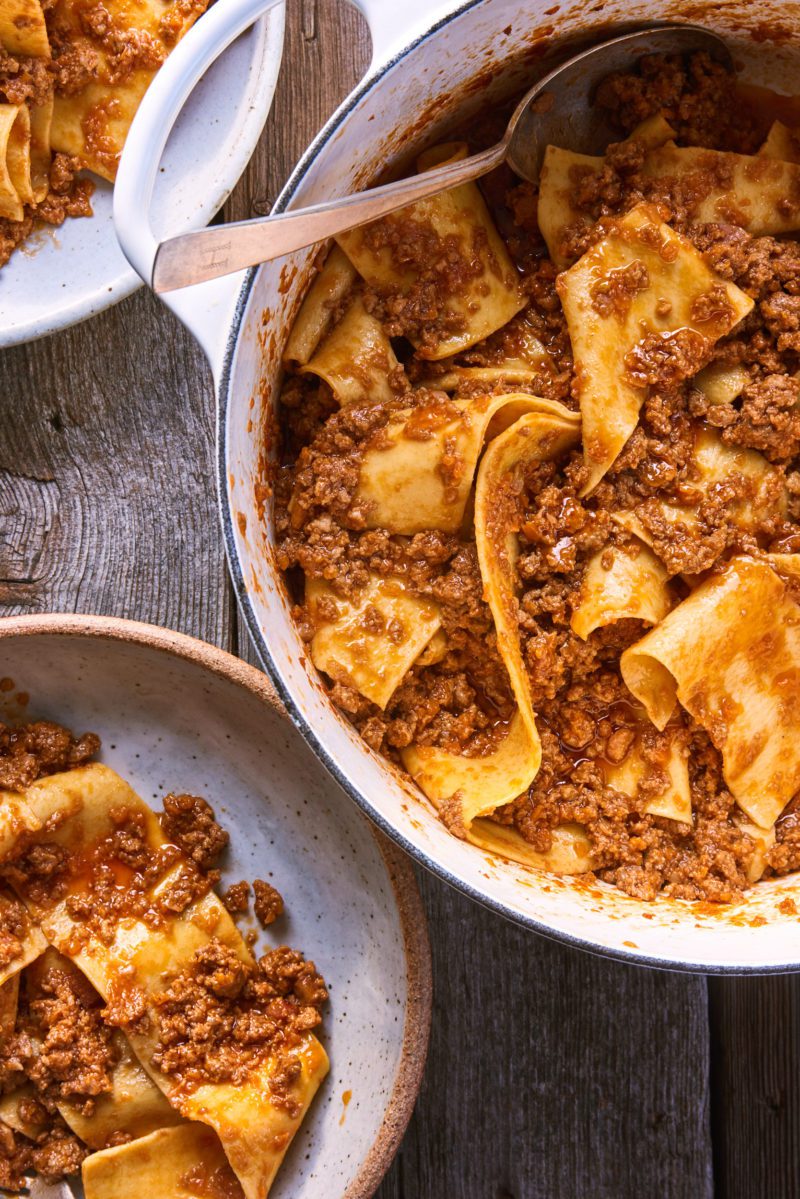
What Sets Ragù Bolognese Apart?
First, it helps to understand the difference between Ragù and Bolognese, terms often used interchangeably (but not quite the same). In Italian, “Ragù” is a broad category of meat sauces made with ground meat, vegetables, wine, and some tomatoes. “Bolognese” is also a meat sauce, but it’s a regional variation prepared in the style of Bologna.
Inside Ragù Bolognese: Ingredients & Tradition
Ragù Bolognese is a beautiful, slow-cooked meat sauce made from ground beef and/or pork, chopped carrots, onion, celery, milk, wine, tomato paste and stock. No garlic.
Of course, there are slight variation as one would expect: cubed pancetta, chicken livers (we add this to our Bolognese sauce at Sfoglia), silky tomato passata, cream, and perhaps a bay leaf or two.
But to me, the biggest difference when compared to the tomato-heavy meat sauce I grew up with, is that Ragù Bolognese uses milk, white wine and notably less tomatoes. The milk tenderizes the meat and mellows out any tart, acidic notes. The flavor is soft, light and slightly sweet! That’s the selling point. And it’s brilliant.
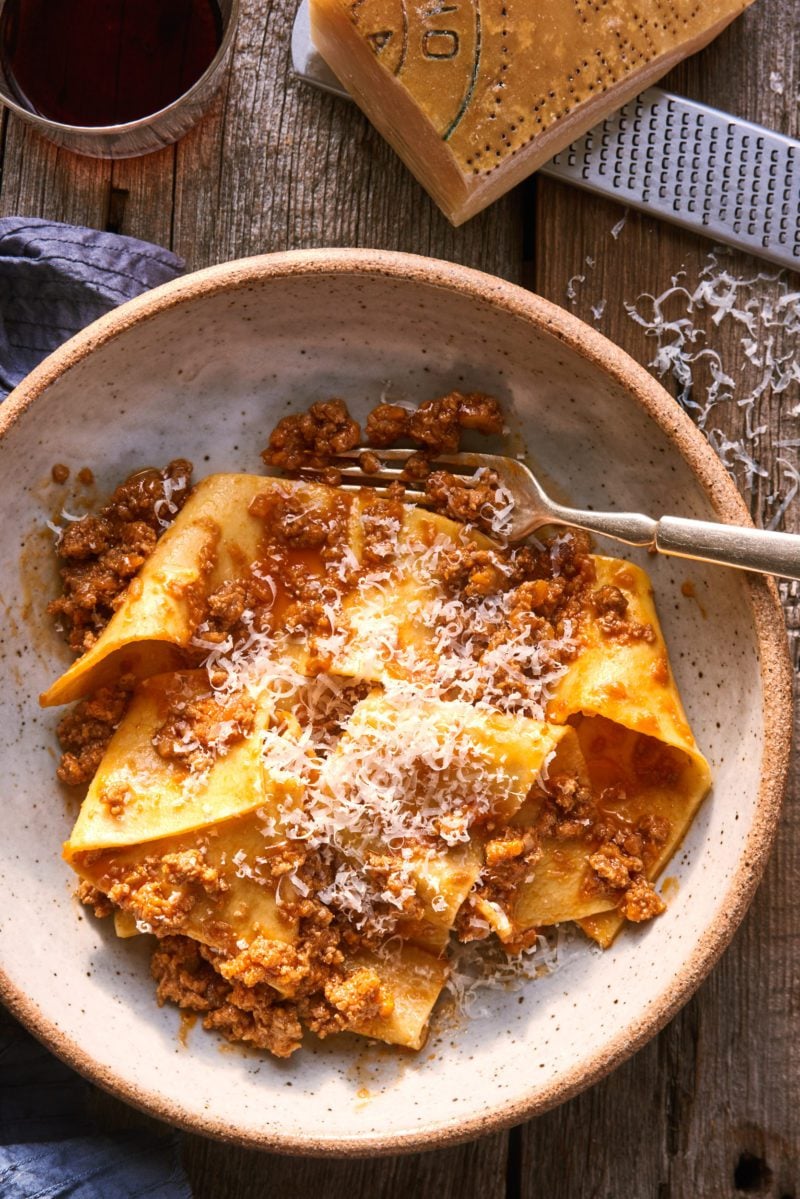
Essential Tips For Authentic Bolognese
- Use a food processor to finely chop the vegetables. Pulse until no large chunks remain, but don’t over process into a wet pulp!
- Don’t skip the milk. Adding it early tenderizes the meat. Some Ragù Bolognese sauce recipes add the milk at the end of cooking, bit by bit. I prefer the texture and flavor when it’s added in the beginning.
- Don’t brown the meat. Cook it gently to keep it soft, not rubbery.
- Try white wine instead of red. It lightens and brightens the sauce.
- Double this recipe and freeze extras. Use it to make my Classic Lasagna Bolognese with Ragù and Béchamel Sauce!
*Photo credit & styling: Melina Hammer.
By signing up, you agree to receive emails from The Clever Carrot. Unsubscribe at any time.
Ragù Bolognese Sauce
- Prep Time: 10 minutes
- Cook Time: 3 hours
- Total Time: 3 hours 10 minutes
- Yield: 5–6 cups 1x
- Category: Pasta Sauce
- Method: Stove Top
- Cuisine: Italian
Description
This authentic Ragù Bolognese sauce recipe boasts a rich, melt in your mouth texture with incredible flavor. The secret is cooking the meat in milk first, to tenderize it, before adding white wine and tomato paste. Serve with fresh homemade pasta, pappardelle or gnocchi for an old world touch.
**Make sure to read the Notes. Tips & Substitutions section below for best results**
Recipe adapted from Essentials of Classic Italian Cooking by Marcella Hazan & The Classic Food of Northern Italy by Anna del Conte.
Ingredients
For the Sauce
- 2 tbsp. (30 g) unsalted butter
- 2 tbsp. (30 ml) olive oil
- 2 oz. (60 g) diced pancetta
- 1 onion
- 1 carrot
- 1 celery stick
- 1/2 lb. (250 g) ground beef, about 80% lean
- 1/2 lb. (250 g) ground pork
- 1 cup (236 ml) whole milk
- pinch of ground nutmeg
- 1 dried bay leaf or 2 fresh
- 1 cup (236 ml) dry white wine
- Heaping 1/4 cup (60–70 g) tomato paste (see Notes below)
- 1–2 cups (236– 472 ml) quality chicken stock (see Notes below)
- (1x) 28 oz (800g) can whole peeled plum tomatoes in purée, passed through food mill (optional, if you want more tomato)
For lasagna Bolognese made with fresh homemade lasagna noodles: I always add the optional (1) can whole peeled plum tomatoes to the recipe above, that I pass through a food mill for a completely smooth texture. The Ragù needs to be “saucier” to account for the lasagna absorbing the sauce while it bakes. Fresh pasta absorbs more liquid than dry pasta. Always have extra sauce on hand.
To Serve
- 1 lb. homemade pappardelle pasta
- Fresh grated Parmesan cheese, to serve
Notes, Tips & Substitutions
- If you do not have tomato paste: omit the chicken stock and used canned tomatoes instead. A good size to start is a 14 oz (400 g) can of whole peeled plum tomatoes, adding more if you want. Chop the tomatoes before adding to the sauce (I snip them with scissors directly in the can.) Alternatively, use 1-2 cups (appx. 236- 475 ml) bottled tomato passata instead.
- My preferred canned tomato brands: San Marzano, Bianco DiNapoli, Cento, Jovial
- Cooking times will depend on the size of your pot (the smaller the pot, the longer it will take). Adjust accordingly.
- If doubling the recipe: increase the cooking times as needed.
Instructions
- In a heavy bottom pot (a Dutch oven is perfect), warm the butter and olive oil over medium-low heat.
- In a food processor: pulse the pancetta, onion, carrot and celery together to finely chop. No large chunks. Note: do not over process the mixture; the texture will become too wet. Chopping can also be done by hand.
- Add the chopped pancetta and veggie mixture to the pot. Sauté, stirring occasionally, for 10-15 minutes until lightly golden. Feel free to add more oil or butter as needed, if the mixture seems dry.
- Add the ground beef and pork. Use a fork to mash the meats together. Season with salt and black pepper. Cook just until the meat looses its pink color; do not brown. This will keep the texture of the meat soft.
- Add the milk, nutmeg and bay leaf. Simmer until almost evaporated, up to 20 minutes (or more) depending on the size of the pot and how much liquid is released from the meat.
- Pour in the wine; simmer until almost evaporated. Add the tomato paste; stir to dissolve. Add 1 cup of stock and tomatoes. Stir well.
- Reduce the heat to low. Cook the sauce, with the lid ajar, for about 1-2 hours. The sauce should just “blip” about and not boil rapidly. Low and slow is key for a melt in your mouth texture. Do not rush the cooking process. If at any point the liquid is reducing too quickly, add more stock or canned tomatoes (if using). Sometimes I add more tomato paste for color. The final sauce should look similar to chili (thick, but no too thick). Skim away any fat from the surface and season with salt, if needed.
- For the pappardelle: bring a large pot of water to a boil. Salt generously. Add the pappardelle noodles and cook until soft and al dente, 3-7 minutes depending on thickness. Taste for doneness. Make sure to to stir occasionally so the pasta doesn’t stick together. When finished, use tongs to transfer the pasta directly into the sauce, adding an additional pat of butter for flavor. Serve with Parmesan cheese.

Comments
Alison Woolcock says
This is the best Ravi sauce recipe I have ever made. The flavour is incredible!
Caroline says
Dion says
Can you please advise how to cook this recipe, including the chicken livers.
Id like to cook with ground lamb and chicken liver, would it be the same meat cooking method as already mentioned?
Lee says
I have made this recipe several times and my family loves it. This last time, I did not have any white wine and looked up that a good substitute would be apple cider vinegar which I had on hand. However, it was a disaster as it was too tangy. What would be a good substitute or is it better to leave it out altogether?
Emilie Raffa says
Great question. I definitely agree with skipping the vinegar. If you don’t have any wine, I’d recommend leaving it out altogether. The final taste will be different, but at least not tangy!
Karen H says
When I don’t have white wine on hand, I’ve used white balsamic vinegar diluted 50/50 with water as a substitute.
Graham Padgett says
You surely don’t mean the beef should be 80% fat (i.e. 20% lean meat). You must mean 20% fat.
Donna Blyth says
I wondered the same thing.
Mike Keighley says
Super recipe, tried it with and without tinned tomatoes, either way it was so soft and melt in your mouth. What really was the star turn was the addition of chicken livers. Amazing, it added a depth of flavour that is irresistible and hard to beat.
Sharon says
Excellent recipe. I don’t care for ground beef, so I chopped the beef and pork into 1/4 inch pieces. A bit of work but I think it creates an even softer texture! It’s what I do for my Italian lasagne recipe. I didn’t think of doing it for bolognese.
Thank you.
Happie says
Perfection!
We have made this a few times now and the sauce is gone before the pasta is cooked!
Everyone keeps dunking their bread in it because it’s sooo good!
What a great dish, thank you!
(Review provided by a support team member for theclevercarrot.com)
Ivana says
Hi Emilie,
Recipe looks great and looking forward to trying it tonight. At what point do you add a can of tomatoes? Recipe doesn’t mention that, only “to add more tomatoes as needed”. But when do you add them to begin with? Thank you. – Ivana
Emilie Raffa says
Hi Ivana! Ahh.. I see the confusion. Great question. Ok, so this recipe uses tomato paste only, with the option to add a can of tomatoes if you want more tomato flavor and/or texture. You would add the can of tomatoes, if using, when the stock goes in. I updated the recipe to clarify (refresh your page if needed). Hope this makes sense :)
Ivana says
Thank you so much! Not only it makes sense, came at a perfect timing! I appreciate it!
Emilie Raffa says
Oh perfect! I love when that happens. Enjoy the Bolognese! :)
Deirdre says
hi Is tomato paste passata or tomato puréé conncentrate in a tube?
Emilie Raffa says
No. They are two separate things. Tomato paste is concentrated tomato in a tube. Passata is tomato puree sold in a jar.
Marc says
Wonderful depth of flavour and a real crowd-pleaser. I made this ragu to layer into my lasagne for a birthday meal. My eldest son, who’s a huge foodie (and sometimes my harshest, most honest critic), gave it 10/10 for flavour. His one comment was that the fresh pasta absorbed a bit too much of the moisture. I had used more lasagne sheets than I normally would, to be honest, but in retrospect, I should have added the recommended larger quantity of stock. (I had 150-200 ml left over). This will be the go-to recipe for bolognese from now on. Worth every bit of effort, it could be left in the slow cooker once bubbling away. Great recipe, Thank you Emilie.
Emilie Raffa says
Marc, thank you so much for the kind feedback! I’m thrilled you liked the Bolognese sauce. Getting a thumbs up from your kid is worth it’s weight in gold, right? (I have 3 of them… I hear it all day!). Your son is right about the fresh pasta too. It absorbs more moisture than dry pasta which is why I usually add more tomatoes (passed through a food mill to emulate passata) when making lasagna. Works like a charm. Extra stock in the Bolognese works too.
Kitty says
Great tips about the cooking: not to overblown it and make it hard and rubbery and to cook it slowly over a longer period of time.
Loved the addition of milk and of the nutmeg. Thank you!
Emilie Raffa says
You’re very welcome, Kitty. Enjoy!
Erica says
Five stars!!! I’ve made this recipe twice and followed it to a T. My family loves it so much I had to double the recipe on my second try. My question is, would there be a significant difference if I add garlic? Thanks!
Emilie Raffa says
Yay! Glad you liked it, Erica. The flavor is good, isn’t it? Re: garlic, it depends on how you cut it. Chopped or minced garlic will lend a stronger flavor; a smashed garlic clove left whole to gently infuse the sauce will lend a lighter taste. If experimenting, I would start with the latter option and see how you like it. You can always remove the clove after the sauce cooks for a little bit 😉
Daniela Sardo says
Loved it! I did 1.5x the recipe – it took quite a while to evaporate the liquid but no worries, the longer it cooks the better! I swapped the milk for an almond creamer since the dairy is not great for me but it was still probably one of the better Ragu sauces I have made!
Emilie Raffa says
Fabulous! I’ve wondered about using a non-dairy option… flavor was good?
Daniela Sardo says
I did some research on cooking with a non dairy option and the suggestion was almond or soy. I’ve got a thyroid condition so soy is out. The almond ‘barista’ creamer is possibly a bit thicker than the almond milk but I think it is just packaging in the end. The almond lent no adverse flavor nor really any flavor at all and worked beautifully. I believe whole cow milk may have been richer in flavor but this was sublime if I do say so myself :)
Emilie Raffa says
Ahh… so interesting. This is really great info, especially since the almond creamer didn’t change the taste. Fantastic! Thanks for the tip!
Allane Cutillo says
Hi Emilie- what are your thoughts on making this recipe for a crowd? Like 40? I know not every recipe does wells being cooked on a large scale, so I’m wondering what you think this one will be? Have you ever tried?
Emilie Raffa says
Hi Allane! Great question. You can definitely scale up to feed 40 ppl. However, I would make the sauce in a few pots (instead of 1 large one) to make sure the liquid reduces properly at each stage, and it’s seasoned correctly. That’s the key to this sauce. If you throw sauce for 40 ppl into 1 pot, it’s going to take a lot longer to cook and you’ll have a ton of extra liquid from the scaled up veggies, meat, milk, wine etc. Does that make sense? I haven’t cooked this recipe for 40, I’ve only doubled it. But I used 2 pots and it came out fine. Hope this helps. Enjoy! :)
Allane Cutillo says
Thank you! I will try that. One more question then- I’m thinking maybe cooking in batches over two days. if I make in advance, does it hold up well for a day or two in the fridge? Thanks for all your help.
Also, saw the lasagna recipe is up- I had asked about that a couple weeks ago- I can’t wait to try :)
Emilie Raffa says
Yes, absolutely. In fact, the flavor will only improve. 1-2 days in advance is 100% fine. Oh yes… that was you! Yay!!! xx
Maria says
I haven’t tried Emilie’s version yet, but have been making Marcella’s version since 1979. I usually make 4x the recipe in a big Le Creuset pot. I’ve made it 4 – 5 days in advance. It also freezes beautifully. It’s really perfect for a big crowd – I’ve made it for a crowd of about 20.
Can’t wait to try this version which seems to be a little shorter to make.
Kristina says
Hello! What do you think about using a slow cooker for this recipe? Seems like it may work but thought I’d ask your opinion. Thanks so much!
Emilie Raffa says
Hi Kristina! I haven’t tried it, but it has to work. I suggest doing steps 1-4 on the stove top to develop flavor, and then switching to the slow cooker after that. Alternatively, if your slow cooker has a saute option, then use it from start to finish. Enjoy.
Stephanie says
It was a bit bland…made it according to the directions
Emilie Raffa says
Hi Stephanie! Thanks for your feedback. Check for salt next time. Some brands of stock, canned tomatoes and even tomato paste have different levels of sauce which can make (or break) a recipe. I’d start there. Also, feel free to adjust the ingredient quantities here, adding more or less of what you like in sauce.
Annier says
We just had this ragu as written, and although it wasn’t as red as a typical tomato sauce or as shown in the pictures, it was truly amazing. I cannot imagine how this could taste any better with homemade pappardelle noodles, but I will attempt to make them next time I truly want to blow anyone’s mind with this ragu. Enough said!
Emilie Raffa says
What lovely feedback, Annier. Thank you! I’m so glad you enjoyed it.
ceebee says
Well, Emilie, you certainly “fell down the right rabbit hole” on this recipe. My Bolognese Nonna would heartily agree. Her preparation of the sauce, and what I use myself now is almost exactly what you described. Squisito!
As I am sure you know Italians from that region are very fond of nutmeg, and I generally go nutmeg heavy when preparing the sauce. I also use 3-4 dried porcini mushrooms, soaked in about 1/2 cup boiling water and then cut up with scissors before adding pieces and liquid to the sauce. They just give a little umami blossom that is not just “mushroomy.”
The milk, though, is the key and I am so pleased that you took the time to share that and hopefully dispel the myths that heavy cream or half and half are needed to make this wonderful sauce.
BTW, when our son was going through a meatless period, I even tried making this using TVP rehydrated in vegetable stock in place of the meat. I had to ramp up the porcini punch, but it was incredibly tasty….a meatless Bolognese.
Emilie Raffa says
It’s a rainy day here in NY and I’m making your version with porcini mushrooms (they have been so difficult to find these days!). It smells divine. I’m also doing a higher ratio of pork to beef because it’s all I have. I’m using fresh, whole nutmeg too. And I absolutely agree with you about the cream- not necessary. In fact, it becomes a completely different sauce, doesn’t it?
ceebee says
You’re tops, Emilie! Thanks again for bringing the authentic Bolognese sauce recipe to everyone. It’s way easy to execute and so tasty. I’m glad that you also had the opportunity to try it w/ Nonna’s umami bomb, the dried porcini mushrooms. Nonna probably never heard of umami, but she sure knew what pleased the palate!
Andrea says
Yessssssss. Omg yes. This was worth every minute it took to make, and start to finish it was just over four hours (I doubled the recipe). I have always wanted to make a bolognese. My word is this recipe incredible. I made the noodles, too, and we all loved them. I didn’t change anything. Definitely perfect as written!
Emilie Raffa says
Andrea, I’m so glad you liked it! This sauce definitely takes time, but it’s a “stirring slowly” kind of thing. A joy really :) And yay! You made the noodles too! Fresh homemade pasta is something else.
jude says
another brilliant recipe, emilie.
rave reviews here at home.
i used onion powder with the nutmeg and bay leaf because we don’t eat onions.
it was mostly a hands off recipe, which is always welcome.
thanks for all your efforts and for sharing them with us!
Emilie Raffa says
Ahhh, this is so great to hear! I’m actually working on a few new recipes that utilize it. When you have some in the freezer ready to go, the possibilities are endless! Jude, the onion powder sounds really interesting. Out of curiosity, how much did you use?
jude says
oh, yes, stuff for the freezer! i am eager to see what you have in store.
i didn’t write down how much i used in my notes but i’m guessing a teaspoon.
i snubbed my nose at onion powder for years but have found a few more recipe developers using it of late and i’m finding it works really well (and sure beats cutting up onions!) thanks for writing back, emilie. i love your site and your work.
Claire Beach says
This recipe is AMAZING! I would eat the sauce everyday if I could. It’s such a nice touch adding the pork- so much flavor.
Emilie Raffa says
Thank you! I never make this without the pork. It’s such an important flavor and I love it with the nutmeg and milk. I get mine at Whole Foods from the butcher counter- so good!
Donna says
I’m at the step where i am simmering the milk, nutmeg and bayleaf…at least 25 minutes has traspired and there is no way it is reduced even by half, never mind almost evaporated…i hace even transferred the mixture to a shallower, wider pan…not sire what to do
Emilie Raffa says
Hi Donna! Cooking time will vary depending on the size of the pot, how much liquid the meat releases, and if you have doubled the recipe. Using a larger, wider pot will remedy this as well as extending the simmering time to account for any excess moisture. Hope this helps.
Sabrina says
I made this and the texture and everything were spot on. It’s so much better than the other meat sauces I’ve tried. The only things I’d suggest is, 1- salt as you go since I missed seeing when to add salt, and 2. I needed to skim off some of the fat as my pork was pretty fatty. I skimmed once the fat was clearly floating on top after i added the milk. I also made a double batch. It’ll go in my recipe folder for sure. Next time I’m making the fresh pasta as well, but ran out of time on a Monday night.
Emilie Raffa says
Hi Sabrina! So glad you liked it! Yes: salt as you go. This is a great tip. In most recipes that call for layered cooking, like soups and stews etc., I typically salt when the veggies go in. But since this recipe includes pancetta (which can be very salty depending on the brand), I wait until the meat goes in. Skimming the fat works as well. I’ve added a note to the recipe :)
Kim’s says
Can you sub skim or 2% milk if you have lactose issues?
Emilie Raffa says
Sure thing! The flavor and overall richness will change slightly, but it’s totally fine. You can use whatever % milk you have on hand.
JaniceY says
My husband has issues with dairy. I always use lactose-free milk (and cream) in my recipes, and there is no difference in taste or texture. Btw…this is a fantastic recipe. A staple in our house for various pastas.
Tim colman says
Love your work. I also think this latest recipe will be easy to swap out the meat. Shared
Tim
Emilie Raffa says
Thanks so much, Tim! Enjoy :)