This post will teach you how to make a beginner sourdough starter at home, step-by-step. All you need is flour, water and a little bit of patience. Before you know it, you’ll have your very own bubbly, active sourdough starter to make my best sourdough bread recipe, sourdough focaccia and more! Grab your personal sourdough starter feeding chart.
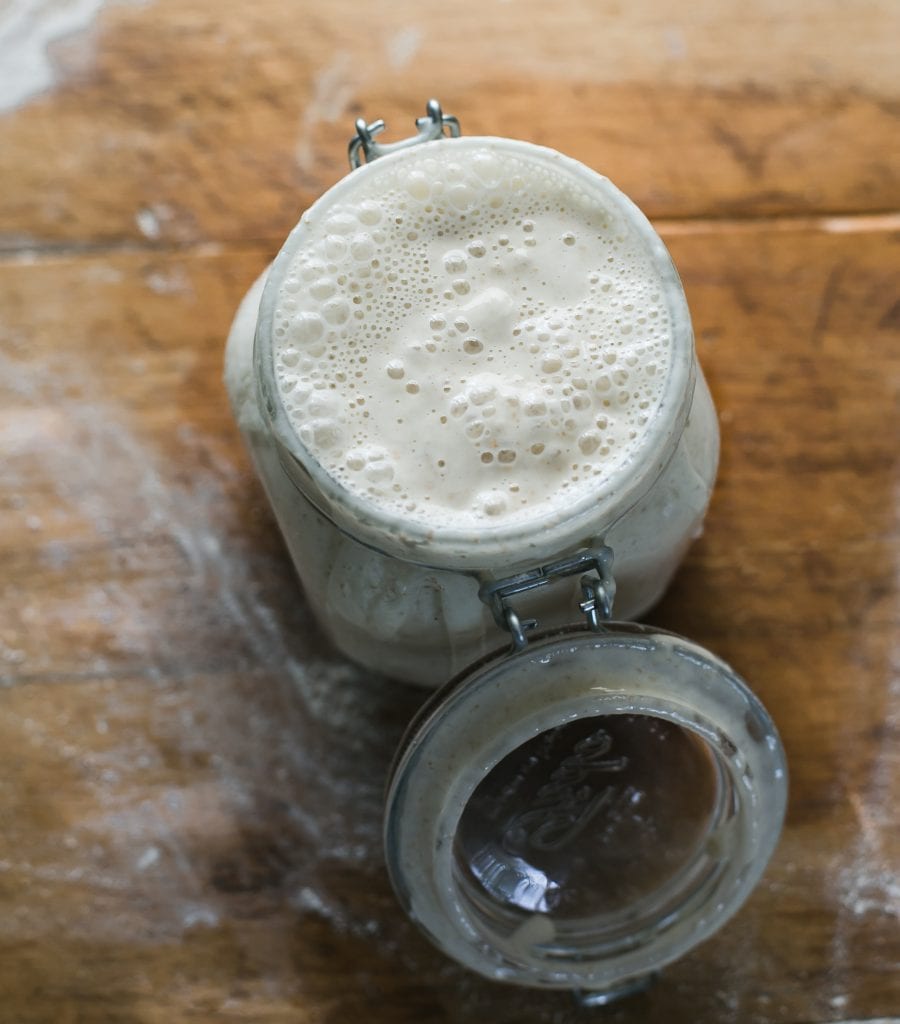
Looking to bake sourdough bread? First: you’ll need a sourdough starter. Without it, your bread won’t rise. It’s the absolute heart and soul of sourdough baking. Creating a sourdough starter from scratch is not hard to do. However, the process is intimidating, especially for beginners. Let’s change that.
Adapted from my bestselling book Artisan Sourdough Made Simple, I will demystify and simplify the process with step-by-step recipe instructions. In approximately 7+ days (yes, it takes that long- there are no shortcuts) you’ll get approximately 1 cup of bubbly, active sourdough starter which is more than enough to make bread, including my best sourdough bread recipe with olive oil (most popular recipe on my blog!). More sourdough bread recipes here.
Sourdough is more than just a recipe; it’s an understanding. So before we dive in, let’s define.
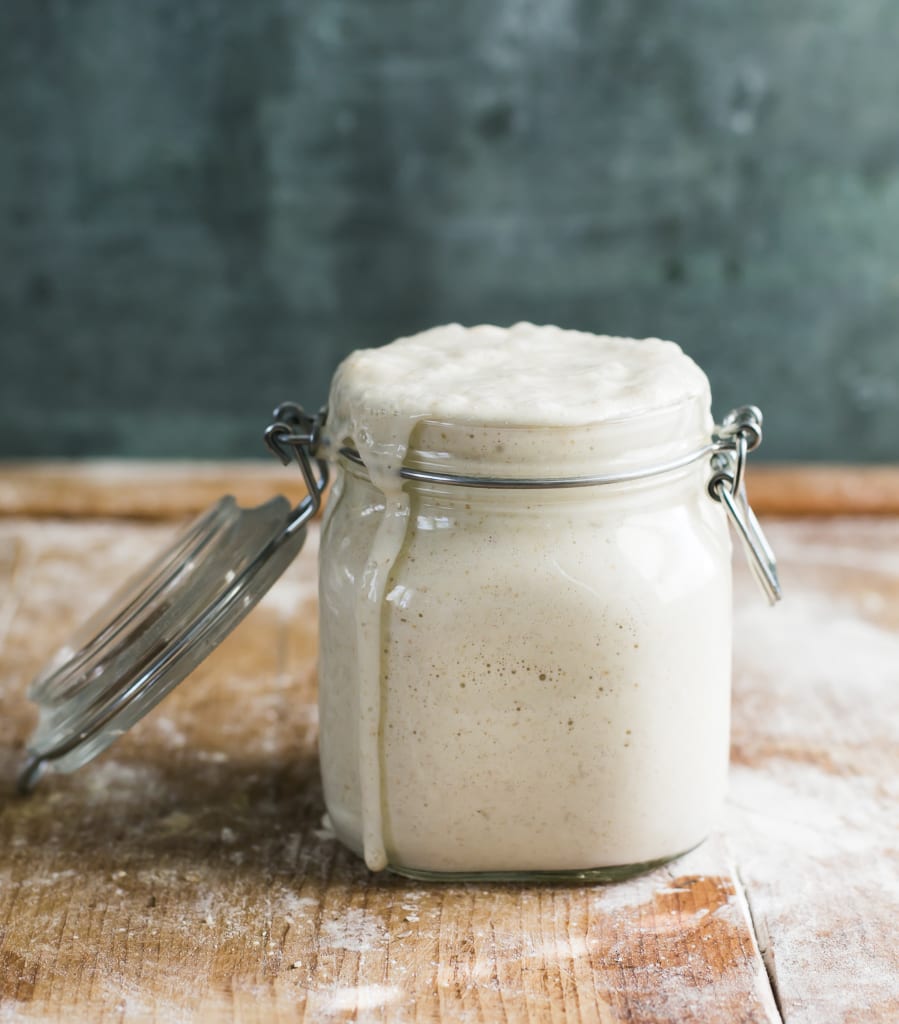
What Is Sourdough Starter?
A sourdough starter is a live, fermented culture of flour and water filled with wild yeast and bacteria from our environment. A small portion is added to sourdough bread dough to make it rise. Commercial yeast IS NOT required.
Sounds a bit weird, right? Of course it does. Know this: natural “wild” yeast is all around us. It can be found in a bag of flour, in the air, on your hands etc. Just because you can’t see it, doesn’t mean it’s not there and doing its thing. It’s like magic.
How Long Will It Take?
To create a sourdough starter from scratch, the overall process will take 7 days (or more) from start to finish. It’s not instant. First, you’ll create the starter with whole wheat flour to jumpstart fermentation. Then, you’ll continue to feed it with regular all purpose flour or bread flour to cultivate the wild yeasts and friendly bacteria. Once it’s created, you’ll keep it alive with ongoing feedings and care, which you can read about here.
When Will It Be Ready To Use?
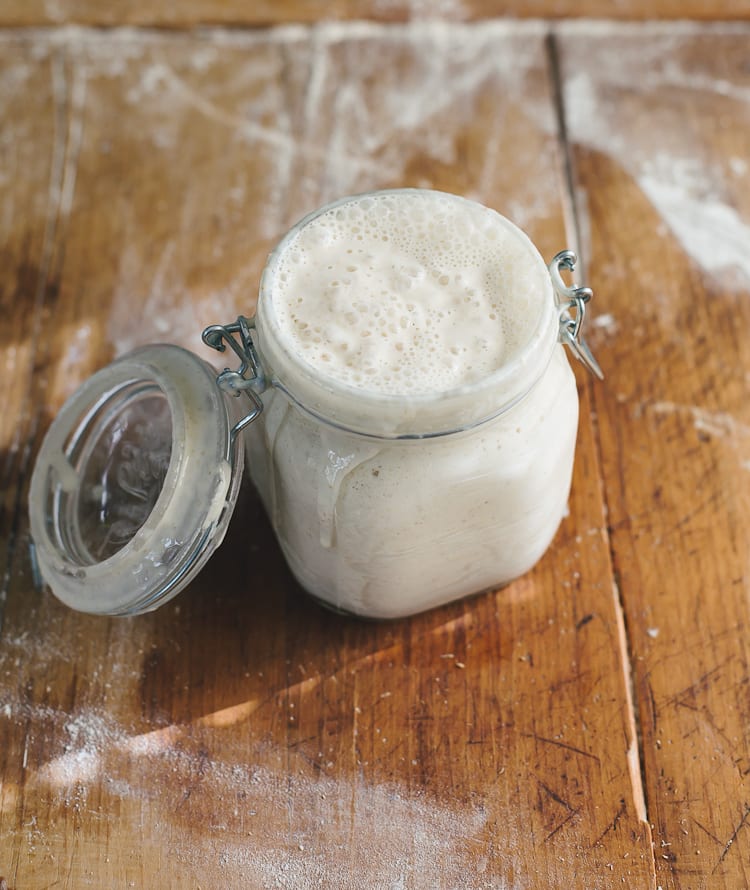
Your starter is ready to use when it has doubled in size, with plenty of bubbles on the surface and throughout the culture.
NOTE: It’s not uncommon for it to take up to two weeks or more for the starter to become active. It all depends. I know this timeframe sounds a bit vague, but growing yeast in a jar (that’s basically what you’re doing) can be unpredictable at times. Please be patient if the process takes time for you- it’s normal.
Is It Difficult To Do?
Absolutely not! In short: you’re basically adding flour and water to a jar, feeding it with more flour and water and waiting for it to become bubbly, active and double in size. That’s it. Most of your time involvement is hands-off. Can I ask you a favor though? Don’t overthink it. There’s a ton of sourdough information out there, and you will fall down a major rabbit hole if you start poking around. Just stick to this tutorial for now, follow the steps as written and just go for it.
Beginner Sourdough Starter Recipe {Step-By-Step}
You Will Need:
Supplies
- 3/4 L jar (I use this one)
- Digital scale
- Small rubber spatula
Ingredients
To create the sourdough starter on Day 1:
- 60 g (1/2 cup) whole wheat flour
- 60 g (1/4 cup) water
To feed the sourdough starter each day (Days 3-7):
- 60 g (1/2 cup) unbleached all purpose flour or bread flour
- 60 g (1/4 cup) water
NOTE: Use regular, unbleached all purpose flour or bread flour for best results. I use flour from KAF, Trader Joe’s or Whole Foods. As for organic flour, I first learned that it wasn’t always successful when first creating a sourdough starter (sourdough can be finicky). However, due to the widespread use of glyphosate, I’ve been inspired to re-test with organic flour. The results were good. Please experiment with what resonates. For the water, filtered or tap water is fine. Use the latter if you know it’s mostly chemical/chlorine free.
Day 1: Make The Sourdough Starter
- First, download and print out this chart. It’s your daily “at a glance” feeding schedule to keep you on track.
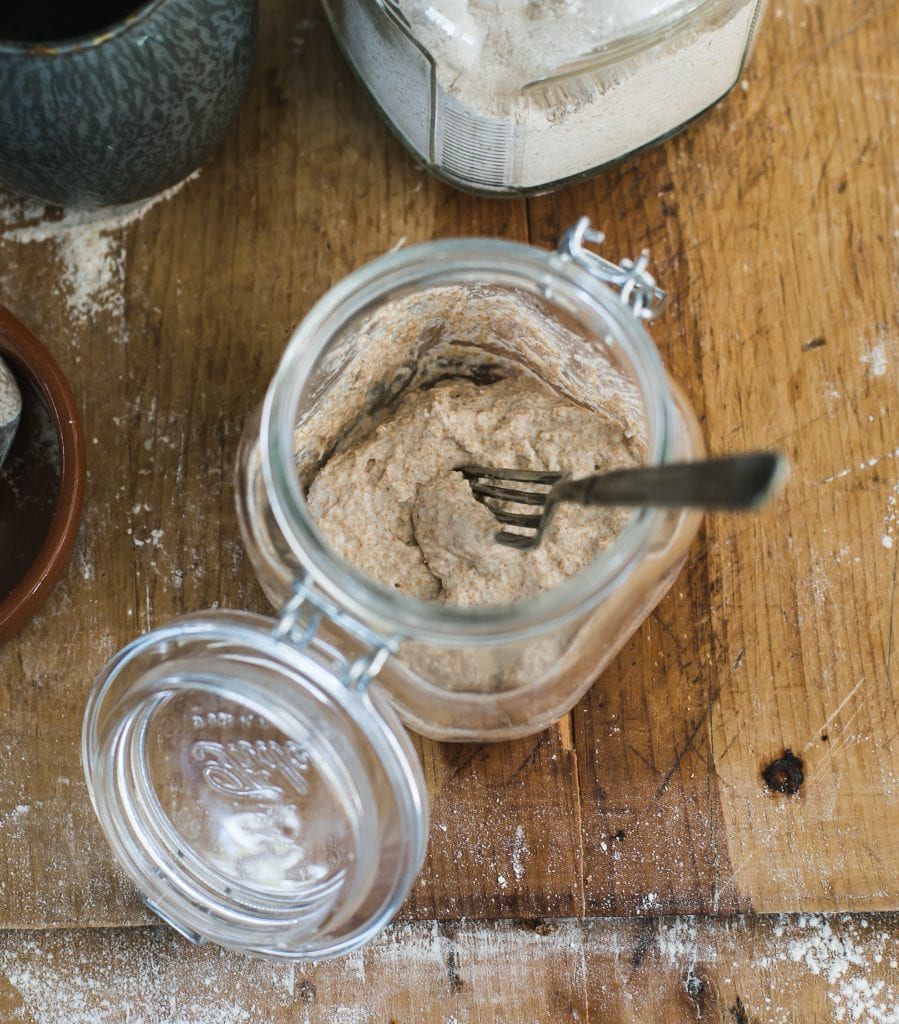
- Add 60 g (1⁄2 cup) of whole wheat flour and 60 g (1⁄4 cup) of water to your sourdough starter jar. Total yield: 120 g sourdough starter.
- Mix with a fork until smooth; the consistency will be thick and pasty.
- Cover with plastic wrap or a lid, and let rest in a warm spot, about 75 F for 24 hours.
Temperature Tips: Temperature is very important. If it’s too cold, your starter won’t rise and the process will take longer. Consider the following tips if you’re looking for a warm, 75 F spot. Place your starter on a cookie sheet inside the oven (turned off) with the light on for a only few hours to give it a boost (please don’t leave it there overnight- the environment will become too warm). Monitor the temperature with an oven thermometer. You can also use a proofing box set to your desired temperature, or a microwave with the door ajar and the light on.
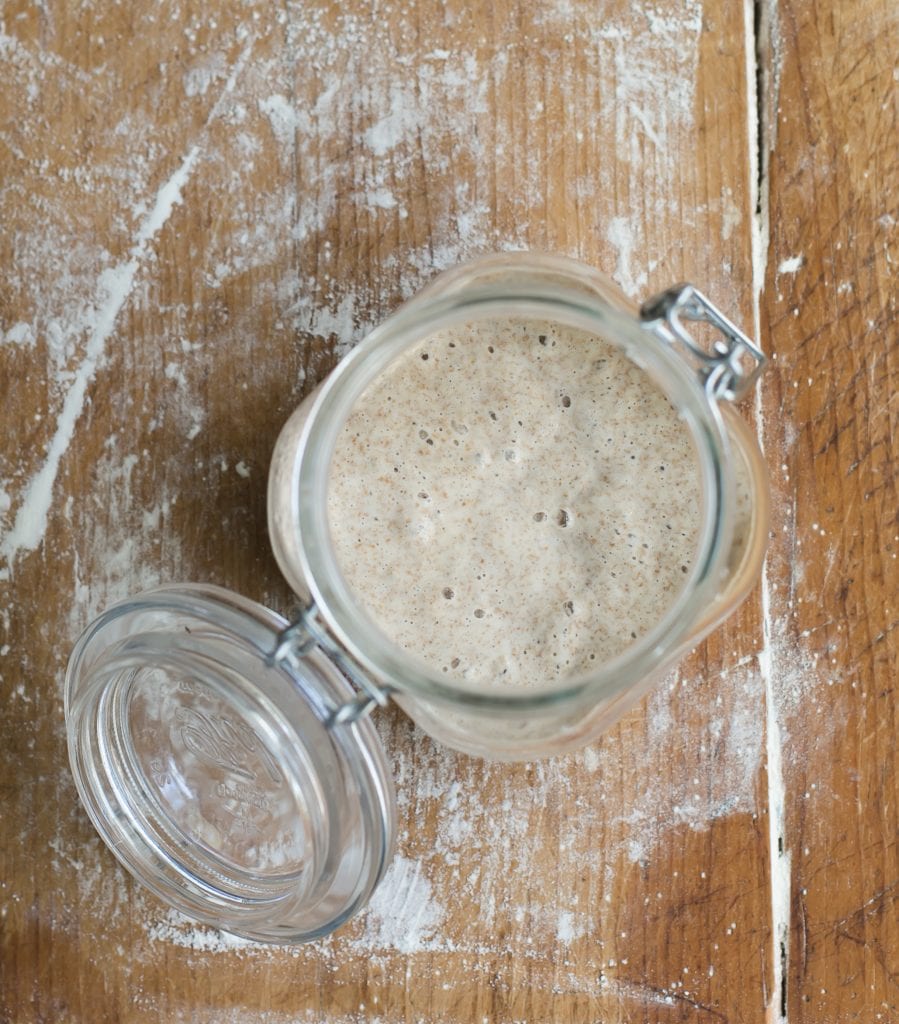
Day 2: Got Bubbles?
- Today, you’re going to check if any small bubbles have appeared on the surface.
- Bubbles indicate fermentation, which is what you want. However, it’s okay if you don’t see anything right away; the bubbles might have appeared and dissolved overnight while you were sleeping. This happens quite often.
- You do not have to do anything else on Day 2. Just let it rest in your warm spot for another 24 hours. Feel free to stir once or twice to oxygenate the mixture.
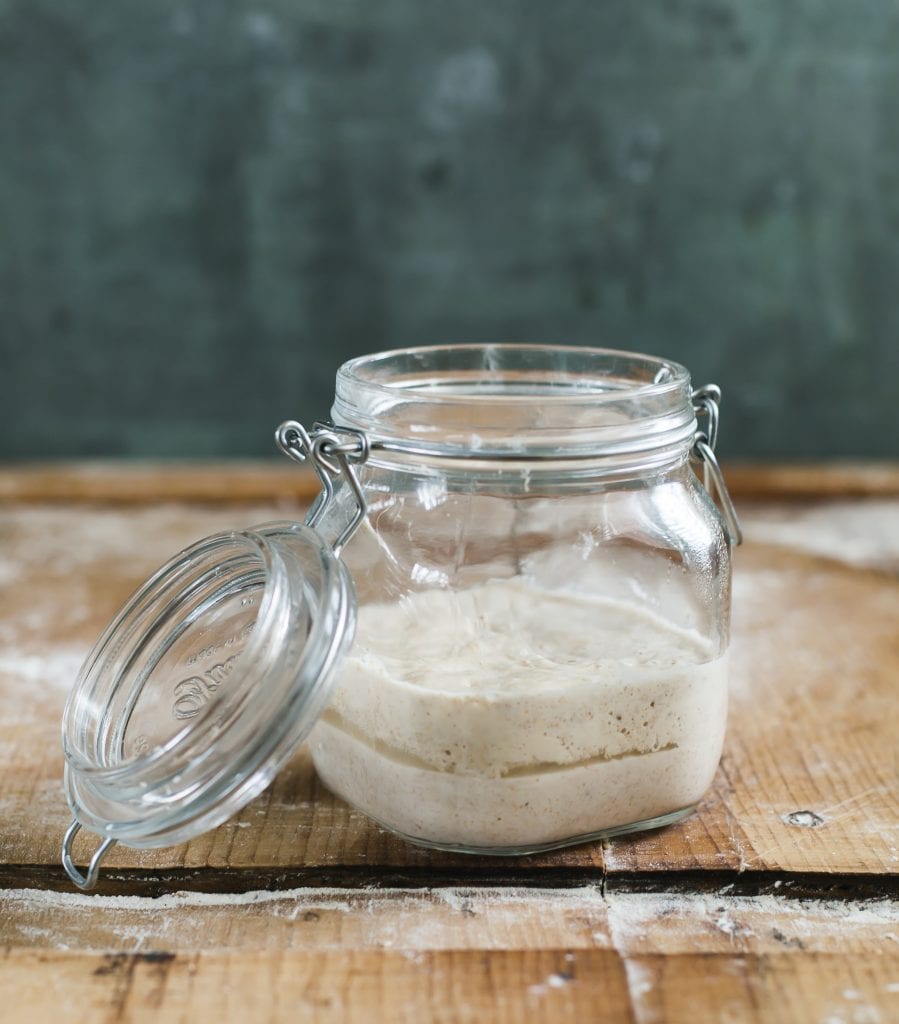
Tip: What’s That Brown Liquid? During the creation process, and even after your starter has been established, a dark liquid might appear on the surface (the image below shows the liquid in the middle of the starter). This liquid is called “hooch” and is an indication that your starter is hungry. It also has a very distinct smell, similar to rubbing alcohol or gym socks. This is normal. Don’t freak out. Any time you see this liquid, it’s best to pour it off before feeding it with fresh flour and water.
Days 3-7: Feed Your Sourdough Starter
Whether bubbles are visible or not, it’s time to start the ongoing feeding process. As the natural yeasts begin to develop, your starter will rise. Bubbles will form on the surface. Eventually, your starter will fall back down or “collapse” indicating that it’s time to feed it again. The goal: is to increase the total quantity to about 236 g (1 cup) following the specific feeding ratio outlined below on each day.
Before you begin, a few tips for success:
- Establish a feeding schedule. Feed your starter at the same time each day. This will train your starter to rise and fall predictably, which is what you want. Consider feeding your starter in the morning when you wake up. Again, this is where my feeding chart comes in handy.
- Track the growth. Place a rubber band or piece of masking tape around the jar to measure the starter as it rises. When it falls, you’ll see streaks of starter on the sides of the jar.
- Keep your jar clean: Use a small rubber spatula to scrape down the sides of the jar to prevent mold growing up the sides.
- Be patient. This is a slow, gradual process. Remember: temperature (75 F) and consistency (daily feedings @ approximately the same time each day) is key.
Day 3:
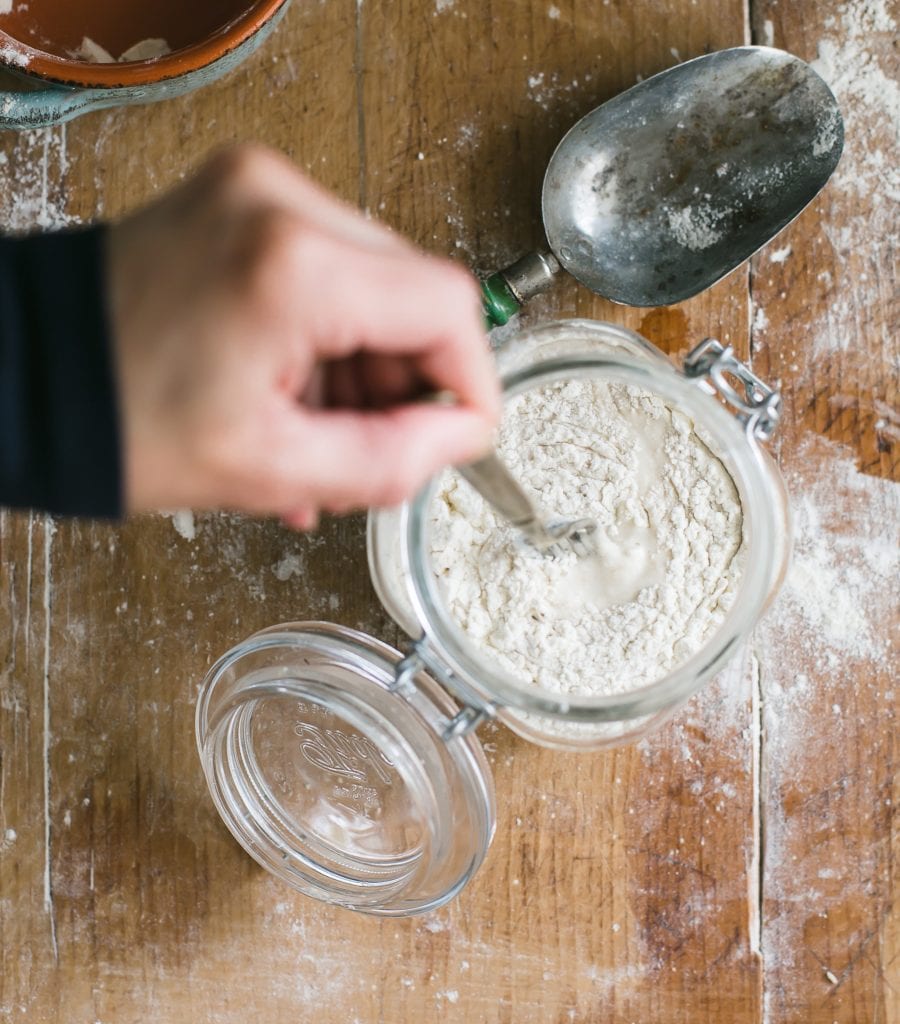
- Remove and discard half (60g) of your sourdough starter from the jar. To do so: use a spoon to scoop it out, or pour the starter directly into a bowl to weigh (you can also just eyeball it- the amount doesn’t have to be exact). The texture will be very stretchy.
- To the jar: Add 60 g (1⁄2 cup) of all-purpose flour + 60 g (1/4 cup) of water. Mix with a fork until smooth. Scrape down the sides with a small rubber spatular. The texture should resemble thick pancake batter or plain yogurt at this point.
- Cover and let rest in a warm spot, 70-75 F for 24 hours.
- Total yield: 180 g starter.
Day 4:
- Remove and discard half (90 g) of the sourdough starter.
- To the jar: Add 60 g (1⁄2 cup) of all-purpose flour + 60 g (1/4 cup) of water to the jar. Mix well and scrape down the sides.
- Cover and let rest in a warm spot for 24 hours.
- Total yield: 210 g starter.
- Note: The growth of your starter might appear to slow down on Days 3-4, after switching to all purpose or bread flour for the ongoing feedings. This is normal. Your starter needs more time to adjust. Be patient.
Day 5:
- Remove and discard half (105 g) of the sourdough starter.
- To the jar: Add 60 g (1⁄2 cup) of all-purpose flour + 60 g (1/4 cup) of water. Mix well.
- Cover and let rest in a warm spot for 24 hours.
- Total yield: 225 g starter
Day 6:
- Remove and discard half (112 g) of the starter.
- To the jar: Add 60 g (1⁄2 cup) of all-purpose flour + 60 g (1/4 cup) of water. Mix well and scrape down the sides.
- Cover and let rest in a warm spot for 24 hours.
- Total yield: 232.5 g starter
Day 7:
- Remove and discard half (116.25) of the sourdough starter.
- To the jar: Add 60 g (1⁄2 cup) of all-purpose flour + 60 g (1/4 cup) of water. Mix well, and scrape down the sides.
- Cover and let rest in a warm spot for 24 hours.
- Total yield: 236 g starter
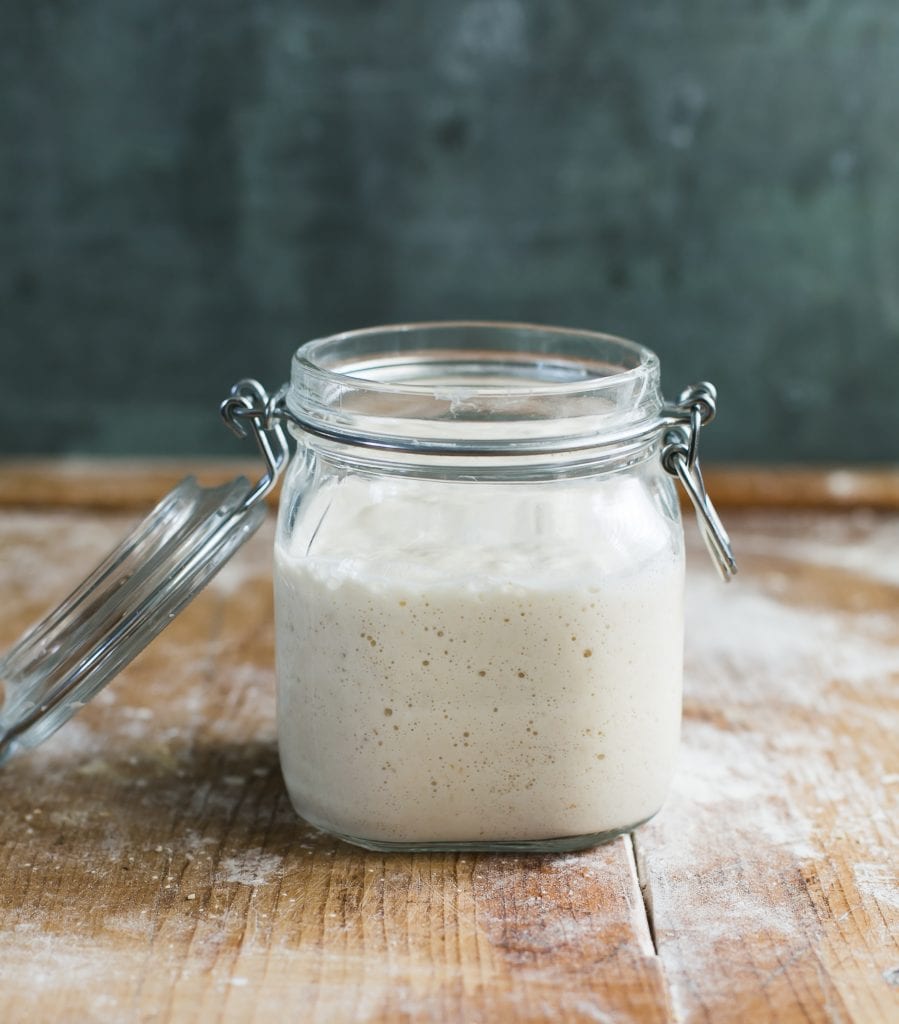
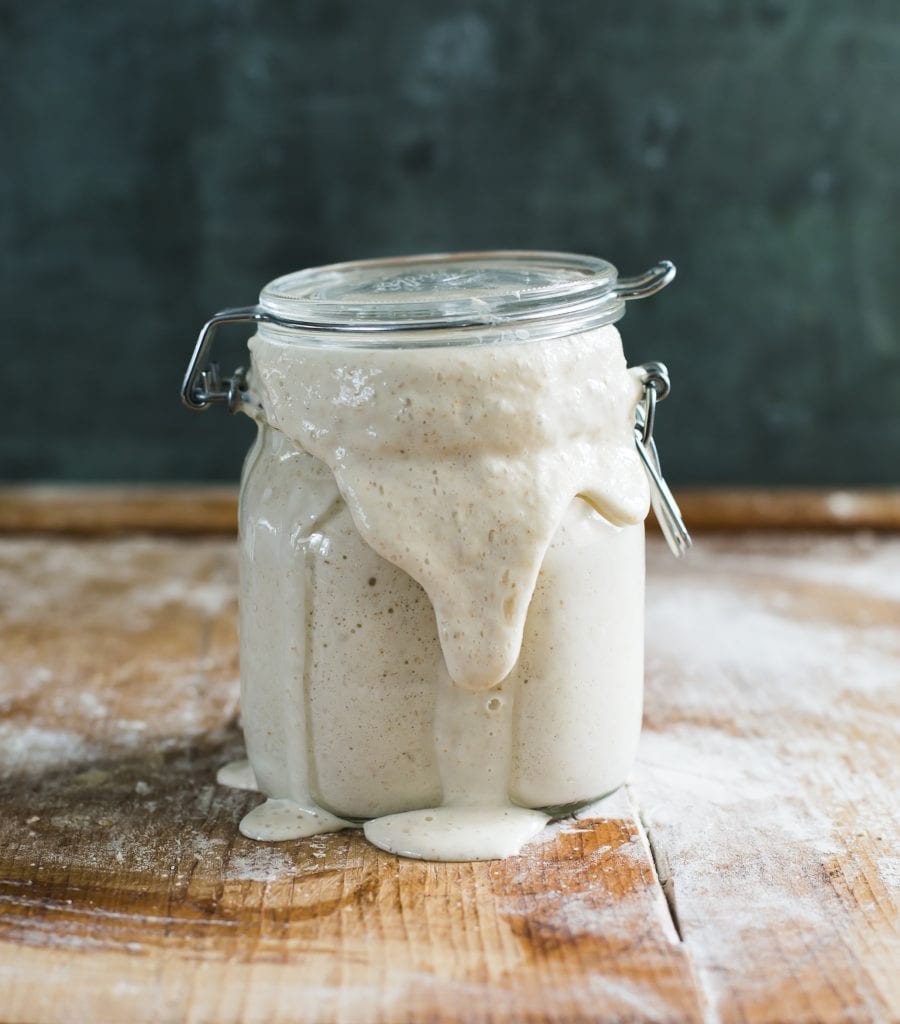
Day 7-8: A Sourdough Starter Is Born!
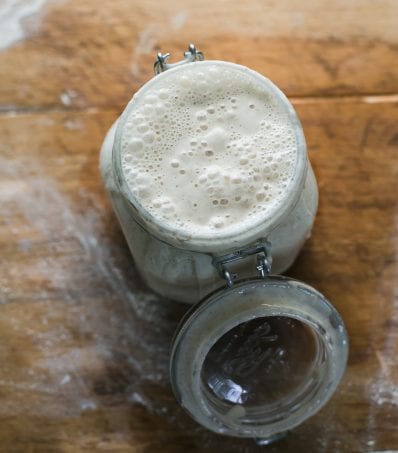
- By now, your sourdough starter should have doubled in size. You should see plenty of bubbles, both large and small. The texture will now be spongy, fluffy, and similar to roasted marshmallows (think: s’mores). It should also smell pleasant and not like stinky gym socks. If these conditions are met, your starter is now active.
- The very last step is to transfer your sourdough starter to a nice, clean jar. Do this only if your current jar needs a good scrub. Otherwise, leave it as is.
- In keeping with tradition, you can also name your sourdough starter (and please do). My starter is called Dillon after my oldest boy. It’s bright and bubbly, just like him ;)
- Now you’re ready to bake. Start with my beginner sourdough bread recipe- you’re going to love it!
Feeding & Maintaining Sourdough Starter For Ongoing Care
So you’ve created a sourdough starter! Now what? Just like any living creature, your starter must be kept alive with regular feedings, proper storage, and ongoing care to keep to maintain its strength. If your starter is not strong, your bread will not rise. Once you’re starter is established, read my companion article to learn exactly how I do it- Feeding Sourdough Starter: My Best Tips & Tricks. Have more questions? Read troubleshooting your sourdough starter.
Note: You will need to feed your starter every time prior to making bread dough and to maintain it (keep it alive).
How To Store Sourdough Starter
At Room Temperature: If you bake often, let’s say a few times a week, store your starter at room temperature. This will speed up fermentation, making the starter bubbly, active, and ready to use faster. Room temperature starters should be fed one to two times a day, depending on how quickly they rise and fall.
In the Fridge: If you don’t bake that often, store your starter in the fridge covered with a lid. You’ll only need to feed it about once a week or so to maintain its strength when not in use (you can just feed it cold and then pop it back in the fridge right afterwards; no need to warm it up first). When you are ready to make dough, feed your starter at room temperature as needed, to wake it back up.
Frequently Asked Questions & Helpful Info:
1.) What If my starter is not ready after 7+ days?
Feed every 8-12 hours (not 24) and continue the same formula: Discard half starter. Feed (Add): 60g flour & 60g water and store at 70-75°F / 21-24°C. Too runny? Add an additional 1-2 tbs of flour. Note: the most common reason for your starter not starting is cold temperature.
2.) Can this sourdough starter be made with all purpose flour only?
Yes. The process might take a little longer.
3.) Can sourdough starter be made with bread flour only?
Yes. Because it’s more “thirsty” than AP flour, add more water if the texture is too thick.
4.) Can this sourdough starter be made with whole wheat, spelt flour or rye flour only?
Yes. Like bread flour, whole grain flour absorbs more water than all purpose flour, so adjust the texture with additional water your starter is too thick.
5.) Can sourdough starter be made with bleached flour?
Yes. But it’s not recommended. The chemicals can throw off the fermentation process. Some readers have reported success, however. Your choice!
6.) Why do you use whole wheat flour in the beginning of the recipe? And then switch to all purpose flour for the ongoing feedings?
Whole wheat flour is used to jumpstart the fermentation process. All purpose flour or bread flour is used for the ongoing feedings because it’s inexpensive, practical and suitable for everyday baking.
7.) On Days 3 & 4, my starter is not as bubbly compared to Days 1 & 2. Growth is slowing down. Why?
As mentioned in question #5, whole wheat flour is used in the beginning to jumpstart fermentation. This is why you saw bubbles right away. When you switch to all purpose or bread flour for the ongoing feedings, growth will inevitably slow down on Days 3-4, as your starter needs time to adjust to the new flour. This is normal. Growth is still happening.
8.) For the daily feedings, you mention to feed your starter “equal parts” flour and water by weight. For example: 60 g (1⁄2 cup) flour + 60 g (1⁄4 cup). But the volume conversions (measuring cups) are not equal. Is this a typo?
No. It’s not a typo. “Equal parts” refers to feeding by weight only. Not measuring cups. Here’s why: different ingredients weigh different amounts based on density. For example 1 cup of flour can weigh anywhere from 125-150 g depending on how it was packed into the measuring cup. 1 cup of water can weigh anywhere between 236-250 g. Because weights are constant, it streamlines the process for accuracy. It is the preferred measuring unit in bread baking. The volume approximates are listed for convenience because not everyone has a scale.
9.) Can I use the sourdough discard from Day 1-7 for something else?
In the beginning, I typically don’t recommend using the discard (it’s usually really smelly and discolored). I recommend using the discard after the starter has been established. However, everyone will have a different experience with this. If it looks good- use it! And yes, you can save it to create a new, separate sourdough starter if you’d like. For more info please read Sourdough Discard 101: Recipes & Faqs Answered.
By signing up, you agree to receive emails from The Clever Carrot. Unsubscribe at any time.
Beginner Sourdough Starter Recipe
- Yield: appx. 236 g (1 cup)
- Category: Sourdough Starter
- Method: 1-Bowl
- Cuisine: American
- Diet: Vegan
Description
Looking for an easy, sourdough starter recipe for beginners? Adapted from my bestselling book Artisan Sourdough Made Simple, follow my no-nonsense, step-by-step guide for practical tips, tricks, and ongoing care- anyone can do it. Use it to make my famous golden, crusty sourdough bread recipe.
Please read my notes below before you begin.
Notes, Tips & Expectations:
- Download & print personal sourdough starter feeding chart {here}.
- The overall process takes ~7+ days, if the temperature is warm enough, ideally 70-75 F. However, it can take up to 2+ weeks or more for a strong starter to become established. Do not ignore the importance of temperature.
- Growth will seem to slow down on Days 3-4. This delay is commonly called a “false” start. It’s also normal- the yeast needs time to cultivate. Please be patient!
- You will need one large 3/4 L jar, or something of similar size (I use this one). Place a rubber band or piece of masking tape around the jar to measure the starter’s growth as it rises.
- To clarify feeding your starter: “equal parts” refers to equal weights only, not measuring cups. Example: 60 g (1/2 cup) flour + 60 g (1/4 cup) water. Same weight. Different volume. Not a typo. Why? Flour is light, fluffy and full of air pockets, so it takes up more space in a measuring cup (but weighs less than water). Water is more dense and compact; it takes up less space but weighs more than flour. That’s why their cup measurements don’t match, even when their weights are identical. Many bakers get confused by this. I’ve included volume measurements for convenience since not everyone owns a scale. But, do choose one measurement system and stick with it for feeding!
Ingredients
Note: Once your starter is established, make your first loaf using my sourdough bread recipe.
- 1x (5lb) bag all purpose flour or bread flour (I use either KAF, Trader Joe’s, or Whole Foods)
- 1/2 cup (60g) whole wheat flour (I use KAF whole wheat)
- Water, preferably warm around 85 F
Instructions
Before you begin: Establish a feeding schedule. Meaning, feed your starter at the same time each day. This will establish consistency, which sourdough starters love. Consider feeding your starter in the morning when you wake up.
Day 1:
- Combine 60 g (1⁄2 cup) of whole wheat flour + 60 g (1⁄4 cup) of warm water in a large jar. Mix with a fork until smooth; the consistency will be thick and pasty.
- Cover with plastic wrap, reusable wax wrap, or a lid and let rest in a warm spot, about 70-75 F for 24 hours. Temperature is important.
- Total approximate yield: 120 g starter
TIP: Looking for a warm, 75 F spot? Place your starter on a cookie sheet inside the oven (turned off) with the light on for only 1-2 hours (it can get hot in there, so keep you eye on it!). Center rack is best. You can also use a proofing box set to your desired temperature, or a microwave with the door ajar and light on.
Day 2:
Check to see if any bubbles have appeared on the surface. If you don’t see anything, it’s okay. The bubbles might have appeared and dissolved overnight while you were sleeping. Feel free to stir once or twice to oxygenate the mixture. Otherwise, you don’t have to do anything else now. Rest the starter for another 24 hours.
TIP: During the creation process, and even after your starter has been established, a dark liquid might appear on the surface and throughout the culture. It has a very stinky smell, similar to rubbing alcohol or gym socks. This liquid is called “hooch” and is an indication that your starter needs to be fed. It’s normal. Any time you see this liquid, it’s best to remove it along with any discolored starter present.
Day 3:
- Remove and discard half (60g) of your sourdough starter from the jar. To do so: use a spoon to scoop it out, or pour it directly into a bowl to weigh (you can also just eyeball the amount- it doesn’t have to be exact). The texture will be very stretchy.
- To the jar: Add 60 g (1⁄2 cup) of all-purpose flour + 60 g (1/4 cup) of water. Mix with a fork until smooth. Scrape down the sides with a small rubber spatular. The texture should resemble thick pancake batter or plain yogurt at this point.
- Cover and let rest in a warm spot, 70-75 F for 24 hours.
- Total yield: 180 g starter
Day 4:
- Remove and discard half (90 g) of the sourdough starter.
- To the jar: Add 60 g (1⁄2 cup) of all-purpose flour + 60 g (1/4 cup) of water to the jar. Mix well. Scrape down the sides.
- Cover and let rest in a warm spot, 70-75 F for 24 hours.
- Total yield: 210 g starter
Note: The growth of your starter might appear to slow down on Days 3-4, after switching to all purpose or bread flour for the ongoing feedings. This is normal. Your starter needs more time to adjust. Be patient.
Day 5:
- Remove and discard half (105 g) of the sourdough starter.
- To the jar: Add 60 g (1⁄2 cup) of all-purpose flour + 60 g (1/4 cup) of water. Mix well. Scrape down the sides.
- Cover and let rest in a warm spot, 70-75 F for 24 hours.
- Total yield: 225 g starter
Day 6:
- Remove and discard half (112 g) of the sourdough starter.
- To the jar: Add 60 g (1⁄2 cup) of all-purpose flour + 60 g (1/4 cup) of water. Mix well. Scrape down the sides.
- Cover and let rest in a warm spot, 70-75 F for 24 hours.
- Total yield: 232.5 g starter
Day 7:
- Remove and discard half (116.25) of the sourdough starter.
- To the jar: Add 60 g (1⁄2 cup) of all-purpose flour + 60 g (1/4 cup) of water. Mix well. Scrape down the sides.
- Cover and let rest in a warm spot, 70-75 F for 24 hours.
- Total yield: 236 g starter
Day 8:
When your starter is fully active, do the float test. Feed your starter, wait for it to double in size, and then drop a teaspoon of bubbly starter into a jar of water; if it floats to the top it’s ready to use.
Storage Options
If you bake often, store your starter at room temperature (feed it 1x-2x a day to keep it active). If you plan to bake only once in a while, store it in the fridge to preserve its strength (feed it 1x a week). When storing your starter in the fridge, there’s no need to bring it to room temperature first before feeding it. Just give it some flour and water and pop it back in the fridge.


Comments
Beth Blaylock says
Good morning! I am on Day 9. I followed the recipe for the 24 hour feedings with no luck. I switched on day 7-1/2 to 12 hour feedings. I use Great Value unbleached bread flour. I invested in a heating plate with dome and have had it at 75 until now. After feeding, I upped it to 76. I get very few bubbles and no rising. Any ideas what may be wrong?
Thank you.
Emilie Raffa says
Hi Beth! These are good changes. You’re on the right path. To clarify: how long have you using the heating pad? The full 9 days? Or have you just started using it on day 7 1/2? Also, what is the texture of your starter? Thick or runny? Thanks!
Etalya Simmonds says
Hi! I’m going to start this weekend, however how much do you feed it while its in storage (the fridge method)? I know you said once a week, but I wasn’t sure how much water/flour & do we have to discard any of it like we previously did when storing it?
Lisa Dawson says
Thank you for the recipe. Maybe this has been asked before, but if so, I apologize. You’ve listed 60g (1/2c) of flour and 60g (1/4c) of water. Isn’t it supposed to be 1/2c of flour and 1/4c of water? Both are listed as 60g
I’m confused.
Emilie Raffa says
Hi Lisa! Yes! I get this one a lot 😂 All good- see the FAQ section, #7 for more detail. In short: Equal parts refers to *weight* only. Not measuring cups. That’s why they are not the same. The conversion doesn’t work that way since different ingredients weigh different amounts.
Benji says
Im on day 22 of making my starter. I’ve had consistent activity with rising and bubbling but it hasn’t doubled yet. My kitchen is 68-72 degrees. I had been using Trader Joe’s AP flour, but I switched to KA bread flour 3 days ago. Activity has remained the same but a strong acetone smell has emerged. I have fed every ~24 hours except for a few times where it clearly peaked and fell and I fed earlier. Water temperature has been around room temperature, maybe a bit cooler.
Is there anything you would suggest? Thanks!
Emilie Raffa says
Hi Benji! Yes. For you specifically: discard 3/4 of your starter, continue feeding with KA bread flour every 8-12 hrs (not 24), use warmer water in your feedings 80-85 F, and leave your starter jar in a hot water bath on the counter changing out the water every time you can remember. And then wait. It will happen.
Alex says
Is the lid supposed to be closed or left ajar? (Excuse the pun)
Emilie Raffa says
Omg 😂 So good. You can do both. Airtight will build up the gases faster and keep out the debris; however sometimes condensation will build on the sides of the jar if it’s too warm. Condensation leads to mold (sometimes). If the lid is ajar you get the best of both worlds: a bit of oxygen for fermentation and it helps to keep any bugs etc. out of the jar.
Kristin says
I have tried this 3 times now. The 1st time, it was doing great until someone turned off the light I had on over it. It just died after that. I tried again the day before yesterday. It didn’t seem to grow at all. Just formed a hard dark crust all over the top. I waited until day 3 and I scraped the hard top off and fed again. Hoping it will rise/fall overnight. Is that hard brown crust on top normal? I started another starter and it dod the same thing. So I now have 2 starters (one on day 3 and one on day 2). Am I doing something wrong?
Emilie Raffa says
Hi Kristin! For the crust- I’m assuming you didn’t cover your jar? A crust will form if the surface of your starter is exposed to too much air. Place a lid on top, or keep the lid ajar because some air is OK.
After you remove the crust, if the color of your starter looks good, continue with the rest of the process using the starters you have. If not, or if you just feel like something is off, start over making sure to cover the jar. Does this help?
Mike Peterson says
Your instructions read: Day 1: Combine 60 g (1⁄2 cup) of whole wheat flour + 60 g (1⁄4 cup) of warm water in a large jar. Obviously, 60g can’t equal 1/2 cup and 1/4 cup. Which is it?
Emilie Raffa says
Hi Mike! I’ve answered this in more detail in the FAQ section, #7. However, to quickly summarize: Equal parts (i.e. 60 g flour + 60 g water) refers to *weight* only. Not measuring cups. This is because different ingredients weigh different amounts due to their specific density. If I had my way (no pun), I’d recommend every baker weigh their ingredients for accuracy and to avoid confusion with measuring cups. But not everyone has a scale. Hope this helps!
Pete says
Hi Emilie, so another question, can I start using my whole wheat flour? I bought a five pound bag and only used 60g to start. My end goal is to make WW bread. And my first day starter worked well. And yes I will modify my schedule.
Thank you.
Emilie Raffa says
Hi Pete! Do you mean to feed your stater with ww flour? Start a new starter with just ww? Or to make sourdough bread with ww flour? Thanks!
Millette says
Hi. I’ve been following your blog to make my first starter. Also bought your book :-). I’m now on Day 11 of the starter but still doesn’t seem ready. It rises and falls but very runny and doesn’t pass the float test. I’m thinking maybe bec it’s cold where I am (indoors it’s around 18 dec celsius). I went back to this comment section about starters still not being ready and I did the following changes: a) poured out the hooch (previously I was stirring it in) b) changed to 30g bread floour + 30 g all-purpose c) started feeding earlier in the day, in case i may need to feed it twice a day. Do you think I’m going the right direction here? Anything else I should do? Should the final starter be thick or runny? I’m counting on the float test to let me know if it’s ready
Emilie Raffa says
Hi Millette! Thank you! 🥰 Ok, so you’ve made a lot of changes to the original recipe and method. This is OK. But we have to fix a few things!
– Temperature (64 F) is too cold. The ideal temperature is 70-75 F. Temperature is incredibly important- treat it as part of your ingredient list. Move your starter to a warm spot to rise, or place it in a hot water bath (do not submerge) and leave it on the counter. Use warm water in your feedings, 80-85 F.
– Hooch (don’t stir it in). Doing do will make it runny and change the acidity levels.
– 50/50 bread & ap flour: Starters like consistency. At this point, I’m unsure if this is even an issue, but stick with just one flour for now so we can rule everything out. Use bread flour only.
– Texture (too runny): add more bread flour as needed to thicken the texture, 1-2 tbsp at a time. The final texture should look and feel like thick pancake batter (not runny or doughy).
– Float test: only do this when your starter is rising and falling predictably. Doing it too soon, before your starter is active, will throw you off.
Don’t forget to take notes! 🥰
Christian says
Hi! I’m confused.
I’m following your directions and by day 3 (and still now at day 5) my starter is so watery and separated. I’m using a scale and following directions to a T
I was told I’m starving my starter bad because in your directions it says that each day you discard exactly half of the starter and add 60g water 60g flour no matter what that starter is weighing. I’m told if you feed the starter less grams of flour and water than it is, itself, it will be starving and that’s why my starters been runny since the ratio of starter became more than the feed. Is that true? Should I feed it the same ratio of water/flour as grams of starter I leave in jar? Thank you!
Just in case it helps, I’ve temped my starter and it’s usually between 72-75 degrees. I started with whole wheat and have fed with bread flour since day 3. I’m using spring water
Mikayla says
Hi, I’m on day 20 with my starter and it smells like nail polish remover. It’s been smelling like that for a while now and it rises a little but not half way. Is there anything you would suggest?
Thanks
Emilie Raffa says
Hi there! Please describe your exact process: type and brand of flour, ambient temperature, water temperature, length of time in between feedings, any additional changes to the recipe etc. If your starter smells strong like that, it’s too acidic, which means something’s off with the feeding schedule and/or temperature. Thanks!
Steven says
If after day 7 my starter isn’t ready, what should my ongoing schedule be as far as discarding and feeding amounts?
Thanks!
Emilie Raffa says
Continue to discard half and feed with 60 g flour + 60 g every 8-12 hours. But assess your conditions first: is the texture runny? Add an additional 1-2 tbsp. of flour to thicken the texture. Prefer to switch to bread flour for a boost? Do so now. Is the spot you’re resting your starter in really warm? If not, find a 70-75 f spot and/or use warmer water in your feedings. Also, and my favorite suggestion, use the hot water bath technique. To do so: place your starter in a bowl of hot water (do to submerge). Leave it on the counter and watch it bubble. Change out the water when you can remember- it will get cold.
Pete says
If my starter is not ready on day seven (not floating or is bubbly/lofty), do I follow the seventh day schedule till it is ready?
Emilie Raffa says
Hi Pete! Yes. You can do that. But I would feed it every 8-12 hours instead of 24 at that point. Additionally, if it’s runny in texture, add 1-2 tbsp. of flour until the texture evens out. Make sure it’s resting in a warm spot and/or use warm water in your feedings.
Tamj says
Hello, this is my third attempt at creating a starter and I’m starting to feel pretty discouraged. I am trying your instructions this time and I just completed day 4. I didn’t have a rise or many bubbles which I understand can be normal at this stage. But it seems pretty thin and it smells bad. Is this normal??
Espy says
Hi does is matter if one uses Organic all purpose flour in combination with non organic whole wheat flour?
Kelli Lozenski says
Hello I am new to this and am just getting started. I have a jar that you recommend. My question is do I just flip the lid over or do I seal it by locking it down?
Emilie Raffa says
You can do both. Resting the lid on top (while not necessarily airtight) is the best of both worlds; you’ll keep flies and debris out while allowing some air in to oxygenate the mixture. Do what feels right. Note: sealing the jar airtight won’t hurt either. It’s just a different approach, one that I use to build up pressure faster (just be careful the jar doesn’t break) or when storing in the fridge so nothing spills out or gets in. Hope this helps.
Kimberly says
I have been so excited to begin my sourdough starter. However, it seems like I have failure after failure after failure. I am begining to question if I am cut out for sourdough creations. I know it takes 7 days (likely longer) of daily feedings. Between the 10 – 14 day point, I seem to end up with mold in my jar. So, I bought two identical jars, and I am trying again. I am not a quitter, if anything I am very persistant. Each feeding, I will start with a clean jar and see how this helps. I have read anything I can get my hands on related to sourdough. There are so many starter recipies floating around, but they all say the same, patience and daily feedings. So, off I go again to start over. =)
Emilie Raffa says
Hi Kimberly! Your persistence and diligence is paying off, even if you’re not seeing the results you want right away. Frustrating, yes. But you’re learning which is really, really important in the long run. You’ll get it done! So, what’s interesting in your case is that mold is appearing each time at 10-14 days, correct? This means something within your variable set is affecting the issue. Can you tell me: what brand/type of flour are you using? Ambient temperature? Water temperature? Type of jar? Where you are storing your jar (is in near a food source like a fruit bowl? The more specific info you can provide, the more I can help 🥰
Kim says
I’m going into day 7 and mine isn’t very bubbly or rising much. My home temp 70-72. I’ve gone by all the directions so I’m not sure if it’s working. Also it smells just like wet flour.
Emilie Raffa says
Hi there! Sometimes it just takes more time to develop and strengthen. Patience is part of the process. You can’t force it. However, you can coax the variables. So, continue to feed your starter at approximately same time each day and continue to let it rest in your warm spot to rise. Try warm(er) water in your feedings, switch to bread flour if not already using, and try my water bath tip for a fermentation boost: place the starter part in a bowl of hot water (do to submerge) and keep it on the counter changing out the water whenever you can remember to do so.
Abby says
My first time making the sourdough starter and I’m feeling unsure about my starter. I started it 9 days ago, it’s been doing great until day 7. It has a strong alcohol smell to it. Before I feed I discard about half and then feed 1/2 C. Of AP and 1/4 C. Warm water. She doubles in size and has big bubbles through out, but the smell is bothering me. I’m questioning if I am feeding too little or if I need to put into my fridge.
Emilie Raffa says
If your starter has big bubbles and it’s doubling in size after a feeding, then it’s active. This is good. However, if the smell is bothering you please note that your starter will have somewhat of a sour-ish smell. This is normal. But if it’s too pungent, like stinging alcohol or vinegar, it’s simply a refreshing issue. Discard a little bit more next time, feed it again (you can up the feeding to 2x/day if you really want to change the acidity level) and wait for it to become active. Store your starter in the fridge if you are not using it.
Hal says
I followed these directions several years ago, and my starter is still going strong. I’ve found that my starter is very forgiving.
I work in the offshore oilfield, where I’m gone for 30+ days. My family does their best to feed it, but it can get migrated to the back of the fridge and forgotten about.
I’ll sometimes come home and find a crock of grey silly putty and clear liquid. But after a couple good feedings, he’s bubbling up and over the top
I didn’t know what to name my starter, and kind of struggled over it. I settled on Ishmael…Because….In the book, the first line is the narrator saying ‘call me Ishmael’. That means we probably don’t know what his actual name really is…
Jai says
I love that you named your starter based on Moby Dick!!!
Hal says
Thanks! Not everyone gets the reference. I’m an ‘Old Salt’ and I’ve read it at least a dozen times over my lifetime.
Emilie Raffa says
Hi there! Thank you for this. Patience and persistence is all part of the process. It literally forces you to get to know your starter and its behavior on a different level. I always tell my bakers, if you focus too hard on the steps you’ll miss all the signs. PS: I totally get the silly putty reference 😂
Helen Strahl says
I have made the starter but it is so wasteful to keep, discarding so much
Hal says
There’s a bunch of sourdough discard recipes available on line. We often make sourdough English muffins or tortillas. Sourdough pancakes and waffles will spoil you for any other kind.
Couple years ago this site had a recipe for onion rings using sourdough discard for the batter; I tried it with some perch and crappy I catch in the lakes….wow.
Emilie Raffa says
Helen, this is a good point. I’m glad you brought it up. Discarding is often misunderstood. Doing so is necessary to refresh the acidity levels within the sourdough starter itself. This is important for strength and optimal performance.
However, there are ways to decrease the actual quantity of discard, giving you more control over the process. As a few baker here mentioned, your can use the discard in sourdough discard recipes like pancakes and waffles. If that’s not your thing, I recommend feeding your starter differently. To do so: always store your starter in the fridge. This is your mother starter. When preparing to make bread dough, only take out a small portion of starter to feed in a separate bowl at room temperature. For example, if your sourdough bread recipe calls for 150 g sourdough starter remove 50 g from your mother starter and feed it separately with 50 g flour + 50 g water. No discard.
Emily says
This is my second attempt now and by day 4 it becomes really runny. I’m able to pour it out to weigh it. The second attempt rose beautifully up until day 4 where it almost didn’t rise at all. What is going so wrong? Is this normal?
My first batch I kept with a lid and it smelt awful like really bad cheese. It stopped rising and I ended up just chucking after I tried to persevere. This one smells good and I’ve just covered with a cloth and rubber band. It’s fairly warm here at the moment and temps can be about 38 degrees C but inside is usually around 23-26.
Any help would be appreciated!! I really want this to work!
Emilie Raffa says
Hi there! Can you tell me the brand and type of flour(s) you’re using? And what temp. is the water you are using in your mix? Thanks!
Colleen says
I am day 3, this is my very first starter attempt. A friend has requested some once it is ready. Do you have a guild for sharing? When can I share? Can I just split it tomorrow and feed what I removed to make two starters?
Emilie Raffa says
Hi Colleen! When your starter is fully established (created), you can share it. To do so, yes, you can split it up and feed separately to make two starters. I don’t have a guide for sharing. But I do have a post that will teach you have to feed and maintain your starter for ongoing use. It’s the next step in the process. See link below.
https://www.theclevercarrot.com/2021/01/feeding-sourdough-starter-my-best-tips-tricks/
Cparks says
Hi – this is my 3rd round trying a starter. Everything was perfect until I place it in the fridge on day 8. Today is day 10 and I pulled it out to feed and use this weekend and there is a mold type film on the top. I’m assuming this isn’t useable now but what should I do differently?
Emilie Raffa says
Hi there! Is it actual mold? Or is it greenish brown liquid? If it’s liquid, this is normal (although it looks unsightly). The liquid is called hooch and simply put, it’s an indication that your starter is hungry and needs to be fed. Pour it off (along with any discolored starter underneath) and give your starter a good feeding. If what you are seeing is actual mold, then you will need to discard the whole thing and start again. I would need to know your exact process to advise on what to do differently (brand/type flour used, ambient temp. water temp. etc).
Perry says
I did the starter with 1/2 cup flour and 1/4 cup water as I mixed it it just became a lump of dough. 30 hours later it looks the same,PLEASE HELP!, Perry
Emilie Raffa says
Hi there! Where are you in the process now? It’s been a few days since you’ve commented and I’m not sure what day you’re one. The texture will change over time!
Diana says
Hi Perry
Mine is the same but when I re read this website, is the measurement wrong? It asks for 60g (1/2 cup flour) and then 60g (1/4 cup of water) to get 120g but wait the conversion is wrong….. hmm
Emilie Raffa says
Hi there! All measurements are correct. Feeding with equal parts refers to weight only, not measuring cups. Please see question #7 in the FAQ section. Thanks 🥰
Madaline Jensen says
Hi. I am new to sourdough & am struggling to get the starter going. Mine is active in that it has bubbles & rises but it NEVER doubles in bulk, only about 1/4 (if that). It certainly does not look as active as the pictures. What am I doing wrong?
Karissa says
I’m having the same problem, it has bubbles but won’t rise. I’m going to give it to day 3 but I’m hopeless at this point lol
Emilie Raffa says
It depends on what day you’re on and where you’re at in the process. In the beginning, you might see a surge of activity. On Days 3-4 however, it will seem to slow down (as indicated) but pick back up as it gets used to regular feedings with white flour. Since you have some activity, you’re in good shape. Now, your starter just needs time to cultivate and grow the yeast. Continue to feed it at the same time each day, keep it in a warm spot and if it’s too runny, add more flour 1-2 tbsp. at a time.
Renee says
Hello, this is my first experience making sourdough starter and it has been an interesting and fun experience. Today is day 7, and the starter has been rising and falling each day. When I opened the jar this morning to feed it, the odor was a strong acidic smell vs the lovely sourdough bread smell it had a couple days ago. I fed it anyway and returned it to its warm location, which vacillates between 72 and 80 degrees. Is this normal (the scent) or do I need to locate it in a more stable temp location? If it is acidic smelling tomorrow, do I just continue the feeding process until it goes back to more of a sourdough scent before making a bread?
Angela says
That’s pretty warm for a sourdough starter. If it smells acidic, you can either feed it every 12 hours instead of 24, store it in a cooler place, or start storing it in the fridge if it is already a healthy and thriving starter. The acidic smell (usually accompanied by a dark liquid called hooch, which is perfectly safe) means that your starter is “hungry” and needs to be fed. Your options are to slow this down with cooler temperatures, or feed it more often.
Renee says
Thank you for your response. I have the starter in a cooler temp and made my first loaf of bread, which turned out beautifully! The bread recipe took nearly all my starter, but I added more flour and water to the remainder and it’s raising and lowering as before. Today I weighed all, removed less and increased the weight so I have more left next time. At what point do I put it in the fridge as I’ll only be baking maybe 1x per week. Do I add flour and water after use, let it rise, then refrigerate after it falls overnight?
Emilie Raffa says
Hi Renee! Congrats on your new starter. I’m thrilled it’s up and running. Angela’s response to your question (see thread below) is spot on. When the aroma becomes more acidic or vinegary, the Ph within your starter are changing. To get it back to the smell you prefer, refresh it more often. You can do so by discarding slightly more and/or feeding every 8-12 hours depending on how fast your starter rises and falls. For temperature, 80 F is warm. I would move it to a cooler spot and/or use cooler water in your feedings. FYI- it’s normal and expected to adjust your conditions based on your own personal ambient temperature and environment. As for baking, in your case, you can use it when the smell goes back to normal.
Kimmie says
Please help. I’m on day 5 following instructions but my starter is running not really rising and just a few bubbles. When I was using the whole wheat flour it was super thick and bubbly. What did I do wrong?
Emilie Raffa says
Hi there! If it’s runny, you can add 1-2 tbsp. of additional flour at your next feedings to thicken the texture. Continue to feed it for the full 7 days in a warm spot. You’re not doing anything wrong! It just takes time to get used to the white flour for ongoing feedings.
Phil Taylor says
First of all, thank you so much for taking the time and trouble to pass on your knowledge!
This is my first time making a sourdough starter and everything went perfectly as described in your instructions – until day 5!
The first two days were uneventful, as expected. then days 3 and 4 the mixture went wild! Almost quadrupling in size and spilled out over the top of my jar! I carried on with the instructions but moved the mixture to a larger jar on day 4. And that seems to have stopped its development somehow.
I am now on day 8 but the mixture is not doing anything. There is a little liquid on the top, but after reading other comments I did as you instructed and just mixed it all together with a fork. It does not smell bad at all but there are no bubbles and it goes very thin over the course of 24 hours.
I live in Thailand and while I don’t have the crazy summer temperatures, it is hardly cold here. The temperature inside the house is around 25C during the day and maybe as low as 17/18 C during the night.
Should I keep persevering or should I stop and start again?
Thank you in advance!
Emilie Raffa says
Hi Phil! You are very welcome. Thank you for being so thorough with your experience. Super helpful. The good news is that you have warm temperature on your side which is essential to boost fermentation. And from what you have described, your starter sounds active.
Sometimes the growth will seem to slow down when changes are made. For example, the new jar you used- is it the same size? More squat? This might give the illusion that nothing is happening (similar to rising bread dough in a tall high sided tub vs. a shallow square pan), so just be mindful of this. But also, when you switch to using white flour for the feedings, growth will seem to slow down because your starter needs time to get used to feedings with the new flour. Does that makes sense?
Your action plan going forward: feed your starter every 8-12 hours (not 24- that’s for the creation process only), add an additional 1-2 tbsp. to thicken the temperature, and continue to let it rest in a warm spot. Let me know how it goes!
Cam says
Thank you!
Denise says
I followed your instructions (for Day 1) and when I mixed the flour and water, it was really chunky and dry. There was no way it would ever create any bubbles. I added enough water to make it a thick paste. Does this sound OK?
Emilie Raffa says
Hi Denise! Yes. All good. 🥰
Maria says
I’m excited to create my first sourdough starter thanks for your clear guide
Emilie Raffa says
You’re very welcome Maria! Thank you! 🥰
Gia says
I have followed your instructions exactly(day 8 today) but my starter is not doing what it supposed to be doing. My plan is to continue to feed it daily but do I also discard daily and if so how much? Trying to be patient!
Cam says
Hello! I am on day 3 and fed my starter for the first time. It is doubling in size beautifully, but smells strongly like alcohol even after discarding and feeding. I am wondering if I had it in too warm of a space. How should I proceed?
Tatum Pridgeon says
you should probably just continue what your doing. The smell will go away. I made my starter like a year ago and I vividly remember that happening. Hope this helps
Anna says
This was a great guide!! My starter wasn’t producing many bubbles and not growing much, but I kept feeding it for two days after the guide stops. On the ninth day, it suddenly took off and was huge and bubbly! I made the beginner sourdough bread that’s linked on this guide and it turned out great. I’m excited to make more!!
For those curious: I followed the directions exactly and kept it in the microwave with the door propped open a few inches. I fed it every night before bed. Used Whole Foods organic whole wheat flour to start, then switched to King Arthur unbleached bread flour until I ran out on day 4, then switched to King Arthur organic unbleached bread flour. After day 7, I scooped out what looked life half of the starter (since the guide doesn’t give directions past day 7 and I didn’t want to do that math myself!) and fed it with 60g flour/60g water each day.
Rose G says
Success on Day 14!!! Thank you! I followed your directions exactly and I just fed it every morning even when it seemed like it nothing was going to happen or change. lol. I did use the oven method (kept it in there, oven off, with the light on) to boost it every now and then. I think it took 14 days because most of the time the temp in my home hovered around 70-72. So the oven trick helped, I think, to give it a warmer environment. I am very excited to make some bread now! Thank you!
Paitra says
Hi! I’m on day 4 and discarded half, kept 90g but I didn’t read it properly and put 90g of flour and water in as well :/ is there a way to fix it on day 5? Should I discard half and go back to 60g water and 60g flour tomorrow?
Amy says
I did the same thing 🙈 I’m on day 6 now and just following the directions from here on out…… We’ll see!
Kaylah Cokinis says
Hi!
So, instructions are amazing and so far my starter is doing swimmingly.
Let’s say I need more starter than I have, how would I go about feeding the starter to insure I have enough for the recipe?
Best,
Kaylah
Melissa Carter says
I am currently on day 6 and I have 214 total grams of starter and very little activity. It seems to have some bubbles at the top when I go to re-feed it but very little growth. Is this normal? I know I seem to have about 10g of total starter less that what is expected.
I did accidentally skip day 4 so I tried to make up on Day 5 by not taking AS much. Maybe this messed it up? Any help would be appreciated :)
Melinda says
Hello! I accidentally added more whole wheat flour on day 3 instead of AP. Do I need to start over or will it be ok if I start added the AP flour tomorrow? Thanks so much!
Emilie Raffa says
No need to starter over. It’s easy to adjust. Just start using the AP flour at your next feeding! PS: some people do this entire process with 50/50 whole wheat flour & bread or AP flour. So you’re all good.
Melinda says
Oh great. Thank you so much for the quick reply! This blog post is so helpful!
Ashley Sherertz says
Another question is, so I noticed probably about 3 hours after doing day 5 feeding a thing clear liquid appeared on top, does this mean I need to do feeding more frequently like 12hrs vs 24hrs? I can’t believe it would be that hungry already or am I adding to much liquid. I am using a scale and weighing water and flour by scale.
Emilie Raffa says
The liquid is called hooch. It’s an indication that your starter is hungry. This liquid will appear more quickly for some, and others not at all. This has to do with your specific conditions: flour type, brand, temperature, texture of the starter etc. So, great question! Since the is happening to you 3 hours after feeding, which is fast, if you feel that adjusting your feeding schedule to every 12 hrs you can try that. it won’t hurt your starter. Take notes and see how it goes, making sure to continue to feed your starter at the same time each day.
Lisa says
If you need to keep feeding after day 7- do you just divide starter in half and continue 60g/60g? Is that too much starter to flour and water ratio?
Emilie Raffa says
Try that to start. But have a look at the consistency first: is it runny? If you’ve made your starter with AP flour vs. bread flour, it’s usually runny at some point throughout the process. If so, please add more flour to your feedings, about 1-2 tbsp or more to achieve a thicker texture. You an also switch to bread flour instead.
Sara G says
I made a starter after nine days and just added it to my first dough batch to make my first sourdough round. There is about 20% of my starter left over. Can I begin again, feeding it daily to build it back up to 1 cup? Right now there is probably about 1/3 cup in my starter container.
Thank you!
Jill says
Hi! I’m on the third day of the starter and it is just thick flour. It definitely does not look like pancake batter or anything thin and liquidy. I’ve double checked and I have the right measurements!
Emilie Raffa says
The texture of your starter will change over time as you continue to feed it. Flour is like a sponge; it absorbs liquid at different rates based on flour type, brand and temperature. Continue with the process!
Jessie Morelli says
My starter is still really watery on day 7. It has a layer of liquid on top every day and is the consistency of pancake batter! What am I doing wrong!?
Emilie Raffa says
Absolutely nothing! Your starter will always look different on different days. This is normal. Some days it will be super thick, other days it will not. When it’s runny, it needs more flour than water. So for your next feeding, add 1-2 tbsp. more flour to thicken the texture.
Jamie Biegeleisen says
Thanks for your detailed instructions! This is my first time doing this. I weighed each step of discarding and adding, but on my 4th day I had 174 grams of starter instead of your 90 grams. Is that ok? Why would that occur? Thank you!!
Emilie Raffa says
Hi Jamie! Something’s off with the math 😂 Are you sure you’re on Day 4? I think you’re on Day 3. On Day 3, you should end up with approximately 180 g starter after feeding it, which falls in line with the 174 g you currently have. The next day, Day 4, you discard half of 180 g (90 g), feed it with 60 g flour + 60 g water to hit 210 g starter. Maybe I’m missing something… hopefully this helps.
Jamie says
Thanks for replying! Definitely day 4, but maybe I added the same measurements that I discarded on day 3. It looks like your pictures. Should I keep it going or start over?
Emilie Raffa says
No need to start over at all. Just continue from where you are!
Jamie says
Well, I messed up. Say I had 200 of starter. I discarded half–100g–of that. Instead of adding 60g of water and 60g of flour to the 100g left of starter, I added 100g of water and 100g of flour to the 100g of starter. It didn’t really rise much. Today I realized my mistake, discarded half and added 60g of each. Did I totally ruin it or can I keep going? Do I just always add 60g of each no matter how much starter I have? Thank you so much for helping me! I can’t wait to use your recipes….if I ever get there!
Carrie says
I also had the same issue. I’m on day 7. The directions say half should be 116.25, but half of mine is actually 169.5. I’ve been measuring everything with a scale. What is more important, taking half away, or measuring outgoing and incoming with a scale according to the recipe?
Marianna says
I am using your method to create my starter, your maintenance article mentions 1:1:1 but for creating the starter we aren’t using that, ex: 105g starter, 60g flour, and 60g water.
Is there a reason why?
Emilie Raffa says
Yes. When first creating a starter from scratch, you will follow a different formula to build up to total quantity, incrementally, to approximately 1 cup. When it’s complete, you will switch to “maintenance.” In maintenance mode, you no longer need to increase the total quantity; you just need to feed it to keep it alive and well.
Gabriella says
The recipe says 1/2 c flour I used whole wheat and 1/4 c water. But it seems like it shouldn’t be as thick as it is. Basically it feels like silly putty.
?
Emilie Raffa says
I know the texture seems weird right now. But as indicated, your starter will be “thick and pasty” when you first mix it together. Just keep going with the process; you’ll see the texture change over time.
Ashley Sherertz says
I created the starter last night. I measured out with scale 60g of whole wheat flour, and 1/4 cups of water with a measuring cup, I know if has not been even 24hrs but just looking at it this morning, it has not moved at all, could I add a little more water or should I just leave it alone? It just seems like it does not have enough water in the mix. Thanks
Emilie Raffa says
I would just leave it alone. It’s normal for the texture to be thick and pasty on Days 1-2. It will change overtime as you continue to feed it.
Naomi Novak says
Today will be day seven for me at it doesn’t seem to be doing any thing at all am I moving on to attempt 4 at this I feel like a failure
Emilie Raffa says
You’re not a failure at all. You’re learning how variables affect your process. Tell me more about your experience- 4 times is a lot. Talk to me about the brand of flour you’re using, if you feed your starter at the same time each day, current ambient temperature etc. We will find the issue.