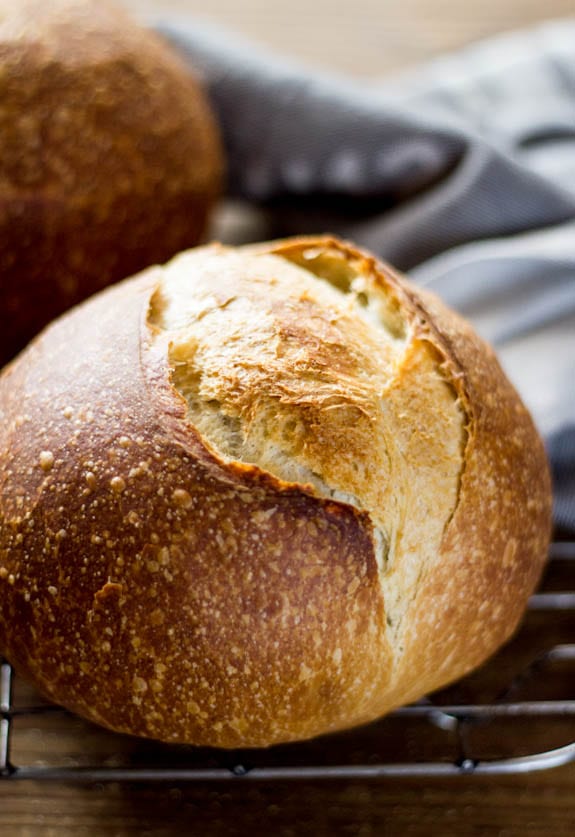
Think you can’t bake fresh, homemade sourdough bread? This easy sourdough bread recipe—trusted by beginner bakers for over a decade—shows you how, step-by-step. No yeast. No kneading. Just simple ingredients and 10 minutes hands on time for soft, crisp sourdough bread at home.
Reader review
“I have tried MULTIPLE sourdough bread recipes and this one has been the very first to make a successful (fully risen) loaf of bread. I am relatively new to sourdough and for some reason, the other recipes just didn’t produce good bread. These instructions and detailed explanations really make a huge difference to someone who is new to the world of sourdough.”
—Savannah
To anyone who thinks their sourdough bread isn’t good enough, I get it. Back in 2013, I set a goal: bake more bread. I tested, failed, succeeded (and tried again). What began with an easy no-knead artisan loaf eventually led to the holy grail: homemade sourdough bread.
Admittedly, I had beginner’s luck. My early scratch-made loaves were light, plump and airy, everything you want sourdough to be! And then? Down the rabbit hole I went: Hydration? Baker’s %? Proofing times?
Now, with 13+ years baking experience and a professional culinary background, I know what holds people back: the confusion, hesitation, comparison. I teach from a practical, straight forward perspective because sourdough is not just a written recipe; it’s an understanding.
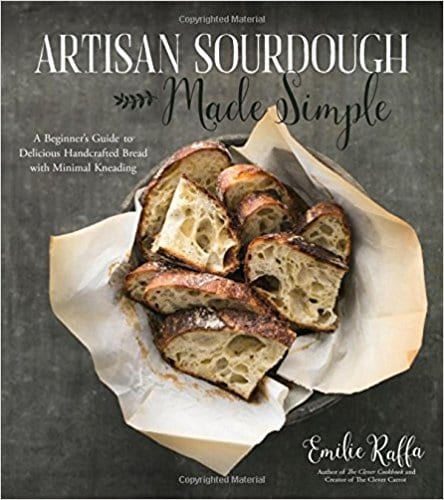
This sourdough bread recipe has been the most popular on my blog for over a decade, with millions of views. It also inspired my bestselling book Artisan Sourdough Made Simple (over 300,000 copies sold), a deeper dive into the world of sourdough bread recipes. So, if you’re at the end of your rope, and just want to make good bread, you’ve made it. Welcome to the journey.
What Sets My Recipe Apart:
- One bowl, 5 ingredients
- Olive oil = soft, plush crumb & crisp, golden crust
- No stand mixer
- No bread machine
- Flexible baker’s schedule
- Personalized support in the comments
But before we make bread, let’s discuss what drives it: your sourdough starter. Once you understand what it is, and how it works, your path will be crystal clear. Have questions? Ask in the comment section. I respond with personalized help.
Where To Get A Sourdough Starter
A sourdough starter is a live fermented culture of flour and water. It naturally leavens bread dough without commercial yeast. There are all different types: homemade, purchased or gifted (ask a fellow baker!). I use two different starters at home: one I made myself, and a vibrant Australian starter gifted from my friend Celia.
But is doesn’t stop there. Once your have your own sourdough starter, it must be kept alive and well with regular feedings to maintain its rising power. Sourdough is not static; it’s a living process. Here’s my personal feeding schedule which you can adapt to suit your style:
How To Feed Sourdough Starter
- Remove and discard half of your sourdough starter
- Feed what’s left in the jar with equal parts flour and water by weight (1:1:1 feeding ratio).
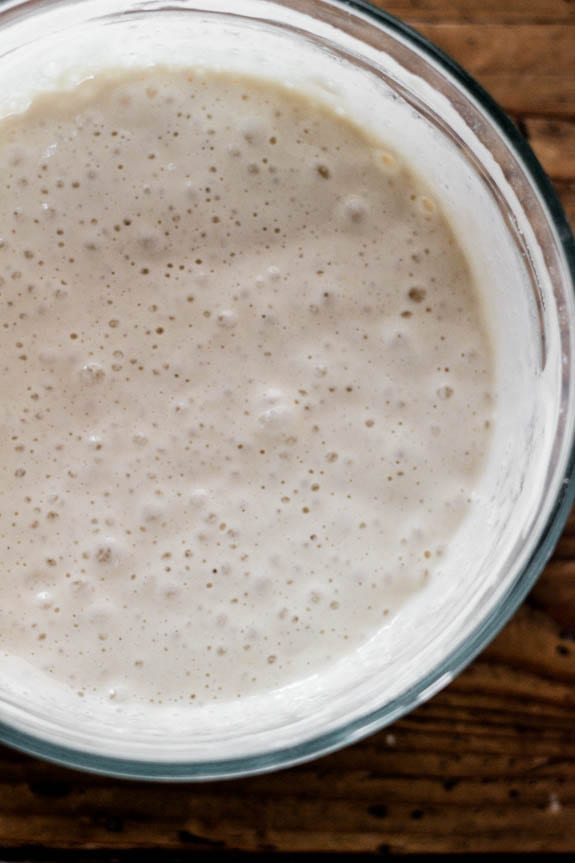
- Let rise at room temperature (loosely covered or airtight) ideally 75+F until bubbly, active and double in size (2-12 hrs). I use this sourdough starter jar.
Recommended Reading: Feeding Sourdough Starter: My Best Tips & Tricks
When Is Sourdough Starter Ready To Use?
Your fed starter is ready to use when it’s bubbly, active, and doubles in size. This can take 2-12 hours or more, depending on the temperature of your kitchen and the strength of your starter. My best advice? Be patient, plan ahead, and make sure your starter is in a warm place (ideally 75 F). The process is not instant.
Float Test: If you’re unsure whether your starter is ready, drop 1 tsp at peak height into a glass of water. If it floats to the top it’s ready to use. If it sinks, feed your starter again.
Storing Your Starter
Most people don’t realize that your feeding schedule is directly related to your baking preferences. If you only bake a few times a month, store your starter in the refrigerator and feed it once a week. If you bake often, store it at room temperature and feed it once a day.
How To Make Sourdough Bread: Step-By-Step Recipe
To Start: Feed your starter until it’s bubbly and active first (remember this can take anywhere from 2-12 hours, so plan ahead). Then mix the dough. Detailed instructions follow below. For a printable recipe & sample baking schedule, scroll to the end.
Step 1: Mix The Dough
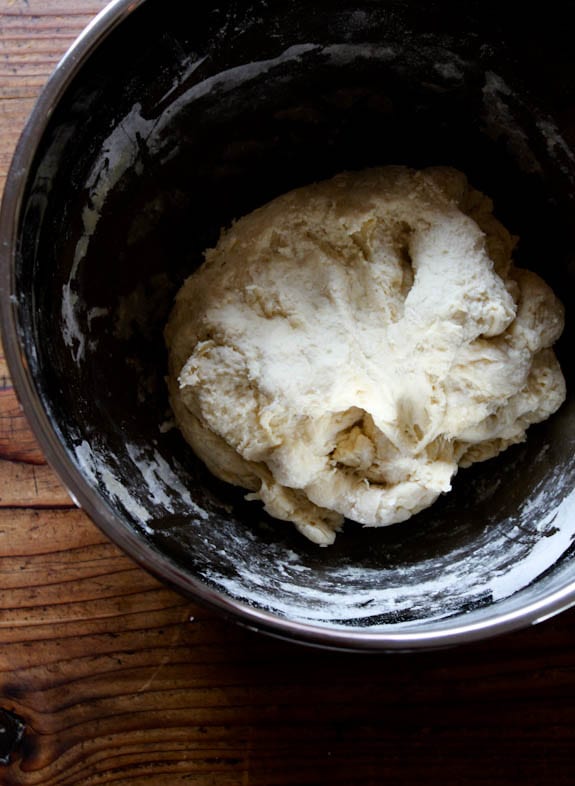
- Add water, sourdough starter, and olive oil to a large bowl. Whisk well to combine, making sure the starter is fully dissolved. Then add the bread flour and salt. Continue mixing (I use a fork at this point) until the flour is absorbed. The dough will feel rough and shaggy, which is normal.
- Cover the bowl and let rest (autolyse) for 30 minutes to 1 hour at room temperature. Then shape the dough into a rough ball. It doesn’t have to look perfect.
Tip: Weigh your ingredients with a digital kitchen scale. Measuring cups vary in size and don’t account for ingredient density which can lead to dry, dense, or overly sticky dough.
Why Autolyse Matters
Autolyse is the first rest after mixing bread dough. It jumpstarts gluten development without kneading, making the dough stronger, stretchier, and easier to shape I never skip it. For this recipe, rest for at least 30-45 minutes (or when time permits, I’ll do 1 hour for an even softer, more manageable dough). To learn more about common sourdough bread terms read my Sourdough Baking Glossary. I’ve included the only 12 you need to know!
A Note on Salt: Some bakers only add salt after autolyse, believing it slows down gluten development. I’ve followed that method for years, but now mix everything at once. It’s simpler, faster, and still makes excellent loaves (plus, you won’t forget to add the salt later on!). I’ll leave the choice up to you.
Want To Add Inclusions?
Mix in flavor additions after autolyse, when the dough is softer and more pliable. This is another reason not to skip the autolyse step. Alternatively, inclusions can be added during the first stretch and fold.
A few ideas:
- Roasted garlic
- Chopped olives
- Fresh or dried herbs (rosemary, thyme)
- Seed or nuts
- Cheese
- Dried fruit (raisins, cranberries)
- Jalapeños

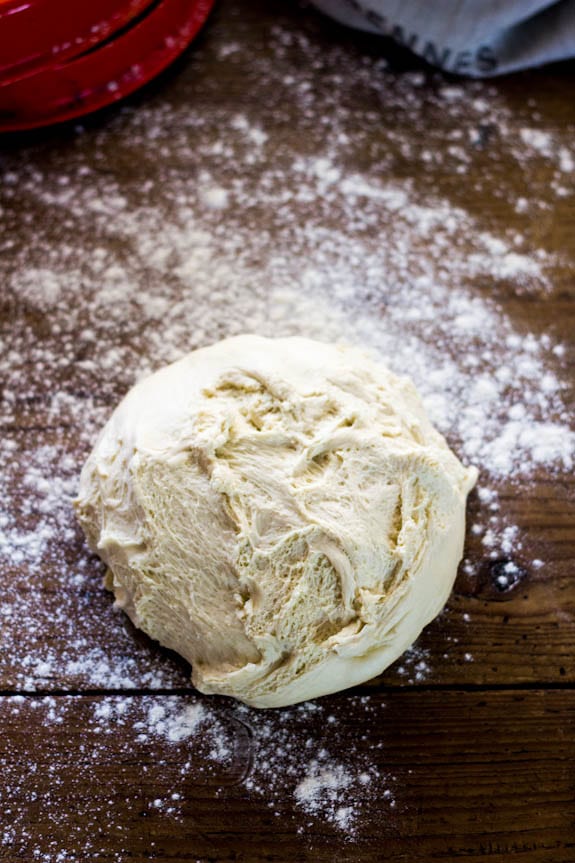
Step 2: Bulk Rise
Now the dough is ready to rise. Cover the bowl with lightly oiled plastic wrap so the dough doesn’t stick to the top, or transfer to a dough tub. Let rise at room temperature, about 68-70 F (20-21 C).
How Long Does It Take For Sourdough Bread To Rise?
The dough is ready when it’s puffy, slightly domed and nearly double in size. This can take 3-12 hours depending on room temperature, the quantity and strength of your sourdough starter, and seasonal conditions. All variables work together. See my example below:
For My Sourdough Bread Recipe (with ~150 g sourdough starter):
- In the summer: ~2-4 hours @ 80 F (26 C)
- In the winter: ~10-12 hours @ 68 F (20 C)
Diving Deeper: Temperature controls time. This is where I see the majority of beginner baker’s make mistakes- the temperature is overlooked. Sourdough takes longer to rise than yeasted bread, and it’s highly dependent on your specific environment. My kitchen might be 75 F. Yours? 68 F. Watch the dough, not the clock. For more details and troubleshooting read my companion article: Why Won’t My Sourdough Bread Rise?
Stretch And Fold The Dough (Optional Step)
About 30 minutes into the bulk rise, you can perform a series of “stretch & folds” to strengthen the bread dough. This step is not mandatory; however it has the potential to add height and structure to the finished loaf. Check out my how to stretch and fold sourdough guide to learn more, step-by-step. It’s easy and fun to do!

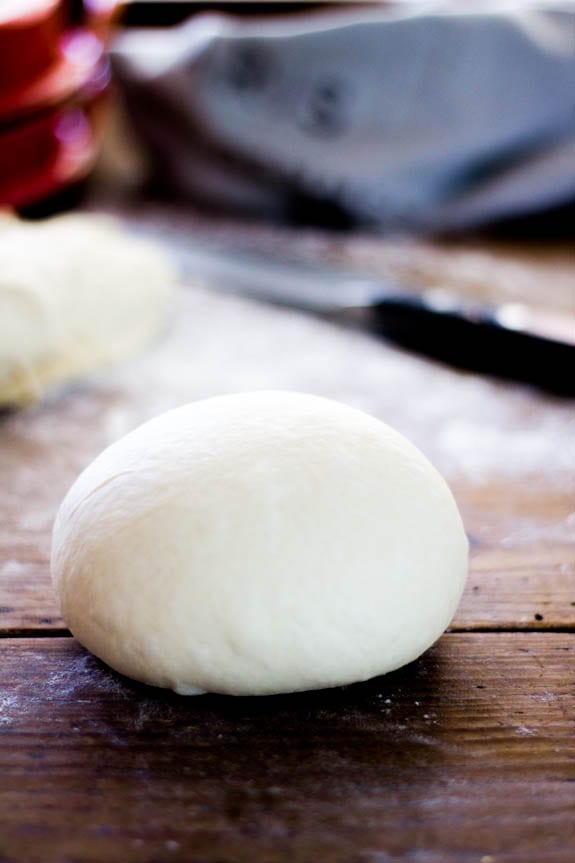
Step 3: Divide & Shape The Dough
At this stage, remove the dough onto a lightly floured surface. For two smaller loaves, divide the dough in half. For a single, standard size loaf leave it whole.
How To Shape A Round Sourdough Boule (Loaf)
Starting at the top of the dough, fold it over toward the center. Give it a slight turn, and then fold over the next section of dough. Repeat until you have come full circle to form a tight round. This creates surface tension for better oven spring. You can also try the envelope-style fold.
Tip: I used to get so nervous when shaping bread dough because you only had one chance to get it right. So intuitively, I would practice using a piece of Play-Doh or with a kitchen towel to go through the motions at my own pace.

Step 4: Choose The Right Baking Pot
If you want bakery-style results, bake sourdough bread in a Dutch oven. Why? Pots trap steam which is the secret to homemade sourdough with bold rise and golden crust. Without steam, the crust will set too fast casing the loaf to harden, split or bake unevenly. I’ve been there and it’s not pretty.
What If You Don’t Have A Dutch Oven?
You’ll need another oven-safe pot with a lid to create steam. It must be able to withstand up to 450 F/232 C (lid and handles included).
A few options:
- Enamel roasting pan with lid (or sheet pan to cover)
- Cast iron skillet with upside down roasting pan to cover
- Covered sandwich loaf pans
- Clay Baker or Romertopf (soaked first)
- Preheated baking stone w/ metal bowl to cover
Here’s what happened to me: I tried the “no pot” baking route in the past, using just about everything from pizza stones, to baking sheets with no luck! The crust always hardened too quickly. Then I tried various steaming methods to remedy this (e.g. ice cubes in a hot pan, spraying my loaves with water) but my personal oven could not retain enough moisture. The environment was always too dry. For me, using a Dutch oven was the only reliable solution that worked with consistent results.
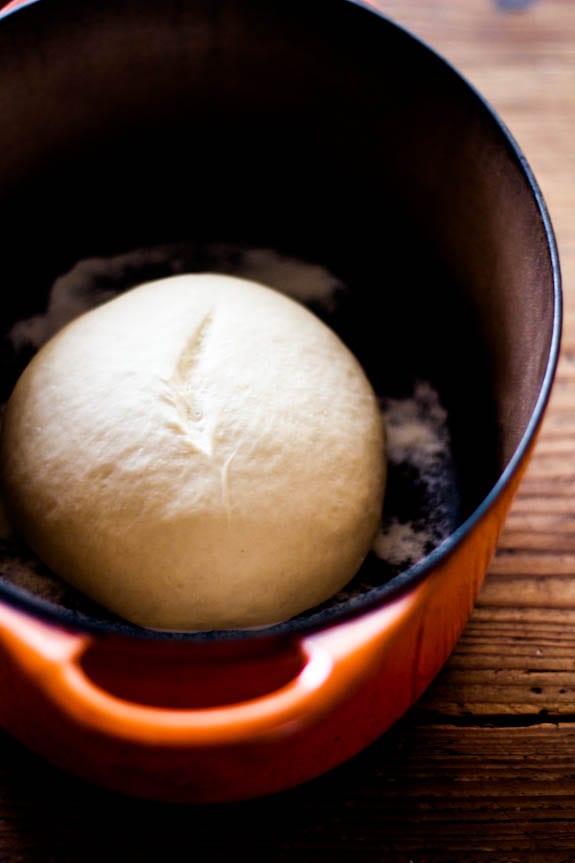
Step 5: Second Rise (Proofing)
- After shaping, your dough needs to rise again. To do so, generously dust the bottom of your Dutch oven with cornmeal, or line with non-stick parchment paper to prevent sticking. Gently place the dough inside (see tip below)
- Let the dough rise for 30 minutes to 1 hour, or until it’s visibly puffy and no longer feels dense. It doesn’t need to double in size. While the dough proofs, preheat your oven to 450 F (232 C).
Tip: Want better shape and structure? Proof the dough in a floured, cloth-lined, 8-inch bowl or banneton instead of directly in the Dutch oven. This will contain the dough and hold its shape without spreading. Bread flour or rice flour is fine for dusting.
Step 6: Score The Dough
- Right before the dough goes into the oven, make a shallow slash down the center of the dough, about 2-3 inches long. Use a small serrated knife, sharp knife or bread lame. This lets the steam escape, and allows the bread to “bloom” or expand in the oven.
- Admittedly, this step is a bit nerve racking, so I don’t want to gloss over it. Be quick and confident. I’ll share what my sourdough mentor told me: “Slash with panache!”
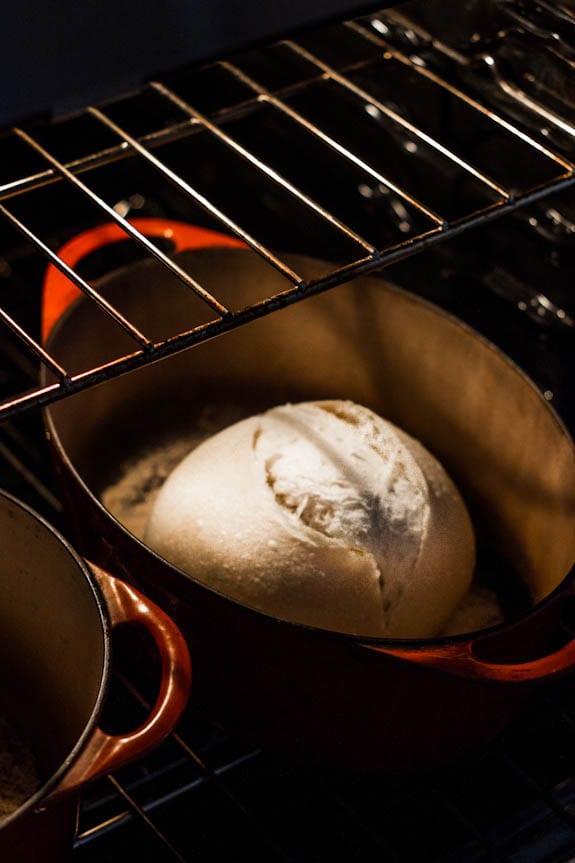
Step 7: Bake The Bread
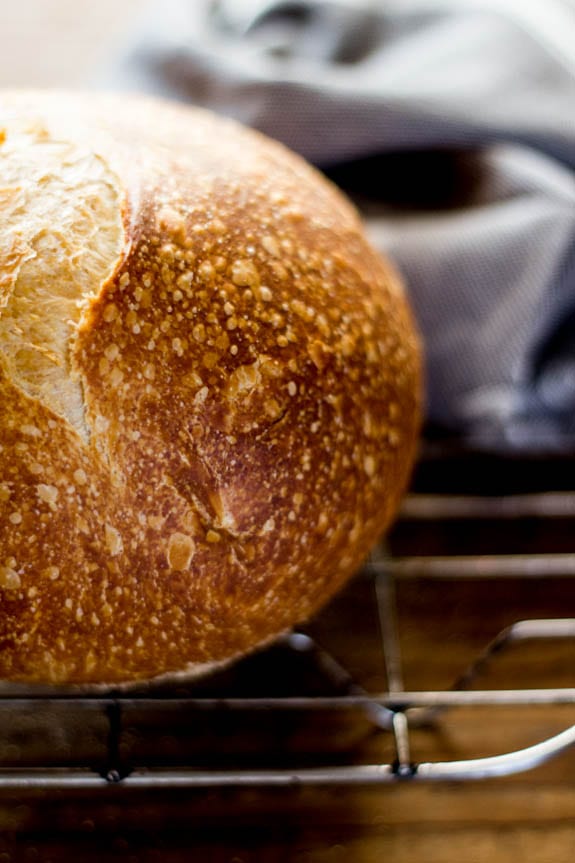
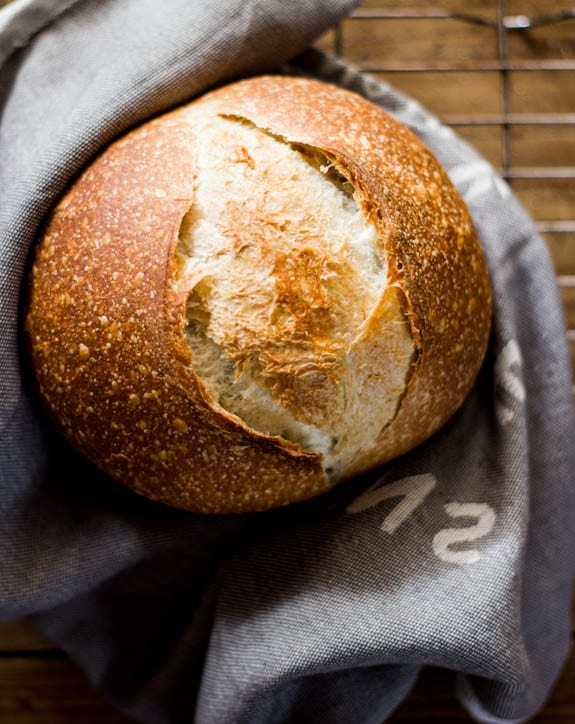
You’re at the finish line now! Bake on the center rack (lid on) for 20 minutes. Then remove the lid. Your bread will look pale and slightly shiny. Then finish baking (uncovered) for 40 minutes or until the crust is deep golden brown. The internal temperature should be 205-210 F/96-98 C.
Tip: During the last 10 minutes of baking, crack open the oven door to let the moisture out. This creates a crispier crust. Or, remove the bread from the hot Dutch oven and bake directly on the oven rack. The latter creates the crispiest finish.
Step 8: Cool & Slice
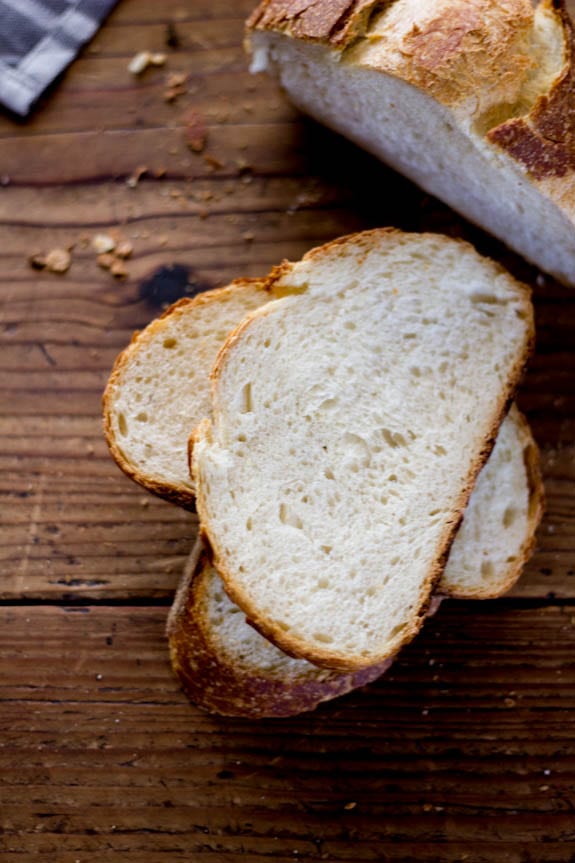
Cool the bread on a wire rack for at least 1 hour before slicing. Be patient! If you cut into it too soon, the texture will be damp and gummy. Life’s too short for sub par bread.
Final Thoughts
There are a gazillion sourdough bread recipes out there. No two loaves look alike. Start with this guide, master the basics and then branch out: try my golden sourdough focaccia recipe, this easy sourdough sandwich bread, or my one-bowl sourdough pancakes for breakfast! Once you have a few loaves under your belt, the process will become an imminent rhythm and you’ll become a sourdough pro in no time.
Sourdough Baking Schedule
- Friday Evening: Feed your starter, cover the jar, and leave it on the counter overnight. If you keep your starter in the fridge, it might need two feedings to perk back up (feed it in the morning & in the evening).
- Saturday Morning: Check your starter: if it’s alive and bubbling, you can make the dough to rise during the day. Or, feed it again in the afternoon to make the dough in the evening for an overnight rise. Remember to use the float test mentioned above to make sure your starter is ready to use.
- Saturday Morning/Evening (or whenever your starter is ready): Make the dough. Leave on the counter to bulk rise at room temperature. In the summer, if your dough rises quickly and you’re not ready to bake, cover the whole bowl with lightly oiled wrap and chill until ready to use.
- Sunday Morning: cut and shape the dough. Place in Dutch oven for second rise. Slash. Bake. Cool. Eat.
By signing up, you agree to receive emails from The Clever Carrot. Unsubscribe at any time.

Sourdough Bread Recipe for Beginners
- Prep Time: 13 hours
- Cook Time: 1 hour
- Total Time: 14 hours
- Yield: 1 loaf 1x
- Category: Sourdough Bread Recipes
- Method: Oven-Baked
- Cuisine: American
- Diet: Vegan
Description
New to sourdough? My easy beginner sourdough bread recipe makes the best artisan-style loaf at home with just 5 simple ingredients: bread flour, active sourdough starter, water, salt, and olive oil (my signature addition) known for creating a light, plush crumb and a crisp golden crust. Follow my clear, step-by-step instructions and video guidance to bake fresh sourdough bread with confidence (even on your first try!).
Ingredients
- 150g bubbly, active sourdough starter
- 250g warm water (see Note 2)
- 25g olive oil
- 500g bread flour (not all purpose flour)
- 10g fine sea salt
- fine ground cornmeal or non-stick parchment paper
Instructions
Make The Dough
In a large bowl, add the sourdough starter, water and olive oil. Mix with a fork to combine, then add the flour and salt. Continue mixing until the dough becomes stiff, then squish it together with your hands to incorporate all the flour. The dough will be rough and shaggy.
Cover the bowl with plastic wrap, reusable wrap, or very damp kitchen towel. Let rest (autolyse) for 30 minutes to 1 hour.
After resting, return to the bowl and work the dough into a rough ball, about 15 seconds.
Bulk Rise (First Rise or Bulk Fermentation)
Cover the bowl with lightly oiled plastic wrap. Alternatively, transfer the dough to a high-sided dough tub. Let it rise in a warm place, ideally 70-75 F. The dough is ready when it no longer looks dense and has almost doubled in size.
Note: The bulk rise time will be different for everyone. For example, in the summer, expect ~2-4 hours @ 80 F/ 26 C. In the winter, ~10-12 hours @ 68º F/ 20º C. Watch the dough and not the clock.
Optional Step: Stretch & Fold The Dough
During the bulk fermentation, you can do a series of ‘stretch & folds’ to strengthen the dough. Start 30-45 minutes in: lift a portion of the dough, stretch it upwards, and fold it over itself. Rotate the bowl ¼ turn and repeat until you’ve come full circle (1 set). Do 1-2 additional sets, spaced ~1 hour apart. Click here for a step-by-step video tutorial.
Note: Dough made with 250g water will feel stiffer; 300-325g water will be more stretchy and elastic. Let it rest longer in between sets if it resists stretching.
Shape The Dough
Remove the dough onto a lightly floured surface. Starting at the top, fold the dough over toward the center. Turn slightly, and then fold over the next section. Repeat until you have come full circle. Flip the dough over, seam side down. Gently cup the sides and rotate in a circular motion to tighten the shape. The goal is to build surface tension to create a tight ball (too much flour will cause the dough to slide around).
Second Rise
Now the dough needs to rise again. If you’ve used 250g water, you can do a free-form second rise in the Dutch oven (if not, see note below). Line the pot with a piece of parchment paper (this is what I do) or coat with cornmeal. Place the dough inside, cover and let rise for about 30 minutes to 1 hour. It’s ready when slightly puffy, but not double in size. Preheat your oven to 450 F/ 232 C.
Note: If your dough contains more than 250g water, skip the free-from rise. Your dough will spread. Instead, use a floured, cloth-lined, proofing basket to help hold its shape.
Score The Dough
Right before baking, make a shallow 2-3 inch slash (or longer) in the center of the dough using a bread lame, razor blade, or small sharp knife. The cut should be ~1/4-inch deep.
Bake The Dough
Place the bread in the oven on the center rack (lid on) and reduce the temperature to 400 F/ 204 C. Bake for 20 minutes, then remove the lid, and continue to bake (uncovered) for an another 40 minutes, until deep, golden brown. All ovens are different; feel free to make minimal adjustments to these temperatures.
Check for doneness with a digital thermometer: 205-210 F/ 96-98 C for sourdough.
Remove the bread from the hot Dutch oven, and cool on a wire rack for at least an hour before slicing.
Notes
- Weigh your ingredients with a digital scale for best results
- For a more soft and pliable dough, increase the water up to 300 g- 325 g total. Use a floured, cloth-lined bowl or proofing basket (instead of the Dutch oven) for the second rise.
- You will need a 5 1/2 or 6 quart Dutch oven for baking
- This recipe was tested with King Arthur Bread Flour, Gold Medal Bread Flour, Pillsbury Bread Flour


Comments
Louise Gallant says
Hi there! The best recipe I have used so far for delicious sourdough bread! Do you have the nutritional information for this recipe? Thanks so much! 😊
Oli says
My bread keeps coming out more dense like sandwich bread. Personally I think it’s undercooked as well but my boyfriend says it’s fine. I’m so confused as to why I can’t just get it right when it comes to sourdough.
Nikki says
Hi your recipe and instructions are amazing but I wanted to ask what temperature the warm water should be it says see Note 2 but I can’t seem to find it! Sorry if I have missed it! Wanted to check before I go ahead with recipe! So excited to try this all thanks to your inspirational recipe and info!
Emilie Raffa says
Hi Nikki! Thank you! For warm water, 85-90 F (give or take) is fine to use. This will give the dough a nice boost, especially if it’s cold by you. Enjoy!
Carrie says
Found you and not giving up!! Made my second loaf today, and waiting impatiently for it to cool. The first one was so yummy but not as airy inside as I’d like. Hoping this one will be better!
Emilie Raffa says
Hi Carrie! Don’t give up! Sourdough is 100% practice, patience and persistence. You will get it. PS: light and airy loaves boil down to adequate gluten development and proper fermentation in relation to the recipe/method. Most new bakers rush these steps (not their fault – timing can be tricky). Just an fyi as you continue to experiment!
Maya says
Hello!
Is this recipe okay to use for high altitude? Or would I need to make some adjustments to the quantities? I’ve used this recipe for years. The taste is always amazing, but the finished loaves are not big.
Thank you!
Emilie Raffa says
Hi Maya! Great question. So, this is not my area of expertise. I could give you a general textbook answer, but without me testing this recipe in real-life at a higher altitude, I don’t have exact specifics for you.
With that said: if you’ve had previous success with this recipe, you also have a good baseline for what the dough and loaf should look and feel like. This is good. You might consider decreasing the total water quantity to start, and then observe how fast/slow the dough rises. Then, you’ll have a better idea if you’re under or over fermenting the dough, which will ultimately provide more data about the final size of the baked bread. Hope this helps! Keep me posted!
Kelly says
Hi Emily
My starter won’t stay in a doubled volume. It smells fruity and has bubbles and it has doubled as it has left a mark around the jar , but it doesn’t stay risen. I fed it again but still no luck. I’m assuming it’s not warm enough to maintain the rise. Is there anyway around this
Kelly
Emilie Raffa says
Hi Kelly! Your starter will never stay fully doubled. Once it has consumed its food supply (flour and water) it wall fall back down. The next time you feed it, it will rise again. The cycling back and forth – the rise and fall – is an expected part of the process. Your job is to use your sourdough starter when it’s at peak height (doubled). If you are feeding your starter at a 1:1:1 ratio, it will stay at peak height for 1-2 hours. This is your window for timing.
PS: based on what you’re telling me, my sense is that your starter is active and you have working knowledge of how temperature affects the rise. This is good! While warmth is needed to boost fermentation, ideally 75 F or so, this doesn’t necessarily mean it will maintain the rise. Feeding your starter at a higher ratio, for example 1:2:2 or 1:3:3, will maintain the rise (2-3 hour window). However, there is a drawback: these feeding ratios take anywhere from 6-10 hrs to reach peak height in the first place.
Kieran says
This is my 9th or 10th try at this point and I was breaking down because all my loaves were coming out flat. I thought I just wasn’t meant to make sourdough and I gave this recipe a try as a last ditch effort. It worked!! I have a beautiful loaf of bread and I’m not going to give up. THANK YOU!!
Emilie Raffa says
This is so good Kieran! Thanks so much for telling me! I’m curious – what is it about this dough or loaf in general that you found easier to work with?
Matthew says
This recipe helped get me out of bed in the mornings i wanted to make sourdough for the longest time but its hard to stand much longer than 30minutes at a time and being able to rest for long periods of time while baking has been great, taking care of my sourdough starter has helped get me up out of bed
Emilie Raffa says
This is wonderful and encouraging to hear, Matthew! Thank you 🙏🏻
Stacy George says
Hi! It doesn’t sound like it’s necessary to put your dough in the fridge overnight…or am I missing something?!
Thanks!
Emilie Raffa says
Hi Stacy! Correct. It’s not necessary to cold proof your dough overnight once it’s shaped. It’s a popular method, as baker’s can simply bake the dough in the morning, but it’s not a hard and fast rule. Same day second rise/proof is 100% fine.
Maree O'Neill says
What do you do to the remaining starter after making a loaf of bread?
Emilie Raffa says
Hi Maree! You reserve what’s left in the jar to keep the feeding cycle going. In general, you don’t use your entire jar of starter when making bread dough. You only use a portion of it so you have enough leftover to feed for next time.
Liesl Coates says
Hi Emilie,
It’s been years since I checked in, but I want to give some updates. Your post and Sourdough book is what got me started (2020- but not realizing that everyone else was also doing it!), and although I haven’t been able to do it even a fraction as much as I want- again and again I still come back to the High-Hydration loaf. The directions and tips are still the best out there! Here’s the news that I want to share: my son (who’s grown and lives in Orange County- too far away!) has followed in my footsteps with a passion for cooking, and most recently, baking. He told me casually one day that someone gave him a starter, and he tried making bread. Guess whose website he found?! Right! By complete coincidence, he found the “Beginners-Guide,” the same one “Mom” began with! I gave him the cookbook and he’s been making all sorts of things, including bagels- which is still on my bucket list! Thanks, Emilie, for doing such great work!!! (I also love your food recipes).
Emilie Raffa says
Hi Liesl! It’s great to hear from you! 🥰 I literally got chills reading this. That’s so wild. Stories like yours make my day, make me smile (big), and truly – no matter how cliché it sounds – continue to inspire what I do! So thank you for taking the time to reach out. Sourdough has a brilliant way of keeping us all connected.
Mae says
My go to recipe! Easy to follow and always perfect.
Devan says
I started with 250g water but I was using a whole wheat levain and substituted 90g of the bread flour for whole wheat because I ran out and found the dough to be way too dry and stiff upon mixing and the first 1hr rest. During the stretch and folds I added some water but I’m wondering if it needs to bulk ferment for the 2 to 12hrs AFTER the stretch and folds? My kitchen is 20C even though it’s summer and the stretch and folds have been over a couple hours, so I’m thinking it’ll be 10h at room temp to ferment? Is that right?
Emilie Raffa says
Hi Devan! Whole wheat flour is much thirstier than bread flour, so yes: when paired with only 250g of water, the dough will be naturally stiff. I’m glad you did the 1 hour rest and included more water to create a softer, more pliable dough. Stretch and folds happen during the bulk rise. So, with regards to timing: the clock has already started! Here’s what I want to point out, specific to your situation: your kitchen is cold (20C) and you’ve added whole wheat flour which speeds up fermentation (it’s higher in natural enzymes). Based on this, I can’t tell you your exact rise time. But I’d check your dough at the 5-6 hr mark the get a baseline for what it’s doing. How did it come out?!
Devan says
Thank you! I didn’t realize it ferments faster with whole wheat but regardless I took the cautious approach and put it in the fridge overnight then removed it and baked it at 1pm the next day. I think it definitely was underproofed either due to my bad timing or a weak starter so next time I’m going to start the process overnight for the starter and try to not cold proof it. It did turn out delicious, just a bit tough.
Marci says
Apologies if this was already asked- I wish there was a way to search the comments. If I want to bake dough the next day and do an overnight rise. At what point in recipe would it be good to do that? Thanks!
Emilie Raffa says
Hi Marci! I wish there was a way too 🥰 To clarify, are you referring to mixing the (bulk) dough in the evening, letting it rise overnight, and then shaping & baking it in the morning? Or are you looking to do a cold proof (second rise) overnight in the fridge to bake the next day?
Marci says
Referring to the bulk (first) rise overnight, but would be good to know if I could do at second rise as well. Thank you!
Kimberly says
I baked this bread today and it turned out beautifully and tastes amazingly delicious! I used 250g water. I did several minutes of kneading after the fermentolyse. I did 4 sets of stretch & folds and coil folds. I let the dough rise by about 50% in a Cambro container–very handy to monitor rising. I shaped and transferred to a floured banneton and placed in refrigerator overnight. In the morning I transferred the dough onto parchment paper and transferred to my Dutch oven. I put the cold dough and Dutch oven into my preheated oven. I added some rice under the parchment and a few ice cubes for steam. I am so happy with my results! The lower hydration dough with the added oil is so much easier to work with. It was easier to score too, since it kept its shape instead of collapsing. (I also think I was overproofing my dough on previous tries.) I think I may have found the perfect recipe!
Emilie Raffa says
Kimberly, this is excellent! It sounds like you’ve found your way! Thank you for sharing all your personal experience with us. And yes: low-hydration doughs are the way to go due to how easy they are to handle and shape compared to wet and stretchy loaves. I’ve found they are a bit stronger too, which helps to prevent spreading when you’re about to score – I still get nervous at that part! 🥰