Let’s bake my easy sourdough focaccia recipe, step-by-step. No kneading, no shaping, no Dutch oven. Just golden crisp edges, a light airy crumb, and a simple overnight rise naturally leavened with active starter. Adapted from my bestselling book Artisan Sourdough Made Simple.
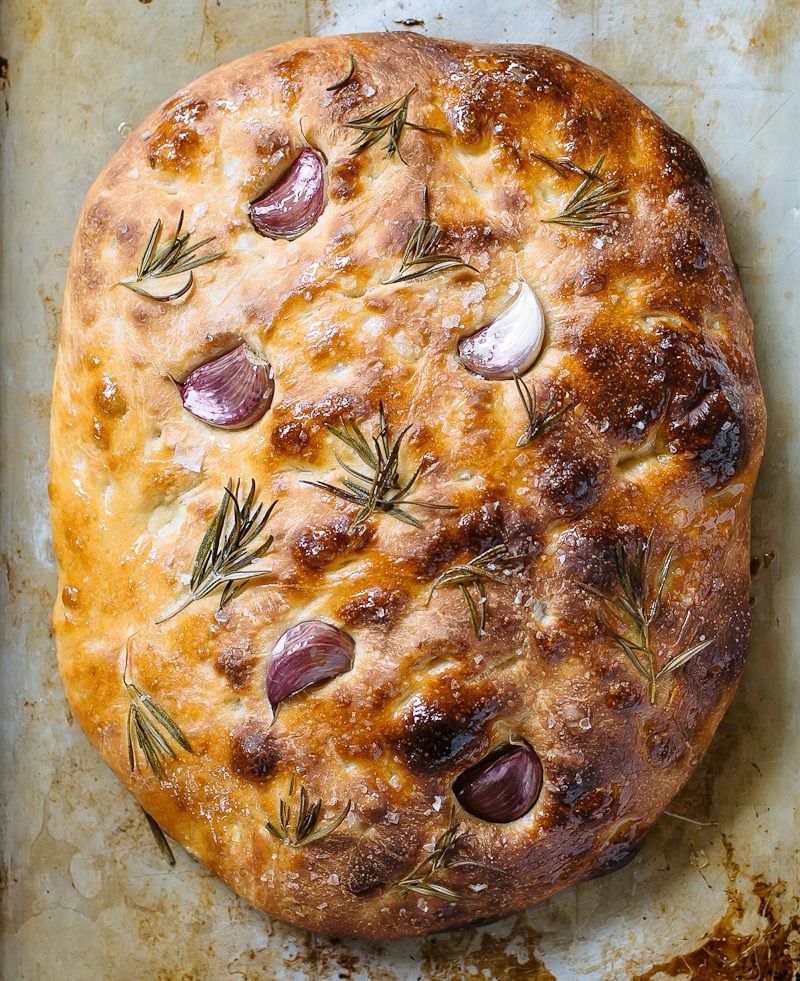
If you’re new to sourdough bread and want an easy, no-knead recipe to expand your repertoire, my sourdough focaccia is you next move. Crisp edges, soft center and perfect, tangy flavor.
Adapted from my book Artisan Sourdough Made Simple, I often recommend this recipe to beginners- there’s no kneading, no scoring, no Dutch oven. Just a handful of ingredients, a bread pan (or not) and some hands off time to let the dough rise. You can start right now.
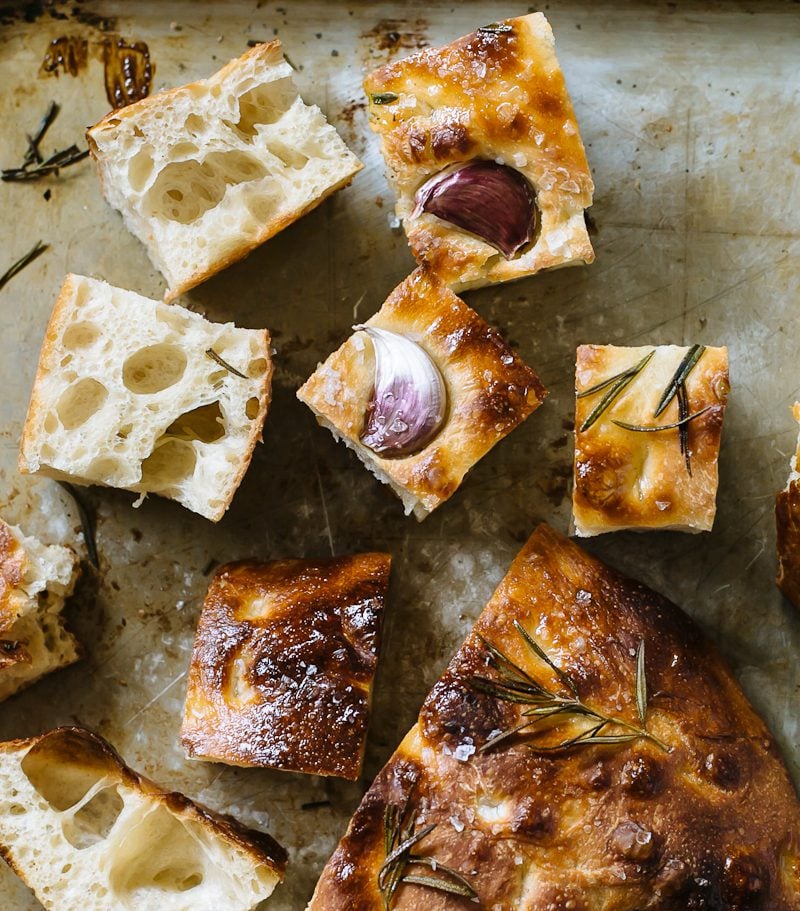
At home, I make sourdough focaccia at least once a week to serve alongside cozy soups and sourdough pasta dishes. Leftovers become golden homemade croutons, fluffy breadcrumbs or sourdough pizza crust (more sourdough bread recipes here). That aside, poking soft, squishy focaccia dough is wildly therapeutic! Let’s make it together, step-by-step.
How To Get A Sourdough Starter For this Recipe
A sourdough bread recipe of any kind cannot be made without a sourdough starter.
You have two options: make one from scratch (see my beginner sourdough starter recipe), buy one online or get some from a fellow baker. Even bakeries sell starters. If you already have one, and need assistance for ongoing care, read my companion articles, Feeding Sourdough: My Best Tips & Tricks and Troubleshooting Sourdough Starter.
My Sourdough Focaccia Tips
Tip #1: Plan ahead. Feed your starter a few days in advance prior to making the focaccia dough. This will ensure a vibrant starter that’s strong enough to make the dough rise.
Tip #2: Use regular olive oil (no extra virgin). It has a higher smoke point and is less likely to burn the top and bottom of your focaccia.
Tip #3: Pick the right pan. Sourdough focaccia can be baked on a regular rimmed sheet pan or a rectangular metal pan (e.g. brownie pan). If using the latter option, I suggest this non-stick pan by Lloyds which I’ve been using for years. It’s truly non-stick and makes the crispiest crust!
How to Make Sourdough Focaccia {Step-By-Step Recipe}
Step 1: Make The Dough
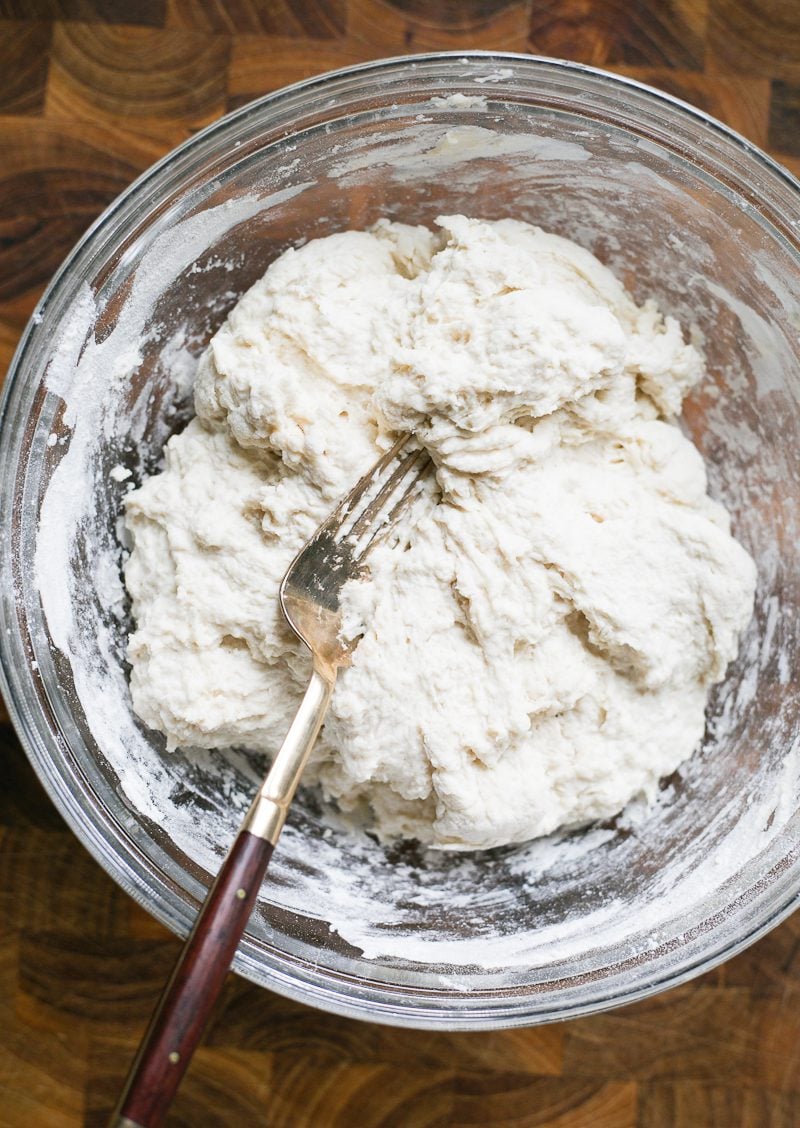
In the evening: whisk the sourdough starter, water and honey together in a large bowl (I use a fork for mixing). Add the flour and salt. Mix to combine and then finish by hand to form a rough dough. It will be wet and sticky.
Cover and let rest for 30 minutes to 1 hour. Timing is flexible here. Then work the dough into a ball. Again, it will be sticky!
When finished, transfer the dough to a lightly oiled dough container or just keep it in the same mixing bowl. It’s up to you. The next step is to let the dough rise.
Step 2: Bulk Rise (Overnight)
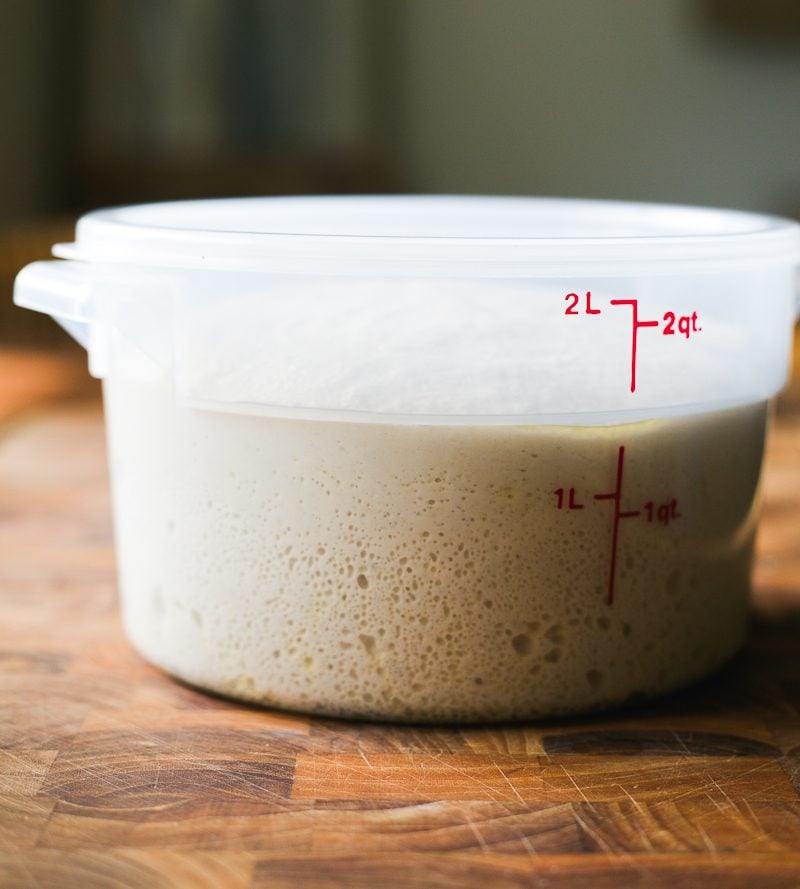
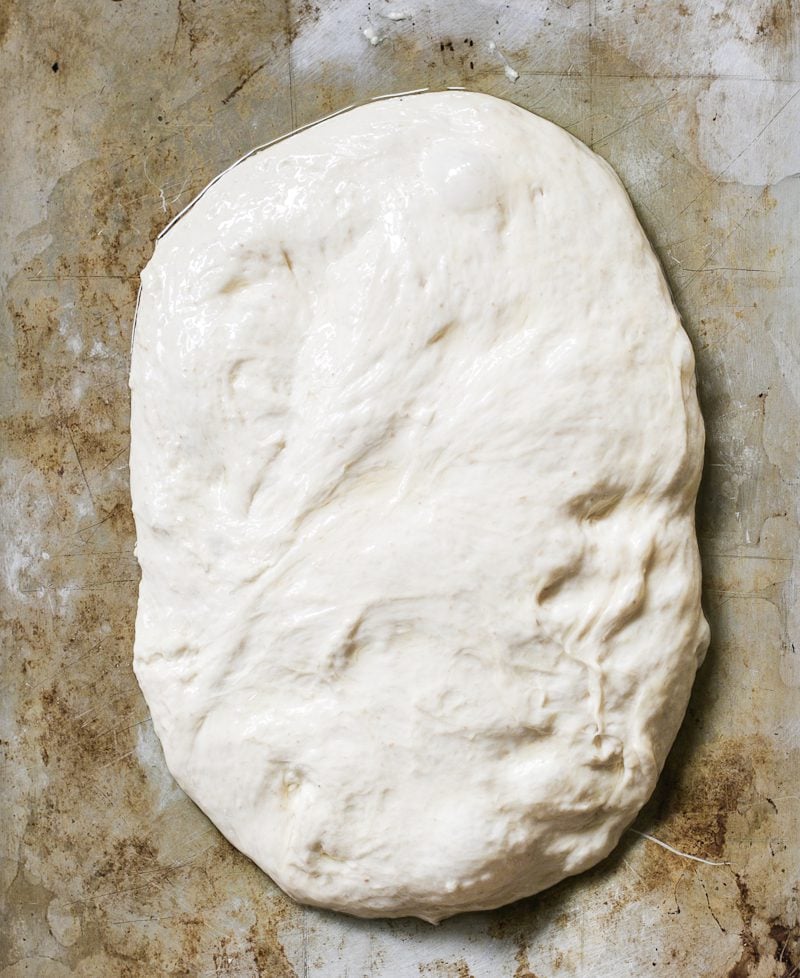
Rest the dough at room temperature and let rise overnight on your countertop. For focaccia, the dough should double or triple in size. This will take approximately 12+ hrs @ 68 F (20C).
Note: the warmer the temperature, the faster the dough will rise. So for example, if your current room temperature is 80 F (27 C), the 12+ rise time mentioned above would not apply to your specific environment. Not even close. The rise time would be shorter, say 3-4 hrs. Watch the dough, not the clock!
Diving Deeper: Why Won’t My Sourdough Bread Rise?
Step 3: Second Rise (In The Pan)
In the morning: oil a rimmed sheet pan. I use my hands to evenly coat the bottom and sides. Then place the dough onto the pan and flip it over to coat both sides. You do not need to pull or stretch the dough to fit the pan. The dough needs to relax first, which happens naturally in the next step.
Cover the dough (I use an inverted sheet pan instead of wrap. It doesn’t touch the dough). Let rest for 1 1/2 to 2 hours or until puffy. Preheat your oven to 425 F (220 C).
Note: I like to rest my dough in a warm spot, usually on top of the oven while it preheats. The dough becomes more soft and bubbly.
Tip: Instead of a sheet pan, you can bake sourdough focaccia in a non-stick rectangular pan instead (9 x 13- inch or 10 x 14-inch).
Step 4: Assemble The Focaccia
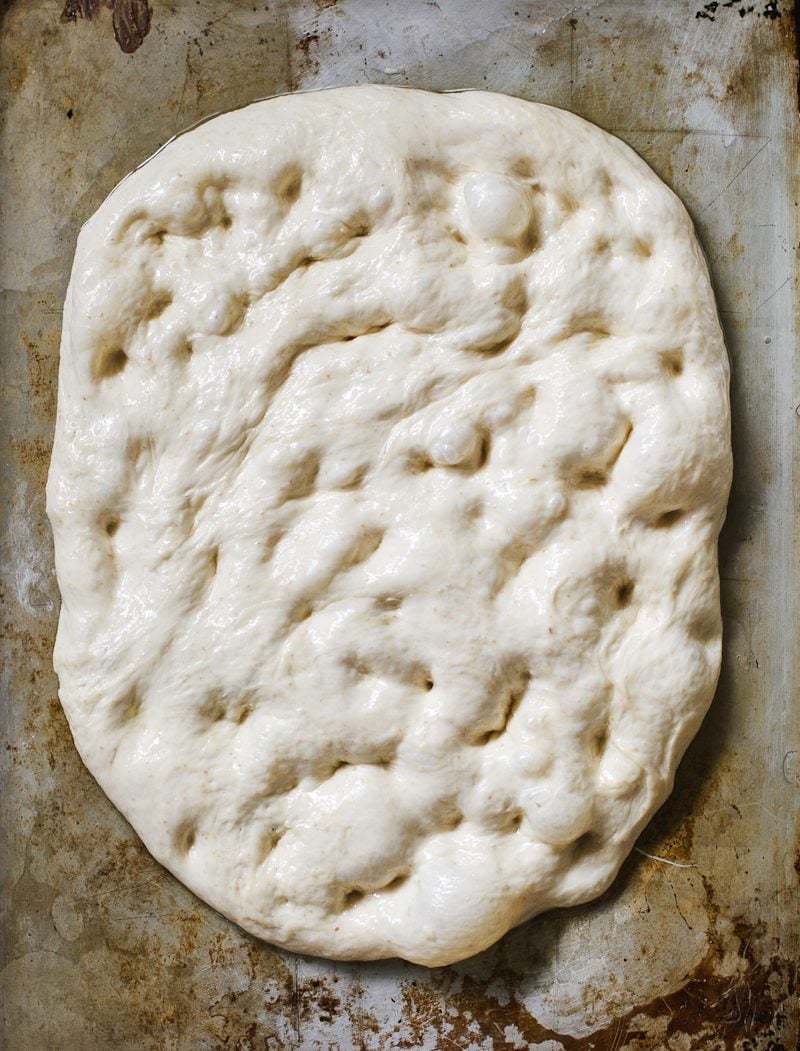
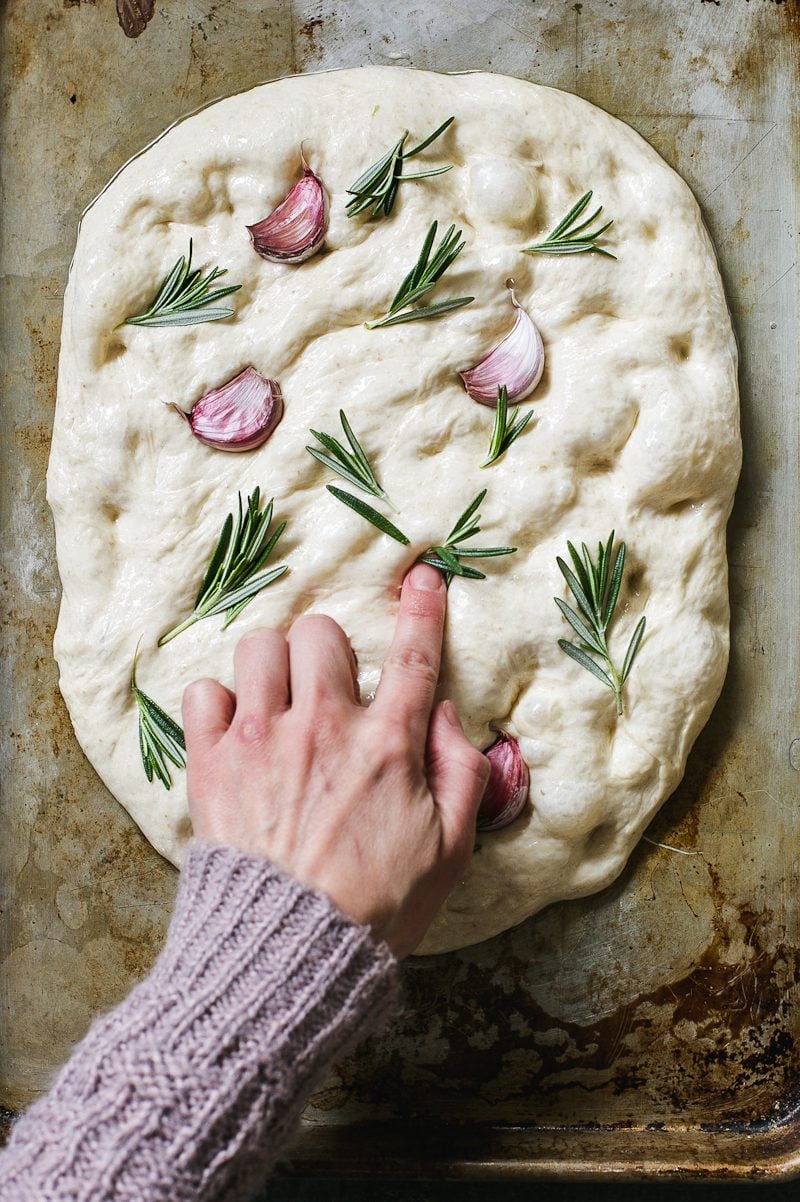
Right before baking, gently dimple the dough with oiled fingertips. As you dimple, the dough will naturally begin to stretch outward. Continue (gently!) until you’ve created a rustic rectangular or oval shape. The dough won’t go all the way to the corners and sides of the sheet pan, which is fine.
If using toppings, press them into the dough. As the dough rises it will puff up, so the toppings need to be well anchored. Press down deeper than you’d think. Otherwise they will pop out!
Step 5: Bake The Focaccia
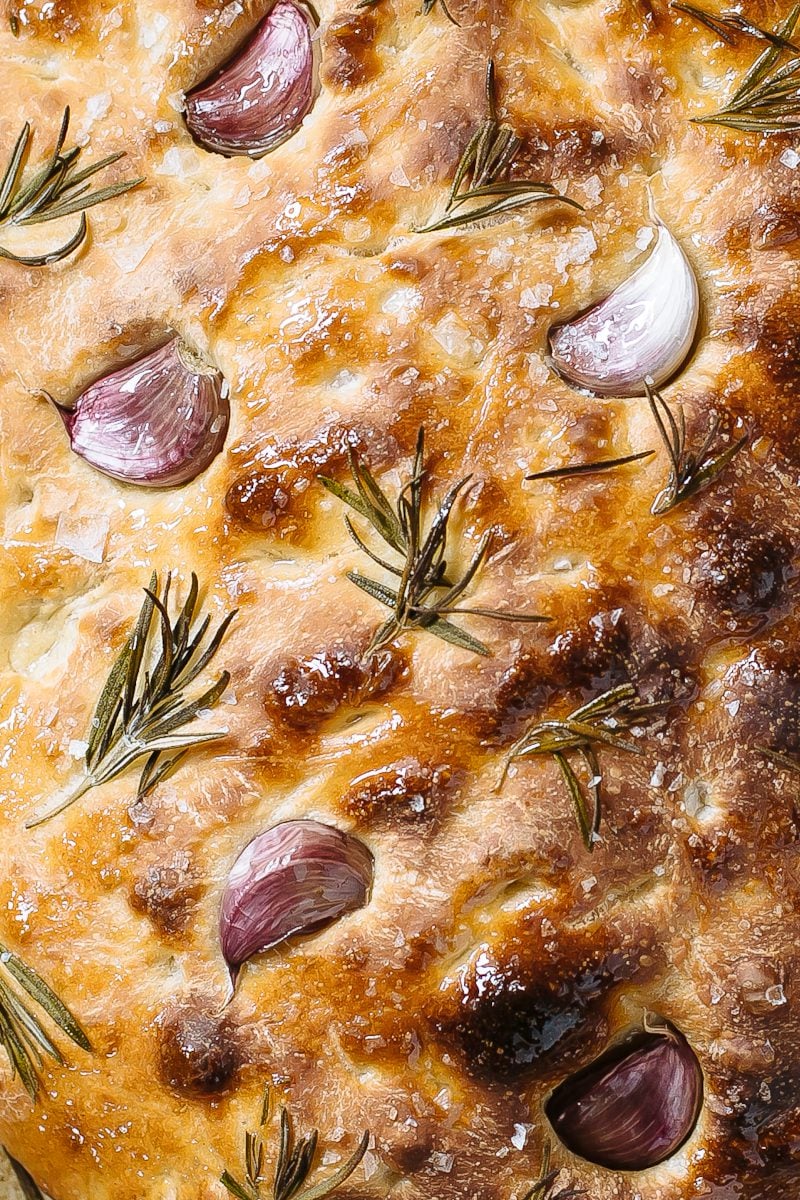
In the oven, set the dough on the center rack. Bake the focaccia for 25-30 minutes or until golden brown. Remove and cool on a wire rack so the underside does not steam for at least 30 minutes. Cut into wedges or squares, and serve warm with dipping oil, if preferred. Delicious!
How to Par-Bake Sourdough Focaccia
Want to prep ahead and bake later? Par-baking is a game changer for serving fresh, warm bread at dinnertime. And it’s perfect for stress free entertaining. Here’s how:
- Bake for 15-18 minutes at 425 F (220 C). The crust should be set but pale, with a golden bottom.
- Cool completely on a wire rack to prevent the underside from steaming.
- Wrap and store at room temperature for up to 6 hours.
- Finish baking in the pan for 12-15 minutes, until golden and crisp.
Sample Sourdough Baking Schedules
The key to sourdough is timing. Here are 2 sample baking schedules to follow and adapt according to season. In my experience, the overnight method is best in cooler temperatures (the dough can survive a long rise without becoming over proofed in the morning). The daytime method is best in warmer temperatures when the dough rises faster. As a rule of thumb, temperature controls time and ultimately: your baking schedule.
Fall/Winter (overnight method)
- 4-6:00 PM: Feed starter
- 8:00 PM: Make the dough
- 8:30 PM: Let rise overnight (bulk rise)
- 8:30 AM (the next day): Inspect the dough. Does it need more time to rise? If so, give it more time, otherwise continue on.
- 9:00-11 AM: Second Rise
- 11:30 AM: Par-bake or Bake.
Spring/Summer (daytime method)
- 8 AM: Feed starter
- 10 AM: Make the dough
- 10:30 AM: Let rise during the day (bulk rise)
- 3:00 PM (onwards): Second rise
- 5:00 PM: Par-bake or Bake
What To Bake Next?
If you haven’t tried it yet, have a go at my beginner sourdough bread recipe for a golden, crackly loaf with a plush interior crumb, my glossy, NY-style sourdough bagels and the highly popular: soft and gooey sourdough cinnamon rolls that you’ll need a hundred napkins for.
By signing up, you agree to receive emails from The Clever Carrot. Unsubscribe at any time.
Beginner’s Guide To Sourdough Focaccia Bread
- Prep Time: 15 hours
- Cook Time: 30 minutes
- Total Time: 15 hours 30 minutes
- Yield: 1 large focaccia 1x
- Category: Sourdough Bread Recipes
- Method: Oven-Baked
- Cuisine: American
- Diet: Vegetarian
Description
Master the best easy sourdough focaccia bread—soft, fluffy, and naturally leavened with bubbly, active sourdough starter. This step-by-step recipe includes an overnight rise, no kneading, and simple tips for par-baking the dough. Adapted from my bestselling book Artisan Sourdough Made Simple.
Ingredients
- 50–75 g bubbly, active sourdough starter
- 375 g water (see Notes below)
- 20 g honey (optional)
- 500 g bread flour or all purpose flour (see Notes below)
- 9 g fine sea salt
- 2–3 tbsp olive oil, for coating the pan
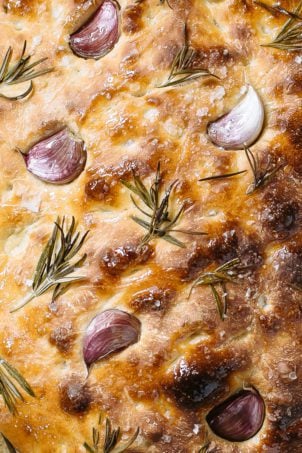
- Assorted Toppings (optional): rosemary, garlic cloves, flaky seat salt, tomatoes, olives etc.
Notes:
- Thoughts on Flour: You can use bread flour or all purpose flour to make sourdough focaccia. Comparatively speaking, bread flour yields a slightly chewier focaccia with a higher rise. All purpose flour creates a more tender focaccia. The choice is up to you. If you prefer to use all purpose flour, I do recommend King Arthur brand. Coming in at over 11.7% protein, this flour is stronger than most all purpose flours, which means it can handle a higher quantity of water without the dough becoming a gloppy mess. It’s actually stronger than most bread flours! If you cannot access this flour, make the following changes to ensure success: decrease the water to 325-350 g (start small and work your way up) OR use King Arthur bread flour with 375 g water instead.
- Thoughts on Sourdough Starter (quantity): When the weather is cold, I’ll use a higher amount of starter to give the dough a boost when doing a long, overnight rise. I’ve given you a range so you can decide what suits you best.
- For Baking: You will need a rimmed sheet pan or non-stick rectangular pan (9×13-inch or 10×14-inch)
Instructions
Before you begin: decide when you want to make the dough. The instructions (below) outline a long, overnight rise @ 68-70 F (20-21 C) Alternatively, you can rise the dough during the day. Please refer to the sample schedules in the post above and choose what suits your needs.
- Make the Dough: In the evening: whisk the sourdough starter, water and honey together in a large bowl (I use a fork for mixing). Add the flour and salt. Mix to combine and then finish by hand to form a rough dough. It will be wet and sticky. Cover and let rest for 30 minutes to an hour. Timing is flexible here. Then return to the bowl and work the dough into a ball.
- Bulk Rise: Cover the bowl of dough with lightly oiled plastic wrap (or transfer the dough to a lightly oiled dough container). Let the dough rise overnight at room temperature, approximately 68-70 F (20-21 C) for about 12+ hours. The dough will double in size (or more) when ready. Note: if the weather is warmer than 68- 70 F (20-21 C) the dough will rise faster than 12+ hrs. Please adjust your timeframes accordingly.
- Second Rise: In the morning, pour 2 tbsp. of olive oil onto a rimmed sheet pan (or 1 tbsp. olive oil if using a non-stick rectangular pan). Use your hands to evenly coat the bottom and sides. With your oiled hands, remove the dough onto the pan, and then flip it to coat both sides. Cover and let rest for 1 1/2- 2 hours or until very puffy (I use an inverted sheet pan to cover the dough). Preheat your oven to 425 F (220 C). Note: I like to rest my dough in a warm spot, usually on top of the oven while it preheats. The dough becomes soft and bubbly.
- Assemble the Focaccia: Right before baking, gently dimple the dough with oiled fingertips. I start at the bottom of the pan and work my way to the top. As you dimple, the dough will naturally begin to stretch outwards. You should end up with a rustic rectangular or oval shape, about 14 x 9-inches (36 x 23 cm) or larger. The dough won’t go all the way to the corners and sides of the sheet pan- this is OK. Note: If using a rectangular pan, the dough will naturally fill the shape of the pan.
- Add Focaccia Toppings (optional): Press your preferred toppings into the dough. As the focaccia rises, the dough will puff up. The toppings will pop out if not properly anchored. If using garlic, I keep the cloves wrapped in their papery peels to prevent burning. Remove and discard the peels before eating.
- Bake the Focaccia: Place the dough onto the center rack. Bake for 25-30 minutes or until crisp and golden brown. Remove from the oven and cool on a wire rack before cutting. TIP: To par-bake focaccia dough: Bake for approximately 15-18 minutes @ 425 F (220 C). The crust will be set, very pale in color and golden underneath. Remove the focaccia from the pan and cool on a wire rack. Once completely cool, wrap in plastic wrap and store at room temperature for up to 6 hrs. To finish, return to the pan and bake for 12-15 minutes.
- To serve, cut the focaccia into wedges or squares and enjoy warm!


Comments
c says
is there anyway to make foccacia without oil? we don’t use any oils. i have non stick pans, silicone and parchment paper to keep from sticking- but is the oil still necessary?
Emilie Raffa says
Hi there! Yes, you can make focaccia without oil. It won’t be as golden and crispy, especially underneath, but it can be done. Make sure to line your pan with non-stick parchment paper so the focaccia dough doesn’t stick – otherwise you won’t be able to get it off the pan! I haven’t tested this dough on a non-stick pan, so if you experiment, I’d be curious to know.
Stephanie says
It’s August in Ohio, so my kitchen was too warm for an overnight rise. Instead, I mixed the dough and let it sit at room temp for an hour with one set of stretch and folds after 30 mins, then I tucked it in the fridge overnight. The next afternoon, I pulled the dough out and proceeded with the recipe as instructed from there, though the second rise ended up taking closer to 4 hours, which is to be expected. This modification worked out very well. I topped the dough with flaky sea salt, and to half I added halved homegrown cherry tomatoes and fresh rosemary–excellent! Thanks for a simple and tasty recipe! Will definitely be making again.
Kristina says
Thanks for sharing that information. I live in Spain and my kitchen is unbearable at the moment. I will give a try!
StartingFresh says
This turned out amazing! I set my oven for 20 minutes and actually wish I would have pulled it out at 18, but otherwise it was perfect. Note to newer bakers: my scale didn’t measure the 9g of salt accurately – i.e. I don’t think it was sensitive enough. Instead, I did 1.5 tablespoons.
David says
Just curious if this dough could be made on a Wednesday and baked on a Friday utilising a long cold ferment?
Brenda McWaters says
I can’t make this too often or my clothes won’t fit!!!! So easy and the step-by-step step instructions are perfect
Emilie Raffa says
This comment made my day!! 😂❤️
Linda Castillo says
Thanks for your detailed easy recipe I will start for the first time I hope I can make it work thank you.
Mike says
Hi Emilie, I have a problem! I Love, Love, Love both focaccia and sourdough. I make focaccia all the time. I would really like to make your recipe, but I’ve never made sourdough (starter) before, and quite frankly, I’m apprehensive about making it. I’ve read that if it’s not right, you can get very sick (bacteria?). So here I sit, afraid to make something I love. Something that looks so simple has me shaking in my boots! What advice can you offer so I can make a starter and not worry about it going bad? How do you know if, in fact, it is or did go bad? Thanks a bunch.
Danielle says
Bad starter happens when it’s not fed often enough and it usually turns black or pink. Keep your starter active and well fed and it won’t go bad!
Emilie Raffa says
Hi Mike! Apologies for the delay here. Sourdough is a hot topic and the debate about sourdough starters, friendly bacteria vs. bad bacteria, and how to feed, maintain, and care for it will rage on until the end of time! I’ve been doing this for over a decade and here’s what I know: if you feed your starter consistently, it will be healthy and strong. If you majorly neglect it, it will turn highly acidic, possibly mold, and get fuzzy pink spot etc. It will literally smell bad. But it takes a lot to get there. All you need to do is store it in the fridge when you’re not baking, and it will last a long time with weekly feedings. This is just a mental summary. The process is learned. So, when you’re ready to dive in, either make one from scratch or purchase one from a reputable source so you can get started right away.
Michelle Lindberg says
I’ve made this focaccia four times in the last three weeks! So many people love it and we made delicious Italian cold cut sandwiches with the focaccia for a family event! What a hit! Easy and great recipe!
Emilie Raffa says
This comment is making me so hungry – I can just see those delicious sandwiches. Yum! Thanks for writing, Michelle! 🥰
dede Lipp says
are you baking directly in a bread oven or in the sheet pan?
Emilie Raffa says
Hi there! My focaccia is baked on a sheet pan. You can also bake it in a 9×13-inch metal pan.
Robin Brennan says
You have great tips, instructions and recipes! Can I make my focaccia on Thursday, par bake and finish baking on Saturday or if I complete it on Thursday will it keep until Saturday?
Emilie Raffa says
Thank you Robin! I would do the first option – make the focaccia on Thursday, par-bake it, wrap it up nicely, then finish baking on Saturday to crisp it up. Personally, I would follow my par-bake instructions outlined in my sourdough pizza post for best results. Bonus points if you have that metal pan!
CJM says
This is a fantastic recipe, mine turned out beautifully! Have you ever tried par-baking, freezing, and then baking? I’m wondering how it would turn out?
Emilie Raffa says
Yes! Check out the method I use in my sourdough pizza post {linked here}. I think you will find it very helpful.
Sally says
May I put the dough in the fridge and bake it two days latee?
Emilie Raffa says
Hi Sally! It depends on what stage you’re referring to. If it’s during the bulk rise, yes, you can do that assuming the dough is not fully risen (it will over proof and collapse). Keep the dough in a lightly oiled bowl for easy removal.
Alex says
Fantastic recipe and a fast family hit! So fluffy and delicious.
I modify the proofing because my mom is gluten sensitive and requests a 48 hour proof.
I’ll mix the dough, let proof for about 2 hours on the countertop. Move to an oiled bread container and let proof on the counter an additional 2 hours or so.
I’ll move it to the refrigerator to proof overnight. The next day I’ll move it to an oiled pan and refrigerate again overnight.
The morning of baking day, I’ll let the dough rise on the countertop before baking.
Question for Emilie: no stretch and folds right?
Kw says
Hi Alex, when you proof in the refrigerator overnight, do you adjust the starter amount?
Thanks!
Emilie Raffa says
This is excellent. Thank you for taking the time to share your experience, tips, and method. You have a baking strong foundation. And you are correct; no stretch and folds are required for this recipe.
Megan Wolff says
I made this bread and it turned out so good I couldn’t believe it! I’m am such a fan lol!!!😂 I can’t wait to try more of your recipes!
Emilie Raffa says
Thank you Megan! 🥰
Katrina Bandeli says
Does this work with whole wheat flour? I’ve made your whole wheat sourdough recipe.
Abby Cecil says
Do you think you could par bake then freeze for later? I would love to make up a few in advance.
Emilie Raffa says
Hi Abby! Yes, you can absolutely do this. Works great. Follow my method and instructions in my sourdough pizza post {linked here}.
Emilie Raffa says
Hi Katrina! You’ll have to make additional adjustments. It won’t taste anything like my original focaccia, which is fine, just a heads up. ☺️ Whole wheat flour is heartier and more “thirsty” then regular flour. It also absorbs water differently. This means the texture of the final product will be more dense and less fluffy, compared to the traditional light and airy focaccia we all know and love. If you’d like to experiment, I’d swap out 10-15% of the regular flour for ww flour to start, move up to 20%, and then re-assess from there.
Tomás says
This recipe is crazy. The effort required is close to zero and the result is amazing. A must-try — I got the best focaccia I’ve ever had from this.