This post will teach you how to make a beginner sourdough starter at home, step-by-step. All you need is flour, water and a little bit of patience. Before you know it, you’ll have your very own bubbly, active sourdough starter to make my best sourdough bread recipe, sourdough focaccia and more! Grab your personal sourdough starter feeding chart.
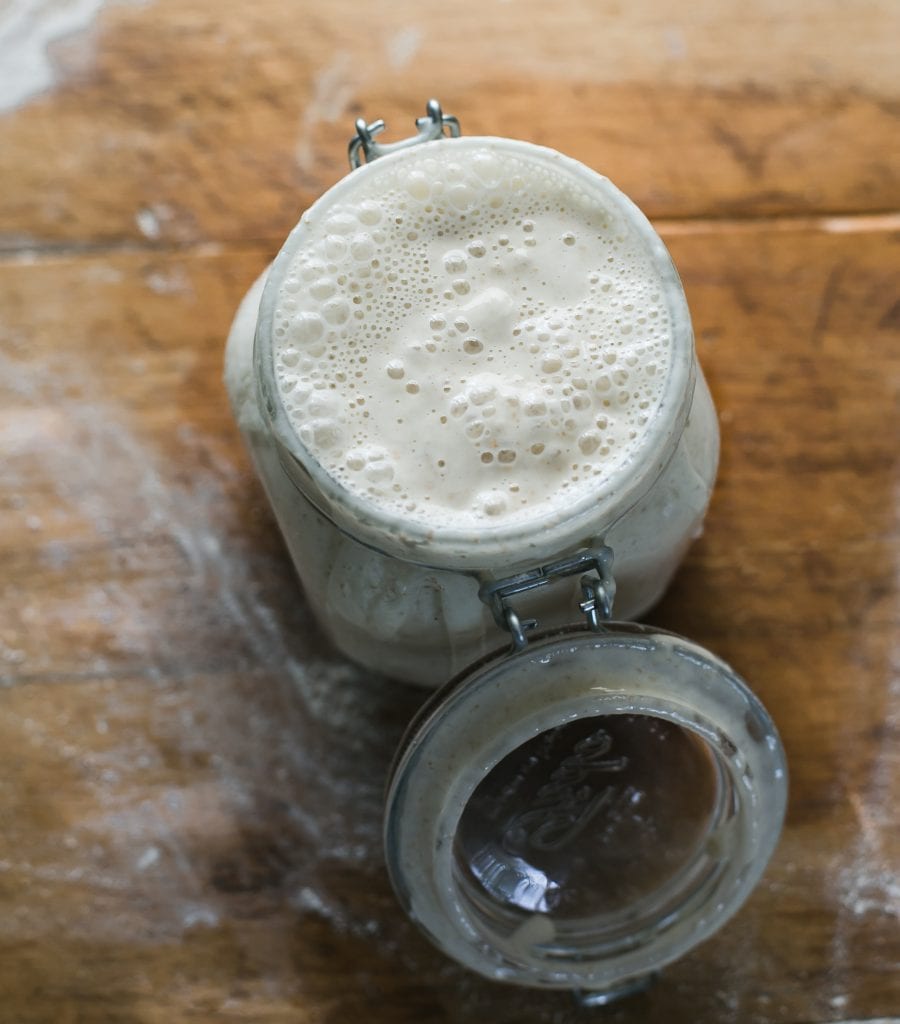
Looking to bake sourdough bread? First: you’ll need a sourdough starter. Without it, your bread won’t rise. It’s the absolute heart and soul of sourdough baking. Creating a sourdough starter from scratch is not hard to do. However, the process is intimidating, especially for beginners. Let’s change that.
Adapted from my bestselling book Artisan Sourdough Made Simple, I will demystify and simplify the process with step-by-step recipe instructions. In approximately 7+ days (yes, it takes that long- there are no shortcuts) you’ll get approximately 1 cup of bubbly, active sourdough starter which is more than enough to make bread, including my best sourdough bread recipe with olive oil (most popular recipe on my blog!). More sourdough bread recipes here.
Sourdough is more than just a recipe; it’s an understanding. So before we dive in, let’s define.
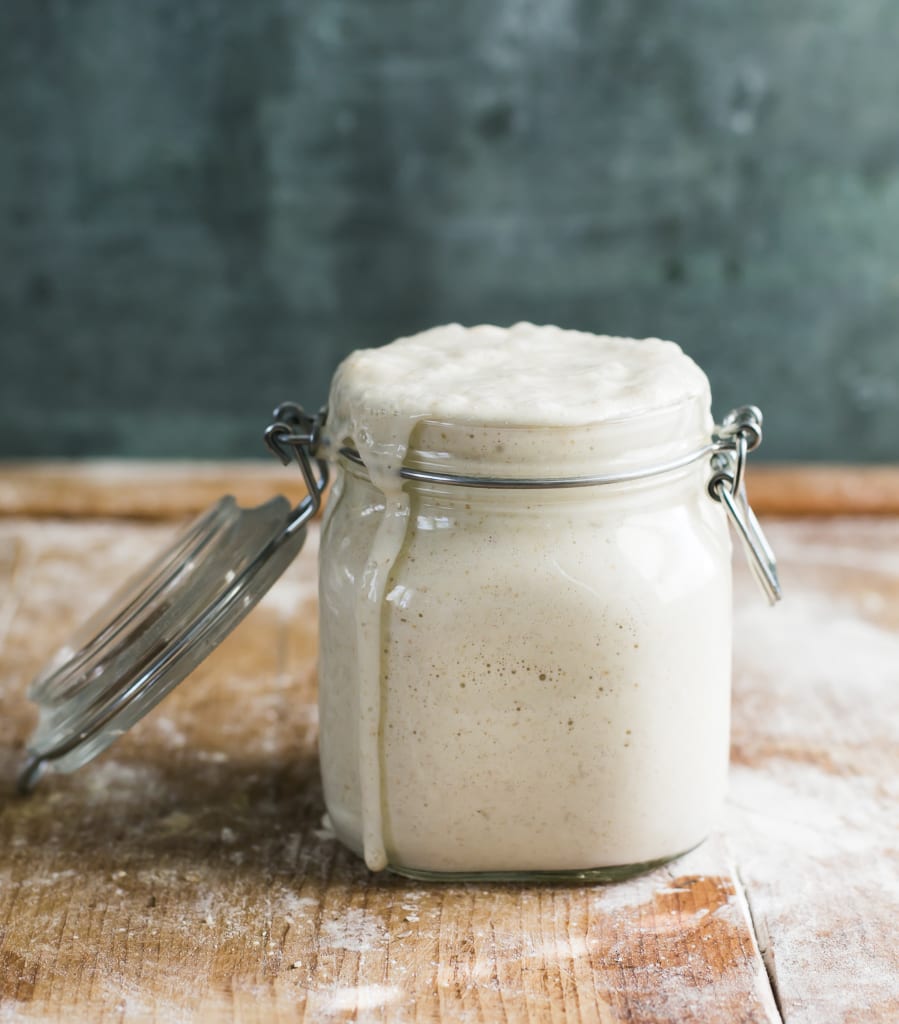
What Is Sourdough Starter?
A sourdough starter is a live, fermented culture of flour and water filled with wild yeast and bacteria from our environment. A small portion is added to sourdough bread dough to make it rise. Commercial yeast IS NOT required.
Sounds a bit weird, right? Of course it does. Know this: natural “wild” yeast is all around us. It can be found in a bag of flour, in the air, on your hands etc. Just because you can’t see it, doesn’t mean it’s not there and doing its thing. It’s like magic.
How Long Will It Take?
To create a sourdough starter from scratch, the overall process will take 7 days (or more) from start to finish. It’s not instant. First, you’ll create the starter with whole wheat flour to jumpstart fermentation. Then, you’ll continue to feed it with regular all purpose flour or bread flour to cultivate the wild yeasts and friendly bacteria. Once it’s created, you’ll keep it alive with ongoing feedings and care, which you can read about here.
When Will It Be Ready To Use?
Your starter is ready to use when it has doubled in size, with plenty of bubbles on the surface and throughout the culture.
NOTE: It’s not uncommon for it to take up to two weeks or more for the starter to become active. It all depends. I know this timeframe sounds a bit vague, but growing yeast in a jar (that’s basically what you’re doing) can be unpredictable at times. Please be patient if the process takes time for you- it’s normal.
Is It Difficult To Do?
Absolutely not! In short: you’re basically adding flour and water to a jar, feeding it with more flour and water and waiting for it to become bubbly, active and double in size. That’s it. Most of your time involvement is hands-off. Can I ask you a favor though? Don’t overthink it. There’s a ton of sourdough information out there, and you will fall down a major rabbit hole if you start poking around. Just stick to this tutorial for now, follow the steps as written and just go for it.
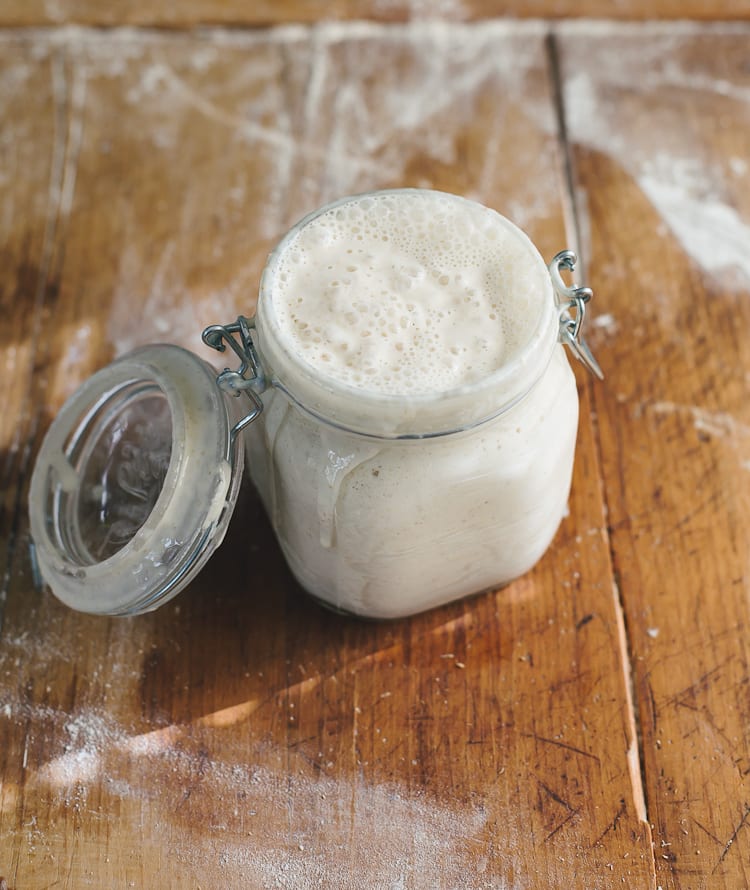
Beginner Sourdough Starter Recipe {Step-By-Step}
You Will Need:
Supplies
- 3/4 L jar (I use this one)
- Digital scale
- Small rubber spatula
Ingredients
To create the sourdough starter on Day 1:
- 60 g (1/2 cup) whole wheat flour
- 60 g (1/4 cup) water
To feed the sourdough starter each day (Days 3-7):
- 60 g (1/2 cup) unbleached all purpose flour or bread flour
- 60 g (1/4 cup) water
NOTE: Use regular, unbleached all purpose flour or bread flour for best results. I use flour from KAF, Trader Joe’s or Whole Foods. As for organic flour, I first learned that it wasn’t always successful when first creating a sourdough starter (sourdough can be finicky). However, due to the widespread use of glyphosate, I’ve been inspired to re-test with organic flour. The results were good. Please experiment with what resonates. For the water, filtered or tap water is fine. Use the latter if you know it’s mostly chemical/chlorine free.
Day 1: Make The Sourdough Starter
- First, download and print out this chart. It’s your daily “at a glance” feeding schedule to keep you on track.
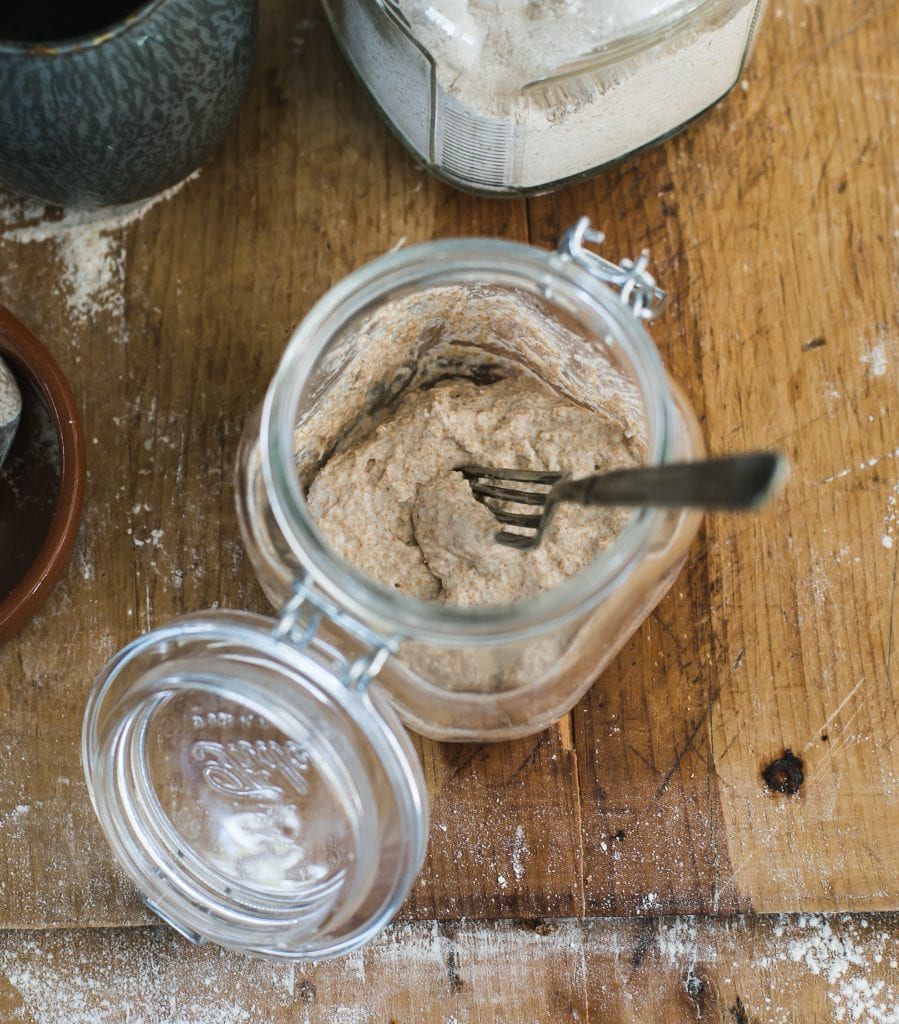
- Add 60 g (1⁄2 cup) of whole wheat flour and 60 g (1⁄4 cup) of water to your sourdough starter jar. Total yield: 120 g sourdough starter.
- Mix with a fork until smooth; the consistency will be thick and pasty.
- Cover with plastic wrap or a lid, and let rest in a warm spot, about 75 F for 24 hours.
Temperature Tips: Temperature is very important. If it’s too cold, your starter won’t rise and the process will take longer. Consider the following tips if you’re looking for a warm, 75 F spot. Place your starter on a cookie sheet inside the oven (turned off) with the light on for a only few hours to give it a boost (please don’t leave it there overnight- the environment will become too warm). Monitor the temperature with an oven thermometer. You can also use a proofing box set to your desired temperature, or a microwave with the door ajar and the light on.
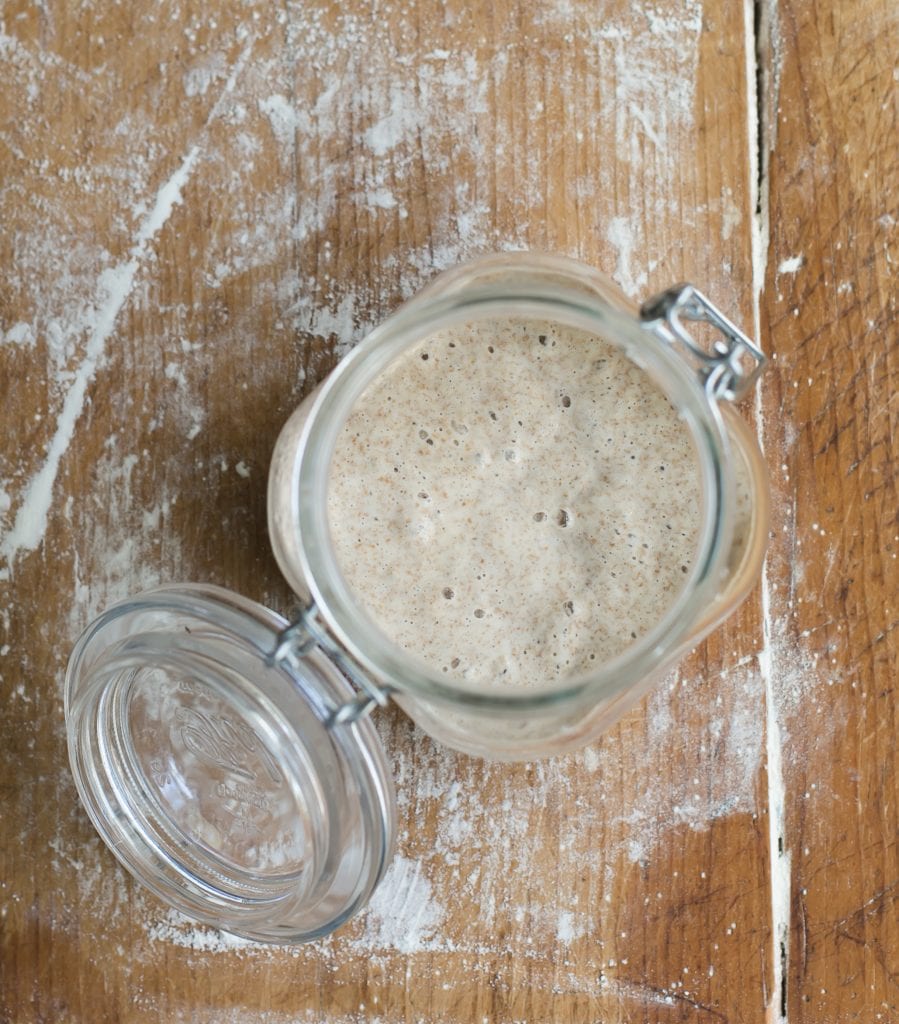
Day 2: Got Bubbles?
- Today, you’re going to check if any small bubbles have appeared on the surface.
- Bubbles indicate fermentation, which is what you want. However, it’s okay if you don’t see anything right away; the bubbles might have appeared and dissolved overnight while you were sleeping. This happens quite often.
- You do not have to do anything else on Day 2. Just let it rest in your warm spot for another 24 hours. Feel free to stir once or twice to oxygenate the mixture.
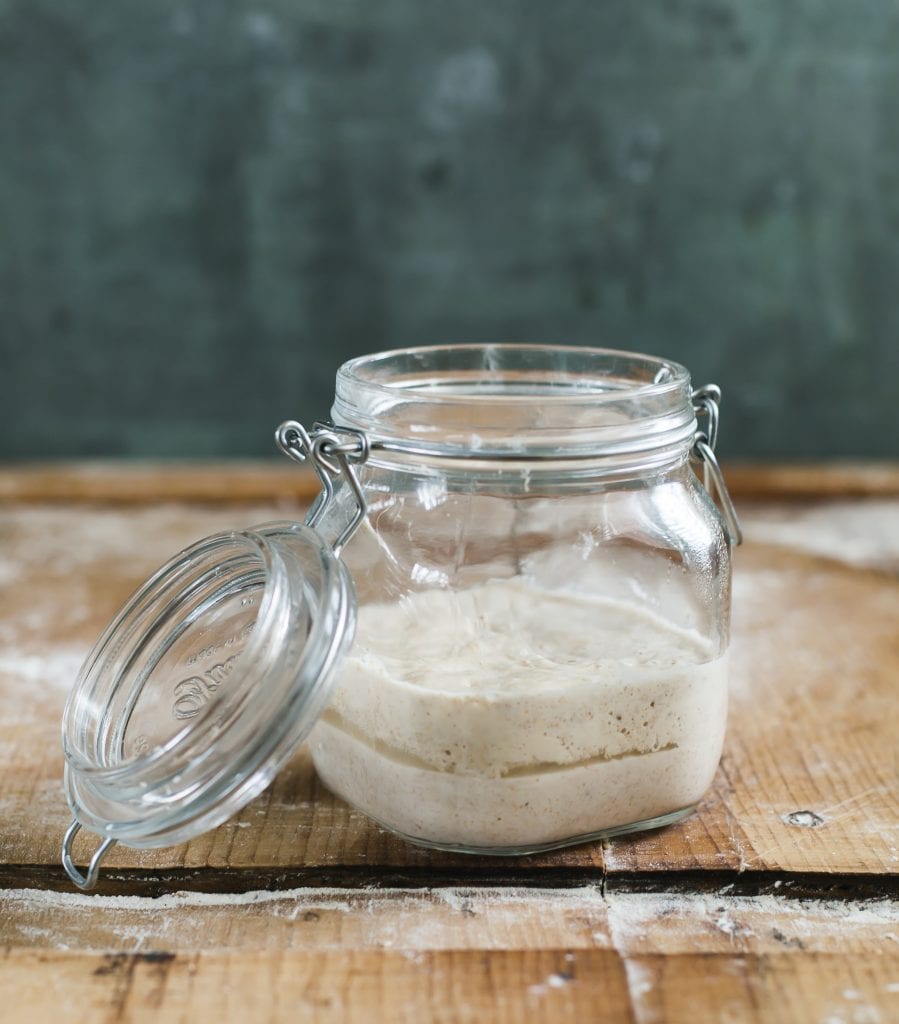
Tip: What’s That Brown Liquid? During the creation process, and even after your starter has been established, a dark liquid might appear on the surface (the image below shows the liquid in the middle of the starter). This liquid is called “hooch” and is an indication that your starter is hungry. It also has a very distinct smell, similar to rubbing alcohol or gym socks. This is normal. Don’t freak out. Any time you see this liquid, it’s best to pour it off before feeding it with fresh flour and water.
Days 3-7: Feed Your Sourdough Starter
Whether bubbles are visible or not, it’s time to start the ongoing feeding process. As the natural yeasts begin to develop, your starter will rise. Bubbles will form on the surface. Eventually, your starter will fall back down or “collapse” indicating that it’s time to feed it again. The goal: is to increase the total quantity to about 236 g (1 cup) following the specific feeding ratio outlined below on each day.
Before you begin, a few tips for success:
- Establish a feeding schedule. Feed your starter at the same time each day. This will train your starter to rise and fall predictably, which is what you want. Consider feeding your starter in the morning when you wake up. Again, this is where my feeding chart comes in handy.
- Track the growth. Place a rubber band or piece of masking tape around the jar to measure the starter as it rises. When it falls, you’ll see streaks of starter on the sides of the jar.
- Keep your jar clean: Use a small rubber spatula to scrape down the sides of the jar to prevent mold growing up the sides.
- Be patient. This is a slow, gradual process. Remember: temperature (75 F) and consistency (daily feedings @ approximately the same time each day) is key.
Day 3:
- Remove and discard half (60g) of your sourdough starter from the jar. To do so: use a spoon to scoop it out, or pour the starter directly into a bowl to weigh (you can also just eyeball it- the amount doesn’t have to be exact). The texture will be very stretchy.
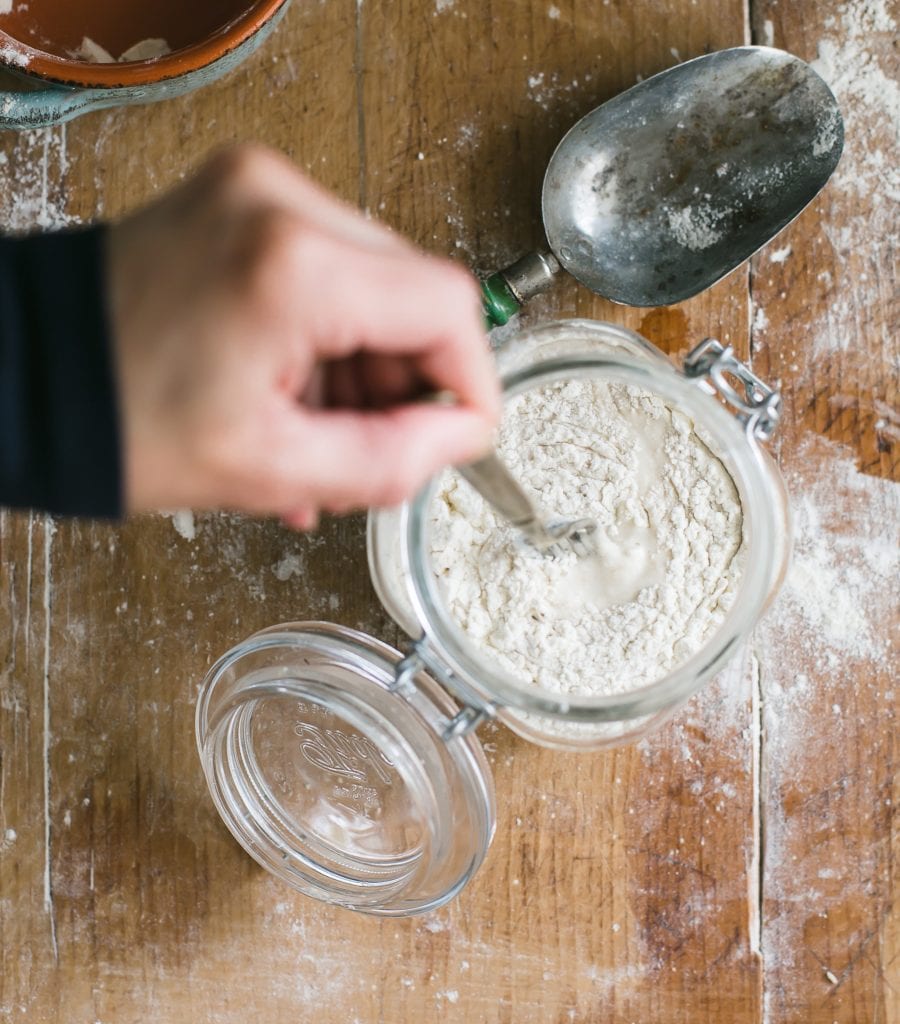
- To the jar: Add 60 g (1⁄2 cup) of all-purpose flour + 60 g (1/4 cup) of water. Mix with a fork until smooth. Scrape down the sides with a small rubber spatular. The texture should resemble thick pancake batter or plain yogurt at this point.
- Cover and let rest in a warm spot, 70-75 F for 24 hours.
- Total yield: 180 g starter.
Day 4:
- Remove and discard half (90 g) of the sourdough starter.
- To the jar: Add 60 g (1⁄2 cup) of all-purpose flour + 60 g (1/4 cup) of water to the jar. Mix well and scrape down the sides.
- Cover and let rest in a warm spot for 24 hours.
- Total yield: 210 g starter.
- Note: The growth of your starter might appear to slow down on Days 3-4, after switching to all purpose or bread flour for the ongoing feedings. This is normal. Your starter needs more time to adjust. Be patient.
Day 5:
- Remove and discard half (105 g) of the sourdough starter.
- To the jar: Add 60 g (1⁄2 cup) of all-purpose flour + 60 g (1/4 cup) of water. Mix well.
- Cover and let rest in a warm spot for 24 hours.
- Total yield: 225 g starter
Day 6:
- Remove and discard half (112 g) of the starter.
- To the jar: Add 60 g (1⁄2 cup) of all-purpose flour + 60 g (1/4 cup) of water. Mix well and scrape down the sides.
- Cover and let rest in a warm spot for 24 hours.
- Total yield: 232.5 g starter
Day 7:
- Remove and discard half (116.25) of the sourdough starter.
- To the jar: Add 60 g (1⁄2 cup) of all-purpose flour + 60 g (1/4 cup) of water. Mix well, and scrape down the sides.
- Cover and let rest in a warm spot for 24 hours.
- Total yield: 236 g starter
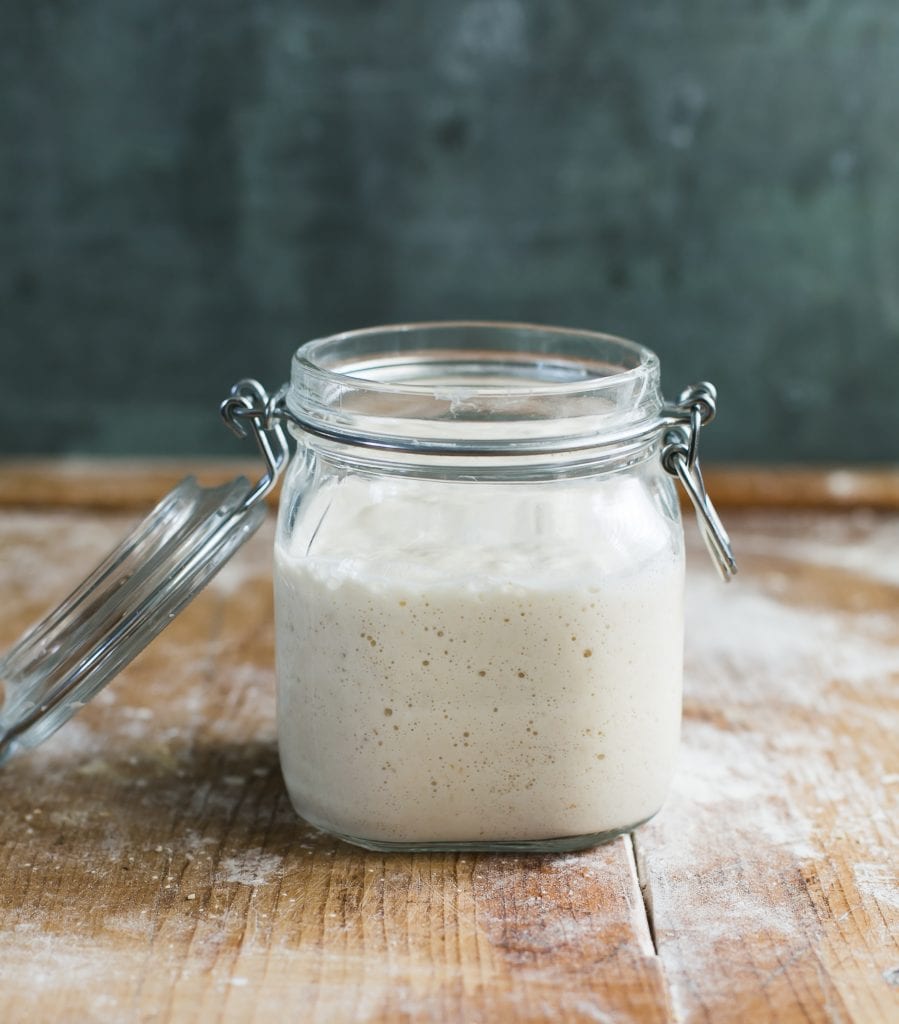
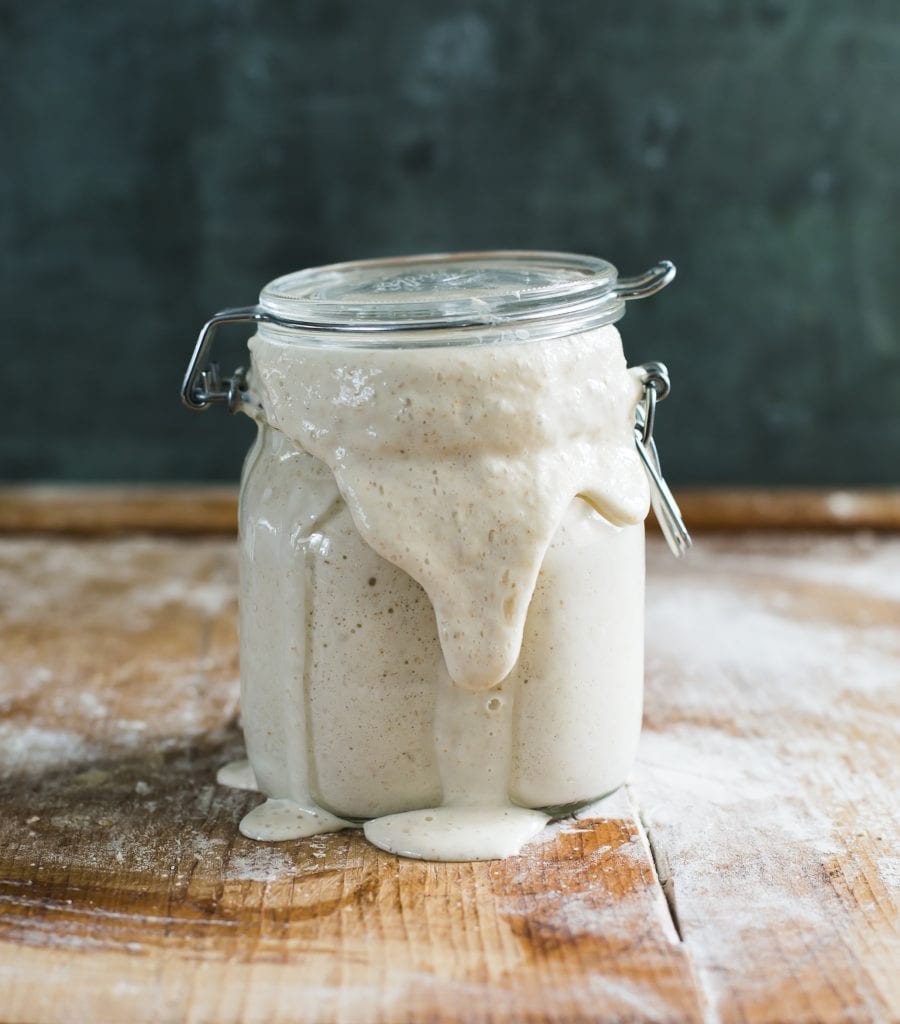
Day 7-8: A Sourdough Starter Is Born!
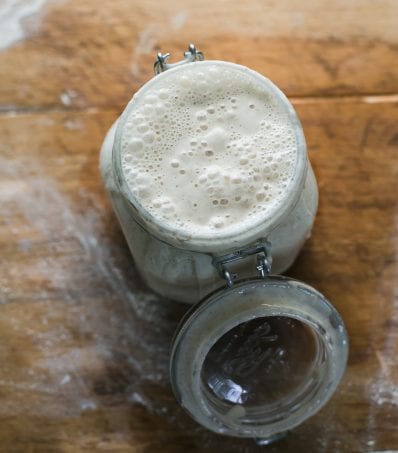
- By now, your sourdough starter should have doubled in size. You should see plenty of bubbles, both large and small. The texture will now be spongy, fluffy, and similar to roasted marshmallows (think: s’mores). It should also smell pleasant and not like stinky gym socks. If these conditions are met, your starter is now active.
- The very last step is to transfer your sourdough starter to a nice, clean jar. Do this only if your current jar needs a good scrub. Otherwise, leave it as is.
- In keeping with tradition, you can also name your sourdough starter (and please do). My starter is called Dillon after my oldest boy. It’s bright and bubbly, just like him ;)
- Now you’re ready to bake. Start with my beginner sourdough bread recipe- you’re going to love it!
Feeding & Maintaining Sourdough Starter For Ongoing Care
So you’ve created a sourdough starter! Now what? Just like any living creature, your starter must be kept alive with regular feedings, proper storage, and ongoing care to keep to maintain its strength. If your starter is not strong, your bread will not rise. Once you’re starter is established, read my companion article to learn exactly how I do it- Feeding Sourdough Starter: My Best Tips & Tricks. Have more questions? Read troubleshooting your sourdough starter.
Note: You will need to feed your starter every time prior to making bread dough and to maintain it (keep it alive).
How To Store Sourdough Starter
At Room Temperature: If you bake often, let’s say a few times a week, store your starter at room temperature. This will speed up fermentation, making the starter bubbly, active, and ready to use faster. Room temperature starters should be fed one to two times a day, depending on how quickly they rise and fall.
In the Fridge: If you don’t bake that often, store your starter in the fridge covered with a lid. You’ll only need to feed it about once a week or so to maintain its strength when not in use (you can just feed it cold and then pop it back in the fridge right afterwards; no need to warm it up first). When you are ready to make dough, feed your starter at room temperature as needed, to wake it back up.
Frequently Asked Questions & Helpful Info:
1.) What If my starter is not ready after 7+ days?
Feed every 8-12 hours (not 24) and continue the same formula: Discard half starter. Feed (Add): 60g flour & 60g water and store at 70-75°F / 21-24°C. Too runny? Add an additional 1-2 tbs of flour. Note: the most common reason for your starter not starting is cold temperature.
2.) Can this sourdough starter be made with all purpose flour only?
Yes. The process might take a little longer.
3.) Can sourdough starter be made with bread flour only?
Yes. Because it’s more “thirsty” than AP flour, add more water if the texture is too thick.
4.) Can this sourdough starter be made with whole wheat, spelt flour or rye flour only?
Yes. Like bread flour, whole grain flour absorbs more water than all purpose flour, so adjust the texture with additional water your starter is too thick.
5.) Can sourdough starter be made with bleached flour?
Yes. But it’s not recommended. The chemicals can throw off the fermentation process. Some readers have reported success, however. Your choice!
6.) Why do you use whole wheat flour in the beginning of the recipe? And then switch to all purpose flour for the ongoing feedings?
Whole wheat flour is used to jumpstart the fermentation process. All purpose flour or bread flour is used for the ongoing feedings because it’s inexpensive, practical and suitable for everyday baking.
7.) On Days 3 & 4, my starter is not as bubbly compared to Days 1 & 2. Growth is slowing down. Why?
As mentioned in question #5, whole wheat flour is used in the beginning to jumpstart fermentation. This is why you saw bubbles right away. When you switch to all purpose or bread flour for the ongoing feedings, growth will inevitably slow down on Days 3-4, as your starter needs time to adjust to the new flour. This is normal. Growth is still happening.
8.) For the daily feedings, you mention to feed your starter “equal parts” flour and water by weight. For example: 60 g (1⁄2 cup) flour + 60 g (1⁄4 cup). But the volume conversions (measuring cups) are not equal. Is this a typo?
No. It’s not a typo. “Equal parts” refers to feeding by weight only. Not measuring cups. Here’s why: different ingredients weigh different amounts based on density. For example 1 cup of flour can weigh anywhere from 125-150 g depending on how it was packed into the measuring cup. 1 cup of water can weigh anywhere between 236-250 g. Because weights are constant, it streamlines the process for accuracy. It is the preferred measuring unit in bread baking. The volume approximates are listed for convenience because not everyone has a scale.
9.) Can I use the sourdough discard from Day 1-7 for something else?
In the beginning, I typically don’t recommend using the discard (it’s usually really smelly and discolored). I recommend using the discard after the starter has been established. However, everyone will have a different experience with this. If it looks good- use it! And yes, you can save it to create a new, separate sourdough starter if you’d like. For more info please read Sourdough Discard 101: Recipes & Faqs Answered.
By signing up, you agree to receive emails from The Clever Carrot. Unsubscribe at any time.
Beginner Sourdough Starter Recipe
- Yield: appx. 236 g (1 cup)
- Category: Sourdough Starter
- Method: 1-Bowl
- Cuisine: American
- Diet: Vegan
Description
Looking for an easy, sourdough starter recipe for beginners? Adapted from my bestselling book Artisan Sourdough Made Simple, follow my no-nonsense, step-by-step guide for practical tips, tricks, and ongoing care- anyone can do it. Use it to make my famous golden, crusty sourdough bread recipe.
Please read my notes below before you begin.
Notes, Tips & Expectations:
- Download & print personal sourdough starter feeding chart {here}.
- The overall process takes ~7+ days, if the temperature is warm enough, ideally 70-75 F. However, it can take up to 2+ weeks or more for a strong starter to become established. Do not ignore the importance of temperature.
- Growth will seem to slow down on Days 3-4. This delay is commonly called a “false” start. It’s also normal- the yeast needs time to cultivate. Please be patient!
- You will need one large 3/4 L jar, or something of similar size (I use this one). Place a rubber band or piece of masking tape around the jar to measure the starter’s growth as it rises.
- To clarify feeding your starter: “equal parts” refers to equal weights only, not measuring cups. Example: 60 g (1/2 cup) flour + 60 g (1/4 cup) water. Same weight. Different volume. Not a typo. Why? Flour is light, fluffy and full of air pockets, so it takes up more space in a measuring cup (but weighs less than water). Water is more dense and compact; it takes up less space but weighs more than flour. That’s why their cup measurements don’t match, even when their weights are identical. Many bakers get confused by this. I’ve included volume measurements for convenience since not everyone owns a scale. But, do choose one measurement system and stick with it for feeding!
Ingredients
Note: Once your starter is established, make your first loaf using my sourdough bread recipe.
- 1x (5lb) bag all purpose flour or bread flour (I use either KAF, Trader Joe’s, or Whole Foods)
- 1/2 cup (60g) whole wheat flour (I use KAF whole wheat)
- Water, preferably warm around 85 F
Instructions
Before you begin: Establish a feeding schedule. Meaning, feed your starter at the same time each day. This will establish consistency, which sourdough starters love. Consider feeding your starter in the morning when you wake up.
Day 1:
- Combine 60 g (1⁄2 cup) of whole wheat flour + 60 g (1⁄4 cup) of warm water in a large jar. Mix with a fork until smooth; the consistency will be thick and pasty.
- Cover with plastic wrap, reusable wax wrap, or a lid and let rest in a warm spot, about 70-75 F for 24 hours. Temperature is important.
- Total approximate yield: 120 g starter
TIP: Looking for a warm, 75 F spot? Place your starter on a cookie sheet inside the oven (turned off) with the light on for only 1-2 hours (it can get hot in there, so keep you eye on it!). Center rack is best. You can also use a proofing box set to your desired temperature, or a microwave with the door ajar and light on.
Day 2:
Check to see if any bubbles have appeared on the surface. If you don’t see anything, it’s okay. The bubbles might have appeared and dissolved overnight while you were sleeping. Feel free to stir once or twice to oxygenate the mixture. Otherwise, you don’t have to do anything else now. Rest the starter for another 24 hours.
TIP: During the creation process, and even after your starter has been established, a dark liquid might appear on the surface and throughout the culture. It has a very stinky smell, similar to rubbing alcohol or gym socks. This liquid is called “hooch” and is an indication that your starter needs to be fed. It’s normal. Any time you see this liquid, it’s best to remove it along with any discolored starter present.
Day 3:
- Remove and discard half (60g) of your sourdough starter from the jar. To do so: use a spoon to scoop it out, or pour it directly into a bowl to weigh (you can also just eyeball the amount- it doesn’t have to be exact). The texture will be very stretchy.
- To the jar: Add 60 g (1⁄2 cup) of all-purpose flour + 60 g (1/4 cup) of water. Mix with a fork until smooth. Scrape down the sides with a small rubber spatular. The texture should resemble thick pancake batter or plain yogurt at this point.
- Cover and let rest in a warm spot, 70-75 F for 24 hours.
- Total yield: 180 g starter
Day 4:
- Remove and discard half (90 g) of the sourdough starter.
- To the jar: Add 60 g (1⁄2 cup) of all-purpose flour + 60 g (1/4 cup) of water to the jar. Mix well. Scrape down the sides.
- Cover and let rest in a warm spot, 70-75 F for 24 hours.
- Total yield: 210 g starter
Note: The growth of your starter might appear to slow down on Days 3-4, after switching to all purpose or bread flour for the ongoing feedings. This is normal. Your starter needs more time to adjust. Be patient.
Day 5:
- Remove and discard half (105 g) of the sourdough starter.
- To the jar: Add 60 g (1⁄2 cup) of all-purpose flour + 60 g (1/4 cup) of water. Mix well. Scrape down the sides.
- Cover and let rest in a warm spot, 70-75 F for 24 hours.
- Total yield: 225 g starter
Day 6:
- Remove and discard half (112 g) of the sourdough starter.
- To the jar: Add 60 g (1⁄2 cup) of all-purpose flour + 60 g (1/4 cup) of water. Mix well. Scrape down the sides.
- Cover and let rest in a warm spot, 70-75 F for 24 hours.
- Total yield: 232.5 g starter
Day 7:
- Remove and discard half (116.25) of the sourdough starter.
- To the jar: Add 60 g (1⁄2 cup) of all-purpose flour + 60 g (1/4 cup) of water. Mix well. Scrape down the sides.
- Cover and let rest in a warm spot, 70-75 F for 24 hours.
- Total yield: 236 g starter
Day 8:
When your starter is fully active, do the float test. Feed your starter, wait for it to double in size, and then drop a teaspoon of bubbly starter into a jar of water; if it floats to the top it’s ready to use.
Storage Options
If you bake often, store your starter at room temperature (feed it 1x-2x a day to keep it active). If you plan to bake only once in a while, store it in the fridge to preserve its strength (feed it 1x a week). When storing your starter in the fridge, there’s no need to bring it to room temperature first before feeding it. Just give it some flour and water and pop it back in the fridge.


Comments
Fiona says
Hi, I used this recipe a few years ago and it worked great (until flies found it). I’m wondering, how do I feed it after day 7? Is it 1:1:1 ratio? For example, 100g starter, 100g flour, 100g water? Thanks.
Emilie Raffa says
Yes: the 1:1:1 ratio works. Some bakers use different ratios, such as 1:2:2. It really just depends. My preference these days is 1:1:1 with KA bread flour. It produces a lovely consistency that’s not too thin, and not too thick. Perfect for most recipes :)
Rich says
Confused as to when to discard half of the starter, and feed it, is it every day after the 3rd day? Very good article, thanks for taking the time to post this info.
Emilie Raffa says
You’re very welcome :) Discard and feed from the 3rd day onwards!
Michelle Murphy says
My starter was in my oven the first 2 1/2 days since our kitchen is cold. Does it need to stay in there or can I leave it on the counter now. It has some bubbles and a scent to it and some liquid?
Emilie Raffa says
You can take it out now- absolutely. Your starter will look different on different days, so observing it is key. Feel free to move it back to a warm spot if the growth starts to slow down.
Angela says
I tried this twice. First few days, it doubles. By day 3, it didn’t rise for me anymore and was watery.
Emilie Raffa says
All of this is normal. Growth typically changes on Day 3 because a switch in flours has been made (ww flour was used in the beginning to jumpstart fermentation and now ap or bread flour is used for ongoing feedings). Just hang in there and keep feeding it!
Rebecca says
Thank you so much for these detailed instructions! They were very helpful in walking me through making my first starter ever. I used organic flour (despite your warnings) and it worked fine. On day 7 I was a little worried since it wasn’t doubling yet. I live in a warm and humid climate and the starter had a slight alcohol smell so I thought maybe I wasn’t feeding it enough. I went to 12 hours (instead of 24) and it was suddenly extremely active and happy. I finally made my first sourdough bread today (and the pancakes and soda bread with discard along the way). Everything turned out really well!!
My question is this: when the starter is stored in the refrigerator and just taken out to feed weekly, is there any need to use warm water? I’m guessing the answer is no, but I’m still curious. Thanks!!
Emilie Raffa says
This is so great to hear Rebecca, thanks for sharing! To answer your question: the temperature of water is up to you. If you feel like using warm water to give it a boost, go ahead- it won’t hurt at all. I do this sometimes when the weather is cold. Starters speak to us, you know ;)
Rebecca says
Thank you so much for taking the time to reply! Since I wrote in early March, I feel like I have it all figured out :) It’s much less mysterious than it was at the beginning. I’ve been making bread at least twice a week plus your soda bread and pancakes to use up discard (and because they are both delicious)! Thank you for the recipes and for this step-to-step guide. I cook a lot but it took me a year to finally decide to embark on the sourdough journey and your online recipes and this step-by-step guide were incredibly helpful in walking me through it and demystifying the process. I live in Argentina and it’s not easy to get your book here, but I’m going to try to order it. Thanks again!!
LuAnn Dolan says
I’m on day 2 of my sourdough starter. I’ve kept it in my oven, with the oven light on, door open @ 74 degrees on a thermometer I’m able to keep in the oven. It looks healthy and full of bubbles. Should I still do nothing today and start up again on day 3? Thank you!
RBlos says
Question: I am new to this and am wondering if, before feeding the starter, you mix it then remove 1/2 or do you just remove 1/2 with the “hooch” still in place and feed the remaining?
SANU SAGAR says
How much starter should I make if I want 10 breads a day? What is the standard weight of a sour bread?
Ann says
How much starter should I make if I need to make about 20 loaves a week? I am making for myself and friends and family.
Jackie says
Thank you so much for these straight forward, step-by-step sourdough starter instructions! Exactly what I’ve been searching for. Confident in starting my starter today.
Kenzie says
Just finished my first two loaves using my sourdough starter made from this recipe. Super happy with them! Like others in the comments, I had some problems with the starter only producing small bubbles after day 4 through to day 7, with little increase in volume. I just kept on with the daily feedings and got bubbly results on day 9. Thank you for this recipe!
Christy Ann says
If I miss a day of feeding on the 6th day is that bad? Should I still keep going with the feeding. Also my house is under 70 degrees most days. Help!!
sheila e says
Thank you for taking the mystery out of making a sourdough starter!
Excited to try this.
jeri moore says
How much starter do you use for two loaves. And I’m assuming you leave some starter in jar…
Gabe says
So I think my starter is born. Do I purchased the jar you recommended. Do I continue to use that jar to feed it? When you say remove half the starter there is a lot left. Others are saying use 75 grams of starter which is about 1/4 cup. I had been leaving way more starter than that and it seemed ok. Used 75 now it’s very runny?
Rachel Parten says
Thanks for all the info. Do you have a recipe using instant potatoes instead of flour for the starter?
Elizabeth Brown says
I’m currently on day 3 did the feed this morning and my starter rose and has fallen. Should I do another feed even though it’s still on day 3?
Dave says
My sourdough starter took right off! In do adjust water and flour a bit (various flours vary) to get a very thick soup. My starter came from The Clever Carrot too, and her book is in constant use in my kitchen!
Sandra Dee says
I followed your recipe to make my first ever sourdough starter. I am on day 7. The starter no longer smells bad, it has grown, but it only has small bubbles. There are no big bubbles and when I do the water test, the starter falls to the bottom of the cup. Any pointers??
Catina says
I can’t wait to get my starter going💜
Sandra says
Is a started affected by altitude?
Simone says
Love these instructions! I used bread flour and bottled natural mineral water. I’m keeping the starter at 74-76 degrees. Today I am on day 5 and so I feed him for the 3rd time. I see a thin layer of yellow clear liquid on the top. Smells mild and pleasant. I am getting worried because I see no rise or bubbles so far. Is that still normal on day 5? Thank you
Chloe says
Hello, my starter is on day 5. It doesn’t seem to be rising much, which I’ve read in the comments can be normal, but should I skip the feeding for that day if it hasn’t risen and fallen? I normally feed it in the evenings so it would not be checked again 8+ hours.
Debra says
I bought your book at a bookstore. I have made the pumpkin cranberry sourdough, the breakfast rolls with pecans, pumpernickel, but used equal rye and bread flour plus 2T vital wheat gluten. It rose and was nice and soft for sandwiches. I did put the dough in the fridge and baked it at 450 from a cold start. It was perfect. I made the pita too. I like the variety of recipes. I always do 4 sets of stretch and fold. I have also made the multi sandwich bread. It was great too. I use an Emile Henry clay baker.
Ann Chappuis says
What can I use for a jar other than whats shown? A mason jar perhaps?
Emilie Raffa says
Any jar will work, it doesn’t have to look like mine. A mason jar is perfect. Just make sure it’s large enough to accommodate the starter’s growth, about double in bulk volume.
Teresa S says
I have made sourdough starter many times, I have never tossed part of the starter. Why do you do that? Seriously interested in the thought process here. Thanks
Emilie Raffa says
Hi Teresa! Discarding a portion of your sourdough starter before feeding it refreshes the acidity levels within the culture itself. The acidity levels will always fluctuate (think: fresh or fruity vs. sour) throughout the process. Discarding also prevents the starter from growing exponentially in size. When found in good condition, the discard can be re-purposed for a variety of recipes such as pancakes, waffles, cakes etc (you don’t always have to throw it away). Some bakers don’t discard at all, which is fine too. It really depends on their personal preference and how often they bake.
Teresa S says
Thank you! Yes makes sense. Sometimes it is a fruity smell which I like.
Marlee says
Hi! Any advice on what to do if i added 1/2 cup water and 1/4 cup flour? Should i add more flour to make it the same ratio?
Nat says
The ratio is based on weight not volumes so the different cup amounts are still the same ratio since they weigh the same. Hope this helps!
Cassidy says
When you put your starter in the fridge do you screw the cap on tight or let it sit on the jar?
Tracey says
Hi! I have had my starter well over a week, it rose the first few days and then not much after that. Every day since it seems runny with lots of tiny bubbles. And then today I accidentally fed it without discarding half. Ugh! What should I do now??
Mellissa Quesenberry says
Hi Tracey,
you have a great question as I’ve got the exact same one ;). I’m on day 5 and fed my starter without discarding half. What should I do?
Thanks for any help!
Dawn Gardner says
Thanks my sourdough starter is on its way 😊Very easy instructions and I am excited to make my first bread today. Kudos to you for making it easy to understand and do. I can’t wait for my bread 💕
Liz says
Hi, I have been feeding my starter for about 3 weeks now. It does not double in size after a feeding or bubbles a lot. I see a little bit of bubbles and did the floating water test and it floats. Is my starter ready even though it’s not doubling in size?
Brittany says
On day 2 of feeding and measured out half and only ended up with 40g. I must’ve only used 40g of each to start instead of 60g. Will that make a difference if I continue with the 40g ratio I started with or should I toss and start over?
Rielly Smith says
Hey! I started my starter on Monday and completely forgot I was leaving this weekend…. I plan to feed it Friday before I leave and Sunday when I get back. Will not feeding it Saturday affect the process?
Dawn Marie says
Question – I have my sourdough starter. I was using Gold Medal flour to feed it but now have King Arthur. Will it be okay to feed it with the King Arthur flour or do I need to keep using the Gold Metal? It took me a month to get my starter going and I don’t want to mess it up *:O Thanks!!
Emmaline says
Hi Emilie,
My sourdough starter was very runny today (Day 4 of starting my sourdough from scratch) I added 60g of flour and 40g of liquid to help with the texture. Is that okay? Or did I make a mistake?
Lastly every time I weigh my jar and subtract my starter I’m not getting the same amount as what I put in the day before (I use a kitchen scale). So when I discard do I just take half the amount of what’s in the jar and add equal grams of flour and water of that back in? Or keep doing the 60g anyways?
Thank you so much!
Brianna Moeller says
What is the best ratio of water flour to feed our starter once active (after day 7)
Emilie Raffa says
Brianna, this is a great question. I use a 1:1:1 feeding ratio (starter, flour, water) by weight, not measuring cup amounts. Some bakers use different ratios, which is fine too. I prefer the above because the texture is versatile- it’s not to0 thin, not too thick. More info here, Feeding Sourdough Starter: My Best Tips & Tricks.
Steven Chen says
Hi Emily, your 1:1:1 ratio is quite different that some others I see online. Every other day after Day 3 you discard half and continue to add 60g of flour and 60g of water. In the end, you actually end up with a bit more sourdough starter since you discard half of the jar by weight. Can I just remove exactly 60g of starter throughout the rest of the process instead of half? So 60 grams of starter, 60 grams or flour, and 60 grams of water from beginning to end.
Mark Vadnais says
Hi Emilie,
I just had a quick question. Is it okay for me to use whole red wheat as the starter flour in the beginning?
Thank you for any response in advance!
Emilie Raffa says
Hi Mark! Yes, red wheat will work.
Lisa Capone says
What happens if you stop feeding your starter. And just put it in the refrigerator to deal with at a later date.
Emilie Raffa says
Hi Lisa! Totally fine. In fact, that’s what you should do. It’s better than leaving it at room temperature, un fed. Just make sure to feed it at least (1x) week to keep it alive.
rebekah says
can you use a bigger jar to begin with or is the size jar mean something?
Emilie Raffa says
Hi Rebkah! A larger jar is fine. Just pay attention to how the starter rises. The starter will shoot up in tall and skinny jars; it will spread more (but still rise) in wider jars.
Jane says
Great instructions and easy to follow! Although I made a mistake – user error not the instructions. I do have a question – I left my starter in the over too long and it was quite warm- probably too warm (almost hot) – the top layer was dried. I scraped the top layer off and fed it. Let it go for the day and It’s really bubbling now – but definitely has a gym sock/stinky cheese smell – has that gone bad ? Did I over heat it ? Dang it – you even said to keep an eye on it in the instructions ! Whoops
Emilie Raffa says
Hi Jane! You did the right thing! Sometimes the top layer will dry out when exposed to air. But it can be easily removed, and the starter underneath is usually perfectly fine and in tact. I’m glad you didn’t throw it out. As for the smell, this is normal. The reason being, is that it was left out for a while in a warm environment without a fresh feeding of flour and water. You can salvage it now by feeding it, possibly (2x) day depending on how bad the smell is. You need to be consistent though to properly refresh the acidity levels: feed it at the same time each day for no less than a week. See how that goes to start. Hope this helps :)
Lindsey says
Thanks for this recipe! I’m on day 4 and in looking ahead am wondering how best to transfer to a clean jar of the current jar I’m using is the one I’d like to store the starter in. Would it be ok to transfer the starter to a bowl while I clean the jar?
Emilie Raffa says
Absolutely! Transfer to a bowl first, and then either clean the original jar or use a new one.
Brandon says
Kinda struggling with my starter and have a backup just in case. I’m on day 6 of my starter and I think the trouble started around day 4. I got great rise and fall on day 3 and did my feeding. During the feeding I think I may have put too much water and accidentally misread the directions and when I split my starter, I only used 60g of my starter along with the 60g flour and water. Got back on track with my discard amount on the following feedings. On the following days, there was no rise and fall and the starter didn’t seem very bubbly. Am I better off starting over? Resting it for a day? I’m lost.
Emilie Raffa says
Hi Brandon! You don’t have to start over. Growth typically slows down on Day 3-4 because the starter needs time to cultivate yeast. So give it time. Additionally, in your case, if the texture is off just add more flour/water as needed to correct it. You’re looking for a thick pancake batter texture. If it’s too thin, it will rise and fall more quickly.
April M says
Sourdough newbie but loving your cookbook! Question…after day 3, do I discard almost 1/2 before feeding? Unclear if just feed or discard/feed days 4-6. Thank you!
Emilie Raffa says
Hi April! Always discard first as part of the feeding process. You’ll do this starting on Day 3 (and then again, discard and feed, Days 4-7 onwards). Hope this helps!
Delia says
Hi Emilie, I’m on day 8. This morning my starter had double and no longer hadn’t the “hooch” or developing smell. It was bubbly throughout the jar and on top. I did the float test and it floated! It seemed like my starter had established. I discarded half and then fed it again per directions. It’s been 12 hours and my starter has not risen even 1/4 of an inch. Did I do something wrong? Was I not supposed to discard half of my potential established discard before doing the final feeding? Was it not yet established perhaps and I was mistaken thinking it was? It’s no longer forming hooch
Emilie Raffa says
Hi Delia! So many things to consider! Ok, so first off, you didn’t do anything wrong. You’re supposed to discard before feeding, even if the established/non established starter is active. As for the timing, it’s possible a separate variable changed. Is the temperature colder? Did you change brand/type of flour? Different water? Think back and start there first.
Sydney says
Can I leave it in the microwave with the light one for 24 hours the first day? Or is it just 2 hours in the oven and microwave regardless
Emilie Raffa says
Hi Sydney! It really depends on the heat level. Some people’s oven/microwave lights are really hot. I would start with 1-2 hours to be on the safe side, take note, and adjust from there.
Austin says
A lot of bakeries suggested keeping the starters loosely covered because the cultures are live and need to breathe. Your container is an airtight type of canister, not sure if you close the lid as it is intended or do you loosely cover the jar. Thanks!
Emilie Raffa says
I do both. I loosely cover the lid to allow for some air-flow. And then when I want to build up pressure fast, I shut it tight. I also keep it shut tight when stored in the fridge.
Joan says
Did I mess this up…I totally forgot about the do nothing day 2 part and fed it…should I leave it alone on day 3 or feed per instructions or start over?
Emilie Raffa says
Hi Joan! Don’t worry, it’s ok. Just leave it alone on day 3 and then continue from there.
Austin says
Questions about “When storing your starter in the fridge, there’s no need to bring it to room temperature first before feeding it. Just give it some flour and water and pop it back in the fridge.”
Do I need Remove & discard? If not, how much is “Just give it some flour and water”
I bake only once in a while, what are the procedures for using referenced starters?
Do they need to bring it back to room temperature before using it?
How do I replenish the remaining starters after I used some for baking?
Thanks
Emilie Raffa says
Hi Austin! Yes: the feeding process (as per my method), always implies removing and discarding a portion of your starter as the first step. Then you’ll feed it with flour and water. The exact amount of flour and water depends on how much starter you have in the jar, and how much you want to maintain going further. That’s why bakers follow a feeding a ratio (instead of exact amounts) so you can scale it accordingly. Does that make sense? For more detailed info on feeding sourdough starters, including the answers to your additional questions listed here, check out this post “Feeding Sourdough Starters: My Best Tips & Tricks.”
Rachel Leonard says
Yes I am the same and would like to know the answers to these questions too.
Su says
This is so much info! Thank you, I need it! I’ve never done this before.
Question: Is it necessary to store the beginning starter in a jar wit a TIGHT lid? Can it just be saran wrap and a rubber band or something like that instead of the fancy jar with the lock top? And how about later storage when it’s established… same question. Thanks!
Emilie Raffa says
Hi Su! You’re very welcome :) Oh, absolutely. Saran wrap with a rubber band is totally fine when first creating a sourdough starter and for ongoing storage.
Su says
Very good info. Thanks so much.. I’m going to give it a try.
Emilie Raffa says
My pleasure :)
Jos says
Can you do sourdought starter whit gluten free flour ?
Emilie Raffa says
Hi there! Yes, you can. Rice flour works. So does a 1:1 all purpose GF flour such as King Arthur Measure For Measure GF flour. Keep in mind though, when ready to bake a sourdough loaf, you’ll need to follow a specific GF sourdough bread recipe; do not substitute your GF starter in a recipe that calls for a regular starter.
Pauline Newman says
My starter doesn’t look like it’s working and I have followed the directions exactly
I wish I could post a picture
It’s not rising like the pictures and this is day 4
Emilie Raffa says
Hi Pauline, don’t worry! Typically, when starters are a bit sluggish, temperature is the main culprit. Are you allowing it to rise in a warm spot, ideally 78 F? This can be hard to achieve in winter. However, there are a few things you can do: place your starter in a hot water bath to give it a boost (change out the water regularly because it will get cold). Alternatively, place the starter in the microwave, keeping the door ajar so the light stays on. This creates a mini “proofing box” with the necessary controlled warmth your starter craves. You can also do this in the oven (switched off) with the light on. if you don’t have a microwave. And lastly, patience is super important. Sometimes it can take up to 2 weeks for a starter to becomes established. Hope this helps :)
Ronalda says
So this i is my first time I’ve ever attempting to do something like this I did the 60 g of whole wheat flour to 60 g of water for my starter the next day I followed the directions not sure if I’m done it correctly. Each time I remove or discard a discard 60 g. I am using a scale so I get 60 g exactly .Then I add in my 60 g of flour and 60 g of water. I’m on day six but I see in your instructions you have it written a little different when you break it down so am I doing this right