Get your FREE Sourdough Starter Cheat Sheet → Subscribe now!

  • Nav Social Menu

    • Amazon
    • Facebook
    • Instagram
    • Pinterest
    • YouTube

The Clever Carrot

  • About
    • About The Clever Carrot
  • My Books
    • Artisan Sourdough
    • The Clever Cookbook
  • Bake Better Bread
  • Sourdough
    • Sourdough Bread Recipes
    • Sourdough Starters
    • Sourdough Discard Recipes
    • Sourdough Tips + Techniques
    • To Serve With Bread
  • Homemade Pasta
    • Fresh Homemade Pasta Recipes
    • Pasta Sauce
    • Homemade Gnocchi
    • Homemade Ravioli
  • Recipes
    • Sourdough Bread Recipes
    • Cookies, Cakes + Sweet Treats
    • Dinner Ideas
    • Pasta + Grains
    • Risotto
    • Side Dish
    • Salads
    • Soups
    • Snacks

Home » Sourdough Starters

Beginner Sourdough Starter Recipe

Sourdough Starters

4.9 from 743 reviews
3,696 comments
By Emilie Raffa — Updated February 28, 2025 — This post may contain affiliate links.
Jump to Recipe

This post will teach you how to make a beginner sourdough starter at home, step-by-step. All you need is flour, water and a little bit of patience. Before you know it, you’ll have your very own bubbly, active sourdough starter to make my best sourdough bread recipe, sourdough focaccia and more! Grab your personal sourdough starter feeding chart.
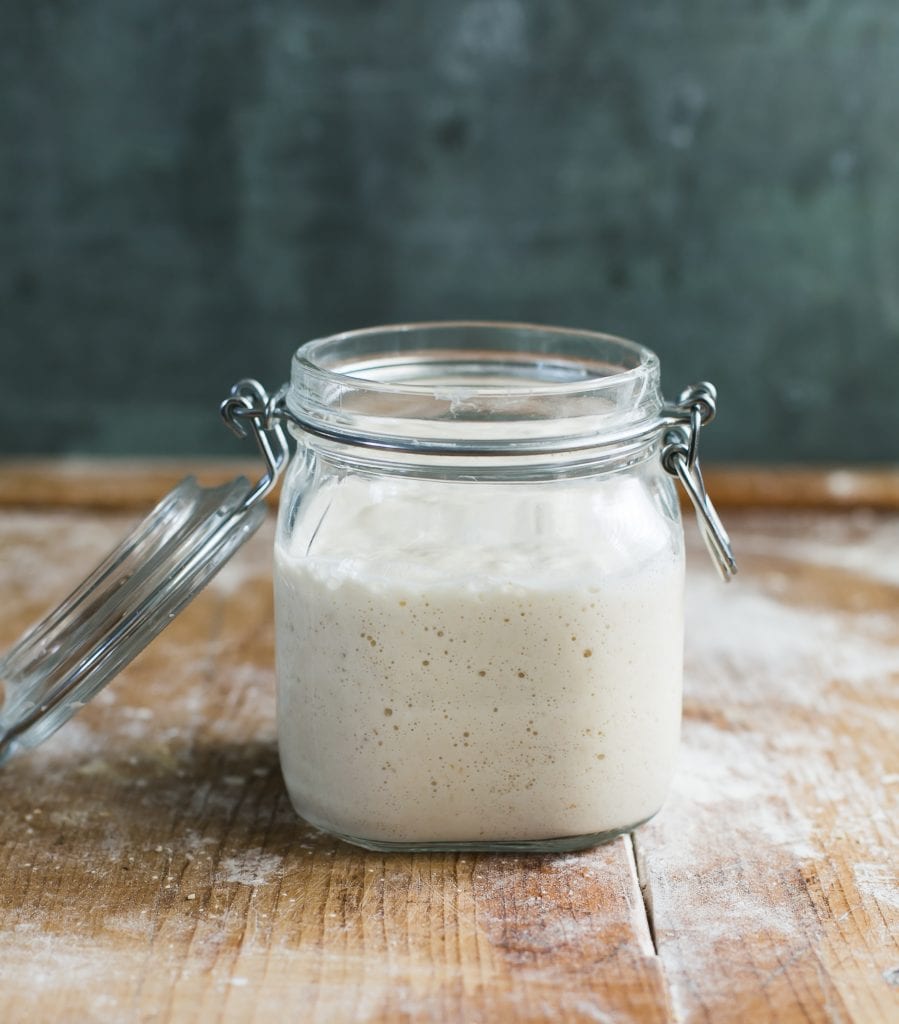
Jar of Bubbly Sourdough Starter | theclevercarrot.com
Sourdough starter

Looking to bake sourdough bread? First: you’ll need a sourdough starter. Without it, your bread won’t rise. It’s the absolute heart and soul of sourdough baking. Creating a sourdough starter from scratch is not hard to do. However, the process is intimidating, especially for beginners. Let’s change that.

Adapted from my bestselling book Artisan Sourdough Made Simple, I will demystify and simplify the process with step-by-step recipe instructions. In approximately 7+ days (yes, it takes that long- there are no shortcuts) you’ll get approximately 1 cup of bubbly, active sourdough starter which is more than enough to make bread, including my best sourdough bread recipe with olive oil (most popular recipe on my blog!). More sourdough bread recipes here.

Sourdough is more than just a recipe; it’s an understanding. So before we dive in, let’s define.
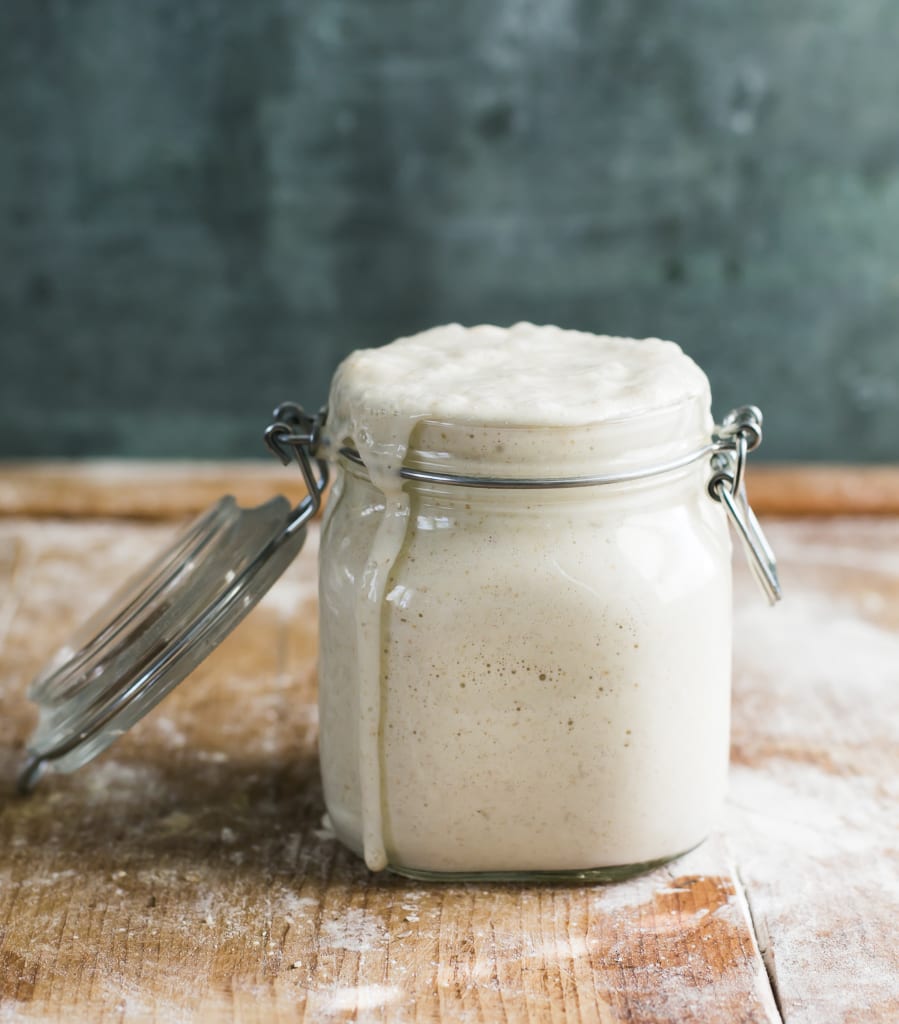
Jar of Sourdough Starter | theclevercarrot.com
Sourdough starter

What Is Sourdough Starter?

A sourdough starter is a live, fermented culture of flour and water filled with wild yeast and bacteria from our environment. A small portion is added to sourdough bread dough to make it rise. Commercial yeast IS NOT required.

Sounds a bit weird, right? Of course it does. Know this: natural “wild” yeast is all around us. It can be found in a bag of flour, in the air, on your hands etc. Just because you can’t see it, doesn’t mean it’s not there and doing its thing. It’s like magic.

How Long Will It Take?

To create a sourdough starter from scratch, the overall process will take 7 days (or more) from start to finish. It’s not instant. First, you’ll create the starter with whole wheat flour to jumpstart fermentation. Then, you’ll continue to feed it with regular all purpose flour or bread flour to cultivate the wild yeasts and friendly bacteria. Once it’s created, you’ll keep it alive with ongoing feedings and care, which you can read about here.

When Will It Be Ready To Use?

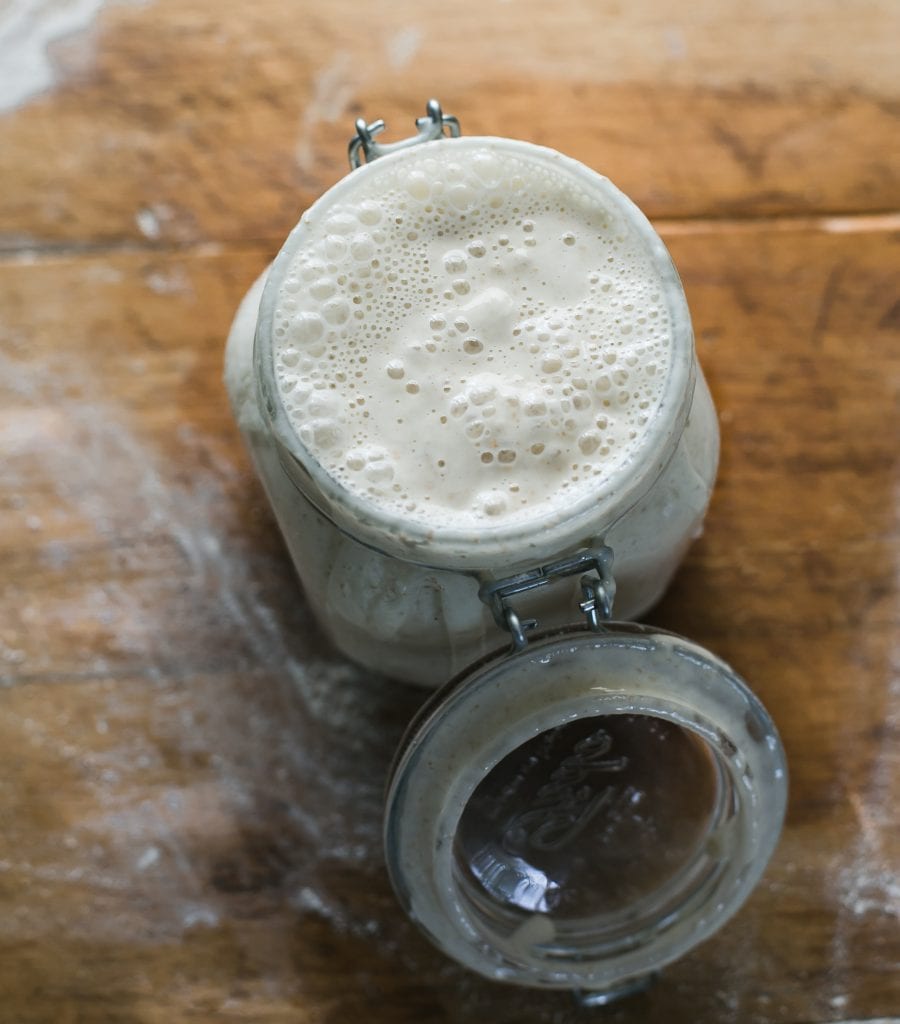
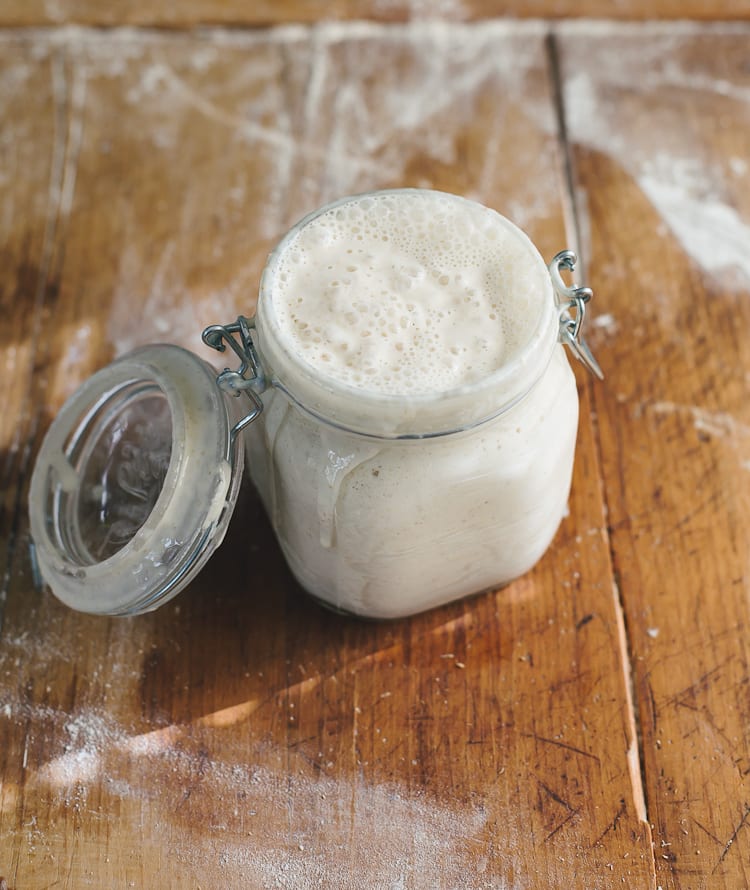
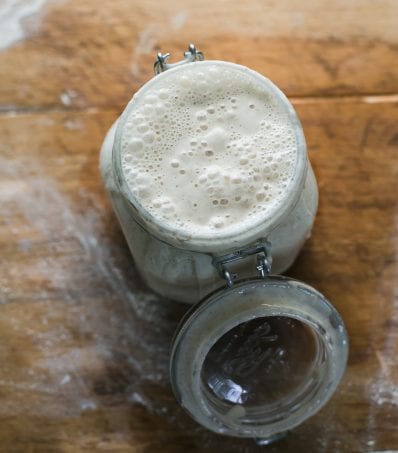
Your starter is ready to use when it has doubled in size, with plenty of bubbles on the surface and throughout the culture.

NOTE: It’s not uncommon for it to take up to two weeks or more for the starter to become active. It all depends. I know this timeframe sounds a bit vague, but growing yeast in a jar (that’s basically what you’re doing) can be unpredictable at times. Please be patient if the process takes time for you- it’s normal.

Is It Difficult To Do?

Absolutely not! In short: you’re basically adding flour and water to a jar, feeding it with more flour and water and waiting for it to become bubbly, active and double in size. That’s it. Most of your time involvement is hands-off. Can I ask you a favor though? Don’t overthink it. There’s a ton of sourdough information out there, and you will fall down a major rabbit hole if you start poking around. Just stick to this tutorial for now, follow the steps as written and just go for it.
Sourdough Starter | theclevercarrot.com
Sourdough starter

Beginner Sourdough Starter Recipe {Step-By-Step}

You Will Need:

Supplies

  • 3/4 L jar (I use this one)
  • Digital scale
  • Small rubber spatula

Ingredients

To create the sourdough starter on Day 1:

  • 60 g (1/2 cup) whole wheat flour
  • 60 g (1/4 cup) water

To feed the sourdough starter each day (Days 3-7):

  • 60 g (1/2 cup) unbleached all purpose flour or bread flour
  • 60 g (1/4 cup) water

NOTE: Use regular, unbleached all purpose flour or bread flour for best results. I use flour from KAF, Trader Joe’s or Whole Foods. As for organic flour, I first learned that it wasn’t always successful when first creating a sourdough starter (sourdough can be finicky). However, due to the widespread use of glyphosate, I’ve been inspired to re-test with organic flour. The results were good. Please experiment with what resonates. For the water, filtered or tap water is fine. Use the latter if you know it’s mostly chemical/chlorine free. 
Sourdough Starter with Whole Wheat Flour | theclevercarrot.com

Day 1: Make The Sourdough Starter

  • First, download and print out this chart. It’s your daily “at a glance” feeding schedule to keep you on track.
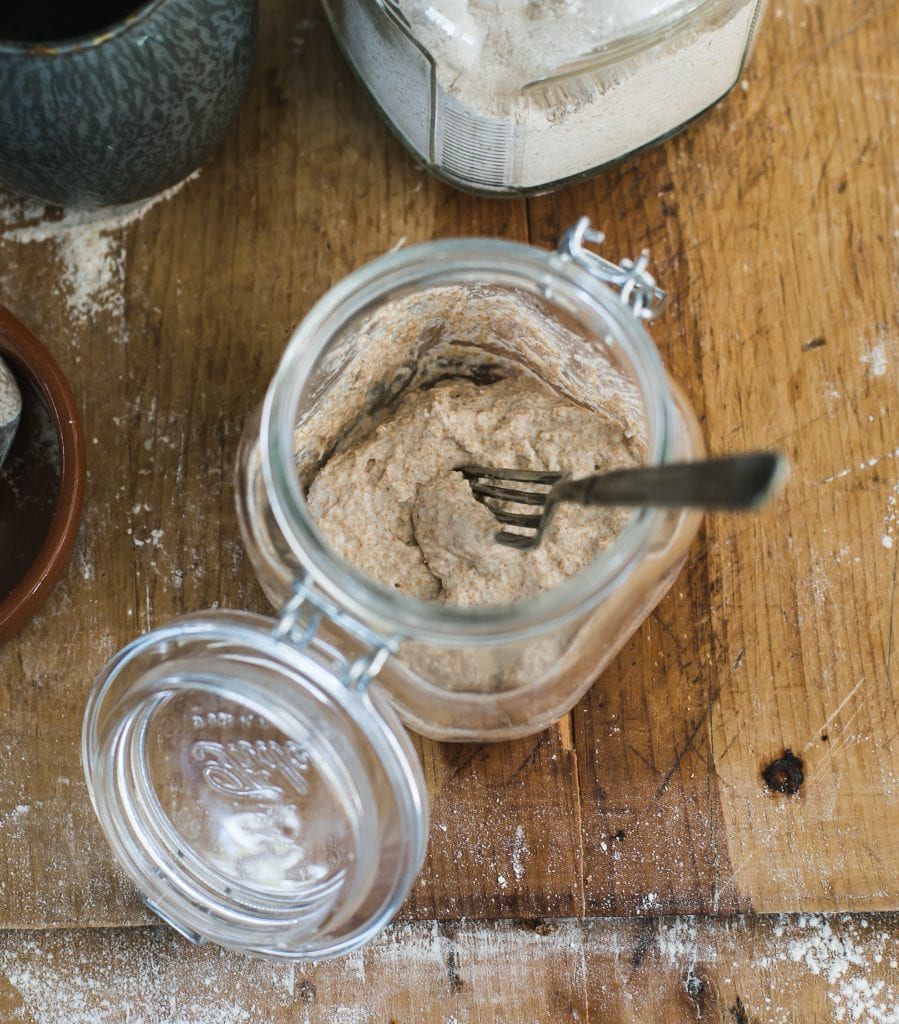
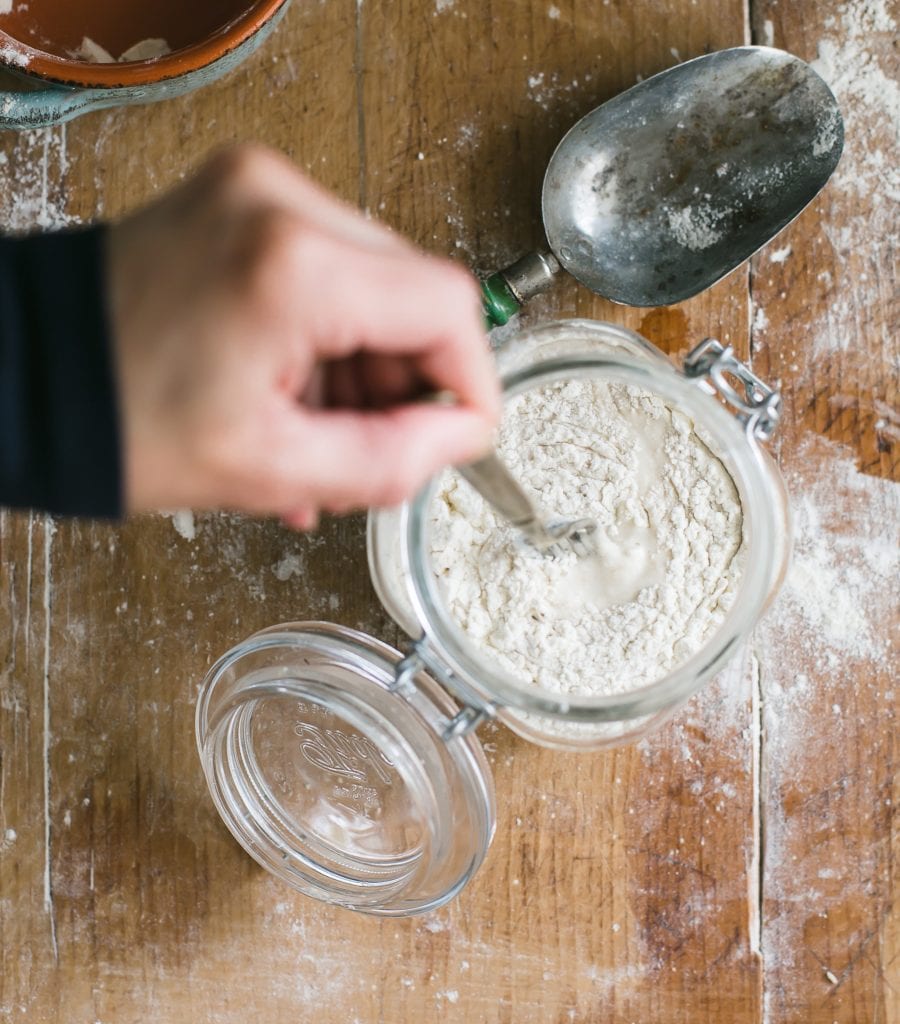
  • Add 60 g (1⁄2 cup) of whole wheat flour and 60 g (1⁄4 cup) of water to your sourdough starter jar. Total yield: 120 g sourdough starter.
  • Mix with a fork until smooth; the consistency will be thick and pasty.
  • Cover with plastic wrap or a lid, and let rest in a warm spot, about 75 F for 24 hours.

Temperature Tips: Temperature is very important. If it’s too cold, your starter won’t rise and the process will take longer. Consider the following tips if you’re looking for a warm, 75 F spot. Place your starter on a cookie sheet inside the oven (turned off) with the light on for a only few hours to give it a boost (please don’t leave it there overnight- the environment will become too warm). Monitor the temperature with an oven thermometer. You can also use a proofing box set to your desired temperature, or a microwave with the door ajar and the light on.
Small Bubbles on Sourdough Starter | theclevercarrot.com

Day 2: Got Bubbles?

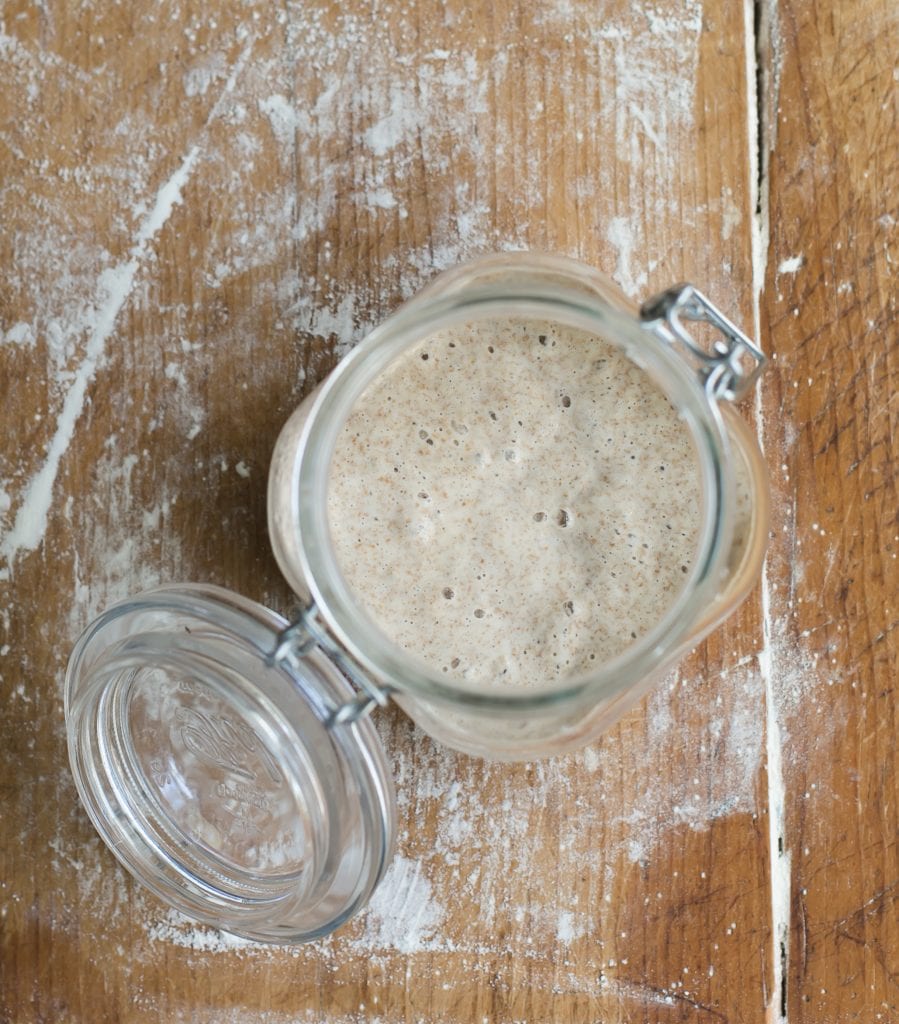
  • Today, you’re going to check if any small bubbles have appeared on the surface.
  • Bubbles indicate fermentation, which is what you want. However, it’s okay if you don’t see anything right away; the bubbles might have appeared and dissolved overnight while you were sleeping. This happens quite often.
  • You do not have to do anything else on Day 2. Just let it rest in your warm spot for another 24 hours. Feel free to stir once or twice to oxygenate the mixture.

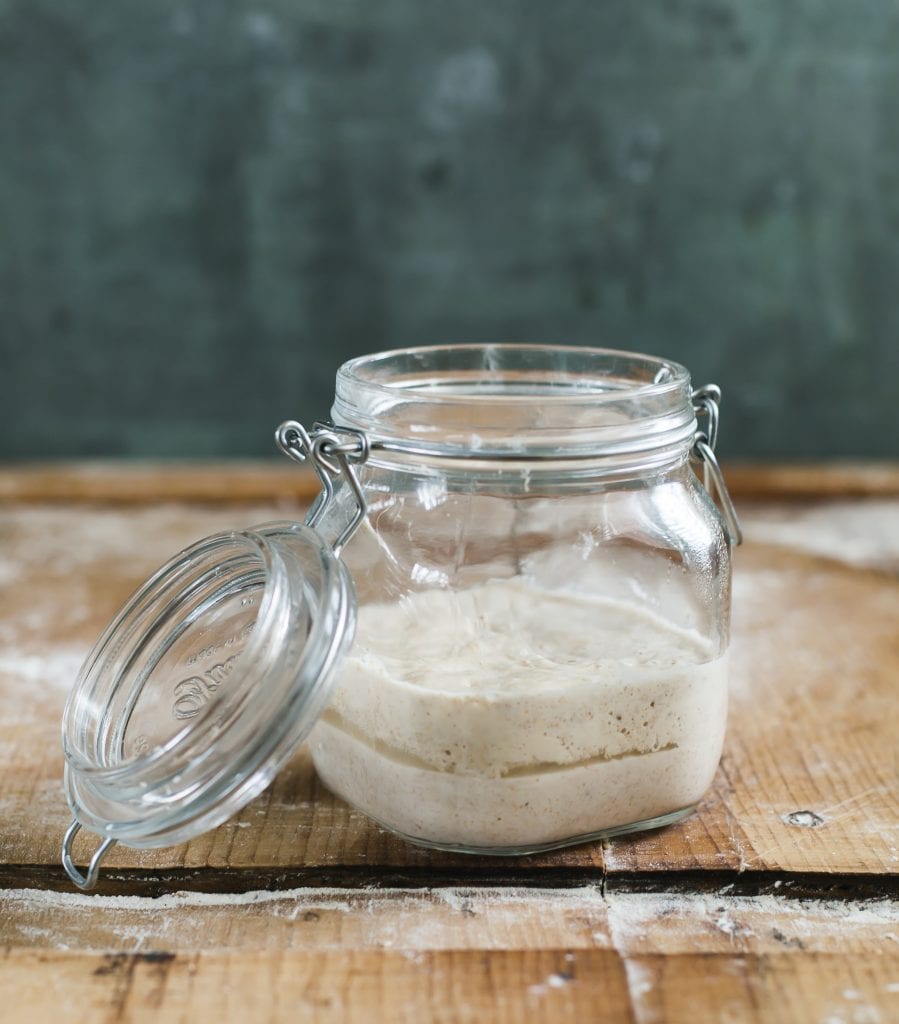
Tip: What’s That Brown Liquid? During the creation process, and even after your starter has been established, a dark liquid might appear on the surface (the image below shows the liquid in the middle of the starter). This liquid is called “hooch” and is an indication that your starter is hungry. It also has a very distinct smell, similar to rubbing alcohol or gym socks. This is normal. Don’t freak out. Any time you see this liquid, it’s best to pour it off before feeding it with fresh flour and water.
Sourdough Starter with Hooch | theclevercarrot.com
Feeding Sourdough Starter with Flour | theclevercarrot.com

Days 3-7: Feed Your Sourdough Starter

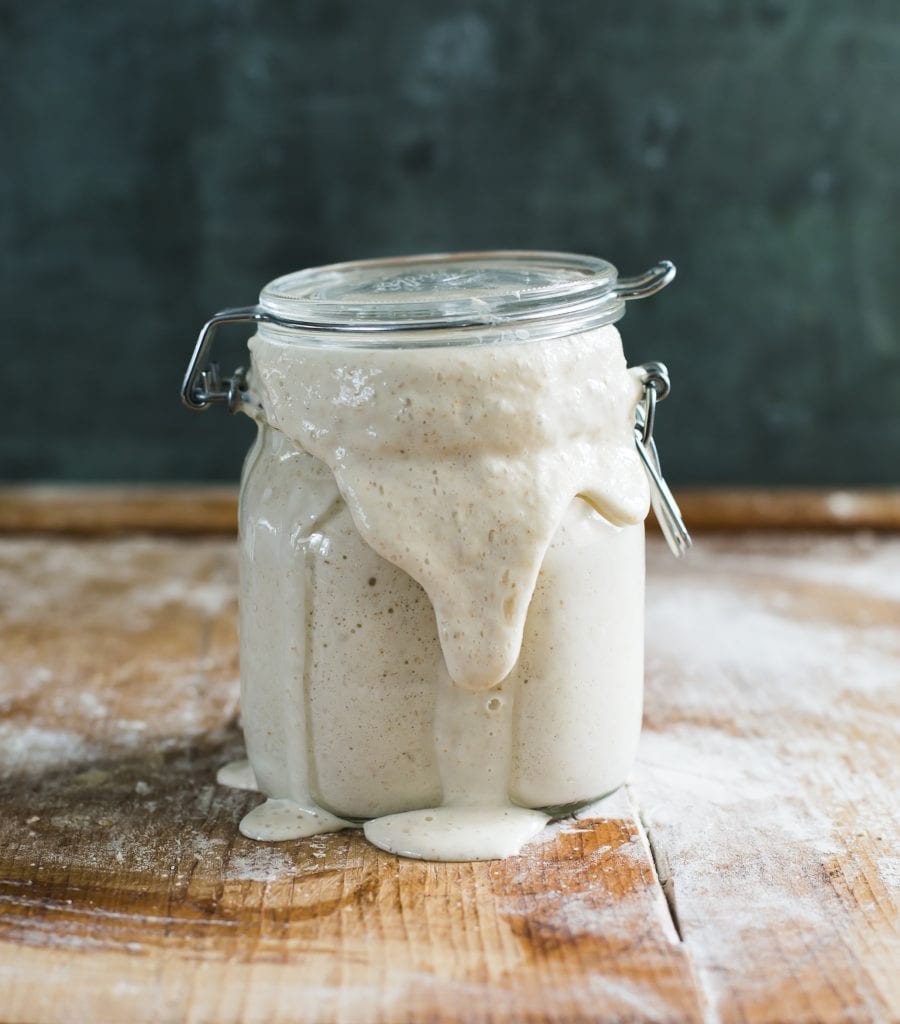
Whether bubbles are visible or not, it’s time to start the ongoing feeding process. As the natural yeasts begin to develop, your starter will rise. Bubbles will form on the surface. Eventually, your starter will fall back down or “collapse” indicating that it’s time to feed it again. The goal: is to increase the total quantity to about 236 g (1 cup) following the specific feeding ratio outlined below on each day.

Before you begin, a few tips for success:

  • Establish a feeding schedule. Feed your starter at the same time each day. This will train your starter to rise and fall predictably, which is what you want. Consider feeding your starter in the morning when you wake up. Again, this is where my feeding chart comes in handy.
  • Track the growth. Place a rubber band or piece of masking tape around the jar to measure the starter as it rises. When it falls, you’ll see streaks of starter on the sides of the jar.
  • Keep your jar clean: Use a small rubber spatula to scrape down the sides of the jar to prevent mold growing up the sides.
  • Be patient. This is a slow, gradual process. Remember: temperature (75 F) and consistency (daily feedings @ approximately the same time each day) is key.

Day 3:

  • Remove and discard half (60g) of your sourdough starter from the jar. To do so: use a spoon to scoop it out, or pour the starter directly into a bowl to weigh (you can also just eyeball it- the amount doesn’t have to be exact). The texture will be very stretchy.
  • To the jar: Add 60 g (1⁄2 cup) of all-purpose flour + 60 g (1/4 cup) of water. Mix with a fork until smooth. Scrape down the sides with a small rubber spatular. The texture should resemble thick pancake batter or plain yogurt at this point.
  • Cover and let rest in a warm spot, 70-75 F for 24 hours.
  • Total yield: 180 g starter.

Day 4:

  • Remove and discard half (90 g) of the sourdough starter.
  • To the jar: Add 60 g (1⁄2 cup) of all-purpose flour + 60 g (1/4 cup) of water to the jar. Mix well and scrape down the sides.
  • Cover and let rest in a warm spot for 24 hours.
  • Total yield: 210 g starter.
  • Note: The growth of your starter might appear to slow down on Days 3-4, after switching to all purpose or bread flour for the ongoing feedings. This is normal. Your starter needs more time to adjust. Be patient.

Day 5:

  • Remove and discard half (105 g) of the sourdough starter.
  • To the jar: Add 60 g (1⁄2 cup) of all-purpose flour + 60 g (1/4 cup) of water. Mix well.
  • Cover and let rest in a warm spot for 24 hours.
  • Total yield: 225 g starter

Day 6:

  • Remove and discard half (112 g) of the starter.
  • To the jar: Add 60 g (1⁄2 cup) of all-purpose flour + 60 g (1/4 cup) of water. Mix well and scrape down the sides.
  • Cover and let rest in a warm spot for 24 hours.
  • Total yield: 232.5 g starter

Day 7:

  • Remove and discard half (116.25) of the sourdough starter.
  • To the jar: Add 60 g (1⁄2 cup) of all-purpose flour + 60 g (1/4 cup) of water. Mix well, and scrape down the sides.
  • Cover and let rest in a warm spot for 24 hours.
  • Total yield: 236 g starter

Jar of Sourdough Starter | theclevercarrot.comJar of Bubbly Sourdough Starter | theclevercarrot.com

Day 7-8: A Sourdough Starter Is Born!

  • By now, your sourdough starter should have doubled in size. You should see plenty of bubbles, both large and small. The texture will now be spongy, fluffy, and similar to roasted marshmallows (think: s’mores). It should also smell pleasant and not like stinky gym socks. If these conditions are met, your starter is now active.
  • The very last step is to transfer your sourdough starter to a nice, clean jar. Do this only if your current jar needs a good scrub. Otherwise, leave it as is.
  • In keeping with tradition, you can also name your sourdough starter (and please do). My starter is called Dillon after my oldest boy. It’s bright and bubbly, just like him ;)
  • Now you’re ready to bake. Start with my beginner sourdough bread recipe- you’re going to love it!

Feeding & Maintaining Sourdough Starter For Ongoing Care

So you’ve created a sourdough starter! Now what? Just like any living creature, your starter must be kept alive with regular feedings, proper storage, and ongoing care to keep to maintain its strength. If your starter is not strong, your bread will not rise. Once you’re starter is established, read my companion article to learn exactly how I do it- Feeding Sourdough Starter: My Best Tips & Tricks. Have more questions? Read troubleshooting your sourdough starter.

Note: You will need to feed your starter every time prior to making bread dough and to maintain it (keep it alive).

How To Store Sourdough Starter

At Room Temperature: If you bake often, let’s say a few times a week, store your starter at room temperature. This will speed up fermentation, making the starter bubbly, active, and ready to use faster. Room temperature starters should be fed one to two times a day, depending on how quickly they rise and fall.

In the Fridge: If you don’t bake that often, store your starter in the fridge covered with a lid. You’ll only need to feed it about once a week or so to maintain its strength when not in use (you can just feed it cold and then pop it back in the fridge right afterwards; no need to warm it up first). When you are ready to make dough, feed your starter at room temperature as needed, to wake it back up.

Frequently Asked Questions & Helpful Info:

1.) What If my starter is not ready after 7+ days?

Feed every 8-12 hours (not 24) and continue the same formula: Discard half starter. Feed (Add): 60g flour & 60g water and store at 70-75°F / 21-24°C. Too runny? Add an additional 1-2 tbs of flour. Note: the most common reason for your starter not starting is cold temperature.

2.) Can this sourdough starter be made with all purpose flour only?

Yes. The process might take a little longer.

3.) Can sourdough starter be made with bread flour only?

Yes. Because it’s more “thirsty” than AP flour, add more water if the texture is too thick.

4.) Can this sourdough starter be made with whole wheat, spelt flour or rye flour only?

Yes. Like bread flour, whole grain flour absorbs more water than all purpose flour, so adjust the texture with additional water your starter is too thick.

5.) Can sourdough starter be made with bleached flour?

Yes. But it’s not recommended. The chemicals can throw off the fermentation process. Some readers have reported success, however. Your choice!

6.) Why do you use whole wheat flour in the beginning of the recipe? And then switch to all purpose flour for the ongoing feedings?

Whole wheat flour is used to jumpstart the fermentation process. All purpose flour or bread flour is used for the ongoing feedings because it’s inexpensive, practical and suitable for everyday baking.

7.) On Days 3 & 4, my starter is not as bubbly compared to Days 1 & 2. Growth is slowing down. Why?

As mentioned in question #5, whole wheat flour is used in the beginning to jumpstart fermentation. This is why you saw bubbles right away. When you switch to all purpose or bread flour for the ongoing feedings, growth will inevitably slow down on Days 3-4, as your starter needs time to adjust to the new flour. This is normal. Growth is still happening.

8.) For the daily feedings, you mention to feed your starter “equal parts” flour and water by weight. For example: 60 g (1⁄2 cup) flour + 60 g (1⁄4 cup). But the volume conversions (measuring cups) are not equal. Is this a typo?

No. It’s not a typo. “Equal parts” refers to feeding by weight only. Not measuring cups. Here’s why: different ingredients weigh different amounts based on density. For example 1 cup of flour can weigh anywhere from 125-150 g depending on how it was packed into the measuring cup. 1 cup of water can weigh anywhere between 236-250 g. Because weights are constant, it streamlines the process for accuracy. It is the preferred measuring unit in bread baking. The volume approximates are listed for convenience because not everyone has a scale.

9.) Can I use the sourdough discard from Day 1-7 for something else?

In the beginning, I typically don’t recommend using the discard (it’s usually really smelly and discolored). I recommend using the discard after the starter has been established. However, everyone will have a different experience with this. If it looks good- use it! And yes, you can save it to create a new, separate sourdough starter if you’d like. For more info please read Sourdough Discard 101: Recipes & Faqs Answered.

By signing up, you agree to receive emails from The Clever Carrot. Unsubscribe at any time.
clock clock iconcutlery cutlery iconflag flag iconfolder folder iconinstagram instagram iconpinterest pinterest iconfacebook facebook iconprint print iconsquares squares iconheart heart iconheart solid heart solid icon
Beginner Sourdough Starter Recipe | theclevercarrot.com

Beginner Sourdough Starter Recipe

5 Stars 4 Stars 3 Stars 2 Stars 1 Star 4.9 from 743 reviews
  • Author: Emilie Raffa
  • Yield: appx. 236 g (1 cup)
  • Category: Sourdough Starter
  • Method: 1-Bowl
  • Cuisine: American
  • Diet: Vegan
Print Recipe
Pin Recipe

Description

Looking for an easy, sourdough starter recipe for beginners? Adapted from my bestselling book Artisan Sourdough Made Simple, follow my no-nonsense, step-by-step guide for practical tips, tricks, and ongoing care- anyone can do it. Use it to make my famous golden, crusty sourdough bread recipe.

Please read my notes below before you begin.

Notes, Tips & Expectations:

  • Download & print personal sourdough starter feeding chart {here}. 
  • The overall process takes ~7+ days, if the temperature is warm enough, ideally 70-75 F. However, it can take up to 2+ weeks or more for a strong starter to become established. Do not ignore the importance of temperature.
  • Growth will seem to slow down on Days 3-4. This delay is commonly called a “false” start. It’s also normal- the yeast needs time to cultivate. Please be patient!
  • You will need one large 3/4 L jar, or something of similar size (I use this one). Place a rubber band or piece of masking tape around the jar to measure the starter’s growth as it rises.
  • To clarify feeding your starter: “equal parts” refers to equal weights only, not measuring cups. Example: 60 g (1/2 cup) flour + 60 g (1/4 cup) water. Same weight. Different volume. Not a typo. Why? Flour is light, fluffy and full of air pockets, so it takes up more space in a measuring cup (but weighs less than water). Water is more dense and compact; it takes up less space but weighs more than flour. That’s why their cup measurements don’t match, even when their weights are identical. Many bakers get confused by this. I’ve included volume measurements for convenience since not everyone owns a scale. But, do choose one measurement system and stick with it for feeding!

Ingredients

Note: Once your starter is established, make your first loaf using my sourdough bread recipe.

  • 1x (5lb) bag all purpose flour or bread flour (I use either KAF, Trader Joe’s, or Whole Foods)
  • 1/2 cup (60g) whole wheat flour (I use KAF whole wheat)
  • Water, preferably warm around 85 F 


Instructions

Before you begin: Establish a feeding schedule. Meaning, feed your starter at the same time each day. This will establish consistency, which sourdough starters love. Consider feeding your starter in the morning when you wake up. 

Day 1:

  • Combine 60 g (1⁄2 cup) of whole wheat flour + 60 g (1⁄4 cup) of warm water in a large jar. Mix with a fork until smooth; the consistency will be thick and pasty. 
  • Cover with plastic wrap, reusable wax wrap, or a lid and let rest in a warm spot, about 70-75 F for 24 hours. Temperature is important.
  • Total approximate yield: 120 g starter

TIP: Looking for a warm, 75 F spot? Place your starter on a cookie sheet inside the oven (turned off) with the light on for only 1-2 hours (it can get hot in there, so keep you eye on it!). Center rack is best. You can also use a proofing box set to your desired temperature, or a microwave with the door ajar and light on.

Day 2: 

Check to see if any bubbles have appeared on the surface. If you don’t see anything, it’s okay. The bubbles might have appeared and dissolved overnight while you were sleeping. Feel free to stir once or twice to oxygenate the mixture.  Otherwise, you don’t have to do anything else now. Rest the starter for another 24 hours.

TIP: During the creation process, and even after your starter has been established, a dark liquid might appear on the surface and throughout the culture. It has a very stinky smell, similar to rubbing alcohol or gym socks. This liquid is called “hooch” and is an indication that your starter needs to be fed. It’s normal. Any time you see this liquid, it’s best to remove it along with any discolored starter present.

Day 3:

  • Remove and discard half (60g) of your sourdough starter from the jar. To do so: use a spoon to scoop it out, or pour it directly into a bowl to weigh (you can also just eyeball the amount- it doesn’t have to be exact). The texture will be very stretchy.
  • To the jar: Add 60 g (1⁄2 cup) of all-purpose flour + 60 g (1/4 cup) of water. Mix with a fork until smooth. Scrape down the sides with a small rubber spatular. The texture should resemble thick pancake batter or plain yogurt at this point.
  • Cover and let rest in a warm spot, 70-75 F for 24 hours.
  • Total yield: 180 g starter

Day 4:

  • Remove and discard half (90 g) of the sourdough starter.
  • To the jar: Add 60 g (1⁄2 cup) of all-purpose flour + 60 g (1/4 cup) of water to the jar. Mix well. Scrape down the sides.
  • Cover and let rest in a warm spot, 70-75 F for 24 hours.
  • Total yield: 210 g starter

Note: The growth of your starter might appear to slow down on Days 3-4, after switching to all purpose or bread flour for the ongoing feedings. This is normal. Your starter needs more time to adjust. Be patient.

Day 5:

  • Remove and discard half (105 g) of the sourdough starter.
  • To the jar: Add 60 g (1⁄2 cup) of all-purpose flour + 60 g (1/4 cup) of water. Mix well. Scrape down the sides.
  • Cover and let rest in a warm spot, 70-75 F for 24 hours.
  • Total yield: 225 g starter

Day 6:

  • Remove and discard half (112 g) of the sourdough starter. 
  • To the jar: Add 60 g (1⁄2 cup) of all-purpose flour + 60 g (1/4 cup) of water. Mix well. Scrape down the sides.
  • Cover and let rest in a warm spot, 70-75 F for 24 hours.
  • Total yield: 232.5 g starter

Day 7:

  • Remove and discard half (116.25) of the sourdough starter. 
  • To the jar: Add 60 g (1⁄2 cup) of all-purpose flour + 60 g (1/4 cup) of water. Mix well. Scrape down the sides.
  • Cover and let rest in a warm spot, 70-75 F for 24 hours. 
  • Total yield: 236 g starter

Day 8:

By now, your starter should have doubled in size. You should see plenty of bubbles, both large and small. The texture will be spongy, fluffy, and similar to roasted marshmallows (think: s’mores). It should smell pleasant, and not link stinky like gym socks. If these conditions are met, your starter is now active and ready to use!
 
Please keep in mind, if your starter is not ready at this point, which is quite common due to temperature issues (too cold), timing, and other factors, continue feeding it for 1-2 weeks or more. Be patient! 
 
The very last step is to transfer your starter to a nice, clean jar. You only need to do this if your jar is crusty looking and needs a good wash. Then, in keeping with tradition, name your starter. My starter is called Dillon, after my oldest boy.
 
Wondering if your starter is ready to use?

When your starter is fully active, do the float test. Feed your starter, wait for it to double in size, and then drop a teaspoon of bubbly starter into a jar of water; if it floats to the top it’s ready to use. 

Storage Options

If you bake often, store your starter at room temperature (feed it 1x-2x a day to keep it active). If you plan to bake only once in a while, store it in the fridge to preserve its strength (feed it 1x a week). When storing your starter in the fridge, there’s no need to bring it to room temperature first before feeding it. Just give it some flour and water and pop it back in the fridge.


Did you make this recipe?

Share a photo and tag us — we can’t wait to see what you’ve made!

Filed Under: Sourdough Starters

3,696 Comments

Previous Post: « Sourdough Baking Glossary
Next Post: Amazing Sourdough Waffles {Overnight or Same Day} »

Reader Interactions

Artisan Sourdough Made Simple |theclevercarrot.com

Artisan Sourdough Made Simple

A beginner’s guide to delicious hand-crafted bread with minimal kneading.

Buy now

    Leave a Comment & Star Rating Cancel reply

    Did you find this post helpful? By leaving a star rating and review, it will help others find my recipes and tutorials too. As always, thanks for your support! —Emilie

    Your email address will not be published. Required fields are marked *

    Recipe rating 5 Stars 4 Stars 3 Stars 2 Stars 1 Star

    Comments

  1. Matilda Attey says

    February 10, 2026 at 3:08 am

    Can I do this with half Rye flour half bread flour?

    Reply
    • Emilie Raffa says

      February 10, 2026 at 9:17 am

      Hi Matlida! Yes, you can. You’ll just have a different type of starter compared to mine (which is fine), with different visual characteristics.

      Reply
  2. Cherie says

    February 7, 2026 at 7:18 pm

    The post stated the starter is fed when bread is being made. I have a couple of questions – 1. Is the starter fed before or after the amount needed for the bread has been taken? 2. Does the feeding process at that point require discarding os half the contents of the jar?
    Also, when the starter is fed for maintenance, are we still discarding half of the starter before adding the flour and water?
    Thank you.

    Reply
    • Emilie Raffa says

      February 9, 2026 at 10:20 am

      Hi Cherie! Your starter needs to be fed before the amount needed is removed to make bread (it has to become active first). Then, you’ll feed what’s left in the jar with fresh flour and water to keep the process going. The feeding process always includes discarding. The amount doesn’t have to be half; that’s only what is indicated here because you’re creating a starter from scratch and it follows a different formula. Once it’s up and running you might decide to only discard a tbsp. It depends on what your starter looks like. And yes, you’ll continue to discard in maintenance as well.

      Reply
  3. Charlotte says

    February 5, 2026 at 1:45 pm

    My sourdough starter has gotten puffy and beautiful with a sweet smell but has this odd crusty film on top (and I’m convinced little fuzz of mold). Do I scoop that top off and throw away or is it all ruined?!

    Reply
    • Emilie Raffa says

      February 9, 2026 at 10:21 am

      Hi Charlotte! If it’s mold, I recommend throwing it out. If it’s just crusty, which can happen if it’s exposed to too much air, you can just peel of the surface crust, give the starter a good feeding, and continue to use it.

      Reply
  4. Judy says

    February 3, 2026 at 11:37 pm

    Can I use 00 flour instead of wheat?

    Reply
    • Emilie Raffa says

      February 9, 2026 at 10:22 am

      Hi Judy! Yes, you can use 00 flour. But the process might take longer (or faster!) depending on the protein content, wheat variety and if it’s Italian or American 00.

      Reply
  5. Kandi says

    January 28, 2026 at 5:58 pm

    I live in Bakersfield, CA, so even though it’s January, it’s not super cold, so I don’t turn on my heater. But it was cold enough to not be a prime environment for a sourdough starter to develop quickly. I have been diligent for 2.5 weeks, & finally came home to a bubbly starter flowing over the top of the jar, when it was only half full when I left. I’m so excited to finally make some bread! 🫶🏼

    Reply
    • Emilie Raffa says

      February 9, 2026 at 10:24 am

      This is such excellent feedback! Thank you Kandi! Patience and persistence are the two magic ingredients, and your diligence proves you can 100% succeed in less than ideal temperature conditions. Well done! 🙌🏻

      Reply
  6. Hilary says

    January 28, 2026 at 1:05 pm

    Hi! Maybe I misunderstood but can I feed my sourdough starter whole wheat?

    Reply
    • Emilie Raffa says

      February 9, 2026 at 10:26 am

      Hi Hilary! Yes, you can feed it with whole wheat if you prefer. You’ll just end up with a 100% whole wheat sourdough starter instead. To further clarify: whole wheat flour is only used to jumpstart fermentation in the recipe. Once that’s done, you then switch to white flour (bread or all purpose) for the ongoing feedings. Doing so creates a versatile starter suitable for a variety of sourdough bread recipes.

      Reply
  7. Naomi Burke says

    January 28, 2026 at 7:22 am

    Day 14 of following the recipe and Seymour is ALIVE!!!! I’m in chilly WI and had accidentally started feeding it bleached AP flour instead of unbleached. Excited to try my first loaf. Thank you for the mentorship!

    Reply
    • Emilie Raffa says

      February 9, 2026 at 10:28 am

      Welcome to the world Seymour! Love the name. And you are very welcome, Naomi. Thanks for sharing your experience 🥰

      Reply
  8. Cindy E says

    January 27, 2026 at 6:53 pm

    I’m struggling a bit. First attempt ended up with separated starter by day 4, which I threw out to start again. Realized my kitchen is very cold, so bought a starter warming plate. This time, my Day 4 had a crusty dry patch on top, which I incorporated into the discard. But 60g seemed like more than half. I’m weighing everything. I don’t know what Day 5 will bring, but I don’t think it’s going well. Any thoughts? I bought your book; it’s wonderful!!

    Reply
    • Emilie Raffa says

      February 9, 2026 at 10:32 am

      Hi Cindy! Next time, you don’t need to throw your starter out if it separates. The liquid usually forms on top, but sometimes you’ll see it in the middle (there’s an image in my book that shows this). Just pour it out if you can. The crusty dry patch is because your starter was exposed to too much air. Seal your jar with a lid. This will help. I don’t know where you are in the process now, but with consistent feedings and controlled temperature, you’ll have better results. Keep going!

      Reply
    • Harold says

      February 12, 2026 at 10:15 am

      I like this recipe

      Reply
  9. Kassy says

    January 27, 2026 at 1:10 pm

    This is my first time attempting to make sourdough and I’m feeling a little discouraged. I’m on day 4 for my starter and haven’t noticed any growth after feeding it on day 3 and also see a brown liquid up top that I believe is “hooch”. For day 4 I see I’m suppose to remove 90g but don’t think I even have that much in my jar. What should I do?

    Reply
    • Emilie Raffa says

      February 9, 2026 at 10:35 am

      Hi Kassy! You won’t see much happening on day 3-4. Your starter needs more time to cultivate yeast- this is normal. The brown liquid is also normal (just pour it off). Continue to feed your starter consistently, keeping it in a warm spot for best results. I’m not sure where you are in the process now, but if your amounts are off, you can always get back on track by working out the difference and adding that amount of flour/water back to the jar.

      Reply
  10. Youlande says

    January 27, 2026 at 2:43 am

    I found this explanation to be extremely helpful, as it’s very comprehensive. Could you please clarify how much of the beginner sourdough starter I should use when I start baking?

    Reply
    • Emilie Raffa says

      February 9, 2026 at 10:37 am

      Hi Youlande! Appreciate the feedback, thank you. In general, expect to use anywhere from 50g-150g of sourdough starter. It depends on the recipe you’re following. My sourdough starter recipe, which is what you’re looking at here, builds your starter up to approximately 1 cup (~236 g) so you’ll have enough to make any dough, plus more leftover to feed again to keep the process going.

      Reply
  11. Doris Chambers says

    January 26, 2026 at 9:57 pm

    Thank you. Still sounds confusing but it should be better after doing it one time.

    Reply
  12. Tea says

    January 26, 2026 at 8:56 pm

    Hi Emilie,

    I started this 3 days ago and went to do my 3 day feed and it’s got pink mould and smells quite horrible. I googled it and it’s stating to throw away? Do you know why this has happened?
    Cheers
    Tea

    Reply
  13. April says

    January 25, 2026 at 2:55 pm

    Hi Emilie! I have your book and love it. I’ve learned so much! After taking a break from baking for the last year, I want to start up again with my dried starter. I’m spending a few months away from home and brought my dried starter with me, but unfortunately forgot my copy of your book. I can’t seem to find the instructions on restarting on you website, can you help me? I’m not sure how much of the dried starter to use and how much it should be fed before I start baking again. Thank you!

    Reply
  14. Gabriel says

    January 24, 2026 at 11:40 am

    Hi! Thanks for the amazing recipe. I am on day 6, and it is not clear to me the feeding process after day 8. Quick questions:
    1) From day 8 on, how much should I feed and discard if I am baking once a week? Do I need to discard?
    2) How many grams of the starter should I use to make a sourdough? How much should I feed the remaining starter?

    Thanks.

    Reply
  15. Tonia says

    January 24, 2026 at 8:22 am

    Hello! I have a question about the whole weed flour. Do I only use it in day 1? Less and less is left in the jar with every feeding. I’m on day three now.

    Reply
  16. Jayne Ellis says

    January 24, 2026 at 7:17 am

    When you discard half the starter, do you stir it first? My bubbles are all on the top, so I’m not sure if I should stir it before discarding it.

    Reply
    • Emilie Raffa says

      January 24, 2026 at 9:39 am

      Hi Jayne! No, I don’t. I just pour it off straight from the top, especially when there’s dark liquid on the surface. I get what you mean about the bubbles- but don’t worry about discarding them. You can give the starter a stir afterwards to oxygenate the culture. That’s always a good move!

      Reply
      • Mandi says

        February 6, 2026 at 6:59 am

        Hello, I am day 4 and I made a mistake, I took away 60grams of the starter instead of 90 grams, and I already added the new flour and water and mixed it, what do I do now ? Do I prolong for another day ?

        Reply
  17. Joyce says

    January 23, 2026 at 11:53 am

    This is a good starter process for beginners nice and simple. Thank you

    Reply
  18. Baily says

    January 21, 2026 at 3:01 pm

    I am curious about the ratio of the feeds in your guide for making a starter, as they are less than a 1:1:1 – What I have seen other places all say you shouldn’t feed less than a 1:1:1 ratio, and even in your blog articles etc you use a 1:1:1, so why are we feeding less here?
    Apart from that questions, so far so good, I am only on day 4 but my starter has bubbles and has risen at least by double within hours of feeding. I have never made sourdough before so I am happy that it seems to be going well so far. I named her Doughchet, (like Crochet) as I am a crafter and thought it was cute haha.
    Fun tip for all the people wondering about where to keep their starter warm, my house is always cold and I keep her at the back of the counter right beside the fridge as the fridge coils give off a fair bit of heat! Seems to be working perfectly so far :)

    Reply
    • Emilie Raffa says

      January 21, 2026 at 6:56 pm

      Hi Baily! The ratio for creating a sourdough starter from scratch is different from the 1:1:1 feeding ratio. It’s intentionally designed to incrementally build up your starter to ~1 cup when the process is finished. You’ll switch to the 1:1:1 (or another ratio of your choice) for ongoing feeding and care. As you continue to learn about sourdough, you’ll read tons of conflicting info re: feeding ratios! It’s all good. It keeps this community lively! My advice is to look at them like guidelines, not black and white rules. All starters behave differently. PS: thanks for sharing your tip!

      Reply
    • Anna says

      February 1, 2026 at 12:22 pm

      I keep mine beside of my fridge where it’s warm also! NC is so cold right now. On day 4 here. Good luck and happy baking!

      Reply
  19. Krystel says

    January 21, 2026 at 1:32 am

    Hi
    Im on my day 7 and it double the size about like in 9 hours after I fed my starter in the morning. I also tried the float test it kind of float on the top if I put only a little bit, but if i put alot then it sinks. So im giving it a couple more days to strengthen my starter. Should I keep still feeding it once a day? Or twice a day?

    Reply
  20. Stacy says

    January 19, 2026 at 11:26 am

    Thank you for sharing this starter recipe. I have been using this and following the directions each day. I am @27 grams short of your target 236g at the end of day 7. Should I continue to feed it to try and get to 237 or do the float test?
    Thanks for any help or tips.

    Reply
    • Emilie Raffa says

      January 21, 2026 at 12:06 pm

      Hi Stacy! This is 100% ok. And normal. Variables like temperature, evaporation, leftover starter on your mixing utensil can throw the total amount off. The final yield is approximate. If your starter is ready, go ahead and do the float test. No need to build it up further if it’s active. Hope this helps!

      Reply
  21. Jolie says

    January 15, 2026 at 4:04 pm

    Hi I’m trying out my first starter since im home recovering from surgery. I started it on January 13th. On the 14th there was no change. I did put it in my oven overnight as my house is on the cooler. I live in the northeast. Today, January 15th i have a few bu bubbles and it’s a little runny. Did I mess it up? I went ahead and fed it and left it on the counter. I’m tempted it put it in my oven again because I’m always cold, so I’m assuming its not warm enough at room temp. Would I benefit from a proofing box? Help I want this to work. Thank you for your step by step instructions, it’s so very appreciated and helpful!

    Reply
    • Emilie Raffa says

      January 21, 2026 at 12:08 pm

      Hi Jolie! The overall process takes a minimum of 7 days, and in some cases, up to two weeks to activate. In my experience, the biggest factor hindering growth is temperature and in consistent feedings. Make sure to leave it in a warm spot, ideally 75 F (try a hot water bath on the counter first before purchasing a proofing box or sourdough starter home) and feeding it at the same time each day.

      Reply
  22. Teresa Bozovich says

    January 14, 2026 at 12:05 pm

    Tried to create a starter twice…fail. Found your recipe and blog, tried one more time…SUCCESS! “Chancho” is alive (Nacho Libre little fluffy character). I’m on day 14 and my starter almost tripled in size yesterday!!! Been feeding twice (after day 8 and not seeing too much action), boosted with half whole wheat/half bread flour. Timing it so that I can give it a go tomorrow at making my first loaf. So exciting!!!

    Reply
    • Emilie Raffa says

      January 21, 2026 at 12:09 pm

      Love this! Congrats! The bread flour/whole wheat boost worked nicely. Have fun baking!

      Reply
  23. Megan says

    January 13, 2026 at 8:34 am

    I really want to take the sourdough baking plunge and am trying to understand the process and gather my supplies. I am seeing kits online that include starters. I am wondering the difference in making my own starter vs. using a starter marketed as “100 year old French starter”?

    Reply
    • Emilie Raffa says

      January 21, 2026 at 12:17 pm

      Hi Megan! Simply put: the 100 yr old starter is already established and mature. Mature starters tend to be more reliable and predictable in performance- they’ve been kept alive and well for decades! Plus, you don’t have to go through the 7-10 day creation process when making a starter from scratch; you basically feed it per the instructions it came with to re-activate. I don’t know what kind of customer support comes with it. Comparatively speaking, when you make one yourself, it’s considered a younger starter. It will still perform, just a little bit differently.

      Reply
    • Jackie's says

      February 1, 2026 at 7:35 am

      Hi I followed the ingredients as per your recipe using cups but the starter was very ‘shaggy’ dry so had to add a little more water. Will it still work do you think? Its thick and pasty now I’ve added the extra

      Reply
  24. Cassie says

    January 12, 2026 at 7:41 pm

    I accidentally used whole wheat flour on the fist feeding (day 3) instead of all purpose. Is that ok? I’ll switch to all Purpose after this. Thanks so much for this beginners recipe!

    Reply
    • Emilie Raffa says

      January 21, 2026 at 12:17 pm

      All good! You can easily fix this using regular flour for the ongoing feedings. Not a problem.

      Reply
  25. Maddie Tillem says

    January 10, 2026 at 6:40 pm

    It has been two weeks and my sourdough starter hasn’t risen at all except for the false rise on day three. What can I do to make it rise faster?

    Reply
    • Emilie Raffa says

      January 21, 2026 at 12:18 pm

      Hi there! Make sure to leave it in a warm spot 75 F+ (try a hot water bath on your counter), feed it at the same time each day, and if it’s very watery add 1-2 tbsp of additional flour for a boost.

      Reply
  26. Mia says

    January 10, 2026 at 2:10 pm

    How much do you feed it after day 7

    Reply
  27. Brenda Penn says

    January 9, 2026 at 1:28 pm

    Hi Emilie,
    Brenda here from Yahk/Kingsgate BC. I have been following your days of feeding sourdough starter only to realize I was using 60g of water and 60g of flour in the same measuring cup with no results. Yesterday I used proper measuring cups, one for liquid and one for dry measuring.
    In your outline, you state the amount to discard, for example, from Day 3: Remove and discard half (90 g) of the sourdough starter. I am assuming the(90g) is the discard, or is it what you’re left with to feed?

    Reply
  28. Kristen says

    January 8, 2026 at 6:23 am

    Hi,
    After day 7, how much do you discard and feed, if you think your starter needs more time.

    Thanks!

    Reply
  29. Racina Ventrello says

    January 5, 2026 at 11:18 pm

    Hello! I am on day 5 of my starter and I have been feeding it APF can I switch to Bread flower from now on as I am running low on the all purpose flour.

    Thank you

    Reply
    • Emilie Raffa says

      January 21, 2026 at 12:19 pm

      Yes, absolutely. Bread flour is fine!

      Reply
  30. Janice Siminiuk says

    January 5, 2026 at 1:05 am

    I followed your instructions perfectly. Then I thought I put the completed starter in my fridge as I wasn’t ready to use it. But OH NOOOO I put it in the freezer by mistake 😭 Is it destroyed?

    Reply
    • Emilie Raffa says

      January 21, 2026 at 12:20 pm

      Hi Janice! In all the years I’ve been doing this, your comment is the first ever of its kind! Is it destroyed? I don’t know. Starters can be temperamental; you’ll have to feed it at room temperature over the course of several days to see if it re-activates. Keep me posted!

      Reply
  31. Megan says

    January 3, 2026 at 7:08 pm

    I’ve become overwhelmed with baking and so I’m planning to keep my starter in the fridge and feed it weekly. My qustion is, if I take it out of the fridge friday morning and feed it – using it to start a loaf friday night – should I just leave it out after feeding?
    And if I’m using a recipe that needs active starter, does that mean I should feed it again Friday night? Is it “active” right after feeding or do I need to wait for the bubbles and the growth (which I would see by Friday night!)

    Reply
    • Emilie Raffa says

      January 21, 2026 at 12:24 pm

      Hi Megan! Yes: feed your starter on Friday morning and leave it out at room temperature in a warm spot to activate. Hopefully it’s ready by the time you want to start the dough (everyone’s starter has a different rise time- warmth helps!). Your starter is not active right after feeding it. It needs time. You need to look for the signs of readiness which include at least double in volume, and bubbles on the surface and throughout the culture.

      Reply
  32. Emily says

    January 3, 2026 at 10:01 am

    I notice that you use a mason jar type for the starter, do you close the cover completely so it is tight or just cover?

    Reply
    • Emilie Raffa says

      January 21, 2026 at 12:25 pm

      Most of the time I keep it completely sealed. Other times, I’ll just rest the lid on top.

      Reply
  33. mario says

    December 30, 2025 at 9:11 pm

    Don’t make this complicated? It’s very simple? LOL…Look at the list of directions and the steps involved to create this starter! Do yourself a favour…either spend the 5$ and purchase a live starter on marketplace, or just buy a sourdough bread freshly made for the same price every morning at your local grocery chain! Now that’s simple and worth it! Or spend 7 days and a few hours trying to prepare this the right way to save a handful of dollars and hope it comes out right! LOL No thank you!

    Reply
    • Chris says

      January 4, 2026 at 9:18 am

      Those of us that make our own sourdough starter and bread – enjoy it, find it relaxing, and personal pride in the accomplishment. Made with love to share with family and friends. Why knit a sweater or make your own furniture? – because we choose to – we love doing it.

      The only reason to be on this site is if you want to make something delicious from scratch. So try it before you knock it or please take your negativity elsewhere. Find a hobby creating something from scratch – you’ll see.

      Reply
      • Emilie Raffa says

        January 21, 2026 at 12:26 pm

        Chris, thank you for your kind support.

        Reply
  34. EDEN NAVARETTE FLORESCA says

    December 29, 2025 at 7:01 pm

    Hi! I’m on my 11th day, but there’s only a little lift, maybe 0.25 inches. It has small bubbles, consistency is just like pancake batter. It’s been cold and I put my starter jar on top of my Wifi router as the temp there is warm and constant. On the verge of giving up! Appreciate some tips, thank you in advance!

    Reply
    • Dawn says

      December 31, 2025 at 2:48 pm

      Hi I put my jar on a heat register, it doubles overnight every time

      Reply
    • Sara says

      January 4, 2026 at 1:49 am

      Add 2g of sugar

      Reply
      • Samantha says

        January 11, 2026 at 3:46 am

        Adding sugar will ruin the whole purpose of making sourdough! We make it with simple flour and water to ensure it’s as healthy as possible! Sugar to artisan loaves maybe but don’t mess with the simplicity of authentic good sourdough. Sugar is so bad for you! Sourdough left alone has amazing health benefits and is fab for your gut microbiome. Please do not add sugar!

        Reply
  35. Debbi Propp says

    December 27, 2025 at 11:12 am

    What part of the USA is producing roundup flour? You mentioned that glyophosphate flour doesn’t work as well. What brand do I avoid. There is a few brands here in rural areas because of size we don’t have access or the money to purchase trader joes or KAF

    Reply
  36. Tiffany Ruble says

    December 27, 2025 at 9:13 am

    Hello and thank you for the detailed explanation and love that there are pictures as well! I was wondering, what do you do with all of the discard? And when your starter is established and you begin using it to bake, should the starter be doubling in size every time you discard and feed?

    Reply
  37. Ingo says

    December 25, 2025 at 12:20 pm

    this is my first time trying, since I’m in Cancun it is extremely hard to maintain the Temperature, after searching for a long time I found a sourdough Incubator online ( cooling and warming), just big enough to hold a 1L jar. , the second challenge is/was to find a flour that has more than 10% protein, I finally found 11.5%, It’s ok to start with whole wheat but In general I don’t like Whole grain flour. Measuring the weight of 1/2 cup of flour was actually 78g so I adjusted the water.accordingly.I also bought Rye flour because that is my end game.sourdough rye bread. also only 10% than I found online I also found Vital Wheat Gluten (VWG) to raise the protein level I ordered it but I will start a starter without it for the first time. I keep my progress updated.

    Reply
  38. Amanda says

    December 24, 2025 at 11:00 pm

    I’ve been working on making my first ever sourdough starter since December 10th with the help of this recipe. I just baked my first ever sourdough bread this Christmas Eve and it’s golden and crispy! Can’t wait for it to cool down so I can cut into it and hopefully have a tasty bread to celebrate Christmas morning!
    Thank you for making this recipe and sharing it with us all – you made it easy to follow, easy to understand, and made it an exciting journey!

    Reply
  39. Dawna says

    December 24, 2025 at 2:41 pm

    Hello,
    I would like to have use less flour, water and starter perportions. How low can I go? 25 gm starter, 50 water and 50 flour? (10 of which is rye)

    thanks

    Dawna

    Reply
  40. Chriss Melancon says

    December 21, 2025 at 10:25 pm

    I’m on day 2 of my starter. K made the executive decision (ha ha) to use King Arthur wheat & all purpose flour. Seeing how active the bubbles are becoming, it was a good choice. Thank you for making something that I considered ‘too intimidating’ actually very simple. *I prayed over it, too. That couldn’t hurt! 😆
    I’m hopeful!!!

    Reply
  41. Joane Azenha says

    December 21, 2025 at 4:44 pm

    Hi Emily! Thanks for this amazing and easy to follow guide. It’s my first time making a sourdough starter, though I have always wanted to try. I am on day 8 and it looks and smells really good. Silly question: From now on, how much do I feed it and do I still need to discard some when feeding it?
    I am looking forward to many happy bakes with Clyde (I will by Bonnie in this relationship!)

    Reply
    • Jennifer Martinez says

      December 27, 2025 at 7:49 pm

      I have the same questions.

      Reply
  42. Cris says

    December 20, 2025 at 5:45 am

    This was incredibly helpful. You explained everything so detailed. Thank you!

    Reply
  43. Sandra B says

    December 20, 2025 at 1:57 am

    No need to throw out discard, whether for beginner starter or feeding. I use a 48 oz jar and add 1/8 of a cup daily and use weekly or bi-weekly or put in refrigerator. I’ll take it out the night before dough prep and add bread flour and water (50/50) it’s ready in the morning.

    And, thank you for your wonderful recipes, I am enjoying the experience!

    Reply
  44. Nandini says

    December 19, 2025 at 4:06 am

    I need some advice. I foolishly added half a cup of water along with half a cup of flour everyday for 7 days already. The starter did rise everyday and showed bubbles as in the recipe so I didn’t suspect anything and didn’t realize until today. This morning as well after feeding it incorrectly it has still almost doubled in size. Should I throw the starter away or still use it to make bread and how? Any help is much appreciated.

    Reply
    • Paige says

      December 22, 2025 at 7:57 pm

      I did the same thing! Though realized on day 5. I googled what to do and it’s still useable but had to discard 3/4 of it and feed it double the amount of what I had been feeding it. So one cup of flour and 1/2 cup water.

      Reply
  45. Callaway says

    December 18, 2025 at 11:34 am

    Worked great!

    Reply
  46. Meredith says

    December 18, 2025 at 8:48 am

    Hi! I’m on day 5 I believe, and have a few questions! First of all, when I first started my starter I used whole wheat flour and warm filtered water as per your measurements. The dough was immediately a pretty tough ball. My sourdough making sister said, no that’s no good. Try again. So I did, with APF, and got the same result however this time I stayed the course. I fed it on day 2 by accident, and the next day it was big and fluffy! Yay! Now, my sister also noticed on day 4 that it was so much starter and I likely won’t need that much getting started. SO..I switched to feeding it 1/4 cup bread flour and 1/8 cup water (after discarding more than usual so try to maintain relative amounts). Was this a huge mistake? I am ready to start fresh if I need to, but just hoping it’s ok!
    It also has not risen as much today and smells …funky, but no hooch.

    Reply
  47. Alabama Barb says

    December 12, 2025 at 1:25 pm

    I started my sourdough starter using Emilie’s recipe during Covid. It is still alive after 4 years and is happy in my refrigerator! I do not discard any of the starter before feeding it and do switch it to clean glass jars every so often. Truth told, these starters are tough and can be ignored for weeks (months) as long as refrigerated. Mine even survived a move:-)

    Reply
    • Emilie Raffa says

      December 17, 2025 at 10:33 am

      Sourdough starters are definitely more resilient than one would think! It’s such a learning process, one that each baker must experience to see understand the value. Thank you for sharing your experience!

      Reply
  48. Zann Reid says

    December 11, 2025 at 8:47 am

    I forgot to discard before feeding my starter, am on day 4. Will it be ok or should I start over?

    Reply
    • Emilie Raffa says

      December 17, 2025 at 10:41 am

      No need to start over! You can discard more at your next feeding to catch up. Focus on the consistency of your starter as your continue to fee it- it should look like thick pancake batter.

      Reply
  49. Erica says

    December 11, 2025 at 12:26 am

    This is my first time making a starter; I am using a glass jar with sealing, hinged lid. Can the lid be kept sealed tight during the making of a starter?

    Reply
    • Emilie Raffa says

      December 17, 2025 at 10:43 am

      Yes. You can keep it sealed shut or rest the lid on top. Either option is fine. Just a heads up about sealed jars: as your starter grows it will build up pressure which can potentially break the jar. Just keep your eye on it.

      Reply
  50. beth says

    December 6, 2025 at 8:29 pm

    Thanks. I started baking sourdough bread during covid, with great success! Now, the rabbit hole has captured me. No matter what I do, most of my loaves have hockey puck texture! I have always baked 50/50 white and wheat, in past have had better luck with AP than with bread flour..now I’ve tried it all to no avail. My home is not very warm; I have used oven lights to create warmer space–have tried both with and without using fridge for final proof (flop!). Now I wonder–I’ve been using rye flour in my starter, which is nice and bubbly–could that be the problem?
    Hope you can help me!

    Reply
    • Emilie Raffa says

      December 17, 2025 at 10:52 am

      Hockey puck loaves are very relatable- sadly we’ve all been there! But on the other side of this frustrating initiation is valuable insight. So, I’ll lead with this: when troubleshooting *any* sourdough bread recipe you need to treat it like a formula. If you make changes to the formula, or miss the indicated temperature for rise times and so on, the formula will break. You’ll end up with less than edible bread.

      Because I do not know the recipe you’re following, can you go back to your process line by line and spot any gaps? I would start there. Then feel free to circle back with any additional questions. PS: off the top of my head, I feel like rye in your starter is not the issue (unless you’re using a very big amount). Again, I’d have to examine your process.

      Reply
« Older Comments
Newer Comments »

Primary Sidebar

Meet Emilie

Hi! I’m Emilie, author of the best selling book: Artisan Sourdough Made Simple. I’m a bread baker, pasta maker, and head over heels for old world Italian recipes. Let’s cook together! More here: about Emilie.

Get the book

Artisan Sourdough Cookbook

Buy Now

Let’s Connect

  • Facebook
  • Instagram
  • Pinterest
  • Twitter

Popular Now

sourdough pizza
Tray of baked sourdough bagels
Soft Sourdough Cinnamon Rolls

Popular Sourdough Recipes

  • Sourdough starter
  • Sourdough bread
  • Sourdough focaccia bread
  • Sourdough pancakes
  • Sourdough pizza crust
  • Sourdough bagels
  • Sourdough cinnamon rolls
  • Sourdough sandwich bread
  • Sourdough pasta

Sourdough Tips + Techniques

  • How to feed sourdough starter
  • What sourdough starter container to use
  • Sourdough starter troubleshooting
  • How to stretch and fold sourdough
  • How to shape a round sourdough boule
  • What to do with sourdough discard
  • Sourdough bread fillings
  • My book, Artisan Sourdough Made Simple

Dinner Pastas & Sauces

  • How to make fresh pasta dough
  • Homemade ravioli
  • Arriabbiata sauce
  • Alfredo sauce
  • Pasta carbonara
  • Ragu bolognese sauce
  • Pomodoro sauce

Seasonal Staples

  • Brioche burger buns
  • Brioche rolls
  • Apple crumble
  • Butternut squash ravioli
  • Classic lasagna
  • Italian anise biscotti
  • Shortbread cookies

  • Privacy Policy
© 2026 Artful Spoon LLC + Design by Tara Hurst + Support by Foodie Digital
Bubbly, active sourdough starter in a jar