This homemade vegetable stock recipe uses onions, carrots, celery & fresh herbs to start, plus a wedge of Parmigiano Reggiano (the rind only) to elevate the taste. Use for soups, stews and risotto.

Vegetable stock was never my thing. Chicken stock was always my go-to, homemade or store-bought- it didn’t really matter. To me, the flavor was superior. But as a food writer, someone who constantly tests and re-tests recipes for a living, what is on my radar is the amount of food waste that comes out of my kitchen. There’s always a pile up and not enough people to consume it!
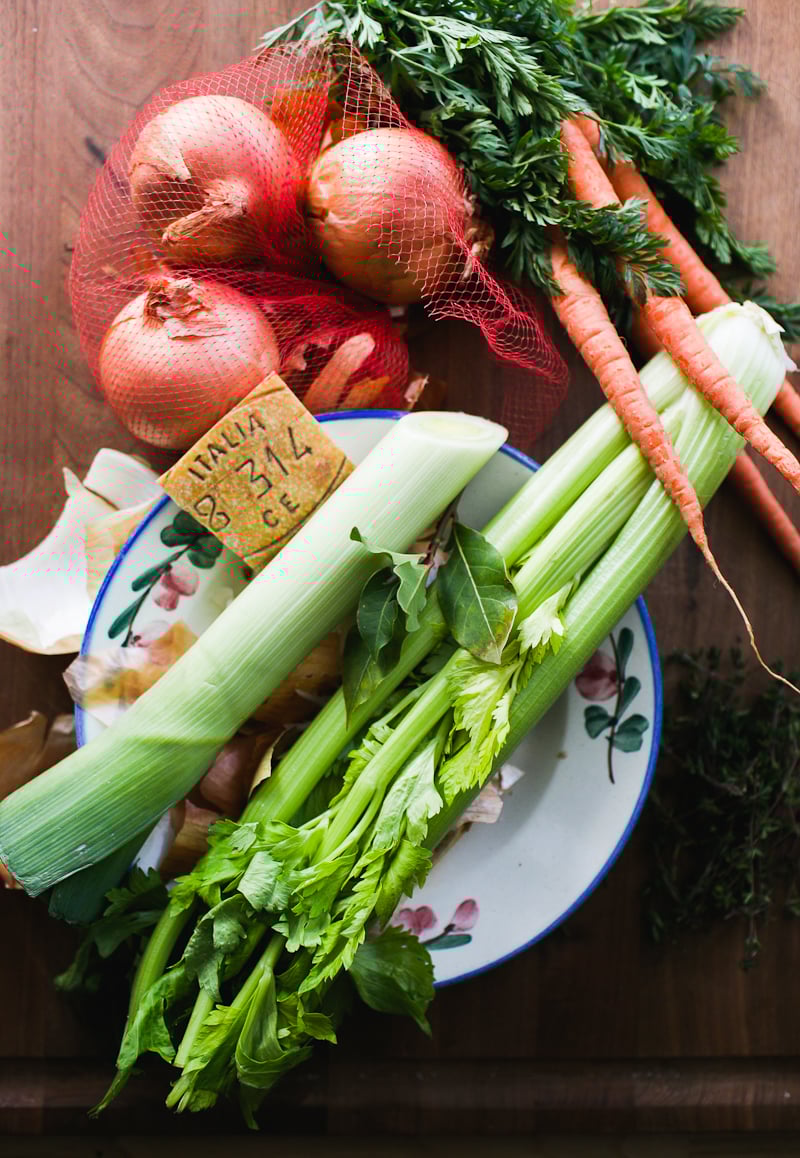
Turns out, homemade vegetable stock is an excellent no-waste recipe. Leftover, past their prime onions, carrots, and wilted celery become a flavorful base for future soups and risotto. Have some fresh herbs? Throw them in too. It’s literally as simple as chopping and simmering vegetables on the stovetop 1 hour. You just have to remember to do it. And when you do, you’ll save time, effort and money later on. I like to make vegetable stock, which tastes delicious by the way, while cleaning up the kitchen or doing other things around the house. Again, it’s just remembering to actually do it. I’m curious: what are some no-waste tips & tricks you do in your kitchen?
Watch The Vegetable Stock Video:
A Few Things:
- It’s all about the ratio. Not enough veggies + too much water = bland stock. Two pounds of vegetables to 10 cups of water is a good place to start. You’ll get about 1 quart vegetable stock. You can always double the recipe.
- Don’t go crazy with the vegetables. Onions, carrots and celery is your base. Add garlic if you want (I don’t use garlic; I add it to my actual recipe to control the taste). Fresh herbs such as thyme, rosemary and fresh bay leaves are perfect. Do not add broccoli (too strong) or sweet potatoes (too sweet).
- Add Parmigiano Reggiano. Yes, that’s right. The rind only. I learned this tip from Cucina Povera from which this recipe is based. It’s what makes this stock Italian-style for me. Great flavor! PS: some people save the cooked Parmigiano rind, dice it into small cubes, and eat it. I tried this. And although the rind is soft, the texture is a bit rubbery for me! Am I doing it wrong?
- Understand flavor. Vegeteble stock, the way I make it, is mild. It’s a blank canvas for you to build upon to create something new. If your stock is too strong, whatever you’re making will be that way too. Stock is not soup. It’s the beginning.
- How to use it: Try this vegetable stock recipe in my go-to Minestrone soup, my best-ever Italian lentil soup, this 30-minute butternut squash soup and more.
Italian Soup Recipes To Try:
This vegetable stock recipe is part of my 6-part mini series featuring warm and cozy Italian soups, perfect to serve with homemade sourdough bread. It can be used as a base to make incredible soup! See links below for inspiration.
By signing up, you agree to receive emails from The Clever Carrot. Unsubscribe at any time.
Homemade Italian-Style Vegetable Stock
- Prep Time: 10
- Cook Time: 1 hours
- Total Time: 1 hour 10 minutes
- Yield: 1 quart 1x
- Category: Homemade Stock
- Method: Stove-top
- Cuisine: Italian
- Diet: Vegetarian
Description
This homemade vegetable stock recipe uses onions, carrots, celery & fresh herbs to start, plus a wedge of Parmigiano Reggiano (the rind only) to elevate the taste. Recipe adapted from Cucina Povera by, Giulia Scarpaleggia.
Ingredients
About 2 pounds of mixed vegetables:
- 2 onions
- 2 medium carrots
- 1–2 stalks of celery
- 1 small leek, white and light green part only
- 4 sprigs fresh thyme
- 1 fresh bay leaf
- Parmigiano Reggiano rind, only
- 1 tbsp. flaky sea salt such as Maldon
- 10 cups water
Instructions
- Clean, trim and peel all vegetables (pay close attention to the leeks, they can be very sandy).
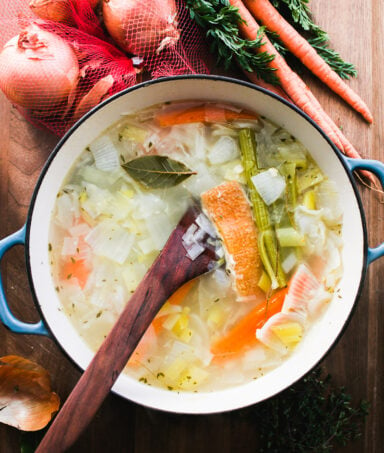
- Roughly chop the vegetables into large pieces; add them to a large pot. I use a wide, 5 quart braise pot.
- Add the thyme springs, bay leaf and Parmigiano Reggiano rind.
- Pour the water over the vegetables to cover.
- Bring the soup to a boil. Add the salt.
- Reduce the heat to medium-low, cover, and cook for 1 hour. After 1 hour, I like to remove the pot from the heat and let the stock sit on the stove for another hour. This gently infuses more flavor into the stock while it gradually cools down. Note: if you are using a different pot, not a wide, 5 quart braised like me, allow for more cooking time to reduce the stock if necessary.
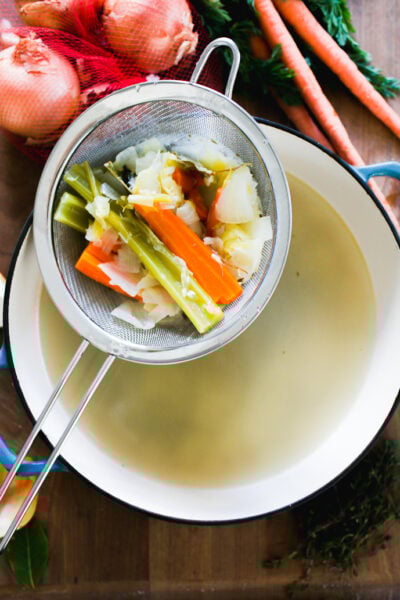
- Strain the soup, pressing down on the soft vegetables to release more liquid.
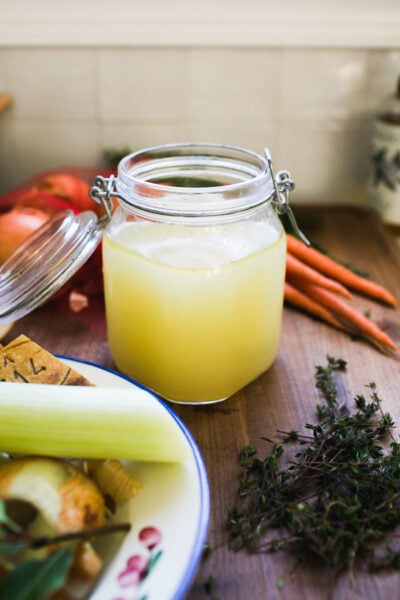
- Store your homemade vegetable stock in a glass jar or plastic quart container.
Note: Store homemade vegetable stock in the fridge (4 days) or in the freezer (up to 3 months). Make sure your container is freezer-safe!

Comments
Lisa says
For those of us who are novices can you tell us how to fire roast the vegetables? Thanks in advance.
Emilie Raffa says
Sure thing! I would drizzle the veggies in olive oil first, then place on a parchment lined sheet pan. Roast @ 400 F until light golden in color. Check to make sure there are no burned bits, which will make the stock bitter. When finished, simmer in water to create the stock. The only thing I might not roast, only because the flavor might be too strong, is the celery. PS: if you don’t want to turn on the oven, you can always sauté the veggies on the stovetop until golden (a Dutch oven is perfect for this), add your water, and simmer away. It’s a one pot situation with less clean up.
Colleen says
This sounds so simple and would work very well at my house! I’m wondering if you’ve ever tried roasting your veggies first? Would that add extra flavour to the stock or just remove all the goodness and flavour of the veggies? I’ve never made my own stock before (vegetable or otherwise), and think this would be an excellent idea. I am guilty of over buying vegetables and never having time to get them all used up. This would be perfect for my family. I’ll have to shop around for a container! Thank you so much for sharing your recipe!
Emilie Raffa says
Colleen, this is a great question. I’m glad you brought it up. You could definitely roast the vegetables first. It will add more flavor to the stock. I believe the nutrients will be preserved in some fashion, as the roasted veggies would then simmer in water to create the stock.
Roasted vegetable stock is very good. The only thing you need to know up front, is that the flavor will be more concentrated and the color of the stock will be darker. This might not be an issue when using roasted stock for butternut squash soup for example, as the roasted carrot flavor from the stock would blend well with the butternut squash (the deep orange color of the soup wouldn’t change too much either). But in the case of a risotto let’s say, which is primarily light in color, a strong stock would not only take over in flavor but it would darken the color of the finished rice dish! Does that makes sense? I’m having culinary school flash backs here.
So, both types of stock- simmered (like this recipe) or roasted- are wonderful. You just have to pick which route you want to go. And don’t you worry: I’m guilty of over buying too! Juicing is also a good alternative if you’re into it.🥰
Chris says
I do not peel my veggies. There’s so many nutrients in the skins also. I do run it thru a cheesecloth when finished to catch any particles. Excellent warm in a mug on a cold winter day.
Emilie Raffa says
Great tips, Chris. Thank you! I love the idea of warm veggie stock in a mug. I do this with warm chicken bone broth sometimes, with fresh lemon, a sprinkle of oregano and good salt.