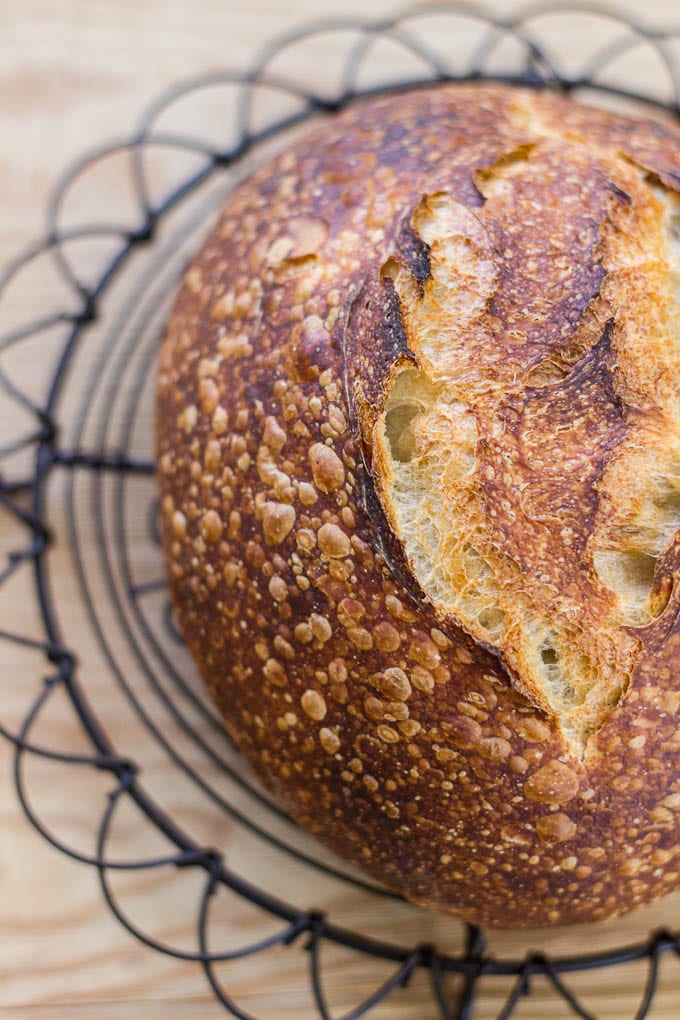
Are you a bread baker?
Do you aspire to be a bread baker?
I did.
Several years ago, my culinary resolution was just that.
I started out with yeast breads, mastering buttery brioche and various sweet doughs. I was really into it. Whoever walked through my door was greeted and welcomed with the aroma of warm, homemade bread. At one point, I boasted my baking skills to my grandfather thinking he’d be proud of my new found self sufficiency. He was from the recession.
But you know what he said?
“Emilie! Don’t you have something better to do with your time?”
Ha! He was right.
I was ready for something new.
Sourdough bread.
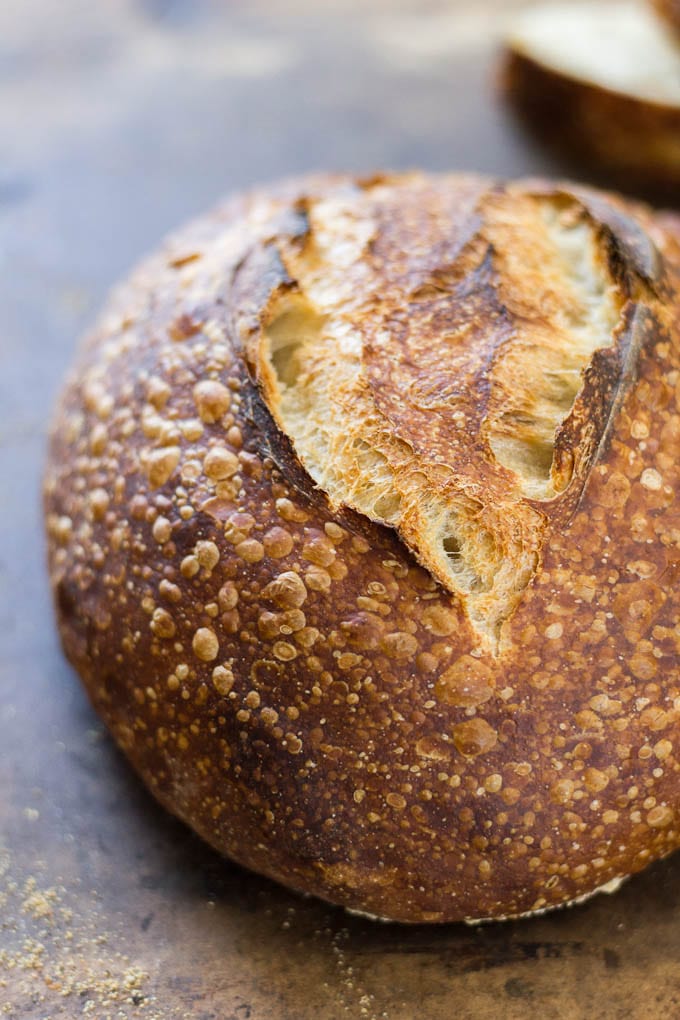
Here’s the deal with sourdough: it tastes absolutely delicious.
Its chewy interior, crispy crust and tangy flavor is highly sought after.
But baking sourdough can be tricky.
Sourdough does not contain fast-acting, commercial yeast. This means it takes considerably longer to rise and can be somewhat unpredictable. There’s a myriad of factors that can hinder your success as well- shaping, spreading, baking, collapsing- I experienced them all.
Long story short…
I failed.
To be honest, I was shocked. I followed the recipe(s) to a tee:
“Begin with an active starter, do a long overnight rise, and bake in the morning. Et voila! Homemade sourdough.”
So, where did I go wrong?
Was it my starter? My oven? Did I need one of those professional steam injectors?
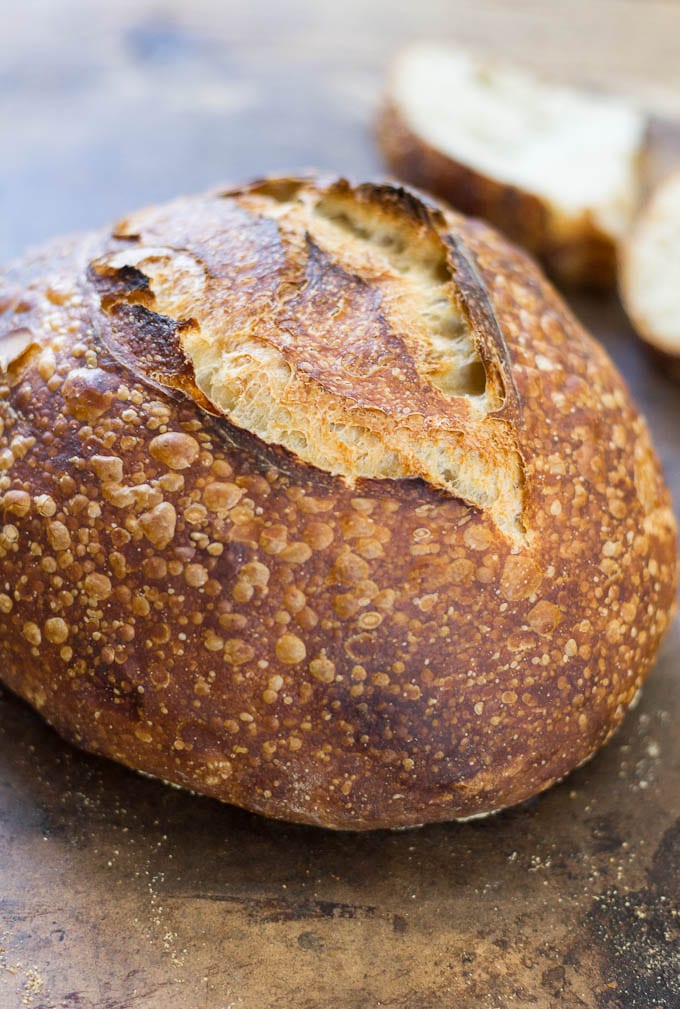
Check it out:
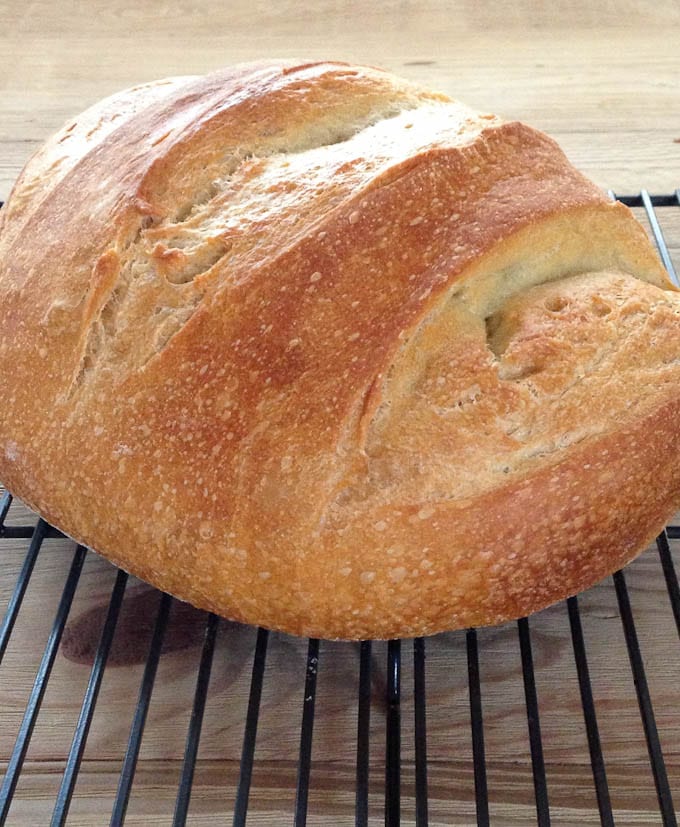
This was my first loaf.
It looks like an underwater sea vessel.
I was so proud.
But I couldn’t stop comparing it to more designer loaves.
I continued to bake everyday until I got it ‘right.’
And what I learned is that sourdough takes motivation and commitment.
It’s like being a first time parent.
You can read tons of guide books, listen to all the advice in the world- but at the end of the day everyone’s situation is different. You need to practice. And improvise. Following technique is only half the battle.
Once I fully embraced this understanding…
I baked a good loaf!
And another one.
And then a better one.
So I wrote a guide.
Because I wished there was a hotline I could call when I was knee deep in flour cursing the baking gods!
Sourdough Bread: a beginner’s guide marks my journey of bread baking through my own personal experience. It serves as a tutorial for beginners and seasoned bakers alike. I also wanted to create a community where like-minded bakers (and hopefuls) could chat about a common theme.
Take a look at the comments section- there are many of you with the same questions… issues.. ‘aha ‘moments.
People want to learn.
And share.
That was my inspiration.
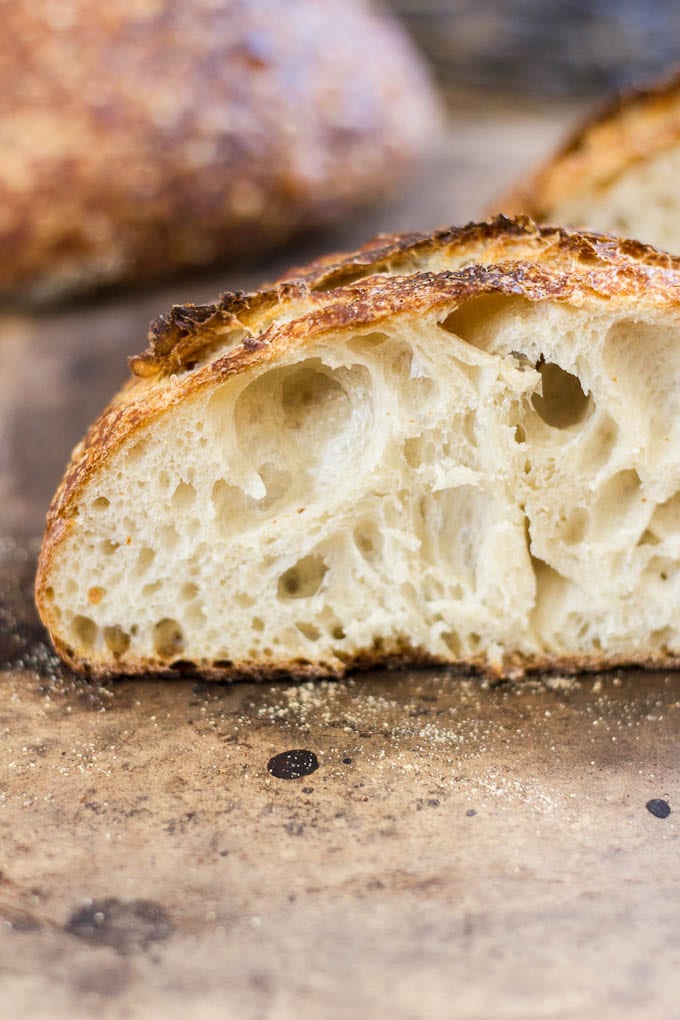
In 2019, I’ve made some updates to to my original guide based on your questions and feedback.
I’ve included answers to the following:
- How do I know when my starter is ready? When do I do the float test?
- Help! Why is my dough spreading out like a pancake?
- How do I get a good rise?
I’ve also re-structured the guide with bold headers for easy reference.
. . . . . . . . . . . . . .
People always ask, why bother?
And what I hope to convey is that bread baking is not only about the end result, it’s about the process. Making something from nothing. Touching, turning, kneading- that crackling sound when it comes out of the oven. I crave it.
Never in a million years would I think of sourdough as therapeutic.
But it is.
It sparked something.

Comments
Chana Ehrenzweig says
Hi Emilie, I was given your website by a friend who uses your recipes. I have spent 2 weeks using other recipes and my experience is that my starter never rose only bubbled very little. I used rye flour and water. I want to make sourdough for my son who cannot eat yeast. He only eats spelt/rye not wheat. If I do not make the starter with wheat flour only spelt or rye flour will this be ok? Thank you
Kiki says
Hi Emilie I live at 5280′ elevation. How would you adapt this recipe for high altitude? I am new to sourdough and I’ve only baked two loaves so far using another recipe which resulted in tasty loaves but the the loaf didn’t rise as much as it should.
I came across your site and would love to try your recipe. The other recipe I used does not call for olive oil ( which I love) so I am intrigued to see how this would affect the rise etc at high elevation.
Thank you!
Linda says
My mom shared a sourdough starter with her neighborhood friends in the early 1970’s. The starter had lore of coming from the pioneers who settled in Denver. I didn’t know I could start my own! I can’t wait to try it. Thank you for this webpage. I’ll be looking for a copy of your book!
Wendy says
I started my sourdough journey with your book and have been making your recipes for 3 years now, it’s my only sourdough book. Your recipes are very good and once I mastered your basic bread recipe I continue to make your sourdough bread recipe with all purpose flour 3 or 4 times a week as well as cinnamon rolls, carrot cake, focaccia, hot cross buns, raisin bread……..
My difficulty is my bread over proofing in summer. I seem to recall you had a recipe for starting, proofing and baking summer bread during the day rather than the overnight process but I can’t find the recipe. I live in Canada and feel like my winter baking is so easy now but when summer comes it’s as if I am a beginner again. Can you help?
Emilie Raffa says
Hi Wendy! This is so great to hear, thank you!
Over proofed dough is very common in summer when the weather speeds things up. Here’s what I suggest, which can be applied to most of my sourdough bread recipes: Make the dough in the morning, or even in the early afternoon when you’re home. Let it rise until almost doubled. Timing depends on temperature. But give yourself a 5-6 hr window @ 75 F; 3-4 hrs. @ 80 F. Then cover with lightly oiled plastic wrap and chill the whole bowl overnight. The next day, when you’re ready to continue, give the dough more time to rise at room temperature (if needed). Then, proceed with the rest of the steps. Using cool water (not cold) in your initial dough mix will control the rise as well.
Eli says
Hello Emilie, such a lovely blog! I have a question: do you preheat the Dutch oven ?
Thank you
Eli
Emilie Raffa says
Hi Eli! I used to preheat in the past. The method does work; you’ll see an increase in oven spring as long as the dough has been properly fermented (not over proofed, adequate gluten development etc.). However, these days, I skip preheating as it can be a bit cumbersome. The results are comparable.
Claudia says
Made my first artisan sourdough boule and it was absolutely delicious, but I found it kind if dense. No big bubbles in the end product. What did I do wrong>
Annabel Bradburn says
Hi Emilie,
Am feeling good – so wanted to convey my thanks to you – I’m loving your website and it’s renewed my love affair with baking sourdough! I’ve had a long and sometimes difficult relationship with sourdough baking and there’s been both successes and failures along the way. I’d put it down for a few months as the last couple of loaves I’d made were frustratingly below par – but after a difficult time (both professionally and personally) – I decided to immerse myself in the culinary world I love so much (my therapy really!), exercise my demons and get back to baking! The tips, techniques, and videos are really clear and helpful and the recipes are delicious! Armed with a fresh new starter I attempted the Beginner’s sourdough recipe first. I followed the method carefully but also tuned into my starter and dough’s look and behaviour which really helped. I was so pleased with the rise and flavour , I’ve just made another loaf today made with half white/quarter spelt wholemeal/quarter seeded wholemeal – I was anxious re only using 50g starter (having used 150g in the first loaf) but stuck to your method in the wholewheat sourdough recipe and whilst not as big a loaf as the first – it achieved a great rise and looks/smells gorgeous! The stretch and folds seem to make all the difference! So thank you for your inspiration, but also your reassurances that it’s normal to have failures (just read your beginner’s sourdough updates) – just part of the complex process that has ssooooo many variables! I’m coming to accept that baking sourdough is a bit like life……bitter sweet at times! Baking bread can teach great life lessons – to greet your failures with acceptance and self love (but good job for trying!), and to celebrate your successes with humility and gratitude for the growth/experience they bring. Can’t wait to try the sourdough cinnamon buns next! Just started reading “Entangled Life” by Merlin Sheldrake – the funghi are definitely in charge!
With love and gratitude x
Emilie Raffa says
Annabel, what a kind thoughtful note. Thank you so much. I agree with you: sourdough is a bit like life. Over the years, I’ve found the process to be quite reflective actually, mirroring back your achievements (and frustrations!). But it’s truly rewarding at the same time. I’m off to check out that book you’re reading… sounds right up my alley. xx
Jennie says
Can I proof my bread in refrigerator overnight and then bake later next day?
Dolores says
Hi, I’m a total beginner at this sourdough thing, and hence having quite some difficulties.
I used this recipe for my dough yesterday.
1st problem: It wasn’t dry when I mixed the ingredients.
I skipped the strech and fold step, and put the dough into the fridge overnight.
2nd problem: It didn’t rise, so I put it in the oven, as you suggest. When I checked it, it was very moist – it was a ball when it went into the oven, but it came out so wet I couldn’t shape it. It didn’t rise. That’s where I stopped experimenting.
Can you please help me?
Thank you so much for your help 🙂
Best wishes from Slovenia,
Dolores
Emilie Raffa says
Hi there! Which recipe are you referring to? The beginner sourdough?
Elizabeth Faullin says
Hello! My issue seems to be the same regardless of recipe (everyday sourdough, choc chip sourdough, whole wheat, high-hydration, etc.). My loaves are all burned on the bottom. Inside they are cooked and the texture is light. But the bottoms are all black and hard. I am using a cast iron dutch oven and baking per the recipe — 20 minutes covered, 40 minutes uncovered in a 450 degree oven. How do I remedy this? Should I bake at a lower temperature? Or reduce the baking time? Or both? Help!
Emilie Raffa says
Hi there! This is actually quite common. Sounds like you have a hot spot in your oven and/or the overall temperature is slightly off. First, use an oven thermometer to monitor the temperature and to rule in/out if it’s an issue. Second, next time you bake, place a sheet pan on the rack directly below you baking pot (not underneath it). This helps to shield any direct heat coming from the bottom up. Many bakers have had success with this. Try these tips first before reducing baking temperatures or times. Hope this helps!
Elizabeth says
Thanks, Emilie. My oven is fairly new but smaller than typical size. I think the Dutch Oven pot is super crowded and being impacted by the heat in the small space. Ill try your suggestions below.
Follow-up question: How does sourdough do in convection oven mode? Is that even worth trying, or no?
Emilie Raffa says
Elizabeth, that makes perfect sense.
Regarding convection mode: while it does have its benefits as far as air circulation goes, I typically do not use this option. I’m just used to conventional mode and stick with that. However, I do know bakers that convection for sourdough, which works with some adjustments and practice. For best results, I would stick with conventional for now and see how you go. :)
Madi Yates says
I put my turkey roasting pan on the bottom and set the baking pan on top of that…it seems to work really well, giving the bread a good 1.5 inches off of the bottom rack. Just an idea!
Emilie Raffa says
Thanks for the tip, Madi!
Mark Grabowski says
Your sourdough recipe is great. I’ve been making sourdough just about every three days since the Pandemic hit the U.S. I’ve been using your A.P. Flour recipe because bread flout is still hard to find.
Anyway, I’ve played around with it a few times. One recipe I used half wheat flour and half A.P. flour. That was too much wheat flour in my opinion so the next one I only used 1/4 wheat and the rest A.P. flour. This was a much better product.
My last loaf I made, I made a Kalamata Walnut loaf. It was soo good.
I used;
1/4 cup starter
1/4 cup Kalamata olive juice
1/2 cup water
2 cups A.P. Flour
I made the autolyse and let it set for an hour. (Oh by the way I live in the central valley of California and the weather has been in the 90’s it stays about 77 – 78 in the house with air conditioning).
While I let the autolyse set I combined
1/2 cup Kalamata Olives sliced (and drained)
1/2 cup chopped walnuts
1 Tbs Italian seasoning
2 tsp Sea Salt
I folded these ingredients in the first fold of the Autolyse.
Everything else I did according to the recipe. On one of the stretch and folds I added a touch more flour because the dough was pretty sticky.
One other note. I have a convection oven and found that the time for baking without the lid of the dutch oven is about 15 to 20 minutes at most….
That probably depends on the oven.
Emilie Raffa says
This is excellent, Mark. Thanks so much for sharing. I love that you added the olive juice to the recipe. What a great addition.
Chris says
It was an exciting time in our house today!
My husband made his first ever bread, sourdough bread at that!
He followed your beginner recipe using all purpose flour. He did a great job! It came out beautifully!
I had a very tiny taste and I have wheat and gluten sensitivity, it was quite good.
Thank you for the expertise you share in your blog!
Barbara Wasilausky says
Love your recipes! I followed your starter recipe and created my first starter. We just finished watching Poldark so I named my starter Demelza because her character was always baking bread!! I have a question, is there any tweak that will increase the sourness a bit? I ordered your book but it’s on backorder at Amazon. Thank you!!
Fateema fakih says
Hi emilie
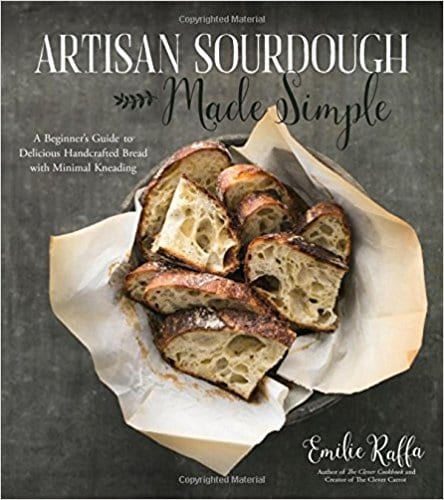
I have one of your book,Artisan sourdough
And im a beginner in the dourdough journey.Followed your instructions,made my first sourdough starter it came to life on the third try?
Trying to bake every bread from your book?,Baked brioche with it it turned out the best brioche i have ever tasted,i tried making the evrryday sourdough as well as the high hydration sourdough
Both rose well had a nice exterior,reasonably tangy flavour but the colour isnt all white.Im using strong white bread flour for the sourdough breads but i see that the colour of the interior is off white as if it was a whole wheat loaf plus it turns out a wee bit gummy.Makes amazing sandwiches but on its own its not as i want it to turn out.Also i wanna mention i used all purpose flour for brioche and the brioche had a beautiful colour as well as texture.?
Lori says
Hi Emilie!
Today is finally baking day! I found your beginner’s guide online! I’ve been feeding my starter for a few weeks, but it did not begin to grow until I found you! Thank you! My question…..the beginners guide uses 150g of starter, I don’t see any basic recipes in your book that uses this much! All other recipes only seem to use 5og using the same amount of flour and no oil. I just find that puzzling! I guess after I’ve baked a few more loaves, I will know for myself, but what does the increased starter do for the bread? I became interested in baking bread about six weeks ago when I came across a recipe for no knead overnight artisan bread and now I bake every weekend!
Your book arrived yesterday, it’s absolutely beautiful! I have been researching all the bread books out there and decided on yours! Thank you!