Description
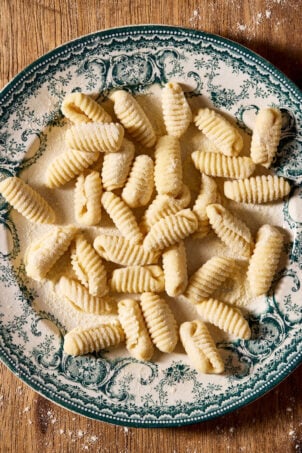
This easy homemade sourdough cavatelli pasta recipe is made by hand with fine semolina flour and sourdough discard (no egg). They’re soft, tender, and irresistibly chewy! Choose from a same-day or overnight fermentation option to deepen the flavor.
Ingredients
- 175 g (~1 cup) fine semolina flour (Caputo semola reminicata)
- 75 g ( ~1/3 cup) warm water
- 50 g (~1/4-1/3 cup) sourdough starter (*See notes 1)
Instructions
For best results, please weigh your ingredients with a digital scale (you’ll get slightly different results using measuring cups).
- Add the semolina flour to a wide shallow bowl. Make a well in the center (I use the bottom of a small bowl and move it around in a circular motion). Add the warm water, followed by the sourdough starter.
- With a fork, gradually mix the flour and water together, starting in the center well and working your way outwards. The mixture will look creamy at first, then crumbly (like wet sand).
- When the dough starts to come together, ditch the fork, and mix by hand to form a cohesive dough- it will feel gritty and stiff. (*See notes 2). Cover with plastic wrap and rest for 5-10 minutes. The dough will be softer and easier to knead in the next step.
- After resting, knead the dough for 2-4 minutes on a wooden board. To do so: push into the dough with the heel of your hand, rocking it back and forth, turning it intuitively as you go. The dough is stiff. Just keep moving it around until the texture changes from gritty to smooth. That’s when you’ll know it’s done. It should feel slightly chalky on the surface too.
- Gently pat the dough into a plump disc, cover, and rest for 1 hour to relax the gluten. Alternatively, chill overnight to ferment. (*See notes 3).
- To shape the cavatelli, line a sheet pan with parchment paper; dust generously with semolina flour. Your cavatelli will land here.
- Uncover the disc of dough. Cut off a strip, about one finger width in thickness. Make sure to keep the rest of the dough covered in plastic wrap (it will dry out).
- On a non-floured surface, roll the dough into a rope, about 5/16 to 3/8-inch thick (e.g. thicker than a pencil, but not quite as thick as a Sharpie). Roll using the palms of your hands instead of pressing down with your fingertips for an even shape.
- Cut across into ¾-inch pieces.
- Using a gnocchi board: place a piece of dough near the top. Press your thumb into the top corner and push downward – it will naturally roll over itself. Make sure to apply firm pressure! This will create a little dip in the center which is perfect for catching the sauce. Each cavatello should not be completely sealed shut.
- Place onto your semolina dusted dish. Keep covered with a clean dish towel or inverted sheet pan as you work.
Notes
Notes & Tips:
- The sourdough starter does not have to be active. Recently fed & collapsed starter OR good quality sourdough discard is good (100% hydration, fed with white flour).
- The texture of your pasta dough will depend on the viscosity of your starter, plus ambient temperature. The variables! If the dough is very, very dry and cannot absorb all of the flour when mixing, lightly wet your hands, shake them off, and then work the dough until it comes together. If it’s too soft or sticky, add a little bit of semolina flour.
- The longer the dough rests, the softer (and stickier) it will become, especially in hot weather. This is problematic when shaping – the cavatelli might stick to your gnocchi board. If this happens, lightly dip a cavatello in some semolina flour and then roll down the board.
- Shaping nuances: when you press the cavatello from the top corner down, you’ll get a different shape compared to when you press straight across, it will be more squat, like fat caterpillars. 🤓 Play around and see what you like best.