Description
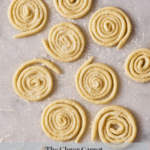
My sourdough pici pasta recipe is made by hand with fine semolina flour, sourdough starter, and olive oil (no egg). Choose from a quick same-day option or ferment overnight to deepen the flavor. Technique adapted from Pasta Everyday by Meryl Feinstein.
Quick Tips:
- Use fine semolina flour. There are two types – fine and coarse. Choose fine semola rimacinata for best texture.
- Use warm water (not cold from the tap!). Semolina is a thirsty, high protein flour; warm water softens the dough and makes it easier to knead by hand.
Ingredients
- 175 g (~1 cup) fine semolina (Caputo semola reminicata)
- 75 g (~1/3 cup) warm water
- 50 g (~1/4 – 1/3 cup) sourdough starter (See notes 1)
- 6 g (1/2 tbsp) olive oil
Instructions
- Add the semolina flour to a wide shallow bowl. Make a well in the center (I use the bottom of a small bowl and move it around in a circular motion). Pour the water into the well, followed by the sourdough starter and olive oil. I keep the olive oil off the the side (it’s easier to mix in with water) not on top of the starter.
- With a fork, gradually mix the flour and water together, starting in the center well and working your way outwards. The mixture will look creamy at first, then crumbly (like wet sand).
- When it starts to come together, mix by hand until a cohesive dough forms—it will feel gritty and stiff. (See notes 2). Cover with plastic wrap and rest for 5–10 minutes. The dough will be easier to knead in the next step.
- After resting, knead the dough for 2-4 minutes on a wooden board: push into the dough with the heel of your hand, rocking it back and forth, turning it intuitively as you go. The dough is stiff, but slightly softer than the cavatelli dough (thanks to the olive oil). Keep kneading until the texture changes from gritty to smooth. That’s when you’ll know it’s done. It should feel slightly chalky on the surface too.
- Gently pat the dough into a plump disc, cover, and rest for 1 hour to relax (See notes 3).
To Make The Pici:
- Line a sheet pan with parchment paper; dust with semolina flour. Your pici pasta will land here.
- Divide the dough into 4 quarters.
- With your palm, flatten one dough into a oval-shaped disc (cover the remaining pieces of dough while you work). It should be about 1/4-inch thick or the thickness of pita bread.
- Position the dough horizontally. With a sharp knife or bench knife, cut across into 1/4-inch wide strips (the lengths will be different).
- With flat palms, roll out one strip, starting in the middle and working your way outwards. Repeat this motion, applying gently pressure as you go, until you end up with a long strand, about 2-3 mm thick. It should be thicker than spaghetti, similar to bucatini. You can cut the rope in half if it’s too long to roll. Ends should be pretty even, not pointy or extremely tapered.
- Dusty with plenty of semolina, and place in a coiled shape (with a little space in between) onto your sheet pan. Pici is notorious for sticking together!
Notes
Notes
1.) The sourdough starter does not have to be active. Recently fed & collapsed starter is fine (100% hydration, fed with white flour only).
2.) The texture of your pasta dough will depend on the viscosity of your starter, plus ambient temperature. I’ve found this dough comes together quite nicely from the olive oil.
3.) The longer the dough rests, the softer (and stickier) it will become, especially in hot weather.